Morningstar Star Ratings, Still Less Useful Than Expense Ratios

jeapordy_shadeFor investment nerds, the recent Wall Street Journal article The Morningstar Mirage was high drama. The subtitle got straight to the point:

Investors everywhere think a 5-star rating from Morningstar means a mutual fund will be a top performer—it doesn’t.

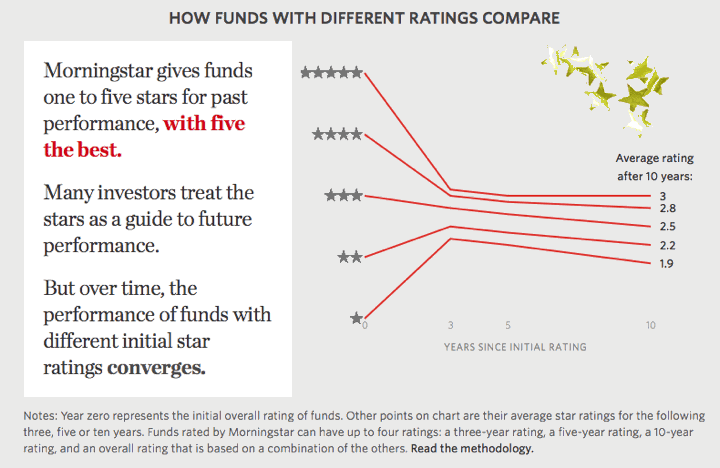
Morningstar ratings mainly reflect past performance. However, something called “mean reversion” usually happens. If a fund has done well recently, it will have a high rating. But it usually doesn’t stick. The WSJ has a good visual:
wsj_mstar1

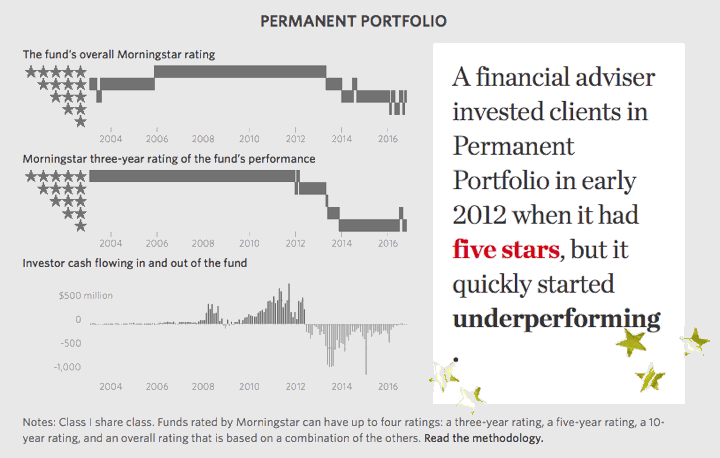
This quote is spot on: “Morningstar’s star ratings for funds are clearly used in the industry to imply that funds that performed well in the past will do so in the future.” Check out the fund flows into the Permanent Portfolio Fund when they were 5-star. Just a couple years later, chheck out the fund flows out when they drop to 1-star.
wsj_mstar2

Morningstar responded with Setting the Record Straight on Our Fund Ratings, which in my opinion just repeated the top graphic above. People think the left part will hold. Reality is the right part.

The Journal’s analysis found that most five-star funds perform somewhat better than lower-rated ones, yet on the average, five-star funds eventually turn into merely ordinary performers.

More importantly, something was conspicuously missing from this rebuttal…

Expense ratios are a more dependable predictor of performance. Source: Morningstar. Back in 2010, Russell Kinnell of M* had what the NY Times called “an act of radical and admirable transparency” in his article How Expense Ratios and Star Ratings Predict Success. Here’s my 2010 post about it.

If there’s anything in the whole world of mutual funds that you can take to the bank, it’s that expense ratios help you make a better decision. In every single time period and data point tested, low-cost funds beat high-cost funds. […] Investors should make expense ratios a primary test in fund selection. They are still the most dependable predictor of performance.

Smart investors know about this article. Morningstar executives choose not to mention it. Why would they? They charge fund companies $10,000 a pop to brag about their 5-star ratings in ads.

This is where my pragmatic side kicks in. I like Morningstar overall. I’m glad they exist. You just have to pick what you consume carefully.

  • Morningstar creates a lot of high-quality, free stuff for DIY investors. They have great free data, some nice tools, and many helpful articles from knowledgable authors. I link to them regularly. I talk about star ratings never.
  • People love star ratings systems. There’s a reason why you see stars on every Amazon product page. Most people don’t want to filter out everything themselves. They want the feeling that some fancy algorithm has hand-picked the best funds for them. They want easy.
  • Financial advisors love star ratings systems. If the financial advisor makes a pick and it goes bad, then whose fault is it? Not mine, I followed the rating system and followed the experts! Financial advisors are incentivized to stay close to the pack, as if they stick out in the wrong way, they will get fired. This is known as minimizing career risk.
  • This is not a perfect analogy, but Morningstar is kind of like Whole Foods. You could make some great food at decent prices using their raw ingredients and 365 product line. But 1/3rd of the store is prepared foods, and the most popular are stuff like pizza, sushi, mac & cheese, chicken nuggets, and chicken wings. Why do they sell these things? It is what the customer wants, and they are a for-profit corporation.

10 years from now, I predict that the system will be exactly the same. Morningstar wants to keep it, most clients want to keep it, and the financial advisors want to keep it. Morningstar stock plunged when the WSJ story broke, but recently bounced back up. I suspect people came to the same conclusion as I did.

Bottom line. The WSJ article reminds us of an important lesson. Morningstar “5-star ratings” are simply markers of past performance. Reversion to the mean usually happens. Consider long-term past performance as one factor amongst many, but don’t chase 5-star funds. Expense ratios are a better predictor of future returns than M* star ratings. If anything, simply avoid 1-star funds.

Early Retirement Income Update 2017 Q3: Do I Have Enough Yet?

dividendmono225

How do you know when you portfolio is enough to retire on? You have to figure out a withdrawal strategy first. This is a tricky question and full of worries about running out of money. You could take out a fixed amount (i.e. $50,000 a year). You could take out a fixed percentage (i.e. 4% a year). You can adjust for inflation. You can implement upper or lower guardrails.

Personally, I appreciate the behavioral reasons why living off income while keeping your ownership stake is desirable. The analogy I fall back on is owning a rental property. If you are reliably getting rent checks that increase with inflation, you can sit back calmly and ignore what the house might sell for on the open market.

I’ve also come to feel that dividend yield can be a quick-and-dirty way to adjust your withdrawal rate for valuation. For example, if the price of S&P 500 index goes up while the dividend payout stays the same, then wouldn’t it be prudent to simply spend the same amount? Check out the historical S&P 500 dividend yield via Multpl. Focus the last 20 years – the yield was highest in the 2008 crash and lowest in the 2000 tech bubble.

sp500dy_1710

Now check out the absolute dividend amount (inflation-adjusted), also via Multpl:

sp500d_1710

Note that if you only buy “high-yield” stocks and “high-yield” bonds, that actually increases the chance that those yields will drop sooner or later. I am trying to reach some sort of balance where I spend the income on a “total return” portfolio.

Even the venerable Jack Bogle advocated something similar in his early books in investing. He suggested owning the Vanguard Value Index fund and spending only the dividends as way to fund retirement.

One simple way to see how much income (dividends and interest) your portfolio is generating is to take the “TTM Yield” or “12 Mo. Yield” from Morningstar (linked below). Trailing 12 Month Yield is the sum of a fund’s total trailing 12-month interest and dividend payments divided by the last month’s ending share price (NAV) plus any capital gains distributed over the same period. SEC yield is another alternative, but I like TTM because it is based on actual distributions (SEC vs. TTM yield article).

Below is a very close approximation of my most recent portfolio update. My current target asset allocation is 66% stocks and 34% bonds, and intend that to be my permanent allocation upon early retirement.

Asset Class / Fund % of Portfolio Trailing 12-Month Yield (Taken 10/23/17) Yield Contribution
US Total Stock
Vanguard Total Stock Market Fund (VTI, VTSAX)
25% 1.85% 0.46%
US Small Value
Vanguard Small-Cap Value ETF (VBR)
5% 1.81% 0.09%
International Total Stock
Vanguard Total International Stock Market Fund (VXUS, VTIAX)
25% 2.57% 0.64%
Emerging Markets
Vanguard Emerging Markets ETF (VWO)
5% 2.34% 0.12%
US Real Estate
Vanguard REIT Index Fund (VNQ, VGSLX)
6% 3.90% 0.23%
Intermediate-Term High Quality Bonds
Vanguard Intermediate-Term Tax-Exempt Fund (VWIUX)
17% 2.81% 0.48%
Inflation-Linked Treasury Bonds
Vanguard Inflation-Protected Securities Fund (VAIPX)
17% 2.99% 0.51%
Totals 100% 2.53%


If I had a $1,000,000 portfolio balance today, a 2.5% yield means that it would have generated $25,000 in interest and dividends over the last 12 months. (The muni bond interest in my portfolio is exempt from federal income taxes.) Some comparison numbers (taken 10/23/2017):

  • Vanguard LifeStrategy Moderate Growth Fund (VSMGX) is a low-cost, passive 60/40 fund that has a trailing 12-month yield of 2.06%.
  • Vanguard Wellington Fund is a low-cost active 65/35 fund that has a trailing 12-month yield of 2.48%.

These income yield numbers are significantly lower than the 4% withdrawal rate often quoted for 65-year-old retirees with 30-year spending horizons, and is even lower than the 3% withdrawal rate that I usually use as a rough benchmark. If I use 3%, my theoretical income would cover my projected annual expenses. If I used the actual numbers above, I am close but still short. Most people won’t want to use this number because it is a very small number. However, I like it for the following reasons:

  • Tracking dividends and interest income is less volatile and stressful than tracking market prices.
  • Dividend yields adjust roughly for stock market valuations (if prices are high, dividend yield is probably down).
  • Bond yields adjust roughly for interest rates (low interest rates now, probably low bond returns in future).
  • With 2/3rds of my portfolio in stocks, I have confidence that over time the income will increase with inflation.

I will admit that planning on spending only 2% is most likely too conservative. Consider that if all your portfolio did was keep up with inflation each year (0% real returns), you could still spend 2% a year for 50 years. But as an aspiring early retiree with hopefully 40+ years ahead of me, I like that this method adapts to the volatility of stock returns and the associated sequence of returns risk.

Early Retirement Portfolio Asset Allocation, 2017 Third Quarter Update

portpie_blank200

Here is an update on my investment portfolio holdings after the third quarter 2017. This includes tax-deferred 401k/403b/IRAs and taxable brokerage holdings, but excludes things like our primary home, cash reserves, and a few other side investments. The purpose of this portfolio is to create enough income to cover our regular household expenses.

Target Asset Allocation. The overall goal is to include asset classes that will provide long-term returns above inflation, distribute income via dividends and interest, and finally offer some historical tendencies to balance each other out. I don’t hold commodities futures or gold as they don’t provide any income and I don’t believe they’ll outpace inflation significantly. I also try to imagine each asset class doing poorly for a long time, and only hold the ones where I think I can maintain faith.

Stocks Breakdown

  • 38% US Total Market
  • 7% US Small-Cap Value
  • 38% International Total Market
  • 7% Emerging Markets
  • 10% US Real Estate (REIT)

Bonds Breakdown

  • 50% High-quality, Intermediate-Term Bonds
  • 50% US Treasury Inflation-Protected Bonds

I have settled into a long-term target ratio is 67% stocks and 33% bonds (2:1 ratio) within our investment strategy of buy, hold, and rebalance. With a self-managed, simple portfolio of low-cost funds, we minimize management fees, commissions, and income taxes.

Actual Asset Allocation and Holdings

aa_portpie_1710

Stock Holdings
Vanguard Total Stock Market Fund (VTI, VTSMX, VTSAX)
Vanguard Total International Stock Market Fund (VXUS, VGTSX, VTIAX)
WisdomTree SmallCap Dividend ETF (DES)
WisdomTree Emerging Markets SmallCap Dividend ETF (DGS)
Vanguard Small Value ETF (VBR)
Vanguard Emerging Markets ETF (VWO)
Vanguard REIT Index Fund (VNQ, VGSIX, VGSLX)

Bond Holdings
Vanguard Limited-Term Tax-Exempt Fund (VMLTX, VMLUX)
Vanguard Intermediate-Term Tax-Exempt Fund (VWITX, VWIUX)
Vanguard High-Yield Tax-Exempt Fund (VWAHX, VWALX)
Vanguard Inflation-Protected Securities Fund (VIPSX, VAIPX)
iShares Barclays TIPS Bond ETF (TIP)
Individual TIPS securities
U.S. Savings Bonds (Series I)

Performance and commentary. According to Personal Capital, which aggregates all of my investment holdings across different accounts, my portfolio has gained 7.41% over the last 6 months since my last update. In the same time period, the S&P 500 has gained 9.21% (excluding dividends) and the US Aggregate bond index has gained 1.34%.

pcport_1710

Things are currently at 69% stocks/31% bonds. For the most part, I continue to invest new money on a monthly basis in order to try and maintain the target ratios. Once a quarter, I also reinvest any accumulated dividends and interest. I don’t use automatic dividend reinvestment. This way, I can usually avoid creating any taxable transactions unless markets are really volatile.

For both simplicity and cost reasons, I am no longer buying DES/DGS and will be phasing them out whenever there are tax-loss harvesting opportunities. New money is going into the more “vanilla” Vanguard versions: Vanguard Small Value ETF (VBR) and Vanguard Emerging Markets ETF (VWO).

I’m still somewhat underweight in TIPS and REITs mostly due to limited tax-deferred space as I don’t want to hold them in a taxable account. My taxable muni bonds are split roughly evenly between the three Vanguard muni funds with an average duration of 4.5 years. I may start switching back to US Treasuries if my income tax rate changes signficantly.

In a separate post, I will track dividend and interest income.

Housing Has Higher Long-Term Returns Than Stocks?

housemoneyI finally got around to reading an academic paper that looked a bit dry but had a great title: The Rate of Return on Everything, 1870–2015 [pdf] by Jorda, Knoll, Kuvshinov, Schularick, and Taylor. I wonder which of the authors came up with that.

One of the major findings that was residential housing – when you add up the returns from both price change and imputed rent – had a higher overall average return than stocks (equities). Not only did housing have higher returns, but it also had lower volatility (standard deviation). Here’s a chart that compares housing and equities:

jorda1b

When the paper was released, places like the Financial Times discussed the paper’s conclusions but none of them addressed my two immediate questions.

Did they account for the maintenance and management costs of rental real estate? If you own a rental property, you may still have to pay for lawn maintenance, replacing roofs, HVAC units, interior and exterior painting, replacing carpets, and various other issues. To be fairly compared with equities, you should also account for property management costs. Here’s are excerpts that deal with maintenance and repairs:

To the best of the authors’ knowledge, this study is the first to present long-run returns on residential real estate. We combine the long-run house price series presented by Knoll, Schularick, and Steger (2016) with a novel dataset on rents from Knoll (2016). For most countries, the rent series rely on the rent components of the cost of living of consumer price indices as constructed by national statistical offices and combines them with information from other sources to create long-run series reaching back to the late 19th century.

A number of additional issues have to be considered when constructing returns on housing. First, any homeowner incurs costs for maintenance and repairs which lower the rental yield and thus the effective return on housing. We deal with this issue by the choice of the benchmark rent-price ratios. Specifically, in the Investment Property Database (IPD) the rental yields reflect net income (i.e., net of property management costs, ground rent, and other irrecoverable expenditure) received for residential real estate as percentage of the capital employed.

Did they account for the annual property taxes required on residential real estate? In many US states, the annual property tax bill can exceed 1% of the value of the house. Some are closer to 2% annually, and these are owner-occupied numbers. Rental properties may be higher. That’s on top of any potential capital gains you’d owe upon sale of the house, and any taxes you’d owe on rent received. Here’s are excerpts that deal with taxes:

Although the extent of real estate taxation varies widely across countries, real estate is taxed nearly everywhere in the developed world. International comparisons of housing taxation levels are, however, difficult since tax laws, tax rates, assessment rules vary over time and within countries. Typically, real estate is subject to four different kinds of taxes. First, in most countries, transfer taxes or stamp duties are levied when real estate is purchased. Second, in some cases capital gains from property sales are taxed. Often, the tax rates depend on the holding period. Third, income taxes typically also apply to rental income. Fourth, owners’ of real estate may be subject to property taxes and/or wealth taxes where the tax is based upon the (assessed) value of the property.
This section briefly describes the current property tax regimes by country and provides estimates of the tax impact on real estate returns.

With few exceptions, the tax impact on real estate returns can be considered to be less than 1 percentage point per annum.

This is an interesting paper that tries to cover a huge amount of stuff. Estimating the return of all businesses from all countries for the last 150 years? Estimating the return of all residential real estate from all countries for the last 150 years? They mix together a bunch of different datasets, so it’s hard to know exactly the quality level of each and how well they accounted for things like taxes and maintenance.

I’m not sure why they prefer to use arithmetic averages instead of geometric averages, but even if you shave off 1% for additional property taxes and another 1% because you don’t think they account for maintenance costs adequately, housing returns are still at least comparable to equity returns.

Here is the most recent update of the Case/Shiller home price index from Multpl, which tracks US housing prices on an inflation-adjusted basis:

shiller1890

Some people use this to argue that housing returns only keep up with inflation, but home prices ignore the value of rent. The fact that most housing purchases involve a mortgage loan does complicate things a bit.

Bottom line. An interesting paper that compares the long-term returns (last 150 years!) of residential housing and equities. In the long run, some may be surprised that residential housing returns at least matched equity returns, and housing returns had lower volatility. This is a reminder that you can also build wealth via residential real estate, taking into account that rent makes up half of the total return. Stocks are not the only game in town. (Just like with stocks, can is not the same as will.) New services like AirBNB provide an alternate path to monetize residential real estate.

S&P 500 Total Return: Still Doubled From October 2007 to 2017

In early October 2007, the S&P 500 index hit just over 1,500 – an all-time high. You might have been concerned, or you might not have even noticed. Less than 2 years later, the financial crisis occurred and the S&P 500 dropped 50% down to 750 (March 2009). If you were a lump-sum investor, October 2007 would have been the worse month to invest in a rather long time. However, consider this chart via Bloomberg article:

bw_october2017

If you held on through the panic, you broke back even some time in mid-2012 if you include dividends (total return). Four years after hitting bottom, you were again hitting an all-time high. After that, basically all of 2013 was spent reaching new “all-time highs” over and over again. You might have gotten nervous again. Is it time for another drop?

Yet, if you continued to hold on until now (October 2017), even if you had the worst possible timing an pushed all your chips in on October 2007, you would have doubled your money. Over the last 10 years, even after both pushing your chips in at an all-time high and experiencing a 50% drop, you would still have earned over a 7% compounded return.

You could interpret this as pro-stocks, but my takeaway is instead that all-time highs don’t mean much. The price could drop by 50%. The price could go up 100%. We’ve seen that, and thus should be prepared for both. Instead of worrying, try considering either possibility and make a plan.

If stocks keep going up from here, I will ______. If stocks drop 50% from here, I will _______.

In my case, my portfolio could be described roughly as 67% stocks and 33% bonds. If all my stocks dropped 50% and my bonds held steady, then I would end up at 50% stocks and 50% bonds. After a 50% haircut, I would be shaken but hopefully remind myself that stock valuations would look a lot better as well. If I can get up the courage, then I will rebalance back to 67/33. If I turn out to be a scaredy-pants, simply staying at 50/50 should still keep me adequately exposed to any recovery.

Kelly Criterion and Your Fun Money Allocation

chipsDo you think you’re a below-average driver? I didn’t think so. In the same vein, Jason Zweig had a funny tweet the other day that hit home:

His linked article ends with this advice:

Put 90% of your money in low-cost index funds and lock yourself in by adding a fixed amount every month through an electronic transfer from your bank. […] Speculate with just the remaining 10%, and use a checklist of buying criteria to make sure you never buy a stock purely because it has been going up.

This coincided with me reading stuff about the Kelly Criterion, a mathematical formula used to determine the optimal size of a series of bets. Basically, the greater your “edge”, the greater your bet size should be. If you have zero edge, then you should bet nothing. If you have negative edge, you should theoretically bet against yourself (if only casinos allowed that).

Here’s an interesting example that involved a special coin where you have the advance knowledge that it has a 60% chance of heads and 40% chance of tails. In short, with this edge you should consistently bet 20% of your bankroll each time. That’s it! If the coin was 52.5% heads/47.5% tails, you should only bet 5% of your bankroll. Most people do not find this intuitive.

What’s your own edge? Consider that some folks think that only 5% of Active Investment Managers Will Add Value. This is where I insert a couple of Charlie Munger quotes:

I think it is roughly right that the market is efficient, which makes it very hard to beat merely by being an intelligent investor. But I don’t think it’s totally efficient at all. And the difference between being totally efficient and somewhat efficient leaves an enormous opportunity for people like us to get these unusual records. It’s efficient enough, so it’s hard to have a great investment record. But it’s by no means impossible. Nor is it something that only a very few people can do. The top three or four percent of the investment management world will do fine.

If you stop to think about it, civilized man has always had soothsayers, shamans, faith healers, and God knows what all. The stock picking industry is four or five percent super rational, disciplined people, and the rest of them are like faith healers or shamans. And that’s just the way it is, I’m afraid. It’s nice that they keep an image of being constructive, sensible people when they’re really would-be faith healers. It keeps their self respect up.

Bottom line. In stock market investing, most of us lack an edge and thus should stick with index funds. But we all like to think we have some edge, so maybe a 5% or 10% fun money allocation is acceptable. Anything higher would be claiming to have some crazy, unreasonable edge. I would say it also depends on how aggressively your fun money is managed. Berkshire Hathaway stock is relatively low risk. Mine is invested in short-term loans backed by real estate with conservative loan-to-value ratios and a target return of 7%. The latest cryptocurrency promoted by celebrities on social media? Not low risk.

Vanguard Thoughts: Pros and Cons from a 15-Year Client-Owner

vg_own

Vanguard has been sucking up assets like a vacuum, with total assets now exceeding $4 trillion. Their hybrid robo-advisor Vanguard Personal Advisor Services has over $65 billion in assets under management. Are they unbeatable? People tend to love building things up, then love tearing it down.

Vanguard holds the majority of my net worth, grown over 15 years in Vanguard brokerage accounts and Vanguard mutual funds/ETFs. You could therefore call me a fanboy, but also a concerned “client-owner” (I prefer the term “investor-owner”). As they keep hounding me to vote on their proxy, here’s what I like the most and least about Vanguard:

Pros

  • Historical track record. Vanguard has a long history of providing investments at a low cost. When they arrive to an asset class, costs tend to drop like a rock. This the Vanguard Effect.
  • Skill and experience. They are good at what they do – run low-cost index funds and low-cost actively-managed funds. They understand things like reducing index tracking error and utilizing securities lending to boost fund returns.
  • Ownership structure. Vanguard does have a unique ownership structure conducive to continuing to maintaining low costs. There are no outside shareholders or activist hedge funds working to squeeze out every last drop of profit.
  • Profitable. Vanguard has their current expense ratios and is actually making money (or technically breaking even) on every single fund and ETF. The others are losing money on their “cheap” products while they try to make money elsewhere.
  • Less company risk. All the above adds up to my opinion that Vanguard has the best chance of future, ongoing lower costs. A potential cost beyond expense ratios that should be considered is the cost of switching to a different fund in a taxable account. If I sell now to buy something else, I will have to pay taxes on a significant amount of capital gains. I want to minimize the chance of having to do that.

Cons

  • Lack of transparency on marketing costs. Vanguard runs a lot more advertising than they used to. I might argue too much, but nobody knows how much they are spending because they don’t disclose this even to their “investor-owners”. Vanguard is not a non-profit, but I have seen even non-profits suffer from internal bloat and having quality suffer in the pursuit of growth.
  • Lack of transparency on executive compensation. Vanguard may not have outside shareholders, but we also don’t know how much money the CEO or other executives make. If Vanguard were a publicly-traded company like Schwab, they would have to disclose these numbers. As “investor-owners”, I don’t get told anything. As this Bloomberg article states, “Vanguard is an important shareholder voice on executive pay, but it isn’t transparent on its own compensation.”
  • Mediocre customer service. Vanguard has struggled with the quality and responsiveness of their customer service as they have grown in size. My interactions with Fidelity and Schwab have consistently produced faster response times and more accurate levels of service. Vanguard themselves have admitted that they have had struggles in this area.
  • Not necessarily the cheapest at any given moment. If you look at any specific ETF benchmark at any specific moment in time these days, the cheapest offering might come from Vanguard, but it just as likely might come from Schwab, iShares, or Fidelity.

Financial author Jonathan Clements argues in his Protection Money article that he is willing to a little bit more for Vanguard ETFs in order to avoid potentially having to pay significant capital gains if the loss-leader pricing trend stops. I think that is a very valid argument.

Now, you could also buy Vanguard ETFs inside another brokerage account. However, you may have to contend with trade commissions. A few exceptions on ETFs: Merrill Edge and Bank of America will give you 30 free trades a month if you have $50,000 in combined assets at BofA and Merrill (plus better credit card rewards). The Robinhood app lets anyone invest with free commissions (although I’d expect even less than Vanguard in terms of customer service). You can transfer Vanguard ETFs to another custodian for a flat fee if you wish to avoid realized capital gains.

Big picture. Vanguard changed the investment world, but now the gap is much narrower. I started out with Vanguard and think they still have the best long-term structure, so I own Vanguard mutual funds and ETFs. However, Schwab and iShares Core ETFs held somewhere with low trading costs and good customer service are also very good choices for someone starting out. This group of “nearly as good” alternatives to Vanguard continues to grow. Meanwhile, there is still another large group of “definitely worse” alternatives. Debating between 0.01% is rather useless when there are still people paying 1% or more for index funds.

Robinhood: Free Share of Stock for New Users – Estimated Value

rh_freestock

Robinhood is a sleek smartphone app that’s a brokerage account with unlimited $0 trades with no minimum balance requirement. They’ve been around for a few years now and I’ve been impressed that they’ve kept up the free trade business model, partially by recently rolling out premium paid features. I enjoy the minimalist and intuitive interface.

Right now, if you a referred by an existing user you get a free share of stock. The existing user also gets a free share, so thanks if you use it! As I write this, that share is randomly selected from a pool of “widely-held companies”, which includes Apple ($158), Facebook ($172), or Microsoft ($75). Too bad they don’t offer Berkshire Hathaway Class A shares ($274,000). Okay, but there are also shares of companies that are worth $1 or less.

What share value should I expect? Here are screenshots from my phone showing some odds:

rh_freestock3 rh_freestock2

For some reason they try to use the World’s Smallest Fine Print™, but here are selected details from their FAQ:

The stock bonus is one share selected randomly, when the bonus criteria are met, from Robinhood’s inventory of settled shares held for this program. When shares are purchased into this inventory, Robinhood purchases shares from the three to four companies representing the highest market capitalization in various ranges of share prices between approximately $3 and $175, limited to those companies that are widely held among Robinhood accounts. There is an approximately 98% chance of the stock bonus having a value of $2.50-$10, an approximately 1% chance of the stock bonus having a value of $10-$50, and an approximately 1% chance of the stock bonus having a value of $50-$200, based on the price of shares at the time of purchase. The Robinhood platform displays approximate odds of receiving shares from particular companies at the time the screen is generated. These odds do not necessarily reflect the odds of receiving stock in those companies at the time the stock bonus is awarded.

So… basically 98% chance of getting something $10 or less, and 2% chance of something higher. This means the weighted average share price can’t be more than ten bucks.

By the way, you can cash out your bonus by selling after 2 days and withdrawing your balance after 30 days:

Limit one offer per qualified referral with a maximum of one account per referred client. Stock bonus will be credited to the enrolled account within approximately one week after the bonus is claimed. Stock bonuses that are not claimed within 60 days may expire. Shares from stock bonuses cannot be sold until 2 trading days after the bonus is granted. The cash value of the stock bonus may not be withdrawn for 30 days after the bonus is claimed.

Bottom line. The Robinhood “Get Free Stock” promotion is clever and it certainly appeals to the hopeful gambler within us with a $200 potential value, but most people are likely going get a share of stock valued at $10 or less. (Don’t sell it and wait 30 years – see what happens!) I would just treat as a fun game if you otherwise want to be able to trade stocks for free on your smartphone. Robinhood is a good value on its own, see my full Robinhood review.

Sign up for Robinhood and get your free share here, and I’ll report back on any shares that I win.

University of Berkshire Hathaway: Notes From Annual Shareholders Meeting (Book Review)

univ_brk

If you are a Buffett & Munger follower, you should be intrigued by University of Berkshire Hathaway: 30 Years of Lessons Learned from Warren Buffett & Charlie Munger at the Annual Shareholders Meeting by Daniel Pecaut and Corey Wrenn. Anyone can buy all the old BRK shareholder letters, but there are very few transcripts from the live shareholder meetings in Omaha, Nebraska (1986–2015). There is definitely overlap, but these live interactions sometimes provide a peek into their less-publicized opinions (especially Munger’s). Here’s how the authors describe the book:

This book isn’t for the first-time investor. It’s for the informed investor who sees the value of being able to get deep into the mindsets of Warren Buffett and Charlie Munger. If you want to walk around in their shoes for the past three decades, absorb what works, and then apply it to your own investments, then this book is for you.

The current price is only $0.99 in Kindle format. At that price, it should be an easy decision on whether to own the entire book forever, but here are my personal notes and highlights to give you an idea of the contents:

How Berkshire Hathaway differs from other actively-managed stock mutual funds:

The public has long viewed Berkshire as a sort of mutual fund with large stock holdings. This view underestimates or ignores 1) Berkshire’s insurance companies’ impressive generation of low-cost float, 2) Berkshire’s impressive and growing stable of cash-generating operating businesses, and 3) Berkshire’s ability to orchestrate value-enhancing deals.

Classic quote on stock market prices:

Buffett noted that many investors illogically become euphoric when stock prices rise and are downcast when they fall. This makes no more sense than if you bought some hamburger one day, returned the next day to buy more but at a higher price, and then felt euphoric because you had bought some cheaper the day before. If you are going to be a lifelong buyer of food, you welcome falling prices and deplore price increases. So should it be with investments.

Luck and the Ovarian lottery:

Buffett launched into an intriguing thought problem he called “the ovarian lottery.” You are to be born in 24 hours. You are also to write all the rules that will govern the society in which you will live. However, you do not know if you will be born bright or retarded, black or white, male or female, rich or poor, able or disabled. How would you write the rules? Buffett said how one comes out in this lottery is far more important than anything else to one’s future. He and Munger were huge winners having been born American (“in Afghanistan, we wouldn’t be worth a damn”), male (at a time when many women could only be nurses and teachers), white (when opportunities for minorities were slim) and good at valuing businesses (in a system that pays for that like crazy). Buffett noted it is important to take care of the non-winners of the ovarian lottery. Therefore, some sort of taxation is in order. Given that few people with money and talent are turned away from free enterprise under the current system, the 28% capital gains tax is probably okay.

Investing in yourself:

Buffett asserted that the very best investment you can make is in yourself. Buffett shared that, when he talks to students, one of the things he tells them is what a valuable asset they have in themselves. Buffett would pay any bright student probably $50,000 for 10% of their future earnings for the rest of his life. So each student is a $500,000 asset just standing there. What you do with that $500,000 asset should be developing your mind and talent.

State-sponsored legal gambling:

Buffett asserted that to a large extent, gambling is a tax on ignorance. You put it in, and it ends up taxing many that are least able to pay while relieving taxes on those who don’t gamble. He finds it socially revolting when a government preys on its citizens rather than serving them. A government shouldn’t make it easy for people to take their Social Security checks and waste them by pulling a handle. In addition, other negative social things can flow from gambling over time.

Read, read, read:

Buffett agreed that he is big on reading everything in sight and recommended good investors should read everything they can. In his case, he said that by the age of 10, he’d read every book in the Omaha public library on investing, some twice! Fill your mind with competing ideas, and see what makes sense to you.

Investing with real money:

Then you have to jump in the water—take a small amount of money, and do it yourself. He joked that investing on paper is like reading a romance novel versus doing something else. Munger shared that Berkshire Director Sandy Gottesman, who runs a large, successful investment firm (First Manhattan), asks interviewees, “What do you own, and why do you own it?” If you’re not interested enough to own something, then he’d tell you to find something else to do.

Book recommendations, including The Richest Man in Babylon:

We have often recommended to our friends and clients George Clason’s classic, The Richest Man in Babylon, so we were delighted to hear Charlie speak of it. He said that he read the book when he was young and that the book taught him to under-spend his income and invest the difference. Lo and behold, he did this, and it worked.

Munger also suggested that it is very important to learn how to avoid being manipulated by lenders and vendors. He strongly recommended Robert Cialdini’s book, Influence, for the task. He also recommended Cialdini’s newest book, Yes, noting that Cialdini is the rare social psychologist who can connect the world of theory and daily life.

Note: This a dated quote, and Robert Cialdini’s newest book is actually Pre-Suasion: A Revolutionary Way to Influence and Persuade, published in 2016.

Work for yourself an hour each day:

He got the idea to add a mental compound interest as well. So he decided he would sell himself the best hour of the day to improving his own mind, and the world could buy the rest of his time. He said it may sound selfish, but it worked. He also noted that if you become very reliable and stay that way, it will be very hard to fail in doing anything you want.

Simple career advice:

“Do what you enjoy the most. Work for people you admire. You can’t miss if you do that.”

Investing in stocks (equity) vs. bonds (debt):

Buffett noted that the analytical hurdle for buying a bond requires answering the question, “Will the company go out of business?” while buying an equity requires answering the more difficult question, “Will the company prosper?” This is why Berkshire bought the 15% notes of Harley Davidson rather than the stock. He had no question the company would stay in business, quipping, “You have to like a business where the customers tattoo your name on their chests!” But gauging Harley’s long-term prosperity was much more difficult, especially during the throes of the crisis.

Also see my earlier posts on appreciating your absolute standard of living and why you should maintain some optimism.

Bottom line. If you’re a Buffett & Munger enthusiast, this is a nice addition to your collection. Lots of familiar wisdom but also includes some additional perspective. If you’re not a Buffett & Munger enthusiast, I might start elsewhere, for example with Warren Buffett’s Ground Rules if you’re not ready for the original shareholder letters. Here’s to hoping the authors will do a similar book on the Wesco Financial meetings with Charlie Munger.

No Consensus on International Stocks: Make Any Decision, Just Stick With It

globeHere are some updated thoughts on holding stocks based outside the US in your portfolio.

There is no “ideal” amount of international stocks that experts agree upon. You have numbers ranging from 0% (US only) to 50% (market-cap weighting). For a good summary of this situation, check out these two recent articles from Christine Benz and John Rekenthaler of Morningstar.

The world continues to change, and the market weights will change with it. Here’s an interesting infographic by Jeff Desjardins at VisualCapitalist about world GDP breakdown for the last 2,000 years. The time axis is kind of wonky from 1-1900, so I’d focus on just 1900-now. GDP is not the same as market value, but the point is that the world will not look the same in 30 years.

international3

Right now, in terms of valuation, US stocks are relatively expensive and International stocks are relatively cheap. Via this ETFTrends article by Chris Konstantinos at RiverFront Investment Group, via TRB:

Looking a 12-month forward P/E ratio at the MSCI All-Country World Ex-US index, we are currently at the largest valuation gap between US and non-US markets in the 15+ years of data to which we have access.

international2

My take: Make a decission and stick with it. I don’t feel too strongly about this topic. If a Belgian company buys Budweiser, does that change how the business works fundamentally? If you go with 100% US stock and wait 30 years, you’ll probably be just fine. If you go with 50% US and 50% International and wait 30 years, you’ll probably be just fine. One choice will do better than the other, but nobody knows which one. These days I’ll be happy if we manage to avoid nuclear war.

I personally like buying a bigger haystack with all the needles and thus I like 50/50. If you want to hedge somewhere in between, consider that Vanguard Target and Lifecycle All-In-One funds are 60/40 now but they used to be 80/20 and then 70/30. It’s more important that you pick something and stick with it, as opposed to bailing out when one does a lot better than the other.

In terms of psychology, you can always twist the situation as needed. If you are 100% US, you could be happy with US outperformance over the last decade. If you are 50/50, you can take solace in the valuation gap and that any mean reversion from this point onwards will lead to future international outperformance.

Municipal Bonds vs. Treasury Bonds Yield Gap: Liquidity Risk

riskIn my personal portfolio, I’ve been investing in tax-exempt municipal bonds instead of treasury bonds due to their higher taxable-equivalent yields. If you’ve done the same, you may be interested to know that Larry Swedroe at Advisor Perspectives argues that the reason for this yield spread is not credit risk, but liquidity risk.

After the first month or so following issuance, most municipal bonds tend to trade very infrequently, perhaps once a month or even less frequently. Thus, they are illiquid. Since the financial crisis, banks have dramatically reduced assets committed to their bond-trading activities, decreasing liquidity in the municipal bond market. It shouldn’t be a surprise, then, that liquidity premiums have widened. The result is that municipal bond yields are higher than they would have been if liquidity had not been reduced.

Many investors can bear liquidity risk, because they buy individual bonds with the intent of holding them to maturity. For them liquidity is not a major risk, at least in some portion of their portfolio; the reduced liquidity in the market makes municipal bonds more attractive.

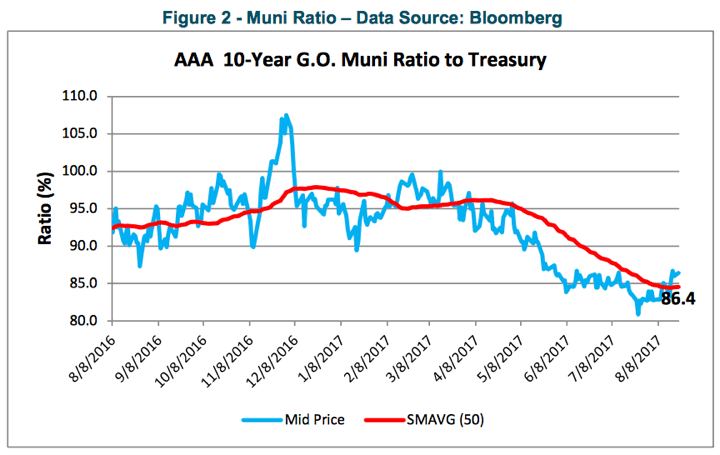
The spread itself has been narrowing, according the chart below tracking the ratio of AAA-rated GO Muni bonds to Treasuries over the last 12 months (not adjusted for taxes). Taken from the most recent Baird’s weekly muni commentary.

muni_ust_1708

Still, muni bond funds remain relatively attractive for many folks, especially in higher tax brackets. Use this Vanguard taxable-equivalent yield calculator and compare the numbers for your own situation.

Bottom line. My takeaway is that muni investors should acknowledge this liquidity risk, and be prepared for short-term swings in muni bond fund prices (due to illiquidity) if there is a major event (like a surprise bankruptcy filing). However, if you are truly a long-term holder of muni bonds, then you can accept this risk, hopefully ride things out, and be compensated with higher tax-equivalent yields.

Tough Times for Conservative Income Investors

JP Morgan Asset Management recently released the Q3 2017 update to their Guide to the Markets, which is another of those resources worth bookmarking for future updates. Some folks put a lot of time and energy into it, and it contains a lot of interesting charts and graphs. Here’s just one that caught my eye.

I consider myself a relatively conservative income-oriented investor, and this chart shows why it’s been a tough several years to be that type of investor. For much of the last 30+ years, you could have put your hard-earned money in an FDIC-insured certificate of deposit and enjoyed a guaranteed return above inflation. This isn’t even when shopping around for the top rates, just taking the average bank CD rates.

saverincome

Nowadays, you’re just trying to keep the bleeding to a minimum, jumping at the chance to grab a 3% APY long-term CD that might just keep up with inflation.

This also partially explains why the stock market keeps going up and up. Which would you rather have?

  • FDIC-insured cash savings that gives you $1 in annual interest per $100 invested, or a
  • S&P 500 ETF with a 4% earnings yield and 2% dividend yield? In other words, a basket of companies that for every $100 invested earns $4 a year in profit and out of that gives you $2 a year in cash dividends?

I really can’t complain as my overall portfolio of stocks, bonds, and bank CDs has more than doubled in the past several years. Yet, I also share that vague feeling of uneasiness with many other investors.