Solo 401k – Best Retirement Plan for Self-Employed Business Owners

solo401kThe wealth management group Del Monte published a whitepaper on Solo 401k plans, calling it the “financial industry’s best kept secret” and a “powerful and underutilized” retirement plan for self-employed business owners. The 4-page PDF does a good job at summarizing the benefits of a Solo 401k, aka Self-Employed 401k. Perhaps most importantly, the Solo 401k allows the maximum annual tax-sheltered contribution (or ties for the max) for all income levels and ages.

se_max

Here’a a quick benefit comparison against the SEP-IRA and SIMPLE IRA:

se_max2

The key difference is the Solo 401k allows an $18,000 salary deferral at any income (i.e. if you make $18k or under, you can put aside all of it) for 2017 and then adds on a profit-sharing component. In addition, Solo 401ks a larger additional “catch-up” contributions at age 50.

I’ve had a Self-Employed 401k through Fidelity for several years, and I have been quite happy with it. The paperwork has been minimal, although you must start filing IRS Form 5500-EZ once your asset exceed $250,000 or face significant penalties. (It’s one page long.) It has been quite flexible – I am able to purchase mutual funds, ETFs, individual stocks, CDs, and individual Treasury and TIPS bonds. There is no annual fee and I’ve only had to pay trade commissions. Fidelity also accepts rollovers from outside IRAs and 401k plans.

Vanguard, Schwab, and TD Ameritrade also offer cheap in-house Solo 401k plans that work well for low-cost DIY investors. There are now several independent providers with “custom” 401k plans which can offer features like 401k loans the ability to invest in alternative asset classes (precious metals, tax liens, real estate, private equity, etc.) at additional cost. Vanguard and TD Ameritrade offer a Roth option; Fidelity and Schwab are only available with “traditional” pre-tax contributions.

Another option to consider is the Solo Defined-Benefit Plan, or “Solo Pension”. The annual maintenance fees are higher and the IRA requirements are significantly more complex, but you can make much larger amounts of tax-deferred contributions (dependent on age and income). The most affordable option appears to be the Schwab Defined-Benefit Plan. If anyone has any experience with this plan, I’d like to hear about it and would be open to a guest post.

Wealthfront Review: Feature Breakdown and Comparison

wfront1707_0

Wealthfront is one of the largest independent digital advisory firms (i.e. not tied to a specific brand of funds like Vanguard or Schwab). With a younger target audience (20s to 40s), their offering is for folks that are comfortable having nearly all interactions via smartphone or website. They frequently announce new features and improvements, so I will work to keep this feature list updated.

Diversified portfolio of high-quality, low-cost ETFs. Their portfolios are a diversified mix of several asset classes including: US Total, US Dividend, International Developed, US Corporate Bonds, Muni Bonds, Emerging Market Bonds, REITs, and Natural Resources. For the most part, low-cost Vanguard and iShares ETFs are used. You could argue the finer points of a specific portfolio, but overall it is backed by academic research (Chief Investment Officer is Burton Malkiel).

Direct indexing. If your account is over $100,000, Wealthfront will buy all the stocks in the S&P 500 individually and commission-free. ETF expense ratios are pretty low now, so this is mostly used as an opportunity for more tax-loss harvesting. No other robo-advisor offers this feature. Here is whitepaper that details their position. As long as you meet the $100k minimum, there is no additional cost fee above the standard management fee.

Smart-beta. If your account is over $500,000, Wealthfront created Advanced Indexing as their answer to “smart-beta” investing. It works within its Direct Indexing feature in order to improve tax efficiency. As long as you meet the $500k minimum, there is no additional cost fee above the standard management fee.

wf_new

Financial planning software with outside account integration. Path is Wealthfront’s new financial planning software, launched in February 2017. This service links your external accounts from other banks, brokerages, and 401k plans (similar to Mint and Personal Capital) in order to see your entire picture without having to manually input your balances and transactions. How much do I have invested elsewhere? How much am I spending? How much am I saving? How much can I spend in retirement?

Path can forecast your saving rate using the last 12 months of transactions. Investment returns are estimated using Monte Carlo analysis. It also accounts for your household income, birthdate, and chosen retirement age to estimate how Social Security will affect your retirement income needs. You can change up the variables and see how it will affect your retirement outlook.

College Savings Planning. You can select a college for real-time expense projections, get a customized estimate of financial aid, and receive a personalized college savings plan to cover the difference. This works with or without their own Wealthfront 529 College Savings account.

Account types. Wealthfront now supports taxable joint accounts, trust accounts, 401k rollovers, Traditional IRAs, Roth IRAs, and SEP IRAs. They also offer a 529 College Savings account.

Tax-sensitive account transfers. This is good news if you already have an existing portfolio with unrealized capital gains. Other robo-advisors may have a “switch calculator” to help you decide whether to move over or not, but Wealthfront will actually accept your existing investments and manage it for you alongside your new investments.

If you want to switch advisors or move your brokerage holdings into a diversified portfolio, you typically have to sell all your holdings and move in cash. This means you will more than likely have a large tax bill. Instead of selling your holdings, Wealthfront will directly transfer them into a diversified portfolio tax efficiently, saving you that tax bill.

Tax-efficent asset location. They will place different asset classes in your taxable accounts vs. tax-deferred accounts (IRAs, 401ks) for a higher after-tax return. However, they do not treat them holistically (i.e. putting all one of one asset in IRA and none in taxable). Non-Wealthfront accounts are also not taken into consideration.

Use dividends and new contributions to rebalance. They will use your dividends and new contributions to rebalance your asset classes in order to minimize sells and thus minimize capital gains.

Concentrated holding of a single stock? Wealthfront caters to the tech start-up crowd with a unique Selling Plan service for people with much of their net worth tied up in a single stock. They’ll help you sell your positions gradually in a tax-efficent manner. Currently available to shareholders of: Alphabet, Amazon, Apple, Arista Networks, Box, Facebook, Pure Storage, Square, Twilio, Twitter, Yelp, Zillow.

Daily tax-loss harvesting. Wealthfront software monitors your holdings daily and attempts to find opportunities to harvest tax losses by switching between “similar but not substantially identical” ETFs. If you can delay paying taxes and reinvest them, this can result in a greater after-tax return. The exact “tax alpha” of this practice depends on multiple factors like portfolio size and tax brackets. You can read the Wealthfront side of things in this whitepaper and Schwab comparison. Here is an outside viewpoint arguing for more conservative estimates.

My opinion is that there is long-term value in tax-loss harvesting and especially daily monitoring to capture more losses. However, I also think it’s wise to use a conservative assumption as to the size of that value. (DIY investors can perform their own tax-loss harvesting as well on a less-frequent basis. I do it myself, but it’s rather tedious and I’m definitely not doing it more often than once a year. I would gladly leave it to the bots if it was cheap enough.)

Portfolio Line of Credit. If your taxable balance is over $100,000, Wealthfront will automatically give you a line of credit of up to 30% of your balance. There is no application, no fees, low interest rates, and you can get cash in as little as 1 business day. The rates are advertised to be even lower than a Home Equity Line of Credit (HELOC). Keep your loan balances modest though, as this is a margin lending product and they may force you to sell your investments if your outstanding balance exceeds your available margin.

Fee schedule. The fee schedule for Wealthfront is simple – Everyone gets charged a flat advisory fee of 0.25% of assets annually (first $10,000 waived). All of the features listed above are included. As your asset size increases, you get access to some additional features like Direct Indexing and Advanced Indexing (Smart-Beta).

Bottom line. Wealthfront is an independent digital advisory firm with over $7 billion in assets. Independent which means they aren’t tied to any specific brand of funds like Vanguard, Fidelity, or Schwab. Their main differentiators from the other independent firms (see my Betterment review) are (1) Direct Indexing and Advanced (Smart-Beta) Indexing portfolio management for optimal tax-efficiency and (2) customized assistance with transferring in your existing investments (including company stock) and then selling them tax-efficiently. Other notable features include: Financial planning software that incorporates external accounts, tax-loss harvesting, 529 college saving plan and guidance software, and a portfolio line-of-credit.

Special offer. Open a Wealthfront account via my invite link and get your first $15,000 managed for free, forever. This is an additional $5,000 above the standard $10,000 balance waiver. You can then invite your own friends for more savings (your friend gets $15k managed free as well, and you get another $5k managed for free.)

Active vs. Passive Funds Debate: Don’t Worry, Be Happy

mrworryA common theme in the financial media these days is that “index funds will take over the world armageddon gaaaaahhhh”. People have already used the “bubble” label. Here’s an example of how three charts on the same topic can suggest very different things. First, you’ve probably seen charts like this that encourage you to extrapolate the current upward trend forever…

activefund0

How about some context? Yes, passive funds are gaining assets, but there is still a ton of money in active funds:

activefund1

Now, what if things are more cyclical? You know, stuff that goes both up and down? Here’s a chart from the Longleaf 2017 Q2 Shareholder letter:

activefund2

The active/passive debate is not new. As the chart [above] shows, performance runs in cycles, and active management is at a low point today. Late in the passive cycle, active investing typically has been declared dead. That declaration has been followed by a strong active management comeback with corresponding disappointment for those who capitulated and owned the index, particularly at its most inflated levels.

In the end, shouldn’t there be a balance? If things get too wacky, then the active stock managers should eventually have easy-pickins and make lots of money on the “dumb” indexers. My guess is that when the market goes down, active funds will get some of their mojo back. Overall, this topic remains in my “not gonna worry about it” folder.

Longleaf Partners Funds Shareholder Letters

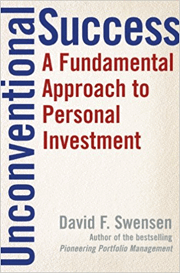
unconventional180One of the early books that impacted my investing philosophy was Unconventional Success: A Fundamental Approach to Personal Investment by David Swensen. As a very successful manager of the Yale Endowment, he offered common-sense explanations of why low-costs are good and which core asset classes make the most sense to own.

In addition, he pointed out the characteristics to look for in successful active management:

  • Hold a limited number of stocks. Bet boldly on fewer companies (high “active share”), as opposed to being a “closet index fund”.
  • High rate of internal investment. The managers should have a high percentage of their own net worth in the same funds that they ask you to invest in. They should “eat their own cooking.”
  • Limit assets under management. If there is more money flowing in than they can invest efficiently, they should close the fund to avoid asset bloat. This requires them to turn down more money!
  • Reasonable management fees. Active management hash higher internal costs than a passive strategy, but you can still charge less than average.

Swensen pointed out Southeastern Asset Management as an example of a company that most clearly displayed all of these characteristics, but don’t miss the last part of the quote:

Southeastern Asset Management (sponsor of the Longleaf Partners mutual-fund family) exemplifies every fundamentally important, investor-friendly characteristic conducive to active-management success. Portfolio managers exhibit the courage to hold concentrated portfolios, to commit substantial funds side by side with shareholders, to limit assets under management, to show sensitivity to tax consequence, to set fees at reasonable levels, and to shut down funds in the face of diminished investment opportunity.

Even though all the signs point in the right direction, investors still face a host of uncertainties regarding Southeastern’s future active-management success.

Due to this recommendation, I try to keep up with the Longleaf Funds shareholder letters. (You can register for free e-mail updates, even if you don’t own their funds.)

Reading the shareholder letters helps illustrate the many difficulties of active management. Here’s how most of their shareholder letters go, along with specific commentary on individual stocks.

  • Our Partners Fund only holds these 15-25 stocks. Our performance has been [x.xx%]. We have done [better/worse] than our benchmarks.
  • We continue to believe we will generate alpha in the future because we only companies at a significant discount to our conservative appraisals.
  • We claim no ability to predict short-term market moves.
  • We believe that our bottom-up intrinsic value investing approach has positioned the Funds with less risk of permanent capital loss than the relevant indices across all of our strategies.

Their flagship Longleaf Partners Fund (LLPFX) has had attractive performance if you look from inception in 1987:

longleaf1987

However, what if you read Swensen’s book when it was popular in 2005 and thought… I should buy some of that! You would have fallen far behind a simple S&P 500 index fund.

longleaf2005

Here’s what Morningstar has to say about it:

Although Longleaf Partners’ 2016 rebound was welcome, past missteps continue to drag down its record and raise concerns about its prospects.

Longleaf again closed their flagship Longleaf Partners Fund (LLPFX) to new investors in June 2017. Their Small Cap fund has been closed to new investors since 1997. This shows that they are still holding true to the positive characteristics listed above. They could make more money by staying open, but they aren’t. Here’s a snippet from their 2017 Q2 Shareholder letter:

The eight-plus year bull market in the U.S. has made finding qualifying opportunities more difficult, particularly in larger cap companies. In addition, this year’s strong returns in most markets outside of the U.S. have made our on-deck list of prospective investments light around the world. Because we have sold and trimmed businesses whose prices have moved closer to our appraisals, our cash reserves are higher than normal. In June, we closed the Longleaf Partners Fund due to limited new investments and a high cash position.

I respect Southeastern Asset Management and I enjoy reading their shareholder letters. They might end up kicking butt in the future. However, I hold no position on any Longleaf funds because I don’t have the level of faith required to maintain my position. It’s a tough world out there, even when you are doing the “right” things. Note that LLPFX charges 0.95% of assets and multiple large-cap index funds only charge 0.05%. Consider that as of this writing, the trailing 15-year total return of LLPFX is 7.12% annualized. The trailing 15-year total return of the S&P 500 is 9.58% annualized. If you held this in a taxable account, the gap would be even wider.

Bottom line. Longleaf Partners Fund continues to be an example of promising characteristics for an investor-friendly, actively-managed mutual fund. However, their recent performance has still been questionable. They may outperform in the future, but will you stick around to see? Reading their free shareholder letters is a good way to learn about what it’s like to invest in a traditional value-oriented, actively-managed strategy.

Free Collection of Investing Books by Meb Faber

investwiththehouse

Free again. Asset manager Meb Faber is promoting the launch of his new book, The Best Investment Writing: Selected writing from leading investors and authors (Vol. 1), by making all four previous self-published books free in Kindle format for a limited time (ends Saturday 8/5). Below are direct links to each book. Check first that the Kindle price is $0 (“0.00 to Buy”), then buy it to own permanently. Do not click “Read for Free”.

Grab them now while they are free, and read later at your convenience. You can read Kindle eBooks on smartphones or on any computer via web browser.

I enjoy reading these books, but I’m always careful when reading about finely-diced backtested strategies that worked well in the past. Before you put your hard-earned money at risk, please realize that even if they continue to work (which is in no way guaranteed given how markets tend to weed out edges), they will still be hard to stick to in real life. At some time, you will underperform other strategies for an extended period of time. You must ride out those low periods in order to achieve any sort of market-beating returns. In my opinion, the fancier the strategy, the harder it is to keep faith.

Most Underfunded Private Pension Plans in the S&P 500 (Infographic)

In addition to data on underfunded state pension funds, Bloomberg also has an infographic on private pensions: S&P 500’s Biggest Pension Plans Face $382 Billion Funding Gap. There are at least 20 large corporations that have put aside less than 70% of what they need to pay out their estimated pension obligations. This is even worse than many state governments, which at least have the ability to increase taxes. Here’s the full list along with their specific funding ratios:

pensionsp500

United Airlines was the largest private pension default in US history. I must admit, I don’t really understand the laws behind private pension obligations. In 2002, United Airlines filed for Chapter 11 bankruptcy. In 2005, a federal bankruptcy judge ruled that United Airlines could default their pension obligations and turn the management of pensions over to the Pension Benefit Guaranty Corporation (PBGC). According to this NYT article, the total shortfall was estimated to be $9.8 billion. Even after the PBGC put up $7.3 billion, this still resulted in a significant cut in promised benefits to many retired workers.

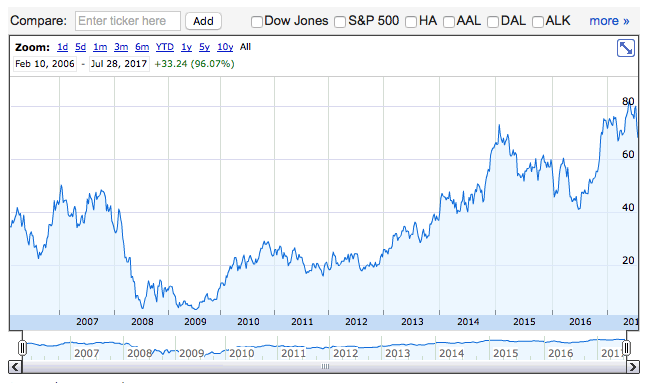
Here’s United’s stock price since emerging from bankruptcy in 2006 (via Google Finance):

ual2017

Yet today, I still see United Airlines on this list at 64% funded. I suppose these are Continental Airlines pensions due to their 2010 merger. American Airlines is also on this list at 58% funded (they also tried to dump their pensions back in 2012). I hope these airlines shores up their pension funds while their stock prices are reaching new highs.

The PBGC has never required taxpayer money and is normally funded by insurance premiums, but it could require a bailout if future pension defaults exhaust PBGC funds. I wonder what kind of future return figures are used in these estimates. If they are too optimistic, the situation could be worse than pictured above.

Fidelity Index Mutual Fund and ETF Expense Ratios (Updated August 2017)

fidodrop0

Updated. Fidelity announced another round of expense ratio cuts effective August 1, 2017. They last announced a big round of expense ratio drops in July 2016. This move allows them to make the following claim:

Fidelity beats Vanguard on expenses on 17 of 17 comparable stock and bond index funds and 11 of 11 comparable sector ETFs. Comparisons based on fund expense ratios only.

fido1708_full

Mutual Fund Share Classes. Fidelity separates mutual funds into Investor Class ($2,500 minimum) and Premium Class ($10,000). Individual ivestors in employer retirement plans may have access to these funds, including institutional share classes, without the minimums. This is in close alignment with Vanguard Investor and Admiral share classes.

Highlights. Here are some broad US and Domestic index funds that I track.

  • Fidelity 500 Index Fund. Investor 0.09% Premium 0.035%
  • Fidelity Total Market Index Fund. Investor 0.09% Premium 0.035%
  • Fidelity (Developed) International Index Fund. Investor 0.16% Premium 0.06%
  • Fidelity Global ex U.S. Index Fund Investor 0.17% Premium 0.10%
  • Fidelity Total International Index Fund Investor 0.17% Premium 0.10%
  • Fidelity Emerging Markets Index Fund Investor 0.29% Premium 0.13%
  • Fidelity U.S. Bond Index Fund Investor 0.14% Premium 0.045%
  • Fidelity Inflation-Protected Bond Index Fund Investor 0.19% Premium 0.09%

Here is the full list with changes (official page):

[Read more…]

Low-Cost Funds Capture Nearly All of the Market’s Gains (and Losses)

Here’s a quick snapshot that illustrates why Vanguard and other low-cost funds are taking assets from active managers. Via this Bloomberg article. The US stock market has been on a great run for nearly 9 years now, and low-cost funds have been giving investors nearly all of those gains.

vgtriple

People always chase past performance. The vast majority of index fund money is in US stock funds, and those have the best recent past performance. But when the US stock market eventually stumbles, those low-cost index funds will also be great at passing along all of those losses.

What will happen then? While it hasn’t been very helpful recently, I still agree with those recommending have diversified exposure into other areas like developed international stocks, emerging markets stocks, and high-quality bonds.

Chart: Hours of Work Required To Buy S&P 500

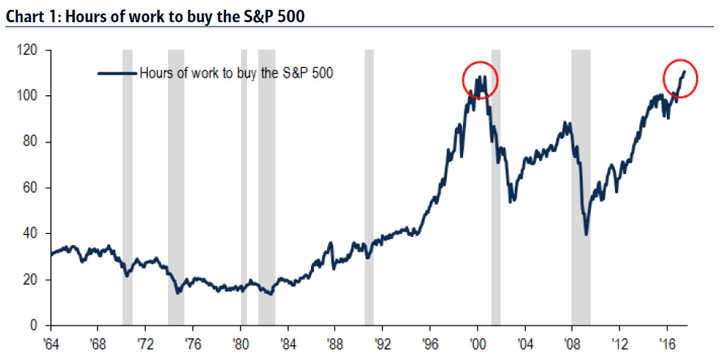
As the US stock market keeps going up, it feels like everyone is whispering the same thing: We are near a top. It’s easiest to do this with numbers. Here’s a valuation metric that divides the price of the S&P 500 stock index by the median US hourly wage. In other words, how many hours of work does it take to buy a unit of the S&P 500?

hours500

Answer: More hours of work than even at the top of the 2000 tech bubble. Found via WSJ Daily Shot newsletter and @ReutersJamie. Original source appears to be BAML (Bank America/Merrill Lynch).

This concerns me of course, but I’m still a buy-hold-and-rebalance investor at roughly 2/3rd stocks and 1/3rd bonds. Sure, we might be at the top. But we could be at new top next week. There are two only possible states: all-time high or drawdown. Here’s a wise observation by @ClementsMoney:

The good news is, many investors are prepared for a stock market decline. The bad news is, they’ve been prepared since 2011.

How Badly Underfunded is Your State’s Retirement Pension Fund? (Infographic)

The state of Illinois narrowly avoided having their S&P credit rating dropped to “Junk” status, but their current rating is already the lowest ever for any state. Their pension promises now total over $200 billion, but they are a bit short… $120 billion short. That’s only 40 cents saved for every $1 owed. Unfortunately, your state might not be doing that much better. Here is a Bloomberg graphic America’s Pension Bomb which shows the funding ratio for every state available:

pensionmap

This reminds me of a car wreck in slow-motion. Politicians get to make financial promises that can last 30-50 years, but they are only interested in being elected for the next 2-4 years. How will it end? Will states accept the pain now to fix things and get back on track? Or will they just keep kicking the can down the road until faced with huge tax hikes or maybe even a federal bailout?

If you are a municipal bond investor, Vanguard says not to worry: Despite Illinois’s financial troubles, muni market looks strong. Well, it’s good to see that Illinois is only about 1% of their national, investment-grade muni bond funds. I’m not worried about a crisis in the next few years either, but I also don’t see any evidence that things are getting better. I was planning to diversify my muni bond holdings anyway as my income drops in early retirement. Perhaps it’s time to speed up that timetable.

Portfolio Visualizer: Asset Allocation Backtesting and Monte Carlo Simulation Tool

portpie_blank200Here’s another neat (and free!) portfolio analysis tool – PortfolioVisualizer.com. You can upload a custom asset allocation and get all sorts of backtest data and Monte Carlo simulation results from it. If you register for an account, it will remember your model portfolios for future use.
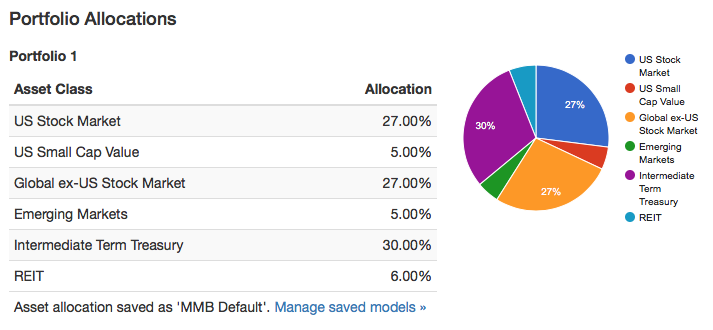
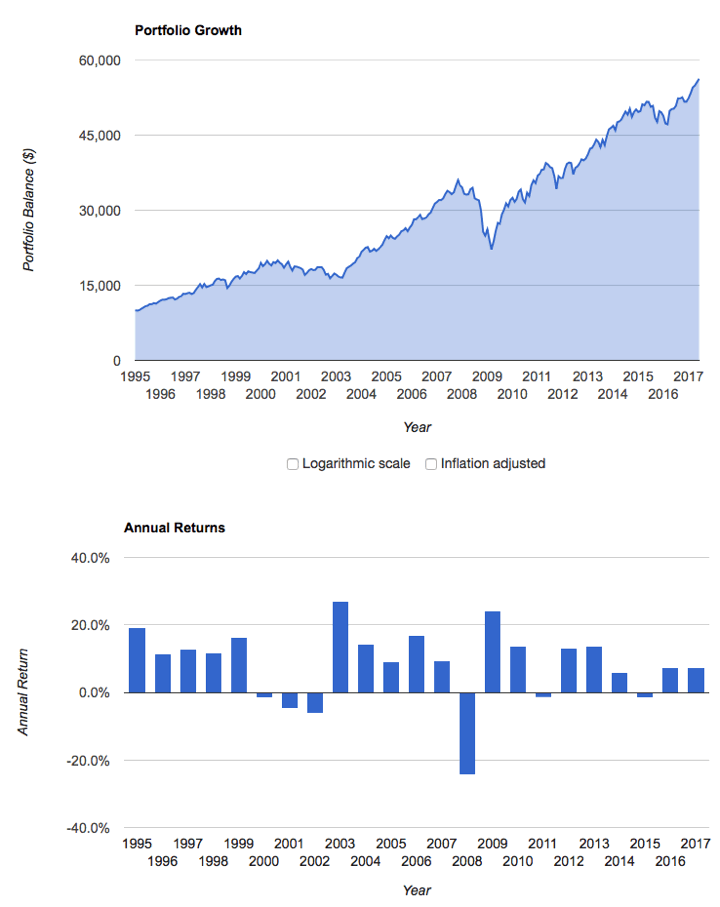
I created a custom portfolio “MMB Default” similar to my current portfolio asset allocation and below are selected charts that were produced. Here’s the summary:

pv1

Historical portfolio growth and annual returns. (Note that the time period shown was limited because the available data for Emerging Markets only went from 1995-2017. Apparently there are some ongoing issues with data licensing.)

pv2

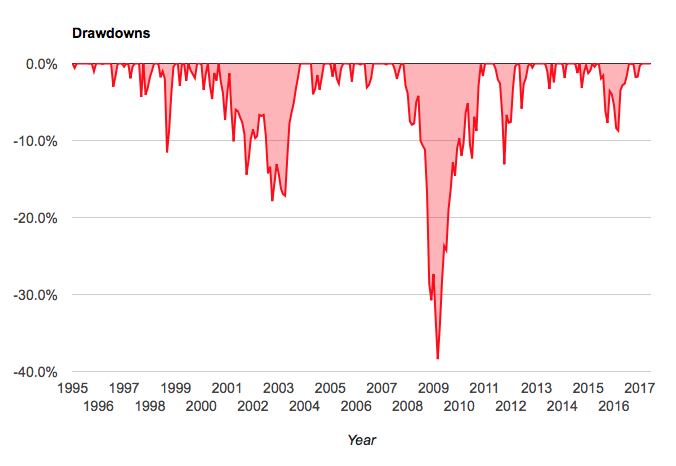
Historical drawdowns during the same period. This provides a good feel of how “painful” it was to hold this portfolio. 2009 was certainly a stressful year when both our portfolio and future job prospects were being questioned.

pv3

Monte Carlo simulation of 4% withdrawal rate over a 30-year retirement period. I used my custom portfolio and had it simulate a withdrawal rate of $40,000 from a $1,000,000 portfolio (4%), adjusted annually for inflation, for a 30-year period. You can alter nearly all of these variables (withdrawal rate, inflation adjustments, period length, etc). Monte Carlo basically looks at many possible trajectories based on historical asset return characteristics. If things turn out well, you end up with a “runaway” portfolio, but if they don’t you can hit zero pretty fast.

pv4

The success rate looks at the percentage of simulated scenarios that end up with a positive value at the end of the period. At a 4% withdrawal rate for 30 years, it was 95%. At a 5% withdrawal rate for 30 years, it was only 84%. At a 5% withdrawal rate for 50 years, it was only 69%.

Here’s where I warn you that Monte Carlo simulations are not the end-all of portfolio safety. You can’t predict the next 50 years when you can barely look back 50 years. Living off a portfolio for decades involves not just a reasonable rate of withdrawal but planning as to how you could cut expenses or create additional income if conditions go sour for an extended time period. I’d rather have 90% theoretical safety and a flexible backup plan over 99% theoretical safety and no backup plan.

Portfolio Visualizer has several additional features that I may never use, but even the above is enough to make it a very interesting tool for the DIY investor. I hope they get their data source issues sorted out eventually. You can find all of my posts about portfolio tools in the Tools & Calculators category.

Jack Bogle Full Interviews with CNN and Business Insider

boglecnn2If you haven’t gotten a dose of Jack Bogle wisdom recently, check out this full Business Insider interview transcript and this 16-minute CNN video interview. There is a lot of ground covered between them. Here are my selected notes:

S&P 500 dividend income reliability. Bogle seems to support the idea of relying on S&P 500 stock dividends to supplement Social Security:

The basic idea of retirement income is, to me, to get a check, two checks every month, one from your fixed income and one from equity account. And you want them to grow over time. Social Security is a cost-of-living hedge, and in the equity account dividends grow over time.

The record of the S&P 500 dividends is almost a complete up trend with only two big declines going back into the ’20s. One would be in 1930s — ’33 or ’34 — and the other is when the banks stocks eliminated their dividends, back in 2009. Those are really the only significant declines in the dividends.

Investors make a big mistake by thinking too much of the value of the account and not enough about the monthly income they want to get. We could have a significant decline in the market with dividends unchanged.

Here’s a chart of the S&P 500 dividend history via Multpl.com:

sp500divmult

Helping investors improve their behavior. For example, 401(k) plans were not designed to be your primary retirement vehicle, and thus have a lot of flexibility built into them. However, this flexibility means a lot of people take money out of their 401(k) when they switch jobs or for loans that never get paid back. A similar thing when people chase performance:

With actively managed funds, people have big behavior problems. With funds that have done well, they put their money in, and when it has done bad, they want to take it out. The index fund always gives you the market return. It may be bad sometimes — it will be bad sometimes — but there’s just no evidence that active managers can win [long term].

Why you don’t see performance-based incentive fees for fund managers. I didn’t know about the SEC symmetrical rule:

The active managers have their work cut out for them. One thing they could do is put in an incentive fee. Get 10 basis points or five [0.10% or 0.05%], unless they beat the market. We’re paying people to beat the market when they aren’t doing it, and when you think about it, that doesn’t make sense.

They can put their expense ratio at 5 [basis points, 0.05%] and get another 1% if they beat the market by X. But they have to, under the SEC rules, be symmetrical. So if they lost to the market by 1%, they would be out of pocket. Managers, at least in this context, are not stupid. They know perfectly well they are going to lose that bet.

What happens if index funds continue to grow in popularity:

Right now I believe indexing to be about 22% to 25% of the marketplace. It’s not disturbing anything. Could it go to 50% and not disturb anything? I believe it could. All you’re doing is immobilizing X percentage of the shares in the market. The remaining 50% can trade away to their hearts’ content.

Could it handle 90%? I think it could, but we’re so far away from that, I don’t spend a lot of time thinking about it. The reality here, however, is that even if the market would reach a level of inefficiency, which everyone says then the active managers can win because then they can find underpriced stocks. [Laughs] It’s such a ridiculous argument it hardly bears refuting. The fact is, if the market is more inefficient, it would be easier for half of the managers to win and by definition easier for half of the managers to lose. Because every purchase is a sale and every sale is a purchase.

This is not a problem that I worry about very much. Markets stay relatively efficient because there continues to be big rewards for those that can figure out any small inefficiency, even for a short period of time. Those rewards aren’t going aways, so markets will stay efficient, and low costs will continue to matter.