Vanguard ETF vs. Mutual Fund Admiral Shares

Building My Portfolio BlocksAllan Roth has a new ETF.com article called Why ETFs Won’t Replace Mutual Funds. Inside, he offers the following reasons why if you are buying Vanguard funds, he typically recommends the Admiral Shares mutual fund over the ETF.

Vanguard Mutual fund advantages

  1. Can buy fractional shares
  2. No premium or discount—all transactions are at net asset value
  3. No spreads between bid and ask
  4. Less cash drag, as dividends are reinvested more quickly
  5. Can do a tax-free exchange from mutual funds to ETFs, but not the reverse
  6. Can do automated dollar cost averaging

In the interest of fairness, I will offer up the following:

Vanguard ETF advantages

  • Lower minimum investment amounts. Usually one share is only about $100, and some brokers even offer fractional shares.
  • No purchase or redemption fees. No short-term trading fee. Vanguard has these on a few mutual funds, for example the Vanguard Global ex-US Real Estate Fund Admiral Share charges a 0.25% fee on both purchases and redemptions.
  • You can easily hold, buy, trade Vanguard ETFs at any brokerage firm. The cost to trade will be as with any stock. (Vanguard mutual funds and ETFs trade free with a Vanguard brokerage account.) You might prefer the customer service of another firm, or you might prefer the convenience of having everything together if you hold non-Vanguard investments. You might already have free trades anyway, for example with the Robinhood app.

Expense ratio is a tie with Admiral Shares. I don’t know if it an official “written in stone” polcy, but Vanguard has a long history of keeping the expense ratios of ETFs and Admiral Shares mutual funds the exact same (mostly $10,000 minimum investment). The Investor Class usually has a slightly higher expense ratio (mostly $3,000 minimum).

Tax-efficiency is a tie. I will add in this reminder that in the case of Vanguard (and only Vanguard as far as I know), the ETF and mutual funds share the same underlying investments and thus the same level of tax-efficiency, utilizing the benefits of both where possible. From the Vanguard ETF FAQ:

Are there any tax advantages to owning a Vanguard ETF®?
Because Vanguard ETFs are shares of conventional Vanguard index funds, they can take full advantage of the tax-management strategies available to both conventional funds and ETFs.

Conventional index funds can offset taxable gains by selling securities that have declined in value at a loss. In addition, they tend to trade less frequently than actively managed funds, which means less taxable income gets passed on to shareholders. Vanguard ETFs can also use in-kind redemptions to remove stocks that have greatly increased in value (which trigger large capital gains) from their holdings.

My money. I hold most of my portfolio in Vanguard mutual funds (Admiral Shares). One reason is that I am old and have a good amount of capital gains in the mutual funds bought before ETFs gained traction. I also hold some Vanguard ETFs, mostly bought back when ETFs were cheaper because I didn’t have enough money to qualify for Admiral shares. (Prior to 2010, the minimum for Admiral funds was $100,000! These days the minimums are mostly a more reasonable $10,000.) These days, I don’t have a strong preference, but I slightly prefer the simplicity of buying mutual funds.

Vanguard ETF tool. If you really want to pick at the details, Vanguard offers their own ETF vs. mutual fund cost comparison calculator. It’s pretty good and even includes things like historical bid-ask spreads.

Bottom line. There are certainly differences between ETFs and mutual funds. It is worth comparing the advantages and disadvantages before making your decision. However, in terms of the big picture, we are talking about relatively small differences. Being low-cost, transparent, and diversified are more important features. Given that both have their relative advantages, both ETFs and mutual funds will be around for a long time.

How to Buy or Sell an ETF: Real-World Best Practices

Building My Portfolio BlocksIn this ETFdb interview with Rich Powers, Head of ETF Product Management at Vanguard, there was a useful bit about the practical mechanics of buying an ETF in your brokerage account. Found via Abnormal Returns.

ETFdb: What would you say are three best practices that investors should keep in mind?

R.P.: The first is to not trade at the open or the close because the markets aren’t very deep during these times. Secondly, avoid market orders at all costs. Finally, investors need to keep their risk/return profile and expectations in mind. A retail investor will have a different set of parameters and risks that they are willing and able to bear, compared to an institutional investor, when selecting a product.

ETFs are an increasingly popular way to build a portfolio and this is good, practical advice from a respected source. I’ll expand with my own commentary below:

Do not trade near the open or close each trading day. The markets are not as liquid during these times, which means that you may get poor pricing. I’ve read elsewhere that you shouldn’t trade during the first hour or the last hour of the trading day. I’ve found this to be a good rule of thumb.

Never use a market order. A market order is like a box of chocolates… you never know what you’re going to get. A limit order simply sets a ceiling on the price you’ll pay to buy (floor on selling). A market order has no theoretical boundary, as you’re saying “just buy/sell it for whatever is the lowest/highest price available at this moment in time”. For example, if you are selling your shares and the bid on an ETF is $100.00 and the ask is $100.20, your market order could still be filled at $90 or even $50 if there is some sort of “flash crash” event. Why take that risk?

You can use a limit order that is as “strict” or “lenient” as you like. I’ve read recommendations to set a limit order for the middle of the bid/ask spread, i.e. $100.10 in the previous example. It isn’t a bad idea, but I don’t use this rule. Let’s say I’m trying to invest roughly $5,000 and thus roughly 50 shares. The difference between $100.00 and $100.10 a share times 50 shares is $5. Am I going to risk not making this buy order over $5? The market could just as easily move upwards to $100.50 as it could go down to $99.50, so any future price movement could dwarf that $5.

Since I am a long-term investor, I just want the trade to go through within a reasonable price range, so I usually choose a limit order close to the bid. Note that this padding should not be an invitation to get ripped off. I routinely get order fills above my limit price. There is an SEC rule called “best execution“. This is from a now-gone Schwab article that I’ve quoted in the past:

Markets are not allowed to fill orders at a price worse than the market price, even if your limit order allows for it. Building in a little extra room to ensure your order is filled will not cause you to overpay—you should still be filled at the prevailing market price when your order comes to the front of the line.

Don’t try to time the market quotes intraday. I’m replacing Mr. Powers’ third best practice with this one, which is supported by a later quote in the interview:

[…] retail or individual investors probably do not benefit from being able to trade an ETF throughout the day.

Since you have to buy an ETF during the day, you may be tempted to delay your purchase if the market appears to be moving upwards or downwards. “If I wait, the price might go back down a bit!”… or “If I wait, the price might go up some more!”. If you are a long-term investor and not a trader, then just type in your limit order and get back to your life. Most of the time my orders fill immediately. Sometimes the market moves and it doesn’t fill right away. I usually just walk away, only to have it fill minutes later. A few times, I forget and the order expires at the end of the day. In that case, I just spend 2 minutes typing in the order again the next day. Don’t worry about daily movements, you can’t predict them anyway.

Dimensional Fund Advisors Profile + 529 College Savings Plan Access

dfalogoInstitutional Investor has an interesting profile of Dimensional Fund Advisors (DFA). Since DFA doesn’t do much marketing, there are very few articles about them in the mainstream financial media. A rare example is this 2007 article (backup copy) by Michael Lewis for a now-defunct magazine.

DFA funds are similar to Vanguard index funds in that they provide low-cost, diversified, tax-efficient funds that try to capture the market’s overall return. DFA differs from Vanguard in that it tries to beat an index benchmark with various tweaks that target systemic market “risk factors” including size, value, and profitability. (They still believe that prices are efficient and thus don’t pick specific stocks.) They also charge a bit more than pure index funds from Vanguard, Fidelity, Schwab, and iShares.

DFA doesn’t accept money directly from individual investors. You must buy their funds through approved financial advisors or via institutional accounts like 401(k), pension, and 529 plans. Their rationale is that retail investors move their money around too much and at the wrong time. Here’s an impressive statistic:

In 2008, while investors pulled an overall $500 billion from equity funds, the firm had positive flows. It wasn’t because of performance: Dimensional’s funds lost more than the market. According to the group gathered for the September dinner in Austin, clients chose to stay because they understood the firm’s philosophy and the small judgment calls it was making on market portfolios.

DFA is privately-owned and highly academic. DFA executives are “engineers, Nobel Prize winners, physicists, and fluid-mechanics experts”. As such, they are all about the science as opposed to the marketing. The article asks what will happen when the founding members eventually die or leave the firm. Will it have an IPO and be publicly-traded? Will this change the culture to be more focused on short-term profits? Will they someday allow Average Jane investors with $500 to invest? Will the new executives be able to continue the superior performance from understanding market factors?

Succession an interesting question that comes up whenever there is a “special sauce” to your investment’s outperformance. I think Vanguard has done a pretty good job of moving on without Bogle, and I can’t name the current CEO. If you own plain, vanilla index funds there are fewer risks tied to specific people. To simply achieve market return at rock-bottom costs, the current structure should still work 50 or 100 years from now.

DFA doesn’t offer a momentum strategy. The hot trend right now is “smart beta”, and momentum is a big part of that:

It’s instructive to consider other things Dimensional doesn’t have. For example, it doesn’t offer a momentum stock strategy even though the pattern of outperformance is seen clearly in the data. The firm believes a portfolio of momentum stocks generates too much turnover and creates a fund whose characteristics look very different from a market portfolio. Instead, Dimensional uses information on momentum to inform its trading strategies, such as delaying purchases and sales at certain times.

Owning a little bit of DFA funds. I remain intrigued by DFA and their unique culture and methods. Since DFA doesn’t trust us DIY investors (probably rightfully so in aggregate) and many financial advisors charge roughly 1% annually on top of the higher costs of DFA funds themselves, I choose not to invest in DFA funds with my primary portfolio. I’m happy retaining full control and keeping costs as low as possible.

However, I do invest in DFA funds through the Utah 529 College Savings plan. A few other 529 plans also offer DFA funds, but I believe Utah has the biggest selection at a reasonable cost. Here are the currently available options:

  • DFA Global Equity Portfolio
  • DFA Global Allocation 60/40 Portfolio
  • DFA Global Allocation 25/75 Portfolio
  • DFA Five-Year Global Fixed Income Portfolio
  • DFA U.S. Large Cap Value Portfolio
  • DFA U.S. Small Cap Value Portfolio
  • DFA Real Estate Securities Portfolio
  • DFA International Value Portfolio
  • DFA One-Year Fixed Income Portfolio

I kept it simple and picked the all-in-one DFA Global Equity fund. I figure, I’ll let DFA take the wheel and see what happens in 20 years. I don’t have to worry about taxes or withdrawals for a long time. As it’s mostly a low-cost index fund at its core, I don’t worry about the downside too much. I just hope Utah does’t change up their fund options down the road and force me into something different.

Schwab Matches Mutual Fund and ETF Expense Ratios, Now $4.95 Trades

schwab0

Update: Schwab has matched Fidelity’s price cut at $4.95 per trade + $0.65 per options contract, effective March 3, 2017. See press release for details. Everyone is battling for your assets and the ability to scale. (TD Ameritrade also announced a price cut to $6.95 per trade, down from $9.99.)

Original post:

Schwab announced some changes last week regarding their index mutual fund line-up and trade commissions. Here is the press release and a table of the updated mutual fund expenses [pdf]. Here are the highlights:

  • Stock trades now $6.95. Beginning February 3, 2017, the company will reduce its standard online equity and ETF trade commissions from $8.95 to $6.95.
  • Schwab Index mutual fund expense ratios now match their Index ETFs. Starting March 1, 2017, expenses for the Schwab market cap-weighted index mutual funds will be lowered to align with their Schwab ETFs™ equivalents.
  • Schwab Index mutual funds now have no investment minimum. You don’t have to worry about Admiral shares, Premium Class shares, etc.
  • New Satisfaction Guarantee. I’m not sure how this would work in practice, but it says “Simply, if a Schwab client is not satisfied for any reason, Schwab will refund any related commission, transaction fee or advisory program fee paid to the firm.”

Here are the three mutual funds that I would care most about:

  • Schwab Total Stock Market Index Fund mutual fund expense ratio used to be 0.09% while the ETF version cost 0.03%.
  • Schwab International Stock Index Fund mutual fund expense ratio used to be 0.19% while the ETF version was 0.07%.
  • Schwab TIPS Index Fund mutual fund version used to cost 0.19% while the ETF version was 0.05%.

These were pretty big differences, which was why I felt it was rather obvious that Schwab was making their ETFs a loss-leader in order to be slightly cheaper than Vanguard and/or iShares. I’m guessing they are still selling these index products at a loss to gain market share, but it’s nice to see that they have now simplified their expense ratios across the board. The self-directed brokerage option of my 401(k) plan is through Schwab and only allows mutual funds, so this is a positive change for me.

I have been impressed by the committed strategy Schwab has undertaken towards low-cost, index investing. Schwab has an existing profit machine from its traditional services, but hasn’t been afraid to disrupt and even cannibalize itself. The key is that people seem to like Schwab customer service, whereas I would rate Vanguard as “satisfactory”. If Schwab can have top-quality index products and maintain a reputation for better customer service, that would be a great long-term position.

As an aside, you can’t buy shares of Vanguard but you can buy an ownership stake in Schwab. I don’t own any individual shares of Schwab (SCHW) stock as of this writing, but I would not be surprised if it made a good long-term holding. Once interest rates rise, Schwab will start making a lot more money on its customers’ cash balances (which it forces you to hold it their Intelligent Portfolios robo-advisor instead of charges upfront fees). It will be interesting to see how it plays out. I’m just putting this down in writing so I can check back on my prediction later in 2022 and 2027.

How to Minimize Investment Returns – By Warren Buffett

brk2015At the bottom of the Berkshire Hathaway 2016 Annual Report, you may not have noticed that Warren Buffett republished a previous article from the 2005 annual report titled “How to Minimize Investment Returns”. A version become the first chapter (find it here) of The Little Book of Common Sense Investing by Jack Bogle. I am jumping on the bandwagon and republishing this 2007 blog post below as well. 🙂

It’s both a highly recommended parable and it comes at the perfect price of free. Read it if you haven’t already.

Original post:

I just watched the Will Smith movie The Pursuit of Happyness this weekend. I found it ironic that he really didn’t change job types when he joined Dean Witter. Mr. Gardner started out a salesman, and ended up a salesman. But by managing to change his product to financial services, he turned his tenacity and people skills into millions of dollars.

Why is financial services such a lucrative field? This reminded of an excerpt that I had saved from Warren Buffett’s 2005 Letter to the shareholders of Berkshire Hathaway. Although a tad on the long side, I think it provides an excellent “big picture” view of investing the the stock market.

[Read more…]

Berkshire Hathaway 2016 Annual Letter by Warren Buffett

brk2015

Berkshire Hathaway (BRK) released its 2016 Letter to Shareholders [pdf] over the weekend. Although the financial media will create some catchy headlines, I recommend reading it for yourself. It is only roughly 30 pages long and is always written in a straightforward and approachable fashion. Even if you aren’t interested in BRK stock at all, reading the letter can be educational for individual investors of any experience level. Here are my personal notes and comments.

Bullish on America. This is a repeated theme from past shareholder letters.

From a standing start 240 years ago – a span of time less than triple my days on earth – Americans have combined human ingenuity, a market system, a tide of talented and ambitious immigrants, and the rule of law to deliver abundance beyond any dreams of our forefathers.

[…] This economic creation will deliver increasing wealth to our progeny far into the future. Yes, the build-up of wealth will be interrupted for short periods from time to time. It will not, however, be stopped. I’ll repeat what I’ve both said in the past and expect to say in future years: Babies born in America today are the luckiest crop in history.

Berkshire Performance. Another topic that has been touched upon before is that Berkshire is huge and you shouldn’t expect the amazing results from when they were much smaller (19% annualized over the last 50+ years). However, they still plan on beating the S&P 500 over the long-term. If they didn’t, they’d tell their shareholders to move their money elsewhere.

As for Berkshire, our size precludes a brilliant result: Prospective returns fall as assets increase. Nonetheless, Berkshire’s collection of good businesses, along with the company’s impregnable financial strength and owner-oriented culture, should deliver decent results. We won’t be satisfied with less.

According to Morningstar as of 2/24/17, the trailing 10-year total return for BRKA is 9.1% annualized. The trailing 10-year total return for the S&P 500 index is 7.5% annualized. Not bad. (I should also disclose here that I own Berkshire (BRKB) shares in my separate “self-directed” portfolio which is a small percentage of net worth.)

Berkshire Fair Price. Another repeated theme. Buffett is authorized to repurchase large amounts of Berkshire shares at 120% or less of book value. In other words, 1.2x book price is a significant discount to Berkshire’s intrinsic value. If you’re getting close to that number, BRK is probably a “good deal”.

Stock holdings: Not necessarily buy-and-hold forever. This year, Buffett chose to emphasize that he has never promised to hold any particular stocks forever. (It does have no interest in selling its wholly-owned and controlled businesses.) Perhaps it is because he just bought shares of American, Delta, Southwest, and United Continental airlines. The airline industry has quite a rocky performance history. Perhaps it also to explain him selling all of his Wal-Mart shares.

Hedge Fund Bet. You’ve probably heard about this 10-year bet between the S&P 500 and a bunch of hedge funds. Here is my 2016 hedge fund bet update. The short version is that with 9 years down and 1 left to go, the S&P Index fund is up 85%. Of the 5 hedge funds (of funds), the worst hedge fund is up only 3%. The best hedge fund up only 63%. Buffett and the S&P 500 are very likely to win this bet.

I found it noteworthy that Buffett focused on the fact that no other hedge fund manager wanted to take the bet at all. Think about that. Only one guy was brave enough to step up, and how he’s getting bad publicity.

Subsequently, I publicly offered to wager $500,000 that no investment pro could select a set of at least five hedge funds – wildly-popular and high-fee investing vehicles – that would over an extended period match the performance of an unmanaged S&P-500 index fund charging only token fees. I suggested a ten-year bet and named a low-cost Vanguard S&P fund as my contender. I then sat back and waited expectantly for a parade of fund managers – who could include their own fund as one of the five – to come forth and defend their occupation. After all, these managers urged others to bet billions on their abilities. Why should they fear putting a little of their own money on the line?

What followed was the sound of silence. Though there are thousands of professional investment managers who have amassed staggering fortunes by touting their stock-selecting prowess, only one man – Ted Seides – stepped up to my challenge. Ted was a co-manager of Protégé Partners, an asset manager that had raised money from limited partners to form a fund-of-funds – in other words, a fund that invests in multiple hedge funds.

Buffett used to run a partnership where he would take a zero management fee and 25% of profits above a 6% annual return. Hedge fund managers today take 2% of assets annually no matter what and 20% of all positive returns. As usual, in this WSJ article Munger tells it straight:

When Mr. Buffett ran his investment partnerships in the 1960s, he charged no management fees and only took 25% of investment gains after the first 6%. Berkshire Vice Chairman Charles Munger praised that fee model earlier this month at the annual meeting of Daily Journal Corp., where Mr. Munger is chairman.

“I think it is fair and I wish it was more common,” he said of Mr. Buffett’s fee formula. “If it’s a bad stretch, why should you scrape money off the top?”

Rarity of skilled stock pickers. If anyone could identify another good stock picker, it would be Warren Buffett. I don’t recall seeing this claim before:

There are, of course, some skilled individuals who are highly likely to out-perform the S&P over long stretches. In my lifetime, though, I’ve identified – early on – only ten or so professionals that I expected would accomplish this feat.

Best book of 2016. I am currently listening to the Audible version of Shoe Dog by Phil Knight and it’s quite good so far. I’m only at the beginning where he bootstraps his shoe business from his parents’ basement and has the guts to fly all the way to Japan in the 1960s to ask for import rights in person. This book works really well as an audiobook.

The best book I read last year was Shoe Dog, by Nike’s Phil Knight. Phil is a very wise, intelligent and competitive fellow who is also a gifted storyteller.

Shareholder letters from 1977 to 2016 are available free to all on the Berkshire Hathaway website. You can also purchase all of the Shareholder letters from 1965 to 2015 for only $2.99 in Amazon Kindle format. Three bucks is a very reasonable price to have an official copy forever stored in electronic format. (Updated paperback will be re-stocked in mid-April for about $20. Don’t overpay for a stale physical copy.)

The 2015 Annual Letter discussed his optimism in America and his “Big 4” stock holdings. The 2014 Annual Letter discussed the power of owning shares of productive businesses (and not just bonds). The 2013 Annual Letter included Buffett’s Simple Investment Advice to Wife After His Death.

Municipal Bonds vs. US Treasury Bond Yield Comparison

As a follow-up to my post on the risks of investing in bonds, I should share that a slight majority of my personal bond holdings are in short-term and intermediate-term municipal bonds. Why? Well, here are some considerations if you are choosing between holding highly-rated municipal bonds and US Treasury bonds right now.

The Blackrock Blog has an article discussing potential effects of tax reform on muni bonds and also their latest Municipal Market Update [pdf]. Here is my interpretation of their points:

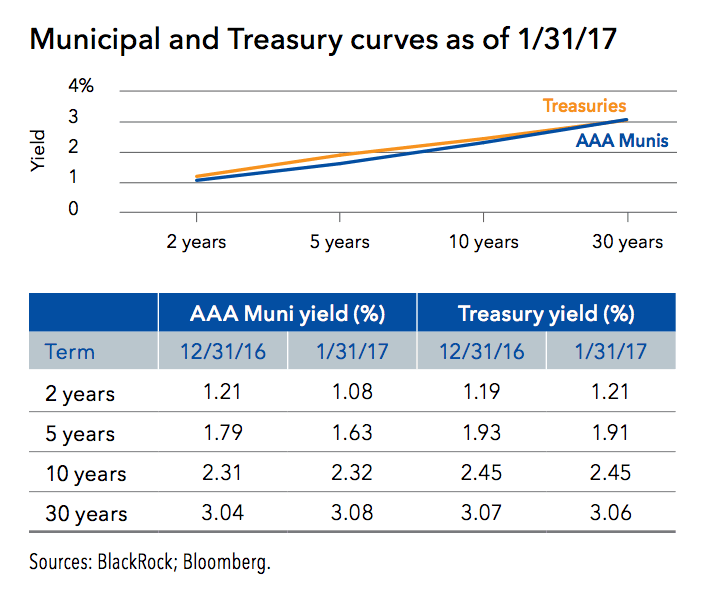
Lower individual tax rates would reduce the value of tax-exempt mutual fund income. However, the tax equivalent yield (TEY) of municipal bonds would likely remain higher than that of Treasuries. The calculation is straightforward. For example, at a 28% marginal tax rate, if a municipal bond earned 2%, that would be a tax-equivialent yield of 2/(1-0.28) = 2.78%. Here’s the chart from Blackrock:

muni1702_br

It is highly unlikely that the tax-exempt status of municipal bonds will be removed. State and local government need low-cost muni bonds to finance improvements in infrastructure. It is possible that the tax-exemption could be capped, but even in that case the market impact would be manageable.

Here’s the ratio of AAA-rated GO Muni bonds to Treasuries over the last 12 months (Source). As you can see, the ratio hovers around 90% to 95% without compensating for taxes.

muni1702_ratio

Here is a chart of the muni and Treasury bond curves as of 1/31/17:

muni1702_br2

Their overall conclusion:

We also expect any market correction required to overcome a drop in the highest tax rate or cap on the tax-exemption would be manageable, and continue to believe munis hold an important place in a diversified portfolio.

Purely my opinion… I don’t bother speculating on future tax reform. I’m not an economist, so I can admit that I don’t know the future. I do know that even in the 25% or 28% marginal tax brackets, right now the tax-equivalent yields of muni bonds are higher than Treasuries by a significant gap. At higher marginal tax brackets, the gap widens further (again, see top chart above).

Municipal bonds are not considered as safe as US Treasuries, and smart people can argue as to how close the risk levels are. I personally think the yield gap is greater than the risk gap, enough that I’d rather be in munis, but others may disagree. Why would this happen in a mostly “efficient” market? My personal view is that the entire world (including entire countries and sovereign funds) relies on US Treasuries as their “safe and liquid” asset, pushing yields downward, while the benefits of muni bonds are only available mostly to US individual taxpayers.

Sometimes I think I should just buy a “total bond” fund (tracks all taxable, nominal US investment grade bonds) and forget about it. But then I look at the yield difference. As of today 2/21/17, Vanguard Total Bond Index has an average duration of 6.1 years and 2.50% yield. Vanguard Intermediate Tax-Exempt has an average duration of 5.2 years and 2.07% yield (tax-exempt). At 28% federal tax rate, that is equivalent to 2.88% taxable. At 43.4%, that is equivalent to 3.65% taxable. (These numbers are for Investor Shares; the gap is even bigger if you have $50,000 and can buy Admiral Shares.) Add in the fact that I have limited space in tax-deferred IRAs and 401(k) accounts, and all this is why I pick munis for my taxable accounts.

Understanding the Risks and Downsides of Bonds

pie_flat_blank_200To get the full return of any asset class, you’ll have to own it through the good times and the bad times. The good times are easy, but getting through the bad times requires deeper understanding and faith. You’ll usually hear this about holding stocks through their inevitable drops and crashes. But recently, many bond funds have dropped in value instead. Here’s a somewhat-reassuring chart from A Wealth of Common Sense comparing historical drawdowns between the S&P 500 stock index and 5-Year US Treasury bonds:

bondsrisks2

Even so, having an investment that is supposed to be “safe” wobble 5% can still be worrisome. If Bank of America or Chase Bank announced tomorrow that their customers with balances above FDIC limits would lose even 1% of their excess deposits, there would be a huge crisis due to the perceived level of safety. A recent post by Longboard Funds makes an interesting claim: “…investors destroy more of their bond returns than their stock returns.”

This statement reminded of my surprise when reading this Bogleheads forum post on 11/14/16:

Bonds have been dropping every day [recently…]
Why? I thought they were a stable fixed investment.

S/he wasn’t alone, and I received a couple of similar e-mails, but I was struck that this person had been a member of the forum for over 2 years, made over 600 posts, and had previously detailed their asset allocation very specifically: “Brokerage account 65/35 | VG total Market 35% | VG total Intl 12% | VG small cap value 12% | VG Reit index 6% | VG Total Bond 35% | TSP Account 75/25 | C Fund 45%, S 15%, I 15%, G 25% | EE Bonds = Emergency Fund” Why did they buy all these things? No doubt from reading a lot of well-meaning advice from well-meaning people.

Bonds can certainly go down. There are also many different types of bonds. Longboard Funds put the two major risks of bonds into a nice graphic:

bondsrisks

This won’t be a bonds primer, but instead I offer up how I try to treat bonds as part of my investment portfolio:

  • I own bonds as a ballast and diversification element in my portfolio. (I also own stocks for inflation-beating growth.) I want relatively low volatility, but there will still be some based on credit and duration risk. I will take a little bit of each type of risk, but not too much.
  • I also own bonds for modest income. I will be satisfied earning only modest interest rates that will roughly match inflation over the long run, and be happy if I earn 1% or 2% more than inflation.
  • In order to take on a small amount of credit risk, I will stick to US Treasury bonds, investment-grade corporate bonds, and investment-grade municipal bonds.
  • In order to take on a small amount of interest rate (duration) risk, I will stick to bond mutual funds with a relatively short duration (less than 5 years). The term “intermediate” could mean anything from 2 years to 10 years, so I’ll have to be careful. As a result, I will be less-exposed to short-term losses if interest rates rise quickly.
  • In order to reduce the risk of any single bond default, I will own a large number of bonds inside a mutual fund or ETF. An exception would be individual US Treasury bonds as they all share the same, highest credit quality available.

Someone else may want to pursue higher bond returns and be willing to take on more risk. You could buy bonds from countries with shakier credit ratings. You could buy bonds from riskier companies. You could buy bonds with longer duration/maturities.

If you look again at that top chart, you can see several drawdowns of around 5% for a 5-Year Treasury. But what about a 20-Year Treasury, or 5-Year Junk Bonds, or international bonds from Argentina or Venezuela? It’s possible for some bond funds to drop 10% or more. If you are buying bonds because you think they are safe, stick to the safer bonds and realize that even they might still drop in price for a while.

Most Individual Stocks Don’t Outperform Cash?

A new academic paper was recently published with a confusing yet provocative title: Do Stocks Outperform Treasury Bills?. Of course they do… right? An excerpt from the abstract:

Most common stocks do not outperform Treasury Bills. Fifty eight percent of common stocks have holding period returns less than those on one-month Treasuries over their full lifetimes on CRSP. […]

But everyone knows stocks return more than cash. How does this work? Taken altogether, stocks outperform cash. But if you picked any individual company, your results can vary from total bankruptcy to extraordinary wealth. The paper found that if you pick an individual company and held it over its lifetime, it would be more likely than not to underperform a 4-week T-Bill (classified as a cash equivalent). You can use the T-Bill as an approximate tracker of inflation.

Wes Gray points out at Alpha Architect that this idea has been explored before. Here’s a chart of the distribution of total lifetime returns for individual U.S. stocks. The research is done by Blackstar Funds, via Mebane Faber at Ivy Portfolio.

captialdist

The U-shaped distribution shows that there are a lot of big losers and a lot of big winners. Actually some are huge winners. In the end, a small minority of stocks have been responsible for virtually all the market’s gains.

captialdist2

Here we see that out of the 26,000 stocks studied, these 10 stocks below have accounted for 1/6th of all the wealth ever created in the US stock market.

captialdist3

I should reiterate that these are lifetime returns, from when they appeared in the CRSP database until now or whenever they liquidated. Unless you bought these stocks essentially at IPO (or 1926 when the database starts), you probably didn’t get these returns. If you go out and buy a well-established company today, your distribution of returns will likely look different. You’d be less likely to go bankrupt but also less likely to make a 20,000% return.

If you take a step back, as Larry Swedroe points out, this means it is technically quite easy to outperform an index fund. You simply either (1) avoid investing in a few big losers or (2) invest extra in a few big winners. That’s it! Gotta be easy to filter out a few duds, right? Yet, the lack of outperformance on average by professional managers continues, and the managers that outperform can’t be predicted ahead of time. So you can keep looking for the needles in the haystack, or you can buy the whole haystack.

Betterment Now Offers Human Advice + Flat Fee Structure

betterment_logoThe robo-advisor evolution continues. Betterment just announced some significant changes that include the option to upgrade to a Certified Financial Planner (CFP®) and a more simplified flat fee structure. Here are highlights from the new plans:

  • Betterment Digital. Their original product with digital portfolio management and guidance. Now at a flat 0.25% annually (no more tiers). No minimum balance. There is no longer be a $3/month fee if you don’t make monthly auto-deposits. The management fee on any assets over $2 million is waived.
  • Betterment Plus. Digital features above + an annual planning call from a “team of CFP® professionals and licensed financial experts who monitor accounts throughout the year.” You will also have unlimited e-mail access. The plan is a flat 0.40% annually. $100,000 minimum balance required.
  • Betterment Premium. Digital features above + unlimited phone access to a “team of CFP® professionals and licensed financial experts who monitor accounts throughout the year.” You will also have unlimited e-mail access. The plan is a flat 0.50% annually. $250,000 minimum balance required.

Betterment’s previous fee structure for Digital was 0.35% for balances under $10,000 with $100/mo auto-deposit (or a flat $3 a month without), 0.25% for balances of $10,000 to $100,000, and 0.15% for balances above $100,000. This means that with the new flat 0.25% fee structure, people with balances under $10k will end up paying less while those with $100k+ will be paying more. If I had a big balance at Betterment, I’d be quite unhappy with the price hike. Existing customers on the 0.15% tier will stay on that fee structure until June 1st, 2017.

Here’s how this breaks down in terms of your account size:

  • $10,000 account balance. Digital would cost just $25 a year ($2.08 a month). There is no longer any requirement for auto-deposit to avoid a $3 a month fee. Plus or Premium not available.
  • $50,000 account balance. Digital would cost $125 a year ($10.41 a month. There is no longer any requirement for auto-deposit to avoid a $3 a month fee. Plus or Premium not available.
  • $100,000 account balance. Digital would cost $250 a year ($20.83 a month). Plus would cost $400 a year ($33.33 a month) and include an annual planning call with a human advisor. Premium not available.
  • $250,000 account balance. Digital would cost $625 a year ($52.08 a month). Plus would cost $1,000 a year ($83.33 a month) and include an annual planning call with a human advisor. Premium would cost $1,250 a year ($104.17 a month) and include unlimited calls to a human advisor.

Commentary. I don’t write about robo-advisors all that often, but Betterment adding human advisors as an upgrade option signals a big change in the industry. For the investors with modest balances, the flat fee is cheaper but it has always been pretty cheap; at $50k in assets it costs the same as a Netflix subscription. Perhaps more important is knowing that as you continue to grow assets, a human advisor will become available without having to move your money elsewhere.

For those with at least $100k in assets, the upgrade cost to talk to a human advisor annually appears reasonable ($150 a year more at $100k asset level). You also get unlimited e-mail interaction for quick questions. If you go to an independent CFP and request a one-time consultation, that will usually cost a $400 to $500 flat fee. Potential concerns include that you don’t get a dedicated person but a team. However, in my experience even if you get assigned a dedicated person, they’ve often moved onto another job within a year. The wording also suggests that the pool of advisors are not all CFPs.

This move signifies both the good and bad about the current robo-advisor environment. The good is that they keep evolving and looking for ways to improve (i.e. index replication, tax-sensitive asset location, tax loss harvesting). The bad is that these can involve big changes with little notice (i.e. portfolio tweaks, fee changes). This time, the good is now you have the option to pay more for human advice. The bad is that if you already had a lot of money with Betterment, your fees got hiked by 10 basis points. This is why I prefer to DIY, because I enjoy being in control.

That said, if I had to switch I would prefer human access for estate-planning purposes (Mrs. MMB doesn’t want to manage our portfolio). Betterment says they have an advantage because they are independent. For comparison, I would look into Vanguard Personal Advisor Services (VPAS) which costs 0.30% annually and includes a team of human advisors. Possible drawbacks of VPAS include no automated tax-loss harvesting and you’ll be confined to Vanguard products.

Howark Marks Oaktree Memo: NFL Bettor’s Guide vs. Coin Flip

silver_eagleHoward Marks released another Oaktree memo earlier this month that somewhat coincides with this weekend’s Super Bowl. Inside, he revisited the New York Post NFL Bettor’s Guide, a panel of “experts” offering their opinion of winning picks for each NFL game during the season. The picks are relative to the point spread offered by the bookmakers. The experts further specify up to three “best bets” each week.

Here were the results after the 2015 NFL Season (from last year’s memo):

nflbet1

Here were the overall results after the 2016 NFL Season:

  • The best picker was right 55.1% of the time.
  • The worst picker was right 48.8% of the time.
  • On average the pickers were right 51.6% of the time.

In terms of the “best bets” only:

  • The best picker was right 62.7% of the time.
  • The worst picker was right 43.1% of the time.
  • On average the pickers were right 54.0% of the time.

Here’s my take on the observations in the memo:

All results cluster closely around 50/50. A blindfolded squirrel (or me flipping a coin) could easily blend in with this panel of “experts”. Some do a bit better than 50/50 (but not much better), while others do a bit worse (but not much worse). This is exactly what the distribution of a high number of coin tosses looks like. It’s very hard to consistently beat the point spread created by the “market” consisting of other bettors.

Don’t forget the vigorish. When you place a bet with a sports book, they charge a fee (“the vig”) for their services. For example, you may have to bet $110 to win $100. That translates to a roughly 5% commission on each bet. Even if you were right on average 54% of the time, you would still lose money in the long run after fees.

These are results from people who are paid to observe, analyze, and write about football games. Yet their performance could be mostly explained by luck, and even any slight outperformance on average is more than negated by fees.

In terms of investing, there are also many “experts” willing to offer their opinion on winning stock picks or other financial forecasts. Most will be average, or perhaps even slightly above average. However, history (and common sense math) shows that their performance won’t be good enough to offset the higher fees that they charge. In addition, there is no surefire way to find these above-average pickers ahead of time (using past performance doesn’t work). Due the presence of such fees, you can guarantee yourself “above average” net results by simply buying low-cost index funds.

I’m not one of those people that completely dismiss the possibility of skill in investing, but you if do want to go that route you should be realistic. If you’re picking your own stocks, keep an honest tab on your performance. If a mutual fund is charging 1.5% annually today to actively manage US stocks, it is rather unlikely that it will outperform a low-cost US stock index fund in the long term. On the other hand, an actively managed mutual fund that charges 0.15% annually and has various other positive factors has a more reasonable chance of slight outperformance. However, at the same time you must also accept the possibility of slight underperformance.

The Jack Bogle Appreciation Curve

commonsenseJack Bogle is rightfully respected and there are probably over a hundred mentions of his name on this site. His message of common sense, simple, low-cost investing continues to spread since he first opened the Vanguard 500 Index fund to the public in 1975. Yet, he still has to keep pounding his drum because there is so much other noise out there. Similar to the sketches of NYT journalist Carl Richards, I present to you what I call the Bogle Appreciation Curve.

boglecurve

The overall shape of this curve can probably be applied to any field where there are classic fundamentals and then a bunch of fancy stuff on top. It definitely applies to investing, where there is an insatiable desire for something newer, better, and more complex.

Beginner Investor. You’re just starting out, and you read some recommended business books. There’s the classic Bogle on Mutual Funds and the much shorter one called The Little Book of Common Sense Investing (which you picked) by Bogle that really made sense and sounded reasonable. You see why low-costs and passive investing are based on common sense and basic mathematics. You understand why you should avoid high-cost, high-turnover funds sold by brokers.

Investor Who “Knows Things”. You read more about investing, learning about correlations and factors and portfolio optimization. This stuff is pretty interesting! Historically, if I bought a nice slug of “small-cap value” stocks, a bit of commodities, a sprinkle of gold, I would have higher returns with less volatility? I’d do even better with a momentum-following strategy, and now there is a smart beta ETF that will do it for me? It seems so easy to do better than a “vanilla” portfolio.

Jack Bogle says “smart beta is dumb”. Hmm, maybe he’s just not with the modern times anymore.

Older, Humbled Investor. Well, that was exhausting. The historically optimal portfolio in 1990 wasn’t the same as the historically optimal portfolio in 2000, and that was again true in 2010 and will be again in 2020. I missed out on part of the 2008-2016 surge because people told me the market was overvalued due to CAPE and PE10 and many other metrics. If I had just stayed the course through it all, I’d have done pretty good. I think someone told me to keep it simple. Who was it? Oh yeah, Jack Bogle. I need to re-read his books.

You can also keep up with John C. Bogle’s media appearances on his personal website. The updates serve as a nice, regular dose of Bogle wisdom.