Fundrise eREIT Quarterly Liquidity Details and Redemption Process

fundrise_logo

I’ve been putting some side money into crowdfunded real-estate investments – see here and here – and I have decided to test out the quarterly liquidity window of my Fundrise eREIT investment (review). An important difference between most of these private real estate investments and publicly-listed REIT is liquidity. On most any given weekday, I can sell my public REIT (i.e. VNQ) for a price that an open market deems fair and within few days I will have cash in hand.

The Fundrise Income eREITs are private REITs that take advantage of new crowdfunding regulations open to all investors (not just accredited investors). The intended time horizon of this investment at least 5 years, but they also advertise “quarterly liquidity” as a feature (see below). I was interested to see how this feature worked, as many of the other asset-backed loans in which I am invested could take a year or longer to get my money back. I decided to test out this “emergency hatch”.

fundrise_ereit1

The rules. You are allowed to make a redemption request once per quarter. For the full details on Fundrise quarterly redemption plans, please see the section of each eREIT Offering Circular titled, “Description of Our Common Shares—Quarterly Redemption Plan” at this link. It’s pretty dense, and I will only highlight this table which includes the “early withdrawal penalty” imposed if you redeem your shares within 5 years.

fundrise_redeem

In other words, if I redeem now after one year, I will pay a 3% penalty on the current net asset value (NAV). The NAV itself is a complex calculation of the underlying assets that I believe is only updated to investors once a quarter.

Note that you are not guaranteed to have liquidity of all your shares. If too many shareholders request liquidity at the same time, that might force them to sell assets at large discounts and harm other shareholders. Here is an excerpt from the Offering Circular:

Q: Will there be any limits on my ability to redeem my shares?

A: Yes. While we designed our redemption plan to allow shareholders to request redemptions on a quarterly basis, we need to impose limitations on the total amount of net redemptions per calendar quarter in order to maintain sufficient sources of liquidity to satisfy redemption requests without impacting our ability to invest in commercial real estate assets and maximize investor returns.
In the event our Manager determines, in its sole discretion, that we do not have sufficient funds available to redeem all of the common shares for which redemption requests have been submitted in any given month or calendar quarter, as applicable, such pending requests will be honored on a pro rata basis. […]

Redemption Process. The process of requesting a quarterly redemption was straightforward. Here’s a step-by-step rundown:

  • Contact Fundrise support and request a redemption (3/6 in my case). You need to make this request at least 15 days prior to the end of the applicable quarter.
  • They asked the reason for my redemption, and I told them. You don’t need to supply a reason, they just wanted feedback.
  • They sent over the official redemption form, which I was able to read and complete online. I received an e-mail confirmation of my redemption request.
  • At the end of the quarter (3/31 in my case), I received another e-mail confirmation that my redemption request was processed.
  • 12 days after the end of the quarter (4/12 in my case), I received another e-mail confirmation that the funds were being transferred to my bank account.

Complete Investment Timeline. Here’s a summary of cashflows from beginning to end.

  • December 29, 2015. Invested $2,000 into Fundrise Income eREIT (200 shares x $10 a share).
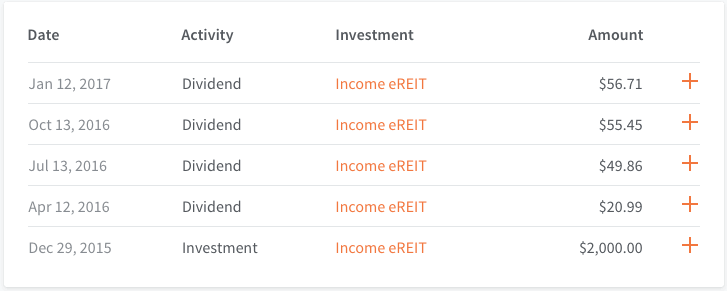
  • Held for 15 months. Received 5 quarterly income distributions on a timely basis in April, July, October 2016 and January, April 2017. Total of $234.79.
  • Early March 2017. Requested redemption of all 200 shares as of the end of quarter 3/31/17.
  • April 12, 2017. Received $1,908 in principal back. 100% of NAV would have been $1967.

Screenshot:

fundrise_final

So I invested $2,000 and after 471 days I collected a total of $2,142.79 for a total gain of 7.14%. The annualized return works out to 5.49%. That’s not amazing but not bad considering that I am bailing out of a 5+ year investment after only a year. I’m confident that my returns would have been better if I waited out the full 5 years as real estate ownership investments take time to work out. (Traditional non-traded REITs are infamous for having huge penalties for early withdrawals where you get back less than 90 cents on the dollar.)

Hopefully this post answers some questions about the liquidity of Fundrise eREITs. I received my money, as requested, in about a month. If instant/daily liquidity is important to you, I would still stick with publicly-traded REITs.

Bottom line. The Fundrise Income eREITs are meant as long-term investments with time horizons of at least 5 years. However, they advertise the availability of limited quarterly liquidity. I tested out this liquidity feature and was able to cash out subject to a 3% discount from net asset value. It worked as promised, howewer I would not recommend using this option unless necessary as it will impair your overall return. Fundrise does warn you that in an extreme event with depressed prices, this liquidity window may be closed for the benefit of long-term investors. You can sign-up and learn about currently-available Fundrise eREITs here.
Buy, Hold, Rebalance a Globally-Diversified Portfolio 2017

When I think about it, I am impressed with how different 2017 feels compared to when I started seriously learning about investing in 2003. Instead of only reading about it in few books mostly read by finance nerds, nowadays nearly every robo-advisor out there uses a globally-diversified mix of low-cost ETFs to build their portfolios. What used to be a relatively quiet alternative to buying 4-star active funds is now becoming the default choice.

We’ve seen from the Callan Investment Returns Table that the best-performing asset classes constantly change from year to year. In a industry magazine called Investments & Wealth Monitor, there was an article titled Why Global Asset Allocation Still Makes Sense by Anthony Davidow. (Found via AllAboutAlpha.)

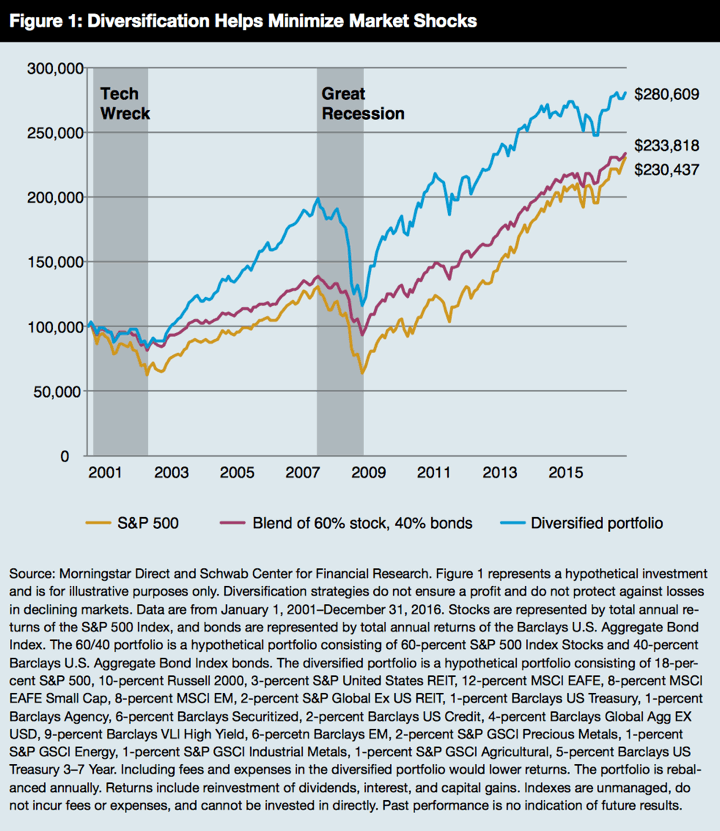
Here’s an illustration of how a globally-diversified portfolio has outperformed. Below is a graphic from the article comparing a 100% S&P 500 portfolio, and 60/40 S&P 500/US Agg Bond portfolio, and a “globally diversified portfolio” using historical data from January 1, 2001 to December 31, 2016. Index values are used directly as opposed to actual ETFs or funds. The portfolio are rebalanced annually back to target asset allocation.

globaldiv

Their “diversified portfolio” had a rather finely-diced list of asset class ingredients:

  • 18% S&P 500 (US Large-Cap)
  • 10% Russell 2000 (US Small-Cap)
  • 3% S&P US REIT
  • 12% MSCI EAFE (International Developed)
  • 8% MSCI EAFE Small Cap
  • 8% MSCI Emerging Markets
  • 2% S&P Global Ex US REIT
  • 1% Barclays US Treasury
  • 1% Barclays Agency
  • 6% Barclays Securitized
  • 2% Barclays US Credit
  • 4% Barclays Global Agg EX USD
  • 9% Barclays VLI High Yield
  • 6% Barclays EM
  • 2% S&P GSCI Precious Metals
  • 1% S&P GSCI Energy
  • 1% S&P GSCI Industrial Metals
  • 1% S&P GSCI Agricultural
  • 5% Barclays US Treasury 3–7 Year

I do wish this portfolio was a bit more simple and easy to replicate. However, if you take a step back, you could simplify this asset allocation into the following:

  • 56% Global Stocks (50% US/50% Non-US)
  • 5% Global REIT (60% US/40% Non-US)
  • 34% Global Bonds (70% US/30% Non-US)
  • 5% Commodities

Now, we can’t necessarily expect a global portfolio to always outperform. One thing is usually doing better than another thing you own. Most recently, US stocks have outperformed International stocks quite significantly. Here’s an explanation from the article about the “free lunch” of diversification:

Diversification strategies do not guarantee capture of profits or protection against losses in any market environment, but they have been shown over time to provide a smoother ride. Rather than bearing the brunt of the 2000 Tech Wreck and the 2008 Great Recession, the diversified portfolio provided cushioning under the large market drop and was able recoup losses and grow over time.

Callan Investment Returns Ranked by Asset Class 1997-2017

callan2016clipWe’ve all been told that past performance is no guarantee of future returns, but it’s still hard to buy an investment that has been performing poorly. We need to remember the historical power of diversification and that even though something may look horrible now, good news may be just around the corner.

Callan Associates updates a “periodic table” annually with the relative performance of 8 major asset classes over the last 20 years. You can find the most recent one at their website Callan.com, with access to previous versions requiring free registration.

Every calendar year, the best performing asset class is listed at the top, and it sorts downward until you have the worst performing asset. Here is the most recent snapshot of 1997-2016:

callan2016

The Callan Periodic Table of Investment Returns conveys the strong case for diversification across asset classes (stocks vs. bonds), investment styles (growth vs. value), capitalizations (large vs. small), and equity markets (U.S. vs. non-U.S.). The Table highlights the uncertainty inherent in all capital markets. Rankings change every year. Also noteworthy is the difference between absolute and relative performance, as returns for the top-performing asset class span a wide range over the past 20 years.

I find it easiest to focus on a specific color (asset class) and then visually noting how its relative performance bounces around. This year, I note that Emerging Markets (Orange) tends to either run really hot or cold. For the past 4 years, Emerging Markets has been near the bottom. MSCI EAFE (Developed Foreign Stocks, Light Grey) have also been doing relatively poorly. I still hold them as they will one day bounce back to the top.

Early Retirement Portfolio Income, 2017 Q1 Update

dividendmono225

While I understand the arguments for a “total return” approach, I also appreciate the behavioral reasons why living off income while keeping your ownership stake is desirable. The analogy I fall back on is owning an investment property that produces rental income. If you are reliably getting rent checks that increase with inflation, you can sit back calmly and let the market value fluctuate. The problem is that buy only things with the highest yields only increases the chance that those yields will drop. Therefore, I am trying to reach some sort of balance between the two approaches.

A quick and dirty way to see how much income (dividends and interest) your portfolio is generating is to take the “TTM Yield” or “12 Mo. Yield” from Morningstar (linked below). Trailing 12 Month Yield is the sum of a fund’s total trailing 12-month interest and dividend payments divided by the last month’s ending share price (NAV) plus any capital gains distributed over the same period. SEC yield is another alternative, but I like TTM because it is based on actual distributions (SEC vs. TTM yield article).

Below is a close approximation of my most recent portfolio update. I have changed my asset allocation slightly to 65% stocks and 35% bonds because I believe that will be my permanent allocation upon early retirement.

Asset Class / Fund % of Portfolio Trailing 12-Month Yield (Taken 4/19/17) Yield Contribution
US Total Stock
Vanguard Total Stock Market Fund (VTI, VTSAX)
25% 1.88% 0.47%
US Small Value
Vanguard Small-Cap Value ETF (VBR)
5% 1.83% 0.09%
International Total Stock
Vanguard Total International Stock Market Fund (VXUS, VTIAX)
25% 2.75% 0.69%
Emerging Markets
Vanguard Emerging Markets ETF (VWO)
5% 2.31% 0.12%
US Real Estate
Vanguard REIT Index Fund (VNQ, VGSLX)
6% 4.42% 0.27%
Intermediate-Term High Quality Bonds
Vanguard Intermediate-Term Tax-Exempt Fund (VWIUX)
17% 2.87% 0.49%
Inflation-Linked Treasury Bonds
Vanguard Inflation-Protected Securities Fund (VAIPX)
17% 2.20% 0.37%
Totals 100% 2.50%


The total weighted 12-month yield on this portfolio has historically varied between 2% and 2.5%. This time, it was on the higher end of 2.50% mostly because inflation has picked up and thus the TIPS fund started to yield more. If I had a $1,000,000 portfolio balance today, a 2.5% yield means that it would have generated $25,000 in interest and dividends over the last 12 months. (The muni bond interest in my portfolio is exempt from federal income taxes.)

For comparison, the Vanguard LifeStrategy Moderate Growth Fund (VSMGX) is a low-cost, passive 60/40 fund that has a trailing 12-month yield of 2.12%. The Vanguard Wellington Fund is a low-cost active 65/35 fund that has a trailing 12-month yield of 2.55%. Numbers taken 4/19/2017.

These income yield numbers are significantly lower than the 4% withdrawal rate often quoted for 65-year-old retirees with 30-year spending horizons, and is even lower than the 3% withdrawal rate that I usually use as a rough benchmark. If I use 3%, my theoretical income would cover my projected annual expenses. If I used the actual numbers above, I am close but still short. Most people won’t want to use this number because it is a very small number. However, I like it for the following reasons:

  • Tracking dividends and interest income is less stressful than tracking market price movements.
  • Dividend yields adjust roughly for stock market valuations (if prices are high, dividend yield is probably down).
  • Bond yields adjust roughly for interest rates (low interest rates now, probably low bond returns in future).
  • With 2/3rds of my portfolio in stocks, I have confidence that over time the income will increase with inflation.

I will admit that planning on spending only 2% is most likely too conservative. Consider that if all your portfolio did was keep up with inflation each year (0% real returns), you could still spend 2% a year for 50 years. But as an aspiring early retiree with hopefully 40+ years ahead of me, I like having safe numbers given the volatility of stock returns and the associated sequence of returns risk.

Early Retirement Portfolio Asset Allocation, 2017 First Quarter Update

portpie_blank200

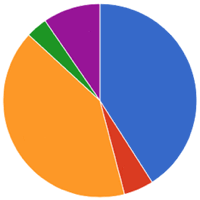
Here is an update on my investment portfolio holdings after the first quarter 2017. This includes tax-deferred accounts like 401ks, IRAs, and taxable brokerage holdings, but excludes things like our primary home, cash reserves, and a few other side investments. The purpose of this portfolio is to create enough income to cover our regular household expenses.

Target Asset Allocation

The overall goal is to include asset classes that will provide long-term returns above inflation, distribute income via dividends and interest, and finally offer some historical tendencies to balance each other out. I don’t hold commodities futures or gold as they don’t provide any income and I don’t believe they’ll outpace inflation significantly. I also believe that it is more important to have asset classes that you are confident you’ll hold through the bad times, as opposed to whatever has been doing well recently. The things that looked promising in 2000 were not the things that looked promising in 2010, and so on.

Stocks Breakdown

  • 38% US Total Market
  • 7% US Small-Cap Value
  • 38% International Total Market
  • 7% Emerging Markets
  • 10% US Real Estate (REIT)

Bonds Breakdown

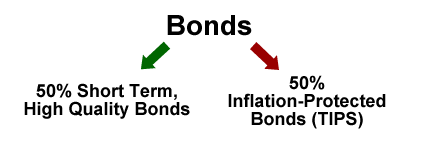
  • 50% High-quality, intermediate-Term Bonds
  • 50% US Treasury Inflation-Protected Bonds

Our current target ratio is 70% stocks and 30% bonds within our investment strategy of buy, hold, and rebalance. With a self-managed, simple portfolio of low-cost funds, we minimize management fees, commissions, and income taxes.

Actual Asset Allocation and Holdings

aa_port1704

Stock Holdings
Vanguard Total Stock Market Fund (VTI, VTSMX, VTSAX)
Vanguard Total International Stock Market Fund (VXUS, VGTSX, VTIAX)
WisdomTree SmallCap Dividend ETF (DES)
Vanguard Small Value ETF (VBR)
Vanguard Emerging Markets ETF (VWO)
Vanguard REIT Index Fund (VNQ, VGSIX, VGSLX)

Bond Holdings
Vanguard Limited-Term Tax-Exempt Fund (VMLTX, VMLUX)
Vanguard Intermediate-Term Tax-Exempt Fund (VWITX, VWIUX)
Vanguard High-Yield Tax-Exempt Fund (VWAHX, VWALX)
Vanguard Inflation-Protected Securities Fund (VIPSX, VAIPX)
iShares Barclays TIPS Bond ETF (TIP)
Individual TIPS securities
U.S. Savings Bonds (Series I)

Commentary

In regards to my target asset allocation, I tweaked the stock percentages slightly so that I will end up with at least 5% overall in any given asset class when I reach my final ratio of roughly 65% stocks and 35% bonds in the next few years. Despite the recent outperformance of US stocks vs. the rest of the word, I am still keeping my 50/50 split between US and International holdings.

In regards to specific holdings, I did some tax-loss harvesting between my Emerging Markets and US Small Cap ETF holdings. I am also shifting towards dropping my WisdomTree ETFs and going to the more “vanilla” Vanguard versions: Vanguard Small Value ETF (VBR) and Vanguard Emerging Markets ETF (VWO). This should lower costs and increase simplicity. Otherwise, there has been little activity besides continued dollar-cost-averaging with monthly income.

I’m still somewhat underweight in TIPS and REITs mostly due to limited tax-deferred space as I really don’t want to hold them in a taxable account. My taxable muni bonds are split roughly evenly between the three Vanguard muni funds with an average duration of 4.5 years. I may start switching back to US Treasuries if my income tax rate changes signficantly.

A rough benchmark for my portfolio is 50% Vanguard LifeStrategy Growth Fund (VASGX) and 50% Vanguard LifeStrategy Moderate Growth Fund (VSMGX), one is 60/40 and one is 80/20 so it also works out to 70% stocks and 30% bonds. That benchmark would have a total return of +7.73% for 2016 and +4.96% YTD (as of 4/17/17).

So this is what I own, and in a separate post I’ll share about how I track if I have enough to retire via dividend and interest income.

Simple Portfolio Rebalancing Spreadsheet Template (Google Drive)

gsheetsUpdated. Automated portfolio management services like Wealthfront and Betterment will help you manage a diversified portfolio of low-cost index funds for a fee. While I understand their appeal for those that wish to outsource that task, I choose to maintain my own diversified portfolio of low-cost index funds. I enjoy having full control of all investment decisions, and I like saving the management fee (and adding that money to my snowball).
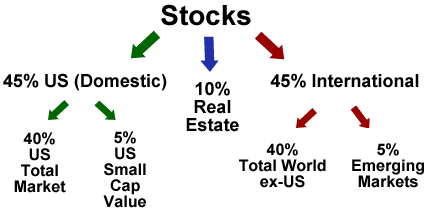
An important part of this DIY portfolio management is staying close to your target asset allocation. I use a very simple Google Spreadsheet to track my portfolio. Here is the direct link and it is also embedded below. Yellow cells are those meant to be edited.

(Download a free copy: I am sharing this spreadsheet online – free of charge – in read-only format. However, please make a copy of it using the menu option File > Make a copy or download it as an Excel file using option File > Download as). Any requests for edit access to the original public spreadsheet will be denied, because you would be changing the appearance for everyone.)


Here are some guidance on how to use the spreadsheet:

1. Decide on a target asset allocation. Don’t use the generic one I put above. There is no perfect portfolio. You can find plenty that look great based on history at this moment, but that will not be the perfect portfolio 5, 10, 25 years down the line. The best portfolio is the one that you can stick through even after your fanciest asset classes have negative returns for 5+ years.

Here are a few model portfolios to get you started. Below is what I have settled on for myself. Details here. You only have to enter this once as long as your target asset allocation stays the same.

2. Enter your total balances for each asset class. The easiest way to grab my holdings from multiple brokerage accounts is to use a aggregation service like Personal Capital (review). If you don’t have that many accounts, simply log into each individual website and add up your totals by asset class.

You could solely rely upon a service like Personal Capital to manage your portfolio, but I tend to use some specific asset classes like “US Small Value” or “Emerging Markets Value” which Personal Capital does not recognize. I do enjoy the fact that it pulls in all of my holdings and balances automatically into one screen and is always updated.

3. Check out the actual breakdown vs. your target breakdown. The spreadsheet shows the current actual percentage breakdown vs. your target breakdown, as well as the dollar amounts of any differences. A positive number means you need to buy more to reach your theoretical target (negative means sell). In the fictitious example shown, I might feel that I was close enough that I wouldn’t really bother with any rebalancing. If things were really off, I could buy/sell as needed.

3. Rebalance with new cashflow, dividends, and interest. Choose your frequency of “forced” rebalancing. By using this spreadsheet, you can see which asset classes should be invested in currently to bring you back towards your target asset allocation. This is where you should invest any new cashflow (i.e. paycheck, dividends, rental income, or interest that your portfolio generates).

In addition, you can rebalance by selling some asset classes and then buying another. I try not to sell too often as to avoid capital gains taxes. You can do this on a set calendar basis such as annually on your birthday or quarterly. Another method is to only rebalance once your percentages are off by a certain amount, like a tolerance band of +/- 5%. I personally check in quarterly to see where I should invest any new cashflows, and if things are really off then I rebalance by selling something at most once a year. If you have sizable taxable holding, you could also attempt some tax-loss harvesting during these check-ins.

Recap. If you are managing your own portfolio, it is important not to stray too far from your target asset allocation. In order to know where you should invest new funds, I track my portfolio in two ways. First, I use Personal Capital for a real-time, daily snapshot of my holdings. Second, I manually update this spreadsheet each quarter and print out a copy for my permanent, physical records. This takes about 15 minutes every 3 months. Using these two methods, I maintain complete control over my portfolio and I don’t have to pay any management fees to a robo-advisor.

S&P 500 Histogram: Annual Returns Are Negative 1/3rd Of The Time

prepyourAs we stand today in early 2017, the performance of the US stock market since 2009 has been pretty impressive with only a few minor hiccups. I am not calling a market drop, but the best time to prepare is before an emergency or crisis occurs. Humans have a well-documented loss-aversion bias. We react to losing money much more severely than positive returns. Therefore, it is wise to remember that historically, the annual return of the S&P 500 index is negative approximately 1 out of every 3 years.
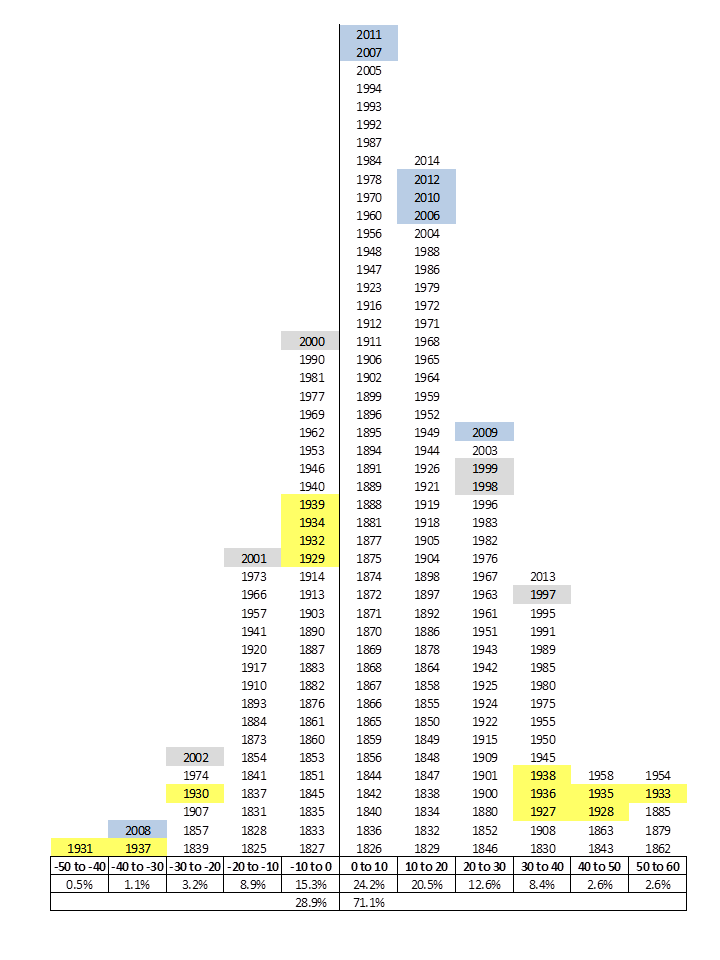
Here’s a histogram that organizes into “buckets” the historical annual returns of the S&P 500 Index* from 1825-2014. We see that negative returns occurred 29% of the time. Legend: DotCom bubble (grey), Great Depression (yellow), Housing bubble (blue). Source: Margin of Safety.

sp500_hist2014

(* For periods before the S&P 500 existed, the S&P Market Index is used. Before that, I have no idea!)

Here’s a similar chart that shows the annual percentage change of the S&P 500 index from 1927-2016. I counted that 28 out of 89 periods were negative (31.4%). Source: Macrotrends.

sp500_returndist

We should expect and accept that negative returns will come 1/3rd of the time. The drops are part of the package. Just like having a hurricane, tornado, or earthquake preparedness plan, you should have a market drop plan. Do you have a cash cushion so you don’t feel the need to sell temporarily-depressed shares? Do you have a high-quality bond or cash allocation that you can use to rebalance and buy even more stocks when they reach lower valuations?

The Full Spectrum of Financial Advisors

spectrum2Do you recommend Wealthfront? Betterment? WiseBanyan? Schwab Intelligent Portfolios? Vanguard Personal Advisor Services? The upstarts like to bash on the competition, making it seem like they are your digital savior while everyone else is evil. The truth is that they are more similar than different.

Morgen Beck Rochard of Origin Wealth Advisors recently created the helpful infographic below on the wide range of possibilities you can get when you hire a “financial advisor”. Found via The Big Picture. Click for full source image.

advisor_spectrum720

What does it mean? The term “financial advisor” tells you nearly nothing about:

  • Their level of training or years of experience.
  • The type of investment products that they sell (individual stocks, active funds, passive ETFs, whole life insurance, complicated annuities?)
  • How they are compensated (flat fee, percentage of assets, commissions).
  • Whether they are a fiduciary (legally required to always act in the client’s best interest)

Wealthfront, Betterment, WiseBanyan, Schwab Intelligent Portfolios, and Fidelity Go are all in the space of “Fee-only Passive Management” near the top. They are all Registered Investment Advisors (RIAs), which amongst other things are fiduciaries legally required to act in your best interest. They all manage a diversified portfolio of low-cost, passively-managed funds. They all charge a fee based on assets managed. They all provide limited financial planning, mostly using software with inputs that you adjust yourself.

Avoid everything below! Stay away from the yellow, orange, and red boxes. Complicated universal life insurance and equity-indexed annuities. Expensive mutual funds with expense ratios of 1% or higher. Using the principle of inversion, by simply avoiding these products you’re already doing above-average (with below-average fees).

Meanwhile, at the very top is what I cynically call “unicorn land”. Who doesn’t want a qualified human advisor that puts your interests first, provides comprehensive financial planning, and charges a reasonable fee? The paradox we get is that if a high-touch human financial advisor is good at what they do, chances are that they won’t look at your account unless you have over $1 million. Also, they tend to be more expensive. Looking at the Form ADV of Origin Wealth Advisors for example, over 75% of clients are “high net worth” and the portfolio management fee is 1.5% annually unless you have more than $5 million. There is nothing wrong with targeting high net worth clients and charging a premium fee for premium service. A human advisor that keeps you on course and prevent market timing or panic selling could create “advisor alpha“. But 1.5% annually is expensive, any way you cut it.

There are qualified, reasonably-priced human advisors out there, but you won’t find them on every street corner. In contrast, anyone with $500 can click on over the Betterment or Wealthfront and get a solid portfolio built and rebalanced regularly for them. At 0.25% annual fee, a $100,000 portfolio will cost $250 a year. Most people don’t even have $100,000 saved up.

If I had to start all over from the beginning, I’d probably do this. First, save up cash until you get $1,000. Then buy and keep investing in a Vanguard Target Retirement mutual fund. At the same time, learn about investing, behavioral psychology, and market history. Read, read, read. Then manage my own portfolio. But that’s not for everyone.

If you can keep putting money into your Target Retirement fund even during market panics with no other authority figure (robo or human) to help you out, then you could just keep your money there indefinitely. Give it a decade or three, and it will work fine. If you want to hire a low-cost robo-advisor to manage your portfolio, that will also work fine (if you also let it be). The more complicated robo-portfolios might create a slightly-higher risk-adjusted return, and automated tax-loss harvesting could offset part or all of the advisory fee. Remember that you are picking between different shades of blue on the above spectrum. You’re doing pretty good. Don’t become a victim of paralysis by analysis. The enemy of a good plan is a perfect plan.

RealtyShares Review 2017: Wisconsin Apartment Loan One-Year Update

realtyshareslogo

Here’s a one-year update on my $2,000 investment through RealtyShares, a partial interest in a loan backed by a 6-unit apartment complex in Milwaukee, Wisconsin. RealtyShares is restricted to accredited investors only. Here are the highlights:

  • Property: 6-unit, 6,490 sf multifamily in Milwaukee, WI.
  • Interest rate: 9% APR, paid monthly.
  • Amount invested: $2,000.
  • Term: 12 months, with 6-month extension option.
  • Total loan amount is $168,000. Purchase price is $220,000 (LTC 76%). Estimated after-repair value is $260,000. Broker Opinion of Value is $238,000.
  • Loan is secured by the property, in the first position. Also have personal guarantee from borrower.
  • Stated goal is to rehab, stabilize, and then either sell or refinance.

rs_okeefe1

Property details. I chose this property because it is different from my other past “experiments”. I have never lived in or visited Milwaukee, Wisconsin. I have never invested in an apartment complex. Where I live, parking spaces have sold for more than $200,000. All units are 2 bed/1 bath, currently fully rented for ~$600 a month each. I don’t know all the numbers, but this place earns roughly $43,000 in gross annual rents with a purchase price of $220,000. Annual property taxes are $3,000 a year. Even if half of the rent is spent on expenses, that is still a cap rate of 10%. To be honest, I have had some second thoughts about this borrower (after a few late payments) that s/he is juggling too many investment properties using crowdfunding websites.

Initial experience. This specific investment was not “pre-funded” by RealtyShares. That meant that I had to wait until they secured enough committed money before the deal can go forward. I committed to this loan on 12/21/15 and $2,000 was debited from my Ally bank account on 12/29/15. However, the funding goal was not reached until 1/13/16 (before which I earned no interest) and I didn’t receive my first interest payment until 3/4/16 (for interest accrued 1/13-2/10). There was essentially a 3 month period between the time where they first took my money and I received my first interest check. I did receive my second month of interest shortly thereafter on 3/17/16.

Since my initial investment, RealtyShares has started offering investments on a pre-funded basis. You should also know that you don’t have to deposit any money into your account first before investing in any deal. You should link an account, but you can sign the papers and they will debit the funds when the investment closes.

What if RealtyShares goes bankrupt? RealtyShares investments have a bankruptcy-remote design. RealtyShares, Inc. is the platform. Your investment is held within a separate special-purpose LLC with a designated trustee which would continue to operate even if RealtyShares, Inc. goes bankrupt.

Payment history. I’ve been earning my 9% APR interest on my $2,000 initial investment, which works out to $15 a month. Below is a screenshot of my interest payments, which I have elected to by deposited directly into my bank account. You can see that I have received 12 payments over the last 12 months (March 2016 to March 2017). The borrower has had a few late payments, but always seems to catch up eventually. There was a mention of late charges potentially being charged, but none appear to have been paid out to my account. I need to follow-up on that (I assume it was within the allowed grace period).

Screen Shot 2017-03-16 at 3.53.47 PM

realtyshares1703b

Recap and next steps? My real-estate-backed loan through RealtyShares is now a year old, designated my Real Estate Crowdfunding Experiment #3. I have received my 9% interest as promised, and the loan is current although some past payments have been late before becoming current again. The borrower has exercised the 6-month extension option and the loan now has an expected maturity of 5/20/17, so it remains a continuing experiment to see how/if/when the borrower pays off the loan in full. I definitely like that my loans are backed by hard assets, and a small part of me is still curious as to what would happen if the borrower just walked away.

Please don’t take any of my experiments as recommendations as the entire point is that I don’t know all the angles. I am sharing and learning. Also, I don’t know your situation. If you are interested and are an accredited investor, you can sign-up for free and browse investments at RealtyShares before depositing any funds or making any investments.

Experiment #1 was with Patch of Land and single-family residential property in California, which was paid back in full with a 12.5% annualized return. Experiment #2 is ongoing with the Fundrise Income eREIT, which holds a basket of commercial property investments and has been paying quarterly distributions on a timely basis.

Fidelity Brokerage and IRA Bonuses for New Asset Transfers

fidelity_logoFidelity Investments has a few different bonuses if you transfer a certain levels of new assets over to them. These are handy if you want to move money out of an old 401(k) plan or are looking to try out a new broker. Besides a cash deposit, you can also do an in-kind transfer and move over your existing investments without incurring any capital gains. Please note that for some you must register soon by March 31st, 2017. You can register now and still have 60 days to move over assets.
You must register first using one of the links below. Compare and pick your favorite bonus; you can only pick one per rolling 12 months. Net new assets means external new money in minus money out, and you must keep it there for 9 months or they will clawback the bonus. (This not a guarantee, but I can report that I did not receive a 1099 for my past Fidelity bonus.)

United MileagePlus Bonus Miles

  • Link: Fidelity.com/United
  • Valid for new or existing Fidelity customers.
  • Account types: Joint or individual non-retirement brokerage accounts only
  • Bonus amount: 15,000 miles for $25k+, 25,000 miles for $50k+, and 50,000 miles for $100k+ in net new assets.
  • New accounts or deposits into existing accounts must be funded within 60 days of registration (“qualification period”).
  • Must maintain the minimum qualifying account balance (minus any losses related to trading or market volatility, or margin debit balances) at Fidelity for nine months from the date on which the reward is received. Please allow 6-8 weeks after completed qualifying activity for miles to post to your account.
  • Offer expires March 31, 2017. Offer is limited to one per individual per rolling 12 months and may not be combined with other offers.

American Airlines AAdvantage® Bonus Miles

  • Link: Fidelity.com/aa
  • Valid for new or existing Fidelity customers.
  • Account types: Joint or individual non-retirement brokerage accounts only.
  • Bonus amount: 15,000 miles for $25k+, 25,000 miles for $50k+, and 50,000 miles for $100k+ in net new assets.
  • New accounts or deposits into existing accounts must be funded within 60 days of registration (“qualification period”). Please allow 6-8 weeks after completed qualifying activity for miles to post to your account.
  • Must maintain the minimum qualifying account balance (minus any losses related to trading or market volatility, or margin debit balances) for 9 months from the date on which the reward is received.
  • Offer expires March 31, 2017. Offer is limited to one per individual per rolling 12 months and may not be combined with other offers.

Delta SkyMiles Bonus

  • Link: Fidelity.com/delta
  • Valid for new or existing Fidelity customers.
  • Account types: Joint or individual non-retirement brokerage accounts only.
  • Bonus amount: 15,000 miles for $25k+, 25,000 miles for $50k+, and 50,000 miles for $100k+ in net new assets.
  • New accounts or deposits into existing accounts must be funded within 60 days of registration (“qualification period”). Please allow 6-8 weeks after completed qualifying activity for miles to post to your account.
  • Must maintain the minimum qualifying account balance (minus any losses related to trading or market volatility, or margin debit balances) for 9 months from the date on which the reward is received.
  • Offer expires March 31, 2017. Offer is limited to one per individual per rolling 12 months and may not be combined with other offers.

Cash Bonus (IRA or Taxable Brokerage Account)

  • Link: https://rewards.fidelity.com/offers/depositbonus
  • Valid for new or existing Fidelity customers.
  • Account types: Nonretirement (individual or joint) or Fidelity IRA (rollover IRA, traditional IRA, Roth IRA, SEP-IRA) brokerage accounts.
  • Bonus amount: $200 for $50k+, $300 for $100k+, $600 for $250k+, $1,200 for $500k+, and $2,500 for $1M+ net new assets. Rollovers from a former employer’s Fidelity-record kept workplace savings plan are not eligible for this offer.
  • New accounts or designated eligible accounts must be funded within 60 days (“the qualification period”). Please allow 2-4 weeks after the qualification period for the bonus award to be credited to your account.
  • Must maintain the minimum qualifying account balance (minus any losses related to trading or market volatility, or margin debit balances) for 9 months from the date on which the reward is received.
  • No stated expiration date. Offer is limited to one per individual per rolling 12 months and may not be combined with other offers.

Apple Store Gift Card

  • Link: Fidelity.com/apple
  • Valid for new or existing Fidelity customers.
  • Account types: Joint or individual non-retirement brokerage accounts only.
  • Bonus amount: $300 gift card for $75k+ and $500 gift card for $150k+ in net new assets.
  • New accounts or deposits into existing accounts must be funded within 60 days of registration (“qualification period”). Please allow 4-6 weeks after completed qualifying activity for miles to post to your account.
  • Must maintain the minimum qualifying account balance (minus any losses related to trading or market volatility, or margin debit balances) for 9 months from the date on which the reward is received.
  • Offer expires July 31, 2017. Offer is limited to one per individual per rolling 12 months and may not be combined with other offers.

Fundrise Income eREIT Review 2017: One Year Update

fundrise_logo

Here’s an update on my $2,000 investment into the Fundrise Income eREIT. Fundrise is taking advantage of recent legislation allowing certain crowdfunding investments to be offered to the general public (they were previously limited only to accredited investors). REIT = Real Estate Investment Trust. This specific eREIT initially sold out of its $50 million offering, but Fundrise has since opened regional eREITs called the West Coast, Heartland, and East Coast eREITs. The highlights:

  • $1,000 investment minimum.
  • Quarterly cash distributions.
  • Quarterly liquidity window. You can request to sell shares quarterly, but liquidity is not always guaranteed.
  • Fees are claimed to be roughly 1/10th the fees of similar non-traded REITs. Until Dec 31, 2017, you pay $0 in asset management fees unless you earn a 15% annualized return.
  • Transparency. They give you the details on the properties held, along with updates whenever a new property is added or sold.

Why not just invest in a low-cost REIT index fund? I happen to think most everyone should invest in a low-cost REIT index fund like the Vanguard REIT ETF (VNQ) if they want commercial real estate exposure. I have many times more money in VNQ than I have in Fundrise. VNQ invests in publicly-traded REITs, huge companies worth up to tens of billions of dollars. VNQ also has wide diversification and daily liquidity. But as publicly-traded REITs have grown in popularity (and price), their income yields have gone down.

Fundrise makes direct investments into smaller properties with the goal of obtaining higher risk-adjusted returns. They do a mix of equity, preferred equity, and debt. Examples of real-life holdings are a luxury rental townhome complex and a $2 million boutique hotel. From their FAQ:

Specifically, we believe the market for smaller real estate transactions (“small balance commercial market or SBC”) is underserved by conventional capital sources and that lending in the market is fragmented, reducing the availability and overall efficiency for real estate owners raising funds. This inefficiency and fragmentation of the SBC market has resulted in a relatively favorable pricing dynamic which the eREIT intends to capitalize on using efficiencies created through our technology platform.

Here’s a comparison chart taken from the Fundrise site:

fundrise_ereit1

Quarterly liquidity. As noted, the investment offers the ability to request liquidity on a quarterly basis, but it is not guaranteed that you can withdraw all that you request. In addition, you may not receive back your full initial investment based on the current calculation of the net asset value (NAV).

Update: I tested out the quarterly liquidity window and was able to withdraw my funds in a simple process and without issue.

Dividend reinvestment. I chose to have my dividends paid directly into my checking account. However, you can now choose to have your dividend automatically reinvested across currently available offerings.

Tax time paperwork? All you get at tax time is a single 1099-DIV form with your ordinary dividends listed in Box 1a. That’s it. Every other box is empty. This is much easier than dealing with the 10-page list of tax lots from LendingClub or Prosper.

Dividend income updates.

  • Q1 2016. 4.5% annualized dividend was announced. This was the first complete quarter of activity, so the dividend was not as large as when funds became fully invested. The portfolio had 13 commercial real estate assets from 8 different metropolitan areas, with approximately $31.5 million committed.
  • Q2 2016. 10% annualized dividend announced, paid mid-July. Portfolio now includes 15 assets totaling roughly $47.25M in committed capital.
  • Q3 2016. 11% annualized dividend announced, paid mid-October.
  • Q4 2016. 11.25% annualized dividend announced, paid mid-January. Portfolio now includes 17 assets and all of the $50 million has been invested.

Screenshot from my account:

fundrise1701

Recap and next steps? It has now been over a year since my initial investment in the Fundrise Income eREIT, designated my Real Estate Crowdfunding Experiment #2. I’ve earned $183.01 in dividends on my initial $2,000 investment. The quarterly dividends have arrived on time, I get regular e-mail updates, and it has been nearly zero-maintenance. I still accept the possibility of wide price fluctuations, as with any real estate investment.

Update: I tested out the quarterly liquidity window and was able to withdraw my funds in a simple process and without issue. Fundrise is still accepting direct investments into some of their eREITs, but I am now looking to re-invest into their new Fundrise 2.0 system, which has a new $500 minimum and allocates across multiple eREITs. You can sign-up and browse investments at Fundrise for free before depositing any funds or making any investments.

High-Cost Index Funds and Low-Cost Actively Managed Funds

Here’s a Vanguard Blog post called Mind fund details, not labels by Frank Kinniry that includes some good reminders about the mutual fund and ETF industry:

  • Low-cost vs. high-cost is more important than actively managed vs. passively managed.
  • Index funds can have high expense ratios.
  • Actively-managed funds can have low expense ratios.
  • You should also evaluate based on “managerial talent”, although that is much harder to judge than costs.
  • Therefore… look under the hood at the asset allocation and expense ratio!

Did you know that the average Vanguard active fund is actually cheaper than the average non-Vanguard index fund or ETF?

vg_lowcosts

A consistent history of low costs and solid, conservative management is why I have overall positive opinions of the Vanguard Wellington and Vanguard Wellesley mutual funds. If you accumulate enough assets to qualify for Admiral Shares, they only cost 0.18% and 0.15% respectively. I wouldn’t necessarily recommend them to my family as my #1 choice, but I wouldn’t tell them to switch out either. I would certainly pick Wellington/Wellesley in a 401(k) plan over a similar allocation towards expensive index funds or an expensive target retirement fund.

Bottom line. There are a lot of expensive index funds out there. Watch out.