If you’re a newer investor in Lending Club P2P notes, you may be wondering how to handle your investments at tax time. Will I get a 1099? Even if you do get a 1099, it might not cover all your loans. Unfortunately, the documentation provided by LC is often inadequate on its own. Here is what their website says you will receive in terms of tax documents;
[Read more…]
LendingClub 1099 Forms and Tax Reporting Questions
Posted on March 6, 2012 // 3 Comments
Vanguard Emerging Markets Fund (VEIEX) Drops Purchase Fee
Posted on March 5, 2012 // 4 Comments
 Vanguard has announced that the Vanguard Emerging Markets Stock Index mutual fund (VEIEX) will no longer have a purchase and redemption fee of 0.25%, effectively immediately. Although not huge, this fee was rather annoying and a major reason for many investors (including me) to buy the ETF version VWO instead. It’s good to see that Vanguard is continuing to pass on lower expenses when possible. There is still a 2% short-term redemption fee to discourage frequent trading.
We’re eliminating the 0.25% fee on all purchases and redemptions of Vanguard Emerging Markets Stock Index Fund. The fees had been in place to offset the higher trading costs associated with foreign and illiquid markets. As the fund has matured, and with cash flow in and out of the fund offsetting much of these costs, we no longer need to assess these fees.
The fund is adopting the short-term trading fee that applies to most of our other international funds. To deter costly short-term trading activity, Vanguard assesses a 2% fee on shares redeemed within two months of purchase. Because the fee is paid directly to the fund, it’s not a load.
The Investor shares of the fund ($3,000 minimum) have an expense ratio of 0.33%, but the ETF and Admiral shares ($10,000 minimum) both have expense ratios of 0.20%. If you have enough fund to qualify for Admiral shares, my slight personal preference is the mutual fund as I have no desire to trade intra-day and I like the ease of dollar-based transactions. If I want to by $500 of the fund, I can buy exactly $500 of the fund without worrying about partial shares, limit orders, or bid/ask spreads.
Now, what to do with my existing shares of VWO? You can’t convert ETF shares into mutual fund shares, unfortunately. My initial action will probably be to stop future purchases of VWO while keeping the old shares, and use new incoming cashflow to buy VEIEX. Once I reach $10,000, I will convert automatically (and seamlessly) to the Admiral shares (VEMAX) and stick with that. In the future, if I have to sell some Emerging Markets when rebalancing asset allocations, perhaps I’ll sell the VWO. Or I’ll sell the VWO if there is another market drop and can reduce any capital gains hit.
You can buy and sell all Vanguard mutual funds and ETFs without a commission with an account directly at Vanguard. 32 Vanguard ETFs, including the Emerging Markets ETF VWO, are available commission-free at TD Ameritrade.
Impact of Inflation on Stocks, Bonds, Housing, and Gold (1900-2011)
Posted on February 22, 2012 // 23 Comments
The Credit Suisse Global Investment Returns Yearbook 2012 (pdf) provides an analysis of returns from 19 major developed countries from 1900-2011. An article inside called The Real Value of Money by Elroy Dimson, Paul Marsh, and Mike Staunton of the London Business School explores how different asset classes respond to various levels of inflation and deflation.
The table below taken from the article summarizes the long-run performance and inflation sensitivity of those assets for which there is a full 112-year return history available. Note that real returns, or returns in excess of inflation, are used instead of nominal returns.
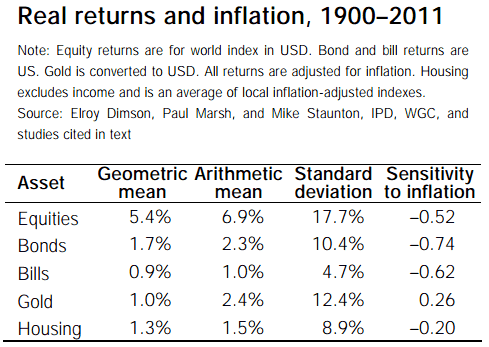
Equities. Represented by a US dollar-denominated world index, equities had the highest annualized real return of 5.4% but also the highest standard deviation. Stocks were moderately affected by inflation overall, but did not do well in periods of extremely high inflation.
Bonds and bills. Represented by US bonds and Treasury bills. But in every country studied, local equities outperformed local government bonds. Treasury bills are closer to cash, with higher credit quality and shorter duration. Bonds provided much lower real returns and lower standard deviation. Bonds were heavily effected by inflation, and did worse than stocks in periods of high inflation. Bonds are the best protection against deflation.
Gold. Long-term real returns are quite low, around 1%, on par with Treasury bills but with higher standard deviation. The bright spot is that they provided the most protection against inflation.
Housing. This refers to average prices of residential real estate across many cities. Long-term real returns are about 1%. However, you get to live in your house so there is a consumption benefit. Housing is less impacted by inflation than everything except gold, but the price risk of owning a single home is probably higher than the average home price data.
Portfolio Asset Allocation & Holdings Update – February 2012
Posted on February 21, 2012 // 29 Comments
I took some time this weekend to check on my investment portfolio, including employer 401(k) plans, self-employed plans, IRAs, and taxable brokerage holdings.
Asset Allocation & Holdings
You can view my target asset allocation here, along with links to other model asset allocations. Despite the headlines, I still like to buy, hold, and rebalance primary in low-cost index funds. Here is my current asset allocation:

I continue to rebalance continuously with new cashflow. Everything looks okay; stocks have been on a pretty good run recently for whatever reason and bond yields are still kept low by central bank policy. My personal outlook for the world economy is still uneasy. My current ratio is about 75% stocks and 25% bonds, but my goal is to get closer to a 60% stocks and 40% bonds setup, the classic balanced fund ratio within the next 5-7 years.
The main change since last time is that I dropped the stock funds in my 401k plan and moved them all to my taxable accounts for tax-efficiency reasons. I needed for space for bonds. I also stopped buying shares of the stable value fund in my 401k because new purchases only earn 1.25% interest. Instead, I am buying the only other bond option which is the behemoth PIMCO Total Return (PTTRX) which has a relatively low 0.46% expense ratio due to it being an institutional share class. This fund is actively managed and includes various types of bonds, but since the portion is so low, I’m still classifying it under my short-term nominal bond asset class.
Stock Holdings
Vanguard Total Stock Market ETF (VTI)
Vanguard Small-Cap Value Index Fund (VISVX)
Vanguard FTSE All-World ex-US ETF (VEU)
Vanguard MSCI Emerging Markets ETF (VWO)
Vanguard REIT Index Fund (VGSIX)
Bond Holdings
Vanguard Limited-Term Tax-Exempt Fund (VMLTX)
PIMCO Total Return Institutional* (PTTRX)
Stable Value Fund* (3% & 1.8% yield on existing balances, no longer contributing)
iShares Barclays TIPS Bond ETF (TIP)
Individual TIPS securities
* Denotes 401k holdings due to limited choice.
The overall expense ratio for this portfolio is in the neighborhood of .20% annually, or 20 basis points, which is much lower hurdle to overcome than the average mutual fund expense ratio of over 1% annually. This is all self-directed inside accounts held at Vanguard (IRAs, taxable), Fidelity (401k, Solo 401k), and a small retirement plan provider. I have some “play money” assets at other discount brokers that is invested in individual stocks, but the total is less than 2% of our net worth and not included here.
Goal Progress
Due to our goals to achieve financial independence early, I use a 3% theoretical safe withdrawal rate on my portfolio for the purposes of my tracking. This means that I expect every $100,000 that I save will provide me an inflation-adjusted $3,000 in expenses forever. However, in reality we will probably adjust our withdrawals based on our personal inflation, continuing income, and market returns.
With portfolio increases and additional contributions, at a 3% withdrawal rate our current portfolio would now cover 50% of our expected non-mortgage expenses. If you recall, I also plan to have the house paid off, and I will be making a lump sum payment shortly to bring our home equity past 50% as well. Hopefully as we cross the 50% hump, things will accelerate as portfolio growth will benefit from compounding returns and our mortgage balance will shrink faster from the opposite effect as more of our monthly payment goes towards principal as opposed to interest!
Consumer Reports Discount Brokerage Ratings 2012
Posted on February 16, 2012 // 27 Comments
I recently started subscribing to Consumer Reports magazine again, and the February 2012 issue included an article about the major financial brokerage companies (subscription required, press release). The first part was an investigation about the big firms (ex. Citibank, Fidelity, Schwab, T. Rowe Price) and their pre-packaged investment plan advice, and the second part was a survey on the quality of service from discount brokerage firms (ex. E-Trade, Ameritrade, Scottrade).
Consumer Reports is always unique because they don’t take any advertisement money at all, and so they sent in their own staffers anonymously (by this I mean they didn’t disclose they were writing this article) and then had the resulting advice analyzed by independent financial planners. Here were my takeaway notes:
- Many firms will offer some level of “free advice” if you have a certain level of assets with them, usually $100,000+.
- Good news: In general, the free advice is okay, but not surprisingly it tends to be boilerplate stuff.
- Bad news: Most people you talk to won’t provide you fiduciary duty. Most of them avoided disclosing how they were paid, and one researcher got pitched a complicated variable annuity after just a brief initial consultation.
I think fiduciary duty is a big deal, as I see no point in paying even a penny for financial advice if they won’t even promise it is in your best interest. Just seems like common sense to me. I don’t think I would bother to take them up on this free advice unless they were fiduciaries.
Self-Service Brokerage Firm Reviews
The Consumer Reports survey revealed that readers were “very satisfied” with 10 of 13 major brokerages, but it also left out a lot of the cheaper guys like OptionsHouse ($3.95) and TradeKing ($4.95). They seem to run this survey every few years, so here are the publicly-available May 2009 ratings:

One new change was that they separated out the “full-service” brokerage firms like Ameriprise, Edward Jones, and Morgan Stanley. In comparing the remaining “discount/online” brokerage firms, it’s noteworthy that the top 4 stayed the same for both 2009 and 2012, although the order changed slightly:
- USAA Brokerage – $8.95 trades at basic tier. Also offer banking and insurance products, although insurance is limited to the military-affiliated. Good all-in-one choice for military-affiliated.
- Scottrade – $7 trades, limited free ETF trade list. Large physical branch network. Has more active-trader tools than others on this list.
- Vanguard Brokerage – $7 trades at basic tier, all Vanguard ETFs trade free. Best known for low-cost index mutual funds.
- Schwab – $8.95 trades, limited free ETF trade list. One of the original “discount” brokers, also expanding into banking.
Non-Deductible IRA Contribution & Roth IRA Conversion Rules
Posted on February 14, 2012 // 21 Comments
 Mrs. MMB and I both contributed $5,000 each to a non-deductible Traditional IRA again for the 2012 tax year this week, with the intention of converting it into a Roth IRA in the future. Are you eligible to do this as well? Of course, we had to wade through a ton of IRS fine print to try and achieve a bit of tax savings.
First, can we just contribute directly to a Roth IRA? Per this IRS flowchart, because we are married filing jointly and will most likely have a modified adjusted gross income (MAGI) over $183,000, we are unable to contribute to a Roth IRA. How many people know what their MAGI is? It’s not impossible to figure out, but if I was closer I’d rather wait and have TurboTax figure it out for me when I filed my 2012 taxes.
Can I contribute to a Traditional IRA, even if I have a work retirement plan? Yes, it doesn’t matter if you have a 401k or 403b or whatever. The question is whether it is tax-deductible. Remember, when money is withdrawn from a Traditional IRA, it is taxed again at ordinary income rates.
Well, is the contribution tax-deductible? From this other IRS flowchart, because we are married filing jointly, covered by a retirement plan at work, and have an MAGI of over $112,000 or more, I see out that our contribution is not tax-deductible. Finally, you should remember to note the non-deductible (post-tax) contributions on IRS Form 8606 at tax time.
Can I convert my non-deductible IRA to a Roth IRA? In 2010, the previous $100,000 income limit for Roth IRA conversions was removed. It was initially thought to be a temporary thing, but it has not been addressed since. There is some speculation that the government is quietly (and happily) collecting taxes right now on all the rollover money, as opposed to later. Thus for 2012, there is again no income limit on the conversion from a Traditional IRA to Roth IRA. Even so, there are still some catches if you have both deductible and non-deductible (pre-tax vs. post-tax) IRA balances available to be converted. We have already converted all our pre-tax IRAs a while back, so it will be a simple “same trustee transfer” at Vanguard for us.
Okay, so we successfully navigated all these IRS rules and legally minimized our tax liability. But how many people won’t? Even for tax benefits for low to moderate-income earners like the Earned Income Tax Credit, the Government Accountability Office (GAO) found that between 15% and 25% of households who are entitled to the EITC do not claim their credit, or between 3.5 million and 7 million households. I mean, just look at how long the Wiki page that supposedly summarizes the credit is. It shouldn’t be this complicated.
Hedge Funds: Actual Investor Returns Less Than Advertised
Posted on February 3, 2012 // 5 Comments
When a mutual fund or hedge fund lists their historical returns, the industry standard is to use time-weighted returns that assume you buy at the beginning of the time period and hold until the end. However, what often happens is that a fund will start out small and have great returns for a while, gradually start attracting lots of investor money, and then the subsequent returns are not so hot. Whatever special inefficiency or investment idea the fund managers had initially is either wiped out by market forces over time or simply hindered by asset bloat. In such a case, the actual returns experienced by investors is less than what is listed under fund return data, even though things like 5-year trailing returns still look quite good.
Via Abnormal Returns, Ben Lorica of The Verisi Data Studio took an academic paper by Dichev and Yu [pdf] in the Journal of Financial Economics and made a nice visualization of the hunk of data presented about hedge funds:

click to enlarge
From the paper’s conclusions:
Using a comprehensive sample, the main finding is that dollar-weighted investor returns are about 3% to 7% lower than fund returns, depending on specification and time period examined. This difference is economically large, and it is enough to reverse the conclusions of existing studies which show outperformance in hedge fund returns. In addition, the estimated dollar-weighted returns are rather modest in absolute magnitude; for example, they are reliably lower than the returns of broad-based indexes like the S&P 500 and only marginally higher than risk-free rates of return.
Most of us can’t invest in hedge funds even if we wanted to, so this is best taken as a larger lesson to be careful when chasing hot returns by any money manager. You don’t want to be the last money in. Morningstar also tracks “investor returns” (dollar-weighted) separately from “total returns” (traditional, time-weighted) in their mutual fund listings.
Correlation Between Age Demographics and Stock Market Prices?
Posted on February 2, 2012 // 11 Comments
While perusing this early retirement reading list for more books to read, I ran across an interesting fellow named Harry S. Dent, Jr. His primary theory is that age demographics are strongly correlated with the economy and thus stock market prices.
In particular, the number of households headed by 46-50 year-olds are the best indicator because they are shown to have the highest spending. This makes sense, as around age 50 is also when peak income occurs while you also have spending pressure from grown-up kids and college tuition. After that, the kids move out, things slow down, and average income drops. Here are some charts from the HS Dent Foundation website:
 Source:HS Dent Foundation
By looking at birth rates and adjusting for immigration, you can basically predict how many 46-50 year-olds there will be well into the future. Here’s how the shifted birthrate data corresponds to the Dow Jones stock index adjusted for inflation:
 Source:HS Dent Foundation
According to the birthrate data, we are looking at depressed prices for another 10-15 years or so, but things will pick back up after that. While I think there may be something to this concept on a long timescale, I would be careful with trying to profit with it in the short-term.
I’m actually look at Mr. Dent himself here – a quick look around shows that he is trying everything under the sun to make money from this simple theory – writing a new book every few years with mostly the same content (2011, 2009, 2006), selling $1,500 seminars to “Demographics School”, and even starting his own Dent Tactical ETF (ticker symbol: DENT) with poor performance since inception and a bloated 1.65% expense ratio. Potential investors should know that he already started a mutual fund previously that failed:
In 1999, the AIM Dent Demographics Trends Fund was launched, based on the demographic economic and lifestyle trends identified by Dent. Unfortunately, the fund’s results were miserable. From 2000 through 2004, the fund lost more than 11 percent per year and underperformed the S&P 500 Index by almost 9 percent per year. In 2005, its sponsor put investors out of their misery by merging it into the AIM Weingarten Fund.
Over the years, he has made many predictions. Some of them came true, more or less. For example, he predicted that the slowdown in Japan economy would coincide with the end of the end of their peak number of 46-50 year-olds in 1990-1994. Some of them did not, like in 2006 when he predicted the Dow Jones would reach 32,000-40,000 in the year 2010 (the highest ever close was 14,164 in 2007).
The last prediction I could find was Dow 4,000 to 6,800 somewhere around 2012. That’s over a 50% drop from today’s prices. I think I’ll add this demographics theory to my investing consciousness, but I’ll leave the bold predictions behind.
How To Retire Early and Live Well With Less Than A Million Dollars [Book Review]
Posted on February 1, 2012 // 8 Comments
 I enjoy reading older books about early retirement; I seek to learn from their experiences, but I also look for ways in that their perspective is colored by their own time period. For instance, a book written in the 80s1 – an era of high inflation – would likely assumed that interest rates would be moderately high forever, at least in the 5% range. The tendency to extend recent trends into the future is unavoidable, and something you should consider when reading or making forecasts today.
This is a review of How To Retire Early and Live Well With Less Than A Million Dollars by Gillette Edmunds, a book published in 2000 that was recommended to me by a reader. Edmunds was a former tax attorney and financial journalist who retired in 1981 at age 29.
Unreasonably High Expected Returns
Remember that for both the 1980s and the 1990s, the average annualized total return of the S&P 500 for both decades was around 18% a year. Imagine two decades of such returns, all before the dot-com bust and the housing bust. Edmunds retiring in 1981 turned out to be some of the luckiest timing possible. As a result, a major criticism of this book is the continued expectation of high stock returns going forward. The quoted excerpts below are taken verbatim from the book:
- Can you retire today? His answer is that “most middle-class Americans, including me, could live comfortably on the investment returns from $500,000.” Perhaps, but with currently-accepted safe withdrawal rates of 3-4%, this would only create $15,000 to $20,000 a year in income. Instead, the book promotes withdrawals rate of 8-10%, which would have left many nest eggs completely wiped out from 2000 to 2010.
- “An average, educated, experienced investor can reasonably expect to make 10% a year for life.”
- “Anyone should be able to produce a 7.75% return.”
I bet these assumptions sounded reasonable, perhaps even conservative, in 2000 but they are just bad jokes today.
Owning Non-Correlated Asset Classes
Edmunds tells us not to time the markets, ride out temporary market drops, and to maintain low investment costs. He advises you to hold a variety of “non-correlated” asset classes such as:
- Real Estate
- Foreign Stocks
- US Large Stocks
- US Small Stocks
- Emerging Markets Stocks
Edmunds believes that these asset classes are on different business cycles. When one is going up, the other is going down. However, I don’t like the term “non-correlated”, as very few asset classes have negative correlations these days. Low or minimally correlated is a better term. As we saw in the recent financial crisis, when the poo hits the fan correlations can go back to 1 (everything goes down together). However, I agree with the general asset allocation advice of holding different asset classes with minimal correlations. He counts as an early proponent of not holding too much in US stocks (no more than 1/3rd of total portfolio), and an equal amount in foreign stocks (also use for 1/3rd of your portfolio).
I did have an issue with the lack of supporting evidence as to why these assets and not others, as we only get weak arguments like “after owning bonds for about five years, I realized that a portfolio of five different high-return asset classes that excluded bonds had both high predictability and high returns”. I’m sorry, but making a conclusion to stop holding bonds after 5 years of data is just plain bad advice and makes him come off as egotistical.
He ends the book with a philosophical epilogue with the usual “money isn’t everything, enjoy life with family and friends” material. I don’t mean to belittle the importance of this factor, just that I didn’t really learn anything new from it. He does come off as well-intentioned and talks about the effect of his divorce. Despite its flaws, I found this book worth the read as it encompasses the overall philosophy of one person who had been successfully retired for 20 years. Just remember he had a very strong tailwind of high returns, and adjust your own expectations accordingly.
Other “early retirement” books that I’ve reviewed:
The Overnight Rule For Managing Your Portfolio
Posted on January 30, 2012 // 22 Comments
 Recently, I came across an investment tip called the Overnight Rule from Carl Richards via the NYT Bucks Blog:
Imagine that all your investment holdings were sold overnight by accident.
You can’t undo the trades, and now all you have is cash.
Would you buy back everything you owned previously again at their current prices? If not, why are you holding them now?
I think this provides a fresh look at your portfolio, as many times we hold investments for irrational reasons. For example, there is the well-documented trait of loss aversion (even though readers of this blog may be immune), where investors really hate selling at a loss, even more than they love selling with a gain.
Perhaps you bought the stock at $20 a share, and it is now at $15 a share. You want to get rid of it “just as soon as it gets back to $20 a share”, so that so you can say you didn’t lose money on it. It’s better to admit the mistake and put your money in something better.
Then there is regret aversion. Perhaps you bought it at $50 a share and now it’s at $400 a share. You get to tell your friends how you bought Apple at $50 a share. You’re afraid it’s overpriced, but you don’t want to miss out if it rises some more. You sit on your gains and choose inaction instead of having to make a hard decision even though your money could be better deployed elsewhere.
Maybe it is company stock from your job, or shares that you inherited from a beloved family member. Whether is it some form of sentimental attachment, inertia, or plain laziness – you may want to consider your reasons for holding them.
There is a small exception to this rule if you are sitting on large capital gains in a taxable account and don’t want to realize them and get hit with the tax bill, especially if the alternative investment is also very similar (ex. mutual funds with similar holdings). However, even in this scenario you want to make sure that you’re not holding a poor investment just to put off a tax bill.
I did not come up with this myself, but read about this rule somewhere online within the last month. I’ve searched for the source but can’t find it, so please let me know if you do. Found it, thanks!
Historical Bond Yields vs. S&P 500 Dividend Yield
Posted on January 18, 2012 // 7 Comments
Here’s a chart from a Morninstar article on dividend stock ETFs that caught my eye. It shows the historical relationship between the yield on 10-year US Treasury bonds and the dividend yield on the S&P 500. I am not convinced that this means one should overweight dividend stocks over bonds, but it does provide some historical perspective. The last time the yield differential was around zero was in the 1950s.

Click to enlarge. Source: Morningstar Analysts
Since we are talking about such long time periods, let me throw in this chart showing (ready for this?) the rolling 10-year average annual inflation adjusted total return for the S&P 500 from 1926 through the end of 2011. Credit to Quant Monitor.

Click to enlarge.
The (Next) Big Short: Current Investments of Michael Burry and Steve Eisman
Posted on January 16, 2012 // 7 Comments
 I’ve read parts of The Big Short by Michael Lewis before, but finally re-read the entire thing over the weekend. If you are unfamiliar with this bestseller, it tells the story of the housing bubble through the viewpoint of investors who saw the crisis coming and bet big money on the collapse of subprime mortgages. Lewis portrays these guys as almost heroes, courageous individuals from smaller hedge funds that went against the commonly-held beliefs of the big firms on Wall Street.
Instead of writing the 8,449th review of this book, my question was – what are these characters betting against now? Now, this doesn’t necessarily mean I think they’ll be right, but I’m still curious.
Michael Burry, Scion Capital
Burry no longer accepts money from outside investors (he doesn’t need to), but still invests at Scion Capital using his own money. He doesn’t write a blog or release his recent letters to shareholders to the public, except for a few old ones. He did make a April 2011 lecture at his alma mater Vanderbilt University entitled Missteps to Mayhem where he sees continued problems with the government printing too much money and not tackling our current fiscal problems.
The government’s borrowing of money for the purpose of injecting cash into society, bailing out banks, brokers, and consumers, is a short-sighted, easy decision for a population that has not yet learned that short-sighted and easy strategies are the route to long-term ruin.
He ends his speech with the ominous advice “All that said, I might suggest opening a retail banking account in Canada.” I’m not even sure that’s possible to do as a U.S. citizen… is it?
From this complete transcript of a September 2010 interview with Bloomberg, he states that he believes that “productive agricultural land with water on site is — will be very valuable in the future”, he is bullish on gold due to currency debasement, but he doesn’t have a good feel for the timing of things as it could take a while to play out.
Steve Eisman, FrontPoint Partners
Eisman left FrontPoint in June 2011 and is reported to start his own hedge fund Emrys Partners in 2012. He has gotten the most publicity in recent years for shorting the stocks of certain for-profit colleges taking advantage of easy credit from government student loans. Basically, people who can’t get into traditional colleges are pitched a great future and convinced to take out large amounts of debt that they can’t pay back, all so these pseudo-accredited colleges can profit. Sound familiar? From a 2010 conference speech:
Until recently, I thought that there would never again be an opportunity to be involved with an industry as socially destructive and morally bankrupt as the subprime mortgage industry. I was wrong. The for-profit education industry has proven equal to the task. […] This is similar to the subprime mortgage sector in that the subprime originators bore far less risk than the investors in their mortgage paper.
I also looked for information on Charles Ledley and James Mai of Cornwall Capital, but really didn’t come up with much. They have a website, but there is nothing to see for the public.
 The Best Credit Card Bonus Offers – 2025
 Big List of Free Stocks from Brokerage Apps
 Best Interest Rates on Cash - 2025
 Free Credit Scores x 3 + Free Credit Monitoring
 Best No Fee 0% APR Balance Transfer Offers
 Little-Known Cellular Data Plans That Can Save Big Money
 How To Haggle Your Cable or Direct TV Bill
 Big List of Free Consumer Data Reports (Credit, Rent, Work)