Investment Portfolio Update: Asset Allocation & Fund Holdings – July 2011

This an update for my investment portfolio, including 401(k) plans, IRAs, and taxable brokerage holdings. There have been only a few small changes since my last portfolio update. As always, this is our own personal portfolio and may not necessarily be completely applicable to anyone else.

Asset Allocation – Target vs. Actual

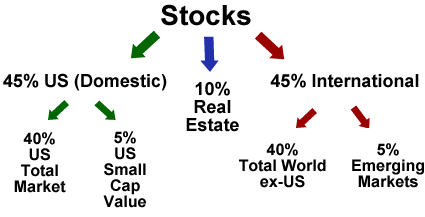
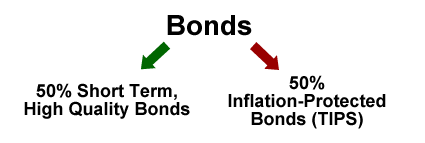
I separate the stock and bond portions for clarity. My target asset allocation remains the same:

Here is my actual stock allocation, where it shows that I am slightly overweight US Total and will need do some light rebalancing.

My actual bonds allocation is not really worth making a chart for… the target is 50%/50% and I have 47% short-term nominal bonds and 53% inflation-protected bonds.

Stocks vs. Bonds Ratio

[Read more…]

How Not To Select A Good Mutual Fund

I was looking through the Barnes & Noble bargain bin and found a book called “How to do just about everything”. Okay, how to unplug a toilet… how to carve a turkey… hey, a personal finance section! Wow, quite awful. After coming home and looking up the book, I found out it was by eHow.com. I should have known. Check out this gem on How to Select a Good Mutual Fund (eHow link), which offers the following advice:

2. Determine how many mutual funds you will invest in. Three to five funds is generally considered an adequate amount of diversification.

Yes, let’s determine diversification by the actual number of funds. One… two… three… done! Never mind that I could easily have more diversification in one mutual fund than in 15 separate niche funds. This is like deciding the best book is the one with the most pages. At least later on it says to vary the size of companies in the funds. However, there is no mention of real diversification between stocks vs. bonds, domestic vs. international, passive vs. active management, etc. What else?

5. Choose high-performance funds by using Internet resources and newspapers to pick those funds that have had the best performance over at least the last three years.

Huh? I don’t know how the advice could get much worse than this. Picking whichever funds that had the best performance over the last three years will virtually guarantee that you will have below average returns going forward. Check out these articles on the persistence of mutual fund returns based on studies of actual mutual fund return data over decades. “The majority of well-done studies tend to support a lack of persistence for all but the worst performing equity mutual funds.”

Don’t chase performance! Again, we see no mention of better indicators like expense ratio, turnover ratio, tax-efficiency, manager ownership of shares, etc.

Content Mills Warning
So how does such a poor article get prominent placement in search engines, not to mention published in a book? eHow is a content mill that encourages people to churn out large numbers of articles with low quality standards, promising them a cut of all future ad revenue. Google has recently penalized them for their low-quality articles as well.

In addition, eHow has a history of treating their freelance writers poorly, and their most recent move was to cut off their share of ad revenue completely, offering them either a lowball buyout or nothing. I’m sure they have some good articles, but in general I would say you’re better off avoiding them, especially for money-related topics.

Why You Should Ignore the Dow Jones Index

The Dow Jones Industrial Average (DJIA) is an antiquated, somewhat-arbitrary, poorly constructed, incomplete indicator that does a subpar job of tracking the actual performance of the U.S. stock market. There, I said it. Every time I see it mentioned in the financial media down to the decimal points like it’s some hyper-accurate holy number, I get a bit annoyed.

A recent BusinessWeek article Why Apple Isn’t in the Dow served as another reminder of why I feel this way. Whether or not you like Apple, it’s the second largest company by market value in the country. Is it in the Dow Jones? Nope. Why not?

The Dow only includes 30 stocks, picked by WSJ editors. In 1896, the DJIA had 12 stocks. In 1916, it grew to 20. In 1928, it increased again to 30. It’s still just 30 stocks over 80 years later. Not only that, but it’s not even clearly defined as the largest 30 companies or something like that. It’s simply 30 companies chosen by a committee to best represent the market out of the ~5,800 publicly traded companies out there. As a result, new companies like Microsoft, Intel, and now Apple are added rather late, and major sectors like transportation and utilities aren’t even represented.

The Dow is a price-weighted index. The DJIA is not weighted according to the relative value of the companies like the S&P 500 or other “Total Market” indexes. Instead, it’s weighted by share price, something that is very arbitrary. The same company could have a million shares at $10 each, or 1,000 shares at $10,000 each. It’s worth the same, but the second company would have 1,000x the effect on the Dow Jones Index. This means Apple stock (about $330) would have the 18 times the effect of General Electric, even though it’s market value is only about 1.5 times more.

This also means you shouldn’t invest in any mutual funds or ETFs that follow the Dow either. I’m looking at you “Diamond”, the SPDR Dow Jones Industrial Average ETF (ticker DIA). By extension, this is also one of my problems with the investing start-up Betterment.com. I would never take advice from a financial planner that said a Dow Jones ETF was a critical part of my portfolio’s asset allocation.

Prosper New Lender Promotion: iPod Nano, Bose, iPad 2

Peer-to-peer lending site Prosper recently received another round of VC money and it appears that they are offering a new iPad 2 promotion to attract enough lenders to match their borrower demand. If you open a new lender account by June 30, 2011 and have a certain amount of funded notes by July 21, 2011, you can earn one of the following bonuses:

  • $5,000 minimum (to $9,999) for an iPod Nano, 8 GB ($149 value)
  • $10,000 minimum (to $19,999) for a set of Bose QuietComfort 15 Noise-Cancelling Headphones ($299 value)
  • $20,000+ for an iPad 2 32 GB WiFi model ($599 value)

These are all pretty high investment amounts, and unless you have a lot of money you’re looking to deploy, I’d recommend wading in gradually and spreading your investments across as many different borrowers as possible. P2P lending has a longer track record now, but you are still basically lending money to people who are looking for a cheaper alternative to credit cards. I’m not surprised there are more borrowers than lenders; rates start at 7.4%. You can see overall performance data at LendStats.com.

If you do become a lender, be on the lookout for their “featured listings”, which currently offer a 4% upfront rebate on investments. Rebates are paid within 60 days of the date that your bid is placed. On $5,000 of investments, that would be $200. The fine print specifically states that you can double dip in this way:
Invested funds may also be used to qualify for Featured Listings promotions, but otherwise such funds cannot be applied to other promotional offers.

Investors Again Had Poor Timing During Recent Market Crash and Recovery

Morningstar.com helpfully provides two types of performance data for mutual funds: total returns and investor returns. Total returns are what you usually see elsewhere, and assumes that one buys all at the beginning and holds the entire period given – the last 5 years, for example. Investor returns account for the timing of the buying and selling of investors on average. An example given is:

Assume a fund generated a 10% total return in a calendar year, with most of those gains coming in the year’s first quarter. If investors added substantial sums of money to the fund after its first-quarter runup, the fund’s investor returns for that year would be lower than the fund’s 10% total return.

Using this data, Morningstar can basically tell how the average investor was at market timing. Apparently, not so good. On average they sold too quickly after losses, and bought too late and missed part of the rebound. From the article Mind the Gap 2011:

In 2010, the average domestic fund earned a return of 18.7% compared with 16.7% for the average fund investor, making for a gap of 200 basis points. For the trailing three years, that gap was 128 basis points. For the past five years, it was 98 basis points, and for the past 10, it was 47 basis points.

For taxable bonds, the return gaps were 138 basis points for one year, 52 basis points for three years, 57 basis points for five years, and 106 basis points for 10 years. That 10-year figure is pretty large considering it meant that returns fell to 4.47% annualized from 5.53%. Municipal bonds have consistently had an even bigger gap ranging from 113 basis points last year to 173 annualized for the trailing 10 years.

To make it clear, those are huge performance gaps over time. Like saying goodbye to 25% of your nest egg huge. The data also found that people who owned balanced funds that owned both stocks and bonds did much better comparatively. This includes target-date style funds. That makes perfect sense to me, because the type of people who buy balanced funds are not the type to try to time the market.

They found similar results when comparing investors in Vanguard mutual funds that had both Investor and Admiral share classes. The more patient (and more wealthy) investors had better performance in 13 out of 15 cases, with a margin greater than the difference in expense ratios:

For example, in the firm’s flagship Total Stock Market fund, Admiral shareholders enjoyed returns of 6.16% annualized compared with 5.35% for Investor shares. At Vanguard Value Index, Admiral shareholders earned a 4.84% annualized return compared with 2.61% for Investor shares.

If you do try to time the market, you owe it to yourself to track your moves carefully (and honestly) to calculate if they were really better than doing nothing at all. Chances are, they weren’t. If you don’t do better after a certain time, say a couple years, it may be a good idea to stop while you’re not too far behind. Here are a couple of ways to find your personal rate of return that accounts for inflows and outflows.

The Value of Diversification Beyond The S&P 500

Scott Burns of Assetbuilder has a new article that shows the benefit of diversifying your portfolio beyond the often-cited S&P 500 index fund that you probably have in your 401(k) plan. During the recent financial crisis, nearly every asset class involving stocks crashed. Large cap stocks, small cap stocks, REITs, international stocks.

From January 2000 to December 2009, the total return (not annualized) of the S&P 500 was negative 9.67%. That means money that you invested in the S&P 500 in 2000 was worth about 10% less an entire decade later. This is the so-called “lost decade” that numerous media articles have focused on.

Well, if you’ve been following this blog since 2004 or many other similar ones, you would have also read about research and historical data that advises you to diversify your investments across some other asset classes. Here are the total returns of other asset classes during that same 10-year period:

* Domestic large cap value stocks returned 53.7 percent
* Domestic small cap value stocks returned 139.5 percent
* REITs returned 170.9 percent
* Large cap international stocks returned 15.1 percent
* International large cap value stocks returned 90.7 percent
* Emerging markets stocks gained 147.8 percent
* Domestic micro-cap stocks, domestic small cap value, international small cap value, emerging markets value stocks, and emerging markets small cap stocks all enjoyed enormous gains. Emerging markets value stocks, for instance, returned 266.7 percent.

The S&P 500 is a good proxy for large-cap stocks in the US, but it doesn’t necessarily make your portfolio complete. Adding other asset classes that zig when others zag can help. Below is a summary of my target allocation, with further details here.

This is not a blanket recommendation for everyone, just an example of what I’m invested in to provide a nudge to read some more.

Loyal3: Easily Invest In Brand Name Company Stocks

Ready for the next new investing start-up idea? It’s “customer stock ownership plans” from Loyal3. Basically, companies encourage consumers to buy shares of their stock with only three clicks of the mouse, in the hopes that this will ownership will garner loyalty (get it?) and thus higher sales. Think Apple, where shareholders of AAPL are more likely to buy MacBooks. [Via Bits]

You’ll be able to buy in increments of as little as $10 via fractional shares, all with no transaction fees at all (they’re covered by the company). Loyal3 hasn’t actually announced the stocks available, but one would guess they’d be brand name makers of consumer goods like clothing, electronics, or food.

My initial impression is lukewarm. Sounds like an easier version of DRIPs. But the stocks will be likely limited to visible brand names, so it won’t really provide investors with actual diversification. Otherwise, I can’t think of any brand I like that much. I have a hard time being emotionally attached to a corporation. The one thing I do like is that they promote individual shareholder activism, which can keep management on their toes.

The other thing that caught my eye was the fact that they accepted credit cards for the stock purchases. Given their “no fees whatsoever” mantra, without fees this means you can get cash back/points/miles from your stocks purchases, kind of like getting a commission instead of paying it :). (The most you can invest per company is $2,500 a month.) Stocks are likely too volatile to easily profit from this, but perhaps someone can figure out a way to take advantage of this feature.

How’s Your Retirement Portfolio Doing?

You may or may not believe me, but even though I blog daily about money I only check my investment portfolio balances every few weeks. It’s part of my selective information restriction diet. I found it curious that the S&P 500 is now at ~1350. This reminded me of this earlier WSJ article about how long-term savers actually haven’t done all that poorly over the last decide. Their example is a young worker starting investing in 2000, investing regularly, and taking advantage of the 401(k) match from their employer amongst other stated assumptions:

Since the article was published, the S&P 500 is up nearly another 8%. Of course, if you invested in bonds for that decade you’d be even better off, but seriously who was 100% bonds the entire time. I know I wasn’t, but I was invested in some bonds, so I get some comfort that my personal return is a bit better. I’m relatively at peace with my investments, other than being a bit nervous after seeing the S&P so high without any proof of improved economic stability.

Fidelity App now has BillPay, Funds Transfer, & Remote Check Deposit

Fidelity Investments has just added some handy new features to their Apple iOS and Android OS apps. You can now use their BillPay service, transfer funds between accounts, and deposit checks remotely via camera. Before, you were limited to viewing account holdings and making trades. Competition is good, and I expect all major banks and brokerages to offer these features soon.

Mobile Check Deposit
Basically the same as other apps, you take a picture of the front and back with your smartphone camera. You can deposit only into non-retirement accounts, and the back must be endorsed with the text “For deposit only to Fidelity account #XXXXXX”. The deposit limits vary.

BillPay & Funds Transfer
You can pay bills with your mobile app, either through a regular brokerage account or their mySmart Cash Account (basically their checking account replacement product). Fidelity also allows you to link outside banks to your accounts, so now you can initiate money transfers both within Fidelity and externally on your phone.

American Association of Individual Investors (AAII) Review – The Numbers Behind The Non-Profit

I’ve been getting letters from the American Association of Individual Investors (AAII) for years now, and another one arrived yesterday. Their stated goal is to “assist individuals in becoming effective managers of their own assets through programs of education, information and research.” In big print on the front of the envelope, they declare that they are a 501(c)(3) non-profit “education” organization.

But after reading their pitch about investing in little-known small-cap stocks and their claims of earning 6% a year more than the averages, I just got the feeling that this was another stock tip newsletter. Keep in mind that if someone could beat the market by just 2% a year consistently, they’d be very rich folks.

From previous research on charities, I know that a lot of “non-profits” have top executives making a lot of money. On the extreme end, there are shell charities that are basically really good-paying jobs that hide behind helping veterans or orphans. Of course, there are many situations where an executive can justify their salary, especially if the organization’s administrative and salary costs are a small percentage of donations and most revenue goes directly into the community.

Usually non-profits have to file an IRS Form 990 that is similar to an annual report, and this document is legally required to be open for inspection by the public. Let’s take a look at the 2009 AAII Form 990 from Guidestar.org.

In 2009, AAII declared revenue of $5.8 million, mostly from annual membership dues and subscriptions to their stock newsletters. That $29 a year adds up! Out of that, the salaries of the employees took up $3.1 million, over 50% of the revenue. The top 5 employees get paid a total of over $1.3 million a year. The top two officers both paid themselves approximately $450,000 each in 2009. Here are the exact numbers from a snippet:

$1.1 million was spent on marketing costs of printing and mailing all those letters, and the organization actually lost $1.6 million for the year. I wish I could start a non-profit that actually didn’t make any profit, but yet still paid me and my buddy both nearly $500k a year!

Finally, let’s take a look at their performance claims. According to the site HenryWirth.com, AAII appears to use the shady tactic of only releasing performance numbers after they know they beat their desired benchmarks. (If it doesn’t, it’s swept under the rug.) After the Hulbert Financial Digest monitored their true performance based on public, replicable stock picks, the newsletter was found to have subpar returns over the last 8 years. It lagged the Wilshire 5000 index by over 2% a year, and lagged the Vanguard Small Cap Index by over 7% a year.

I know there are some happy AAII members out there. Teaching individuals to invest independently seems like a good idea, although promoting unrealistic returns is sketchy in my book. Mostly, I find the fact that they are using non-profit status to increase their own wealth very irksome. I think AAII should be run as a for-profit business, and then they can charge whatever they want and pay themselves whatever they want. If you are happy with how this non-profit enjoys their tax-exempt status and how they spend most of their revenue on themselves, then by all means keep on sending in your money. I’ll pass.

Crunching The Numbers & Looking Into The Crystal Ball

While catching up on some reading over the weekend, I found two articles that both dealt with large issues that we’ll have to face over the next few decades. Predicting the future is always difficult, but sometimes the numbers can seem very compelling.

Oil & Commodities
Jeremy Grantham is co-founder of GMO, an investment management firm with $107B in assets. That doesn’t mean he necessarily knows the future. But in his April 2011 quarterly letter titled Time to Wake Up: Days of Abundant Resources and Falling Prices Are Over Forever, he does manage to put together a convincing argument that we are using up our natural resources very quickly, and we can’t continue on at this rate. It’s mathematically impossible.

Will we find other energy sources to replace cheap oil? Will technology allow us to do more with less? Probably, but I doubt the transition will be a smooth one. I think learning to be less dependent on natural resources (read: be frugal, efficient, and less wasteful) will even more important financially than it is now.

Medicare & Taxes
Paul Krugman is a Nobel-winning economist with a popular blog at the NY Times. In a recent Op-Ed titled Seniors, Guns and Money, if you strip out all the political stuff, you’ll find this: In the coming years, there will be either significant cuts in Medicare, or tax increases to pay for the rising heath care costs.

One, our population is aging, with more retired seniors being supported by fewer workers. Two, health care costs keeps rising on their own. As he says, “It’s just a matter of arithmetic.” Either the government will raises taxes to pay for all this, or there will be major cuts in benefits. My guess is both.

Vanguard Lower Minimum Investment On Target Retirement Funds to $1,000

Effective May 11st, Vanguard has lowered the minimum initial investment on their Target Retirement Funds to $1,000, down from $3,000. Thank goodness, as this avoids having everyone pointing out that the Vanguard STAR fund was the only one with a minimum of $1,000. But seriously, I think this is a smart and overdue move by Vanguard, as it allows investors with limited funds to start out investing in a low-cost, diversified investment that adjusts with age. I put my own mother’s Rollover IRA in a Target Retirement Fund a couple years ago, and I sleep well at night.

(See previous post on the Vanguard Target Date Retirement Funds Glide Path to see how the asset allocation changes over time. I kept my mom’s target date close to their default recommendation, as my dad’s retirement accounts are on the conservative side.)

What if you have less than $1,000? There are plenty of “how to invest with just $100” posts out there, and if I look back I’ve probably done one myself. However, my new advice is this: Don’t bother. Instead, focus your energy on investing in yourself, by either learning about investing in general or improving your career and business skills. Put what you have safely in the bank, now once you have $1,000, then stick it in a Target Retirement Fund via a tax-advantaged IRA.