 Everyone loves a 100% money-back guarantee. A popular option on insurance policies is the “Return of Premium” rider. Let’s say you buy a $1,000,000 term life insurance for 30 years at $1,000 a year. At the end of 30 years, if you’re still alive, the insurance policy will no longer pay you the $1,000,000 if you die, but it will return all the premium you paid ($30,000). In your mind, you could think of it as “no risk” because you’ll get your $30,000 back no matter what!
Similarly, a very popular option on income annuities is the “Return of Principal” rider. Let’s say you pay $100,000 upfront in exchange for them paying you $7,000 in annual income for the rest of your life. What about the unlikely but possible chance that you die early in the first few years? A “return of principal” rider will guarantee that your survivors will at least get that $100,000 back. In your mind, you could think of it as “no risk” because you’ll get $100,000 back no matter what!
Create your own 100% Money Back Guarantee Portfolio. Insurance companies already sell complicated equity-indexed annuities that extend a form of this “no principal loss” to investing. But why not apply it to DIY investing? You may already see the flaw in the “no risk” terminology, but if you still like the psychological benefit of knowing you’ll have at least the same number of dollar bills come back to you after 10 years, read on to create your own “no risk” investment portfolio. Allan Roth writes about this in the AARP article Stock Market Investing for the Faint of Heart.
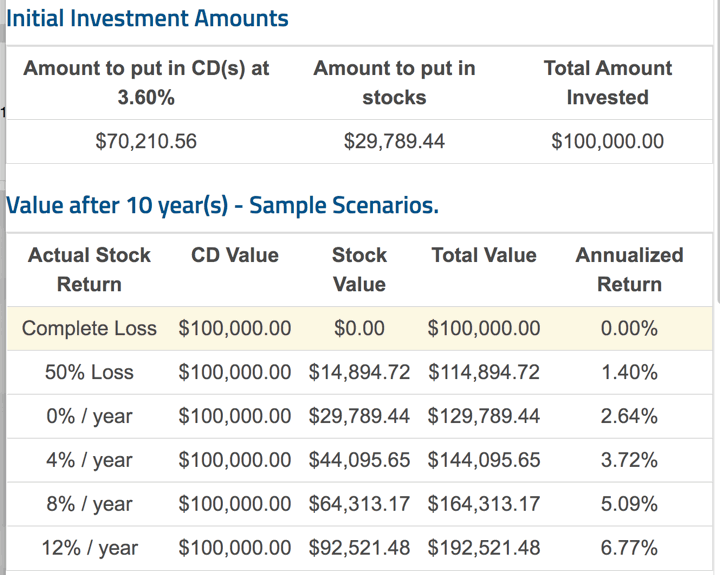
Let’s say you have $100,000. Right now, I see a 10-year FDIC-insured CD paying 3.60% APY (non-callable!) available from Vanguard. Using the Zero Risk Investment calculator from DepositAccounts, I know that I could put $70,210.56 into that CD today, and at the end of 10 years, I will be able to withdraw $100,000 no matter what. That means, I can take the remaining $29,789.44 today and buy stocks. Even if those stocks implode and lose every single penny of value, I will still have $100,000 at the end of 10 years. 100% Money Back Guarantee!
From that perspective, whatever you get from stocks is upside. This chart shows how much of the stock return I would still be exposed to. If stocks alone returned 8% annually, the overall portfolio would still go up about 5% annually, and my total at the end of 10 years would be $164,313.17.
If this level of safety sounds good to you, look more closely. That’s basically a 30% stocks/70% bank CD portfolio, and bank CDs are very similar to high-quality bonds. This is also why I prefer investing in US Treasury bonds and bank CDs for the bond part of my portfolio, I like having a portion of my portfolio that I don’t have to worry about at all. You could also use Treasury STRIPS (zero-coupon bonds) to guarantee a certain future payout.
What if you had a little more faith and just wanted a money back guarantee against the possibility of a 50% stock market loss after 10 years? That would allow you even more stock market exposure at roughly 45% stocks and 55% bank CDs:
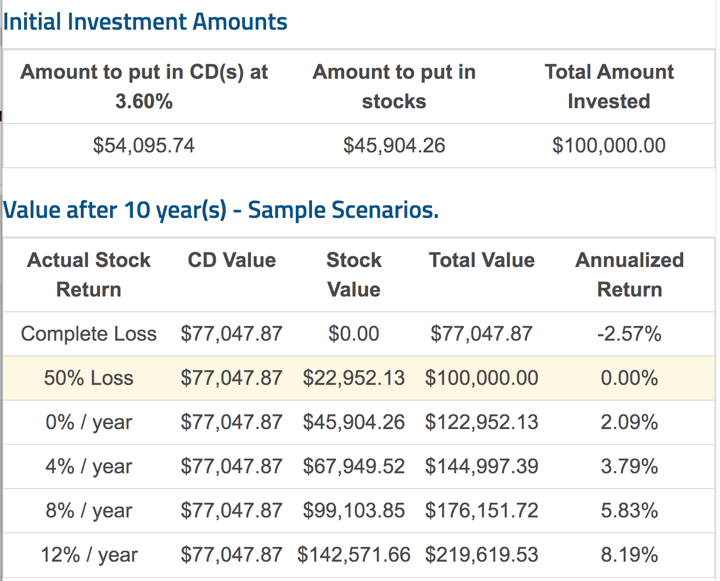
This is an interesting alternative viewpoint for deciding your stock/bonds ratio. Personally, I think having even a 50% decline over a full 10-year span is very unlikely, but having a 50% decline over a 1 or 2 years span is very likely. That sharp decline (and all the real-world events causing that decline) is what makes people panic. If you have more faith in the resiliency of stocks, you can own more stocks. Only want to protect from a 10% loss after a 10-year span? Then you could hold 80% stocks to guarantee your money back in that scenario. If, on the other hand, you believe that stock returns are just a random walk with a greater dispersion in results over longer periods (including the possibility of the S&P 500 ending at 1,000 or less in 10 years), then you might want to own a lot less stocks.
Insurance companies are happy to sell you “return of premium” and “return of principal” riders (they are not free, they have a cost that either reduces your payout received or increases your premium cost) because know they can invest your money in the meantime and pocket the returns. If interest rates are high, that means inflation is likely high as well, and the buying power of your $100,000 is shrinking over time. So really, you are still exposed to risk: inflation risk.
More investment education can help us better tolerate stock market volatility, but we also need to be honest about our human tendencies. If using this “100% money back guarantee” structure helps you maintain a certain level of exposure to the stock market, then that can be a good thing. The fanciest investment strategy will fail if you can’t stay invested during the inevitable downturns.










 Here’s my quarterly update on my current investment holdings as of 7/8/22, including our 401k/403b/IRAs and taxable brokerage accounts but excluding real estate and side portfolio of self-directed investments. Following the concept of

 Fidelity just announced a new feature called



 The Best Credit Card Bonus Offers – 2025
 Big List of Free Stocks from Brokerage Apps
 Best Interest Rates on Cash - 2025
 Free Credit Scores x 3 + Free Credit Monitoring
 Best No Fee 0% APR Balance Transfer Offers
 Little-Known Cellular Data Plans That Can Save Big Money
 How To Haggle Your Cable or Direct TV Bill
 Big List of Free Consumer Data Reports (Credit, Rent, Work)