 I try to ignore talk about pending legislation, but the SECURE Act (Setting Every Community Up for Retirement Enhancement Act) has now been passed by Congress and signed into law by President Trump. Portions are effective as of January 1st, 2020. Instead of going into fine detail, I think this Practical Law article provides a concise summary of all the major points. This way, you can skim it and only dig further if it applies to your specific situation. Many of the points deal with employers, but here are the highlights that apply to workers:
Increased 401k eligibility for part-time employees.
The Act requires that 401(k) plans permit participation by long-term employees working more than 500 but less than 1,000 hours per year in three consecutive years. This provision is effective for plan years beginning after December 31, 2020.
Penalty-free withdrawals for birth of child or adoption.
A new distribution rule will allow participants to take a penalty-free withdrawal of up to $5,000 from a plan following the birth or legal adoption of a child. The distribution option applies to 401(k) plans, 403(b) plans, governmental 457(b) plans, and Individual Retirement Account (IRA). It does not apply to defined benefit plans.
Required minimum distributions now start at age 72.
Currently, required minimum distributions from a retirement plan or IRA must start once an individual turns age 70.5. Under the Act, this age is increased to age 72. The change is effective for distributions required to be made after December 31, 2019, with respect to individuals who turn 70.5 after December 31, 2019.
“Stretch” inherited IRAs eliminated, replaced with 10-year time limit.
For defined contribution plans and IRAs, where a participant dies before the distribution of their entire interest, the distributions must now be made by the end of the tenth calendar year following the participant’s death. The new requirement does not apply if the beneficiary is an eligible beneficiary (for example, a surviving spouse or minor child).
Added lifetime income (annuity) options to your 401k/403b/457b.
The Act permits participants in defined contribution plans, 403(b) plans, and governmental 457(b) plans to take a distribution of lifetime income investment in the form of an annuity if: The lifetime income investment is no longer authorized to be held as an investment option, OR The distribution is made as a direct rollover to a retirement plan, IRA, or annuity contract.
No longer a maximum age for contributions to a traditional IRA.
Previously, you could no longer make contributions to a traditional IRA for the year during which you reached age 70 1/2 or any later year. There is (still) no age restriction for Roth IRA contributions.





 I use a Solo 401k plan because it lets you contribute the most tax-deferred money for a modest amount of self-employed income. At the end of each year, I can more clearly estimate my total income for 2019 and thus my maximum contribution limits. There are several online calculators out there (try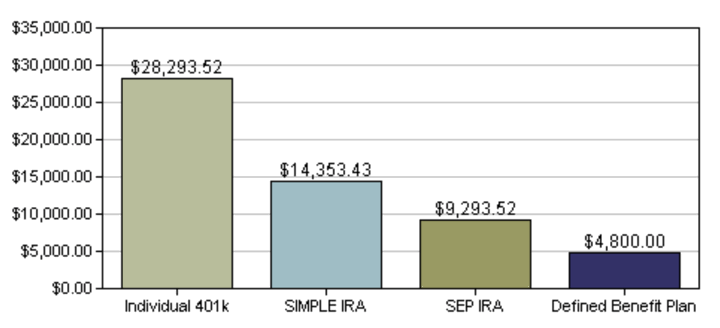








 The financial prediction industry is simply mind-boggling to me. There is zero long-term memory or accountability. You can make all the predictions you want about the stock market, gold prices, and interest rates, and nobody remembers your bad calls. You get a contrarian call right, and all of a sudden you’re on all the TV interviews and news articles.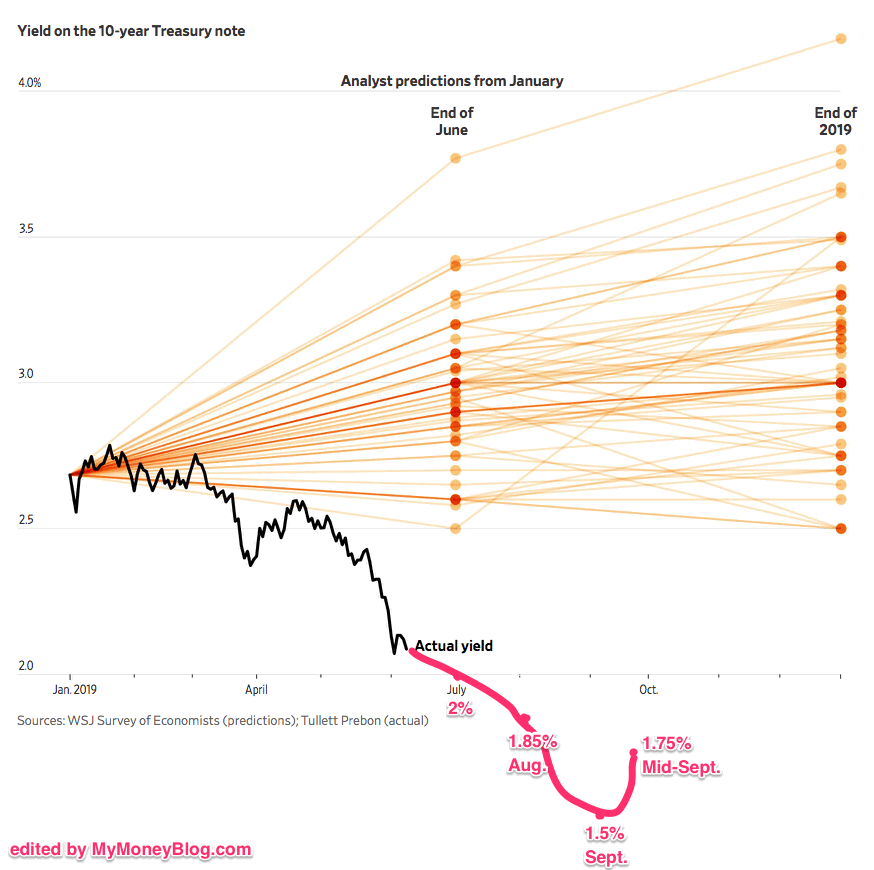


 The big news in sports yesterday was the retirement of Andrew Luck from professional football at the age of 29. Here are two takes from The Ringer:
  The Best Credit Card Bonus Offers – 2025
 Big List of Free Stocks from Brokerage Apps
 Best Interest Rates on Cash - 2025
 Free Credit Scores x 3 + Free Credit Monitoring
 Best No Fee 0% APR Balance Transfer Offers
 Little-Known Cellular Data Plans That Can Save Big Money
 How To Haggle Your Cable or Direct TV Bill
 Big List of Free Consumer Data Reports (Credit, Rent, Work)