FutureAdvisor: Free Online Portfolio Management and Asset Allocation

Another new online portfolio management tool is FutureAdvisor. I want to say they were invite-only for a while, but they appear to be wide open to new accounts now. Their basic account is free “forever”, and you can add 24/7 portfolio rebalancing alerts along with an annual videoconference call with an advisor for $49/year. The process of setting things up is pretty simple with the following steps laid out:

Personal Profile
Enter pertinent information such as current age, current income, desired retirement age, and desired retirement income. I like that they don’t just assume that you want to spend 80% of your current income in retirement. However, the total of your portfolio holdings entered here will be replace by whatever you share in the next step. I’m not really sure why they bother asking.

Financial Profile
You can either manually enter your portfolio holdings or have them import it automatically using your username and password. Most major brokerage companies including 401k accounts are available, but I did notice some that are currently not supported. The supported list includes Vanguard, Fidelity (w/ Netbenefits), Schwab, Merrill, and TD Ameritrade. The unsupported list includes TradeKing, Zecco, and Interactive Brokers.

Asset Allocation
Based on the information given and that same ole’ multiple-choice risk questionnaire, they will suggest to you a model asset allocation. You can tweak the target by picking between Conservative (60/40 stocks/bonds), Moderate (80/20), and Aggressive (90/10). Here’s the conservative asset allocation assigned to me:
[Read more…]

MarketRiders Portfolio Manager Review: First Look, Asset Allocation

Time to try out another online portfolio manager – MarketRiders.com. While previously-reviewed Betterment is an website/broker/advisor combo that handles all the decisions and trade executions for you, MarketRiders is more like an online portfolio coach telling you what trades to place yourself at the discount broker of your choice. Both services offer diversified portfolios using low-cost index ETFs, but think of it as one cooks you a nice tray of lasagna while the other one provides you a detailed, step-by-step recipe.

Free Trial Sign-up
To find out what the recipe is, you have to sign up for a free 30-day trial with your credit card information. The regular price for the service is $149.95 a year or $14.95 per month. You will be auto-enrolled after 30 days, but MarketRiders promises that canceling is easy and can be done completely online within two clicks. I can confirm it is indeed that easy. Just go to My account > Manage my subscription > Cancel my subscription. You still even get to use the rest of your free 30 days after canceling. Now, what do you get?
[Read more…]

More Statistics On 401(k) Target Date Retirement Funds

Just as theorized by a previously-mentioned academic paper about target funds, a new Bloomberg article talks about how some mutual fund providers like PIMCO and Invesco are now adding things like commodities futures, options, and currency swaps into these all-in-one funds. Will all these bells and whistles be worth the added cost? I doubt it, but differentiation is important in marketing. The article also included some interesting stats about these funds:

Investments in the [target date retirement] funds have swelled more than 380 percent since 2005 to about $343 billion as of September, according to the Investment Company Institute, a Washington- based trade group for the mutual-fund industry. […]

The majority, or 53 percent, of plan sponsors that automatically enroll participants in 401(k)s use target-date funds as the default investment, according to a 2011 report by the Plan Sponsor Council of America, a Chicago-based trade group.

There are more than 40 target-date mutual fund families employers may choose from and some sellers also offer them in collective trusts or customized versions, said Jeremy Stempien, director of investments for the retirement solutions group at Morningstar Investment Management. “We can see tremendous discrepancy, tremendous differences among asset managers,” said Harvard’s Pozen, who’s also a senior fellow at the Brookings Institution. “I don’t think most people understand what they’re getting.”

Fidelity, Vanguard and T. Rowe Price Group Inc. controlled about 75 percent of the target-date assets in 2011, according to Morningstar. The average fee for a target-date mutual fund last year was about 1.1 percent, according to Morningstar, which included all share classes and retirement years such as the 2030 or 2040 funds.

Fees for the funds at Pimco and Invesco averaged about 1.2 percent. Vanguard, which mainly uses three broad-market index funds in its series, had the lowest expenses at about 19 basis points, or 84 percent less than the more expensive funds. A basis point is 0.01 percentage point.

Vanguard reported yesterday that in 2011 about 64 percent of new enrollees in 401(k) plans administered by the company invested solely in a target-date fund. The Valley Forge, Pennsylvania-based firm managed about $100 billion in the funds as of Feb. 29, according to spokeswoman Linda Wolohan.

I don’t invest in any of these funds, but I keep track of them because they are where the industry is heading. I have recommended Vanguard Target Retirement 20XX funds to family members, but have adjusted the “date” to match their own situations.

Look Inside the Target Date Retirement Funds in Your 401(k)

If you have a 401(k) plan or similar, then you most likely have a target-date mutual fund (TDF) as the default option. This is a direct result of the Pension Protection Act of 2006 (PPA). These funds contain some mix of stocks and bonds, and the asset allocation changes according to a “glide path” as you reach your “target date” of retirement, and were designed as a stupid-proof, low-maintenance option for investors. But did this turn out to be a good thing or a bad thing?

The Freakonomics blog notes a new academic paper Heterogeneity in Target-Date Funds and the Pension Protection Act of 2006 [pdf] by Balduzzi and Reuter. Heterogeneity is just a fancy word for they tend to be very different from each other even though the yearly dating system can make them seem similar. For example, the WashingtonRock 2020 Fund could be completely different than the LincolnStone 2020 Fund. Why? Their theory is that because every 401(k) now would have a target date fund inside, then every fund provider would have to create a target date fund. However, you wouldn’t want your TDF to be the same as the other guys’ TDF, so you’d make yours slightly different, right?

Here is a glide path comparison done by State Farm showing the paths of the major providers Fidelity, Vanguard, and T. Rowe Price:


(click to enlarge)

[Read more…]

Portfolio Asset Allocation & Holdings Update – February 2012

I took some time this weekend to check on my investment portfolio, including employer 401(k) plans, self-employed plans, IRAs, and taxable brokerage holdings.

Asset Allocation & Holdings

You can view my target asset allocation here, along with links to other model asset allocations. Despite the headlines, I still like to buy, hold, and rebalance primary in low-cost index funds. Here is my current asset allocation:

I continue to rebalance continuously with new cashflow. Everything looks okay; stocks have been on a pretty good run recently for whatever reason and bond yields are still kept low by central bank policy. My personal outlook for the world economy is still uneasy. My current ratio is about 75% stocks and 25% bonds, but my goal is to get closer to a 60% stocks and 40% bonds setup, the classic balanced fund ratio within the next 5-7 years.

The main change since last time is that I dropped the stock funds in my 401k plan and moved them all to my taxable accounts for tax-efficiency reasons. I needed for space for bonds. I also stopped buying shares of the stable value fund in my 401k because new purchases only earn 1.25% interest. Instead, I am buying the only other bond option which is the behemoth PIMCO Total Return (PTTRX) which has a relatively low 0.46% expense ratio due to it being an institutional share class. This fund is actively managed and includes various types of bonds, but since the portion is so low, I’m still classifying it under my short-term nominal bond asset class.

Stock Holdings
Vanguard Total Stock Market ETF (VTI)
Vanguard Small-Cap Value Index Fund (VISVX)
Vanguard FTSE All-World ex-US ETF (VEU)
Vanguard MSCI Emerging Markets ETF (VWO)
Vanguard REIT Index Fund (VGSIX)

Bond Holdings
Vanguard Limited-Term Tax-Exempt Fund (VMLTX)
PIMCO Total Return Institutional* (PTTRX)
Stable Value Fund* (3% & 1.8% yield on existing balances, no longer contributing)
iShares Barclays TIPS Bond ETF (TIP)
Individual TIPS securities

* Denotes 401k holdings due to limited choice.

The overall expense ratio for this portfolio is in the neighborhood of .20% annually, or 20 basis points, which is much lower hurdle to overcome than the average mutual fund expense ratio of over 1% annually. This is all self-directed inside accounts held at Vanguard (IRAs, taxable), Fidelity (401k, Solo 401k), and a small retirement plan provider. I have some “play money” assets at other discount brokers that is invested in individual stocks, but the total is less than 2% of our net worth and not included here.

Goal Progress

Due to our goals to achieve financial independence early, I use a 3% theoretical safe withdrawal rate on my portfolio for the purposes of my tracking. This means that I expect every $100,000 that I save will provide me an inflation-adjusted $3,000 in expenses forever. However, in reality we will probably adjust our withdrawals based on our personal inflation, continuing income, and market returns.

With portfolio increases and additional contributions, at a 3% withdrawal rate our current portfolio would now cover 50% of our expected non-mortgage expenses. If you recall, I also plan to have the house paid off, and I will be making a lump sum payment shortly to bring our home equity past 50% as well. Hopefully as we cross the 50% hump, things will accelerate as portfolio growth will benefit from compounding returns and our mortgage balance will shrink faster from the opposite effect as more of our monthly payment goes towards principal as opposed to interest!

Payroll Tax Cut Extended For 2012: Increase 401k Contributions?

Congress has just passed a bill which the President has promised to sign that includes an extension of the 2% payroll tax cut for the rest of 2012. Specifically, the employee portion of the Social Security tax is reduced to 4.2% in 2012 instead of the standard 6.2%. The employer portion remains unchanged at 6.2%. The Medicare tax remains unchanged at 1.45% each for employers and employees. This tax cut has already been in effect since the beginning of 2011 and was scheduled to end at the end of February 2012 before this most recent extension.
For example, someone earning $50,000 annually will see increased take-home pay of $1,000 spread out evenly over a year of paychecks. The limits on wages subject to Social Security tax is $110,100 for 2012, so the maximum savings per person is $2,202. You can verify this tax cut for yourself by checking your most recent paycheck stub. Divide the Social Security tax line by your Gross Pay line. It should be either equal or less than 0.042, or 4.2%. (It might be less than 4.2% due to items that are exempt from SS tax like flexible spending account contributions.)

Spend it, or save it?

The idea behind this tax break is to provide a small, steady increase in income that you’ll hopefully spend quickly and thus stimulate the economy. Even though $1,000 sounds like a lot, when it comes to you as $40 every bi-weekly paycheck, you tend not to notice it. Surveys confirm that the majority of people don’t even know this tax cut exists after enjoying the benefits for a year.

However, if you’re happy with how you’ve already stimulated the economy and would like to put something away to invest and spend later, this might be a good time to increase your savings rate instead. Remember that your savings rate is the most important factor in whether you’ll be able to retire early (or perhaps ever).

Since this tax break comes automatically every paycheck, it makes sense to “pay yourself first” by putting it aside immediately via automatic savings. Instead of mindlessly spending like they want you to, mindlessly save it instead. 😉 If you have a 401(k) or similar employer-sponsored retirement plan, why not increase your contribution rate by 2%, and see if you notice it for the rest of the year? Of course, if you have high-interest debt and some extra willpower, perhaps you should put it aside each paycheck and pay that off instead. You can also use direct deposit or automatic transfers to send money over every paycheck to an online savings account.

Sources: Philadelphia Inquirer, Associated Press

Consumer Reports Discount Brokerage Ratings 2012

I recently started subscribing to Consumer Reports magazine again, and the February 2012 issue included an article about the major financial brokerage companies (subscription required, press release). The first part was an investigation about the big firms (ex. Citibank, Fidelity, Schwab, T. Rowe Price) and their pre-packaged investment plan advice, and the second part was a survey on the quality of service from discount brokerage firms (ex. E-Trade, Ameritrade, Scottrade).

Consumer Reports is always unique because they don’t take any advertisement money at all, and so they sent in their own staffers anonymously (by this I mean they didn’t disclose they were writing this article) and then had the resulting advice analyzed by independent financial planners. Here were my takeaway notes:

  • Many firms will offer some level of “free advice” if you have a certain level of assets with them, usually $100,000+.
  • Good news: In general, the free advice is okay, but not surprisingly it tends to be boilerplate stuff.
  • Bad news: Most people you talk to won’t provide you fiduciary duty. Most of them avoided disclosing how they were paid, and one researcher got pitched a complicated variable annuity after just a brief initial consultation.

I think fiduciary duty is a big deal, as I see no point in paying even a penny for financial advice if they won’t even promise it is in your best interest. Just seems like common sense to me. I don’t think I would bother to take them up on this free advice unless they were fiduciaries.

Self-Service Brokerage Firm Reviews

The Consumer Reports survey revealed that readers were “very satisfied” with 10 of 13 major brokerages, but it also left out a lot of the cheaper guys like OptionsHouse ($3.95) and TradeKing ($4.95). They seem to run this survey every few years, so here are the publicly-available May 2009 ratings:

One new change was that they separated out the “full-service” brokerage firms like Ameriprise, Edward Jones, and Morgan Stanley. In comparing the remaining “discount/online” brokerage firms, it’s noteworthy that the top 4 stayed the same for both 2009 and 2012, although the order changed slightly:

  • USAA Brokerage – $8.95 trades at basic tier. Also offer banking and insurance products, although insurance is limited to the military-affiliated. Good all-in-one choice for military-affiliated.
  • Scottrade – $7 trades, limited free ETF trade list. Large physical branch network. Has more active-trader tools than others on this list.
  • Vanguard Brokerage – $7 trades at basic tier, all Vanguard ETFs trade free. Best known for low-cost index mutual funds.
  • Schwab – $8.95 trades, limited free ETF trade list. One of the original “discount” brokers, also expanding into banking.

Non-Deductible IRA Contribution & Roth IRA Conversion Rules

Mrs. MMB and I both contributed $5,000 each to a non-deductible Traditional IRA again for the 2012 tax year this week, with the intention of converting it into a Roth IRA in the future. Are you eligible to do this as well? Of course, we had to wade through a ton of IRS fine print to try and achieve a bit of tax savings.

First, can we just contribute directly to a Roth IRA? Per this IRS flowchart, because we are married filing jointly and will most likely have a modified adjusted gross income (MAGI) over $183,000, we are unable to contribute to a Roth IRA. How many people know what their MAGI is? It’s not impossible to figure out, but if I was closer I’d rather wait and have TurboTax figure it out for me when I filed my 2012 taxes.

Can I contribute to a Traditional IRA, even if I have a work retirement plan? Yes, it doesn’t matter if you have a 401k or 403b or whatever. The question is whether it is tax-deductible. Remember, when money is withdrawn from a Traditional IRA, it is taxed again at ordinary income rates.

Well, is the contribution tax-deductible? From this other IRS flowchart, because we are married filing jointly, covered by a retirement plan at work, and have an MAGI of over $112,000 or more, I see out that our contribution is not tax-deductible. Finally, you should remember to note the non-deductible (post-tax) contributions on IRS Form 8606 at tax time.

Can I convert my non-deductible IRA to a Roth IRA? In 2010, the previous $100,000 income limit for Roth IRA conversions was removed. It was initially thought to be a temporary thing, but it has not been addressed since. There is some speculation that the government is quietly (and happily) collecting taxes right now on all the rollover money, as opposed to later. Thus for 2012, there is again no income limit on the conversion from a Traditional IRA to Roth IRA. Even so, there are still some catches if you have both deductible and non-deductible (pre-tax vs. post-tax) IRA balances available to be converted. We have already converted all our pre-tax IRAs a while back, so it will be a simple “same trustee transfer” at Vanguard for us.

Okay, so we successfully navigated all these IRS rules and legally minimized our tax liability. But how many people won’t? Even for tax benefits for low to moderate-income earners like the Earned Income Tax Credit, the Government Accountability Office (GAO) found that between 15% and 25% of households who are entitled to the EITC do not claim their credit, or between 3.5 million and 7 million households. I mean, just look at how long the Wiki page that supposedly summarizes the credit is. It shouldn’t be this complicated.

Pay Your Kids To Fund Their Own Roth IRA?

You’re probably aware of the wonders of the Roth IRA and how it allows your money to grow completely free from taxes, even upon withdrawal. An added wrinkle is the lack of age restriction, so that even kids with earned income (wages, salaries, tips) can contribute to a Roth IRA up the lesser of their taxable income or $5,000.

Along those lines, I received a PR e-mail from a site called 1417power.com. The idea is that you pay them “tuition”, and in return they pay your kids official job income that makes them eligible to contribute to a Roth IRA. They claim to follow all applicable child labor laws for those aged 14 to 17 (thus the name). Your kids do thing like fill out marketing surveys, but you’re essentially buying them a job. Digging through their fee structure, roughly 50% of what you pay them is skimmed off to go to the site owners.

Naturally, my question was – why can’t I just do this myself? The idea of paying your kids to do things like babysitting, lawn care or landscaping work, or manual labor seems simple enough. However, this Fairmark article argues that paying your own kids for chores is usually not considered taxable income, so you can’t “switch it” to taxable income for Roth IRA purposes when it benefits you. I’m not completely convinced, but for the sake of argument let’s explore other options:

  • Have the teenager earn money via traditional jobs like grocery bagger, cashier, food delivery, waiting tables, etc.
  • The child earns income from other neighborhood families doing things like babysitting, lawn care, or painting. The pay rate would have to be at reasonable market rates. You could even work out a “I’ll pay your kid if you pay mine” agreement, if you find a like-minded parent.
  • If you run your own business, you could pay the child for more clerical or administrative-type duties such as proofreading, delivering documents, or office organization.
  • If the teenager is especially industrious, they could be doing more skilled work like graphic design or making iPhone apps.

There would still be some loss, as their gross income would be subject to payroll taxes like Social Security and Medicare, as well as a small amount of federal income taxes (less than 10%). But if your child has the discipline to not touch the money for decades, the tax-free growth could be enormous. You’d have to be comfortable with the fact that they could do whatever they wanted with the money at age 18 as they can withdraw the money after taxes and penalties.

The Parental IRA Match
Another move taken from this Forbes article for those that are already parents of teenagers with part-time jobs is to match their earned income. If little Jane earns $3,000 being a lifeguard, then let her spend her all or part of her take-home pay, but help her fund a Roth IRA to the full $3,000.

Effect on College Financial Aid
From my quick research, it appears that retirement accounts like Roth IRA are not considered an asset by the generic FAFSA form, but individual universities may deem them as a student asset. This could make for example 25% of the IRA to counts toward the student’s expected contribution, which doesn’t seem too bad.

Here’s a question for the parents out there – have you done anything along these lines? What did you do and why (or why not)?

Do I Have An Obsession With Early Retirement?

After my post counting down my years until early retirement earlier this week, I received a very thoughtful e-mail from reader Tim:

I’ve been reading and enjoying your blog for a long time, and think it’s one of the best out there for your mix of personality, short-term and long-term financial tips and advice. But one thing bothers me: the ongoing, almost central theme (obsession?) with early retirement. It seems to be the goal around which everything else in the blog revolves and leads toward.

Why is that? Do you hate your job so much, and can’t even imagine a job you would enjoy enough that you would want to do it whether you were paid or not? It doesn’t strike me that someone as industrious, curious and intellectually active as yourself would really ever retire. I understand there may be other activities you’d like to pursue, but my guess is that most of them would be potentially income-generating. So you’d still have a “job.” And if that’s the case, then why not pursue one or more of those things now, rather than delaying them until “retirement?”

It seems to me that “MyMoneyBlog” is likely one of those things, and I’m very glad you’re doing it. And if one reason is the hope to fully monetize the blog to the point of retirement from your nine-to-five job, then I hope you do that too.

But still, something about that recurrent theme of retiring just leaves me with a hollow, dead feeling in the pit of my stomach, as if we’re all inmates marking time on the wall of a dreary prison cell until our release. Maybe it’s the implied resignation to the assumption that joyless jobs are unavoidable – a bitter fact of life – that I reject. I just don’t like to think that as a society we accept a lifetime of delayed gratification as a given, and don’t rouse ourselves to do anything more about it than make sound financial plans to enjoy ourselves when the pain finally stops.

There are some great questions in there, and really it also showed me that I can improve on explaining my philosophies. I have all these ideas rattling around in my head, and not all of them reach the keyboard. My reply became rather long…

Definition of early retirement. I know that retirement is a very tricky word to use. For too many people, it conjures up images of playing golf and sitting around all day. Financial independence or financial freedom are better terms, and they all mean the same thing to me – I get to do whatever I want. Cook a new dish every day, rebuild a Land Rover Defender or Willys Jeep, volunteer, spend a year abroad, anything. F— You money.

Delayed gratification. Going back to the early retirement curve, a major assumption is that your current expenses are the same as your future expenses. Let’s say your household earns $80k and lives on $40k. Well, that curve assumes you’ll be living on $40k in “retirement” as well. Using a food analogy, getting there is not a crash diet, but requires a permanent change to healthier eating habits. I don’t feel deprived with my current lifestyle as it pertains to spending, otherwise it wouldn’t be sustainable.

A job that I would do forever? I’ve thought about this. Let’s try to design the best job possible. To start, it should satisfy this Career Venn diagram which reminds us to seek the intersection of things that we do well, things that pay well, and things we like to do. In addition, it should provide all the factors that make a job satisfying beyond money: autonomy, complexity, and a connection between effort and reward.

Does my current job cause me pain? Does my wife’s job? Not really, we are white-collar professionals so we have a certain degree of autonomy and challenge to our work. But we also have managers, meetings, clients, and politics.

Is there any such ideal job that exists? Honestly, if it had to pay $50k a year and 40 hours a week, probably not for me. I am the type of person that likes to do something for a while, and then move on to something else. Even self-employment has it’s own set of restrictions. Even though blogging is a sweet gig :), having income that depends on advertising is very volatile.

This is where financial freedom comes in, because it means more flexibility. I have realized over time that I will probably need to do something, and that is a big reason why I am happy with a 4% safe withdrawal rate. All the academic studies that calculate this withdrawal rate stuff assume that a theoretical person blindly takes out 4% inflation-adjusted to the CPI every single year. From reading experiences of real early retirees, they adjust and adapt.

Let’s say we want that 4% withdrawal rate to create $40,000 of income from investments, but it ends up that 3% is a more reasonable number. Now, I need to find a job that pays $10,000 a year. I could do all kinds of things that would be kind of cool for $10,000 a year, and I wouldn’t have to work 40 hours a week either. I could do just about anything – web design, tutor high school or college students, teach English in a foreign country, apprentice with a skilled craftsman, or work as a travel guide.

Indeed, the possibilities are endless. One day, if the stars align, we will have children. At that point, we plan on downshifting to working part-time so that we can both enjoy raising kids without all the financial stress that our parents had. Our portfolio can already cover half of our expenses. Once the kids go to school, there will be more time for work, if needed. In the end, I would say that I am obsessed with freedom and autonomy.

How Many Years Until You Can Reach Early Retirement?

One of the recurring themes of personal finance is that while the concepts are often simple, execution can be quite difficult. A couple of excellent posts from Mr. Money Mustache and The Military Guide (both also mention the Early Retirement Extreme book) provide another example when answering the question “How many years until I can retire?”

Let me summarize. A simple definition of financial independence is creating enough income from your investments to pay for your expenses. Assuming a “safe” withdrawal rate of 4%, this means your portfolio must be 25 times your expenses. So if you spend $30,000 a year, you’ll need $750,000. (If you want “safer” withdrawal rate of 3%, that increases it 33 times expenses.)

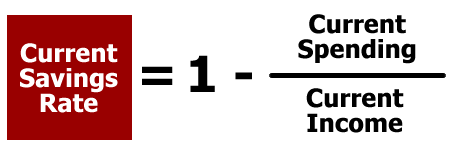
Given the rough assumptions of starting with nothing and earning a 5% inflation-adjusted (real) return on investments every year, you can simplify things even further. (5% real return looks plausible based on the past, but I know it’s harder to see it now.) It works out that the only thing that matters is your personal savings rate:

After-tax numbers work better since expenses are usually after-tax. MMM provides a table, which I in turn converted into a single curve:

Notes:

  • The harsh truth is that if you want to retire before Social Security steps in, you’re going to have to save a lot more than 10%.
  • The curve is steepest at lower savings rates. That means increasing your savings rate from 10% to 20% shaves off more time working (14 years!!!) than increasing from 20% to 30% (still 8 years!), and so on.
  • Retiring in 20 years requires roughly a 40% saving rate. Retiring in 10 years requires a 65% savings rate.

If you’re new to the financial independence community, the idea of saving 40% or more of your income may be incomprehensible. Hopefully you will realize that it is possible, if you wish to pursue it. I have come to the conclusion that some people will happily work for 30 years in exchange for the ability to drive a new BMW every 3 years. Others (gasp!) just like their jobs that much. All that’s fine as long as that’s a conscious decision.

To increase your saving rate, you must either increase income or decrease expenses. While decreasing expenses is actually the more accessible option for most families, it will likely remain unpopular forever. That doesn’t mean you can’t do it, because many people are quietly doing exactly that. Try – you may surprise yourself.

I am also a strong proponent of increasing income. In the end, in our household we did a combination. Both of us earn an solid income after a combination of tuition-based postgraduate education and “DIY education”, but we only live on the lower income. Armed with a 60%+ saving rate, we are on track to achieve financial freedom according to this definition within another 5 years, although we may take a different path by working part-time for a longer period.

I must admit, even though I have known this “truth” for many years, I don’t actively talk about it because we do earn much higher incomes than average. However, that doesn’t change how the numbers work. I applaud all those bloggers and journalists that don’t patronize you and push the idea of higher savings rates, like this article in The Atlantic by Megan McArdle:

If you’re like, well, almost everybody, you’re not saving enough. 15% of each paycheck into the 401(k) is the bare minimum you can get away with, not some aspirational level you can maybe hope to hit someday when you don’t have all these problems.

I mean, obviously if one out of two workers in your household just lost their job, or has been stricken with some horrid cancer requiring all sorts of ancillary expenses, then it’s okay to cut back on the retirement savings for a bit. But let’s be honest: that doesn’t describe most of us in those years when we don’t save enough.

Goal Update: Investment Portfolio Asset Allocation & Holdings – Nov 2011

Time for another update of my investment portfolio, including employer 401(k) plans, self-employed plans, IRAs, and taxable brokerage holdings.

Asset Allocation & Holdings

You can view my target asset allocation here, along with link to other model portfolios. Despite the headlines, I still like to buy, hold, and rebalance. Here is my current actual asset allocation:

Everything is within acceptable ranges, other than I need to buy more TIPS. This is just an overshoot since I have my 401k buying shares in a stable value fund automatically, and my TIPS are mostly stuck in IRAs. Actually, my TIPS holdings have been doing great, due to how low real yields are right now. Last I checked, even 10-year TIPS had negative real yields.

My current ratio is about 75% stocks and 25% bonds. I’ve been thinking about this balance. On one hand, I’m contributing a lot of money into the portfolio, and I hope that I can get my “early” retirement on within the next 10 years. At that point, I’m going to want something closer to a 60% stocks and 40% bonds setup, the classic balanced fund ratio. So I want to shift towards bonds, but bond yields don’t look very appetizing right now. For now, I’m just going to keep up the gradual shift.

Stock Holdings
Vanguard Total Stock Market ETF (VTI)
Diversified S&P 500 Index Fund (DISFX)*
Fidelity Extended Market Index Fund (FSEMX)*
Vanguard Small-Cap Value Index Fund (VISVX)
Vanguard FTSE All-World ex-US ETF (VEU)
Vanguard MSCI Emerging Markets ETF (VWO)
Vanguard REIT Index Fund (VGSIX)

Bond Holdings
Vanguard Limited-Term Tax-Exempt Fund (VMLTX)
Stable Value Fund* (3% yield on past purchases, 1.8% on new)
iShares Barclays TIPS Bond ETF (TIP)
Individual TIPS securities

The overall expense ratio for this portfolio is in the neighborhood of .20% annually, or 20 basis points, which is much lower hurdle to overcome than the average mutual fund expense ratio of over 1% annually. This is all DIY, so I don’t pay portfolio management or financial advisor fees.

3% Safe Withdrawal Rate

I’ve also decided to use a 3% theoretical safe withdrawal rate instead of a 4% withdrawal rate. So instead of reaching 25 times our annual expected expenses, we will need to save 33 times. This is due to the fact that we will probably reach early retirement with 10 years, and thus our portfolio will have to last a lot longer than a conventional age 65 retirement. 3% is a more conservative number, and in reality I doubt that we will even go by the 3% number in strict terms. From reading other early retiree stories, we’ll stay flexible and adjust our withdrawals somewhat with market returns.

With portfolio increases and additional contributions, at a 3% withdrawal rate our current portfolio would now cover 43% of our expected expenses. If you recall, I plan to have the house paid off at retirement as well. It might be nice to have a portfolio that yields 3% where we could spend the dividends and interest payments, and I have been tossing around ideas for that as well. I still like the idea of 50% Target Retirement Income (or similar) and 50% Wellesley Income.