2010 Year-End Financial Goal Progress Update

As 2010 draws to a close and the champagne is all gone, here’s an update on the status of our personal financial goals. I’ve been on the fence for a while about whether to continue our detailed net worth updates, and I’ve decided to reclaim some privacy and stop doing them in the previous format. Instead, I’d like to keep tracking our progress but in a opaque manner where I think everyone can still calculate their own and compare with us if desired. I’m not sure exactly how to do this, but here is a rough outline.
Credit Card & Consumer Debt

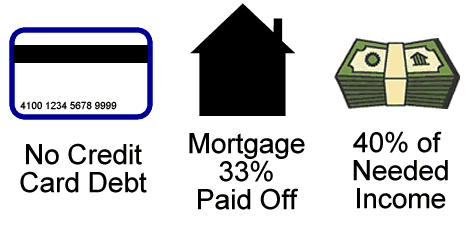
I think the first part of any healthy financial status should be to outline and pay off any consumer loans. We do use credit cards, but we pay our balances in full each month. We don’t have any auto loans or other forms of consumer debt.

I used to take money from credit cards at 0% APR and place it into online savings accounts, bank CDs, or savings bonds that earned 4-5% interest, and keeping the difference as profit while taking minimal risk. (By this I meant that the risk was dependent on my own actions.) I could have also used such 0% loans instead of other debt like student loans. However, given the current lack of great no fee 0% APR balance transfer offers, I am currently not playing this “game”.

Retirement Portfolio

As far as financial freedom goes, there are a number of ways to fund your living expenses without working. Pensions, Social Security, stocks, bonds, real estate, and so on. For us, I have boiled down “financial freedom” to be two things:

Part 1: Accumulate 25 times annual (non-housing) expenses

Part 2: Own my house / Pay off mortgage

I think it’s important to note that these two parts don’t necessarily have a number attached to them. Minimizing expenses are just as important as increasing portfolio size, as well as minimizing the amount of house that you “need”. More detail can be found in this post entitled A Quick & Dirty Plan To Reach Financial Freedom.

For Part 1, the basic idea is to assume that a portfolio can return 4% annually with adjustments for inflation. So if you have $1,000,000, that would create $40,000 a year. The exact implementation of this is more complicated, as there are several ways to help avoid portfolio depletion like annuities and adjusting your withdrawals during market downturns. Most folks won’t need a million dollars, though, if they have already paid off their house. For example, if your non-housing expense are only $1,000 per month, then you’d only need 12 x 25 = $300,000.

Back in July I was 33% of the way to reaching this goal. We are now 40% of the way. At this pace, we could finish Part 1 in less than 10 years, but we will likely scale back our income when we have kids. We’ll have to keep a close eye on those expenses as well.

Housing & Mortgage

Owning a house isn’t for everyone, but I think that if you are geographically stable, it can be a great way to become financially independent. Once you pay off the house, then your housing “expense” is mostly taken care of. (There is still maintenance and property taxes.)

We have owned our house for about 3 years now, having taken out a 30-year fixed rate mortgage initially with a 20% downpayment. Since I want to retire before I’m 50, I need to speed things up. Over the past year, we have made additional payments toward principal, as well as lowered the interest rate to 4.75%. These prepayments have been irregular lump-sum amounts, although I agree an automated plan is easier to maintain. The outstanding loan principal is now 67% of the purchase price. If we were to continue the original minimum-required payments, our home would be now be paid off in 21 years. This is good, as we can support that payment on one income.

Free PDF of Unveiling the Retirement Myth by Jim Otar

I’m still recovering from holidays, but I did see today that retirement specialist Jim Otar has made his book Unveiling The Retirement Myth available in PDF format for free until January 9, 2011. Here is the direct download link (expired).

I haven’t read it, but from I can gather it seems targeted at those DIY investors who are carefully planning the withdrawal phase of retirement, and not for beginners. For example, the summary teaser talks about “non-Gaussian optimum asset allocations”. 🙂 Hey, sounds like great weekend reading to me. Learn more about the material at his site RetirementOptimizer.com. In any case, it’s free and the book retails for $50, so why not download it. I’m now wanting an iPad to read all these free eBooks out there…

Thanks to TheFinanceBuff for the tip.

The Perils of Pursuing Financial Freedom

The following is a guest post from Kent Thune, who is a Certified Financial Planner(R) and the author of The Financial Philosopher, where he urges readers to place *meaning before money and purpose before planning*.

altext

What is freedom? What is financial freedom? Is there a difference? Is the freedom that money apparently purchases worth the sacrifices we make to reach this freedom? Can the pursuit of financial freedom paradoxically reduce one’s actual freedom? Can freedom be bought? If not, then what does this say about the pursuit of financial freedom?

The Tail Wagging the Dog

“Life is about life and not the result of life.” ~ Johann Wolfgang Von Goethe

Financial goals are destinations; they’re not life. If you believe that life is about the journey and not the destination, it’s contradictory to believe that life now must be sacrificed for a life bought by money later.

If retirement, for example, is accomplished only upon (or in unison with) the accomplishment of financial freedom what is the purpose of life now? Are you enslaving yourself now for a perceived freedom years or even decades away?

The blind pursuit of financial freedom is often closer to slavery than it is to liberation. The ultimate example of the metaphorical tail wagging the dog is an individual who creates a financial plan and then shapes their life and behaviors to accomplish the plan; whereas the healthy individual will clarify life (non-financial) goals first, and use money as a tool to reach those goals second. The pursuit of financial freedom can actually be liberating if it is not a blind pursuit—if it is a pursuit consciously defined by the individual.

[Read more…]

Vanguard Target Retirement Funds Changes: Increased International Exposure

A lot of people own Vanguard Target Retirement 20XX Funds, and I just noticed that Vanguard made an announcement that they will be making some changes:

  • The international equity weighting will be increased to 30% of the overall stock portion fund, up from about 20%.
  • Three of the funds (European Stock Index, Pacific Stock Index, and Emerging Markets Stock Index) will be replaced by a single fund, Vanguard Total International Stock Index Fund.
  • The Total International Stock Index Fund itself is making some changes. Its benchmark index will switch to the MSCI All Country World ex USA Investable Market Index, which differs from the previous index by adding exposure to Canada and Israel, as well as adding a ~13% allocation to small-cap companies.

All of these changes sound good to me, even if it is another example of Vanguard following the herd. The very first target retirement funds had no exposure to Emerging Markets. Emerging got hot, and then Vanguard added to their funds. Investors have been increasing their international exposure as well recently, and 20% was less than their competitors like Fidelity and starting to look old-fashioned. (Perhaps this is another move away from the philosophies of founder Jack Bogle.)

This also means most Target funds will consist of just three funds:

  • Vanguard Total Stock Market Index Fund
  • Vanguard Total International Stock Index Fund
  • Vanguard Total Bond Market II Index Fund

The stated reasons are for increased simplification and diversification (and a little less volatility perhaps), and not for any increase in expected future returns. Here’s a Q&A from Morningstar with Vanguard CIO Gus Sauter about the topic.

I still like this series of all-in-one funds for those people who like the idea of auto-pilot and have all their retirement savings in tax-deferred accounts like 401ks and IRAs. They are simple, reduce your stock exposure gradually over time, keep costs low, and rebalance regularly for you. You can also adjust your risk level by choosing a different target year.

I held the Vanguard Target Retirement 2045 (VTIVX) for a while. After selling it, I’ve found it very easy to let my asset allocation shift.

However, if you have both taxable and tax-deferred investment accounts, splitting up your bonds and stocks for optimal tax-efficiency can help you increase your after-tax returns.

ING Your Number: Retirement Calculator Assumptions and Factors

I was watching TV this weekend and kept seeing commercials about ING’s Your Number, which is an online calculator that supposedly helps you plan for retirement by telling you how much you need to save. Here’s one of them if you haven’t heard of them before:

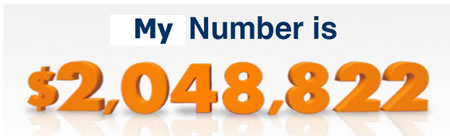
After trying it out and finding out my 7-digit number, I wanted to see what was “under the hood”. Monte carlo simulations? Spits out random number to mess with your head? Maybe my Google-Fu is weak, but I couldn’t find anything except this Your Number worksheet [PDF] from ING dated 2009. The final numbers don’t match up, but it does provide some insight into how the current calculator works. Using this information and trying lots of permutations, I tried to backtrack how each question affects the final output.

Factors and Assumptions

Current age. This factor appears to be used solely to calculate how many years you have left until retirement. Since the ING Your Number is the amount of money you need at the time of retirement, it increases every year with inflation. This is an important fact to note, as needing $1 million today would be the same as needing $2 million 30 years from now due to inflation alone. (Inflation is assumed to be roughly 3% annually.)

Marital status. The calculator says “We’re not trying to pry into your personal life, but whether or not your married has an impact on your number.” Nosy or not, it actually doesn’t seem to matter. I tried all kinds of inputs, but I couldn’t find any that changed based on being married or not. Let me know if I missed something here.

Current household income. At first glance, you’d think your current household income wouldn’t affect Your Number necessarily, since it later on asks for the actual income required during retirement. I noticed that making slight changes in your current income doesn’t affect Your Number at all. However, large changes do – it appears that this number is used to estimate future social security benefits. If your current income is really low, then your future benefits will also be low, which increases Your Number.

Age at retirement. This factor is used twice – once along with your current age to find how long you have until retirement, and again with your death age to find years in retirement. The more years you plan to spend in retirement, the greater Your Number will need to be in order to maintain a margin of safety.

Annual income required during retirement. A recommended amount is 80% of your pre-retirement income, but I hate that rule-of-thumb. Instead, this is probably the hardest part of the calculator because it requires the most personal and in-depth thought. Is your house paid off and are you going to stay in it? How much of your current income goes towards work expenses? What activities do you plan to do in retirement?

Provide income through what age? As noted above, this “death age” is used to calculate the amount of years you’ll spend in retirement. I kind of wish they just assumed 100 or something for this, it seems a bit morbid to guess when you’ll die.

In the end, Your Number is essentially your annual retirement income multiplied by a factor ranging from 5 to 30, depending on how long your retirement horizon is. It could have just told people to multiply by 25 and be just as accurate (or inaccurate) . As you might expect with any calculator that tries to help plan your retirement by asking five questions, Your Number is mostly a marketing gimmick designed to connect you with ING-affiliated financial advisors and insurance salesmen. That doesn’t mean you still don’t want to try it, though, right? 🙂

What’s yours?

2010 Q3 Investment Portfolio Update – Fund Holdings

I’ve already posted my target asset allocation, now here’s my actual portfolio holdings. Again, these are my own choices, governed by the size of my tax-advantaged accounts like IRAs/403b/401ks, the brokerage firms that I use, and my preference of passive management and low fees. Even with the explosion of new blogs, I still don’t see very many people sharing their actual holdings. I hope that if I share, then others will share as well. 🙂

Tax-Efficient Placement

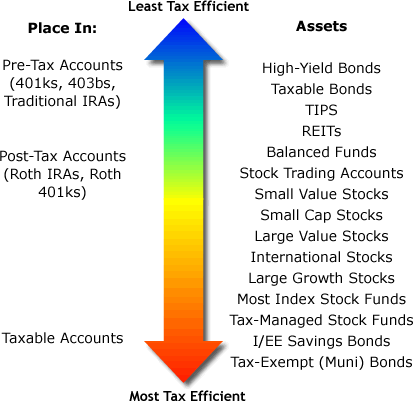
One big change for me over the last two years is that I now run out of room in my IRAs and 401ks each year and now have money sitting in taxable accounts. Since each asset class is taxed differently, where you put your assets can make a big difference in your net return. As a result, I’ve moved some things around. Here’s a handy graphic taken from a post about tax-efficient fund placement:

Chart of Relative Tax Efficiency of Assets

Stocks

US Total Market
I used to own Vanguard Total Stock Market Index Fund (VTSMX) but recently converted that to the ETF share version Vanguard Total Stock Market ETF (VTI) due to the lower 0.07% annual expense ratio. This fund tracks the MSCI US Broad Market Index, and typically holds the largest 1,200–1,300 stocks (covering nearly 95% of the index’s total market capitalization) and a representative sample of the remaining stocks. It currently holds 3,391 different companies. All for $7 a year for each $10,000 hold.

In my 401k, since I have limited options, I hold a mix of 75% Diversified Stock Index Institutional Fund (DISFX) which is basically a S&P 500 fund and 25% Fidelity Spartan Extended Market Index Fund (FSEMX) as it tracks the entire market minus the S&P 500. Together, the track the overall US market very well, at only a slightly higher cost of a weighted 0.25%.

US Small Cap Value
Here, I still hold the Vanguard Small-Cap Value Index Fund (VISVX). I could convert to the Vanguard Small-Cap Value ETF (VBR) with identical holdings and a lower expense ratio of 0.14% vs. 0.28%, but since it is only 5% of my portfolio I haven’t yet. In addition, there are good arguments for alternative ETFs such as iShares Russell 2000 Value Index ETF (IWN) or iShares S&P SmallCap 600 Value Index ETF (IJS). They each track slightly different indices and thus hold different stocks. Something to analyze deeper at a later time.

REIT
I still hold the Vanguard REIT Index Fund (VGSIX) as opposed to the Vanguard REIT ETF (VNQ). Both track the MSCI® US REIT Index. I hold this inside my IRA, so I’d rather just have full investment rather than worry about partial shares and such.

International / Total World excluding US
I used to hold Fidelity Spartan International Index Fund (FSIIX) but now hold the Vanguard FTSE All-World ex-US ETF (VEU) which tracks the FTSE All-World ex US Index and holds 2,239 stocks from around the world. There is the equivalent Vanguard FTSE All-World ex-US Index Fund (VFWIX) but since this is a bigger holding for me, the cheaper expense ratio makes a difference.

Emerging Markets
I converted to the Vanguard Emerging Markets ETF (VWO) from the Vanguard Emerging Markets Stock Index Fund (VEIEX). Even though my overall investment here is low, VEIEX has both a 0.25% redemption fee, and a 0.50% purchase fee, which is just too annoying to stay there. Another option would have been the iShares MSCI Emerging Markets Index (EEM), but it is both more expensive and has had more tracking issues. Here’s a EEM vs. VWO comparison post.

Bonds

Short-Term High Quality Bonds
I used to own the Vanguard Short-Term Treasury Fund Investor Shares (VFISX) but it now only yields 0.41% with an average duration of 2.2 years. If you had an IRA at certain banks, you could buy a CD earning 2-3% over the same time horizon. It would be just as safe. There would be less liquidity, but I’m not really concerned about that. The CD would be even better because you can’t lose what you put in.

I’ve actually gone ahead an put this portion of my portfolio in a stable value fund inside my 401k. I explored the risks and rewards of stable value funds, and while they are not of the utmost safety, the worst-case scenario is on the same order of the worst-case scenario of many short-term bond funds. My stable value fund is earning 3.5% for all of 2010.

I’ve also been looking at municipal bond funds such as the Vanguard Limited-Term Tax-Exempt Fund (VMLTX) and Vanguard Intermediate-Term Tax-Exempt Fund (VWITX) since they are mostly rated AA and above with interest being federally tax-exempt. If I lived in California and had a big bond allocation, I’d still consider a partial holding in the Vanguard California Intermediate-Term Tax-Exempt Fund (VCAIX) since the interest is higher and is exempt from both federal and CA income tax. I wrote about VCAIX in late 2009 when the yield was 3.49%. It’s done quite well since then, although California’s still got major issues to work out. If I lived in New York, I’d consider the same for NY funds.

Inflation-Protected Bonds (TIPS)
Here, the only thing to buy is either individual TIPS bonds or a mutual fund/ETF holding TIPS bonds. Usually buying individual bonds is risky because you aren’t spreading the default risk across hundreds of issuers, but in this case every single bond is just as safe and backed by the US government.

I have my Self-Employed 401k at Fidelity, which allows me to buy individual TIPS with no commission (just bid/ask spread). I bought some longer-term TIPS with real yields of 2-3%, and they’ve been doing well since real yields have dropped since. In addition, I hold shares of the iShares Barclays TIPS Bond ETF (TIP) because I can trade iShares ETFs commission-free at Fidelity.

The Vanguard Inflation-Protected Securities Fund Investor Shares (VIPSX) was also considered, along with new TIPS ETFs that have different maturities such as the PIMCO 15+ Year U.S. TIPS Index ETF (LTPZ).

Target Asset Allocation for Investment Portfolio

Asset allocation (AA) is an important part of portfolio design, and I like pinning down a target asset allocation for personal reference. This helps keep me focused as my portfolio shifts over time and makes it easy to re-balance back. For some educational posts on this topic, please refer to my asset allocation starter guide.

Below is my updated target asset allocation. Here is my target asset allocation from 2008. It’s not dramatically different, but I’ll try to explain the slight changes below. This is just my own AA, and I think everyone should develop their own based on their own beliefs and learning. If you just copy someone else’s without thinking, when things go awry you won’t have the foundation to stick to your guns. I have been strongly influenced by the writings of Jack Bogle, William Bernstein, David Swensen, Rick Ferri, and Larry Swedroe.

Stocks

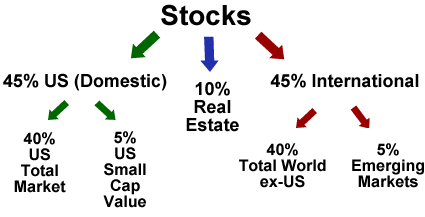
I separate things out first into stocks and bonds, and then later it’s easy to go 60% stocks/40% bonds and so on. Here’s my stocks-only breakdown:

  • I now do a 50/50 split between US and International stocks. In general, I would like to mimic the overall world investment landscape. On a market cap basis, the US stock market is now about 45% of the world, while everyone else takes up 55%. 50/50 is just simpler, with a slight tilt towards domestic stocks.
  • I consider REITs a separate real estate asset class. I used to put Real Estate under US stocks since I only held US Real Estate Investment Trusts (REITs), but in the future I would be open to investing in foreign real estate as property laws improve and investing costs drop.
  • On the US side, I add some extra small-cap value companies. Historically, adding stocks of smaller companies with value characteristics (as opposed to growth) has improved the returns of portfolios while lowering volatility. There is debate amongst portfolio theories as to why this happened and if it will continue.

    If you buy a “total market” mutual fund or ETF, you’ll already own many of these types of companies (although many will not be held due to their small size relative to the big mega-corporations). I feel this adds a bit of diversification.

  • On the international side, I add a little extra exposure to emerging markets. You may be surprised to know that “emerging” countries like China, Brazil, Korea, India, Russia, and Taiwan already make up 26% of the world’s markets when you remove the US. These are countries that have a greater potential for growth, but also lots of ups and downs. I add a little bit more than market weight for these as well.

Bonds

I try to keep things simple for bonds, partially due to the fact that they are currently a smaller portion of my portfolio.

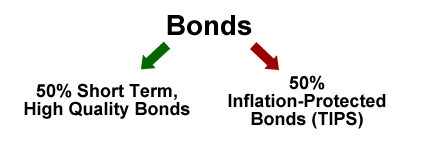
  • I like a 50/50 split between inflation-linked bonds and nominal bonds. Inflation-protected bonds provide a yield that is guaranteed to be a certain level above inflation. Nominal bonds pay a stated rate that is not adjusted for inflation. I like to balance the benefits of both.
  • Instead of only short-term US Treasuries for nominal bonds, I added some flexibility. I used to invest only in short-term US treasuries, as they provided the best buffer in my portfolio as they were of the highest quality and had a low sensitivity to interest rate fluctuations. Both TIPS and nominal Treasuries did great during the 2009 crash and the subsequent flight-to-quality, but now the yield on Treasuries is just too low in my opinion. There are trillions of dollars from countries and huge institutions around the world that are tucking their money away under the safe Treasury mattress. By venturing into other places they won’t with my tiny portfolio, I feel I can stay relatively safe yet increase my yield significantly. Possibilities include bank CDs, stable value funds, and high-quality municipal bonds.

Want more examples? Here are 8 model portfolios from respected sources, an updated Swensen portfolio, one from PIMCO’s El-Erian, and Ferri’s personal portfolio. Have fun!

Portfolio Manager Rick Ferri Shares Personal Portfolio and Asset Allocation

In a recent post on the NY Times Bucks blog, portfolio manager and author Richard Ferri shared his own personal portfolio. As a proponent of low-cost, passive investing, it was not surprising to see mostly index funds in his portfolio, but it was interesting to see that his overall asset allocation is 80% stocks and 20% bonds. He is quick to note that he does have a pension and defined-benefit plans which balance out his overall financial picture. Wouldn’t you like to know what all those financial advisors out there actually own?

Asset Allocation

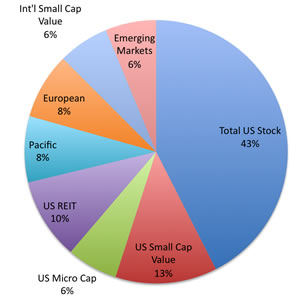
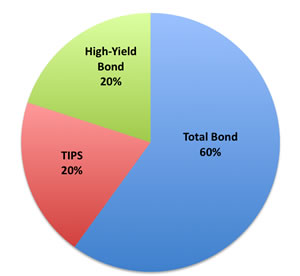
Here is his asset allocation broken down into stocks and bonds separately using pretty pie charts:

Stocks

Bonds

Here’s the overall 80/20 breakdown with ticker symbols (based on this Bogleheads post):

34% Vanguard Total Stock Market ETF (VTI)
10% S&P SmallCap 600 Value Index Fund (IJS)
5% Ultra-Small Company Market (BRSIX)
8% Vanguard REIT ETF (VNQ)

6.5% Vanguard Pacific ETF (VPL)
6.5% Vanguard European ETF (VGK)
5% DFA International Small Cap Value
5% DFA Emerging Markets Core
—- [alternative: Vanguard Emerging Markets ETF (VWO)]

12% Vanguard Total Bond Market Index Fund Investor Shares (VBMFX)
4% Vanguard Inflation-Protected Securities Fund Investor Shares (VIPSX)
4% Vanguard High-Yield Corporate Fund Investor Shares (VWEHX)

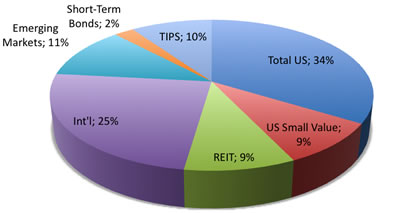
Reading his book All About Asset Allocation was very helpful in creating my own portfolio. (Also see Model Portfolio #3 taken from that book.) I haven’t been updating my own own portfolio asset allocation as diligently as I should, although I have been keeping track of it. Here’s the last snapshot I took:

Pie Chart of Investment Portfolio

I’ve had some asset allocation drift for sure, although I have been countering this by rebalancing with new funds. I really need an update…

Emergency Funds

It’s also interesting to note that he keeps an emergency fund of two years’ living expenses, and that he uses the Vanguard Short-Term Bond (BSV) with a current SEC yield of 1.08%. Very simple and almost no-maintenance.

I prefer using a mix of high interest savings accounts and longer-term CDs/rewards-type checking accounts. I figure that index fund investors get so excited by saving 10 basis points (0.10%) on mutual fund, but with a bit of work you could beat a short-term bond fund by 100 basis points (1%) with what I would call less risk.

Bond funds still have risk to principal, meaning you may have to sell for less than you bought in for, while FDIC-insured bank accounts do not. Money market funds are currently averaging less than 0.10% yield.

Stable Value Funds – Exploring Risks and Rewards

The last time I wrote about stable value funds was in late 2008, both before the 2009 crash and a time when most of my 401k was in stocks. This time around, as I was trying to figure out how to rebalance my larger portfolio in a tax-efficient manner, I took another look at this asset class found almost exclusively in defined-contribution plans like 401ks. According to the Stable Value Investment Association (SVIA), approximately 15 to 20 percent of 401(k) assets are in stable value funds.

What are Stable Value Funds?

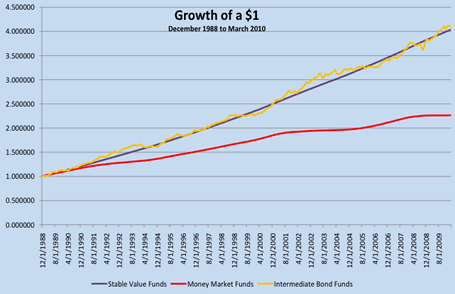
Generally, stable value funds are a bunch of bonds which have a insurance “wrapper” around them which protects it from interest rate volatility. The intended result is a product that pays the higher interest rates of intermediate-term bonds, with the liquidity and stable day-to-day price of a money market fund. Think “cash but pays higher interest”. A chart from the SVIA [pdf] illustrates:

The Attraction

Here’s my current situation. The stable value fund in my 401k has a guaranteed net interest rate in 2010 of 3.50%. The low-cost Vanguard Intermediate-Term Bond Index Fund Investor Shares (VBIIX) currently yields 3.17%, but will have a moderate amount of price volatility, especially if interest rates rise. The Vanguard Prime Money Market Fund (VMMXX) currently yields 0.11% with its high-quality, ultra-short-term holdings and Vanguard backing.

I could get the stability of money market fund, with an interest rate more than 3% higher! (All yields are net of fees.)

The Risks

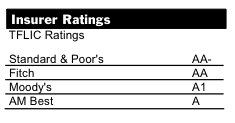
Higher interest rates with no price volatility? Free lunch? Not quite. First of all, any guarantee is only as good as the entity doing the guarantee. Check the safety ratings of the insurer of your fund. Mine is Transamerica Financial Life Insurance Co. (TFLIC):

Not the greatest, but not bad. In addition, there are actually several ways an insurer can get “out” of the contract. From the SVIA FAQ:

Are there instances when book value or contract value does not apply?
There are a few, limited instances when participants do not get book value from a stable value fund. These limited instances are typically contractually defined. One such instance typically not covered is security defaults or downgrades. In order to protect the integrity of the stable value fund, most contracts incorporate investment guidelines establishing minimum credit quality requirements for the underlying securities. These contracts have established mechanisms to address downgraded or defaulted securities that fall outside the contractual guidelines.

Corporate-initiated events, which are employer-driven events such as an early retirement program, layoff, or bankruptcy, are also typically not covered. Corporate-initiated events generally cause withdrawals in masse from a stable value fund. These withdrawals can negatively impact investors and plans that choose to remain in the fund.

First up, if the underlying securities turn out to be utter crap via a default or credit downgrade, then the insurance doesn’t apply? Wait, the insurer gets to choose the securities in the first place? Sometimes smells here. In fact, this happened in 2009 to the insurer State Street, although they decided to step in to make investors whole in order to preserve their reputation. Via this CBS Moneywatch article:

In December 2008 and January 2009, State Street elected to provide support – a total of $610 million – to the bond portfolio in stable value funds the company managed. State Street was not contractually obligated to do this. As the company’s 8-K filing (a report filed with the SEC to notify investors of any events that could be of importance to shareholders) stated, “liquidity and pricing issues in the fixed income markets” so affected the accounts that the wrappers “considered terminating their financial guarantees.” State Street’s action to bolster its portfolios kept the wrappers in place.

Finally, there is the “corporate-initiated event” of a huge layoff or bankruptcy. At the end of 2008, Lehman Brothers infamously went bankrupt, which left their stable value fund managed by Invesco with a negative return of 1.7 percent in December and an annual return for 2008 of 2 percent. In April 2009, a stable value fund for Chrysler employees only paid out 89 cents on the dollar, a drop of 11% due to the company’s troubles.

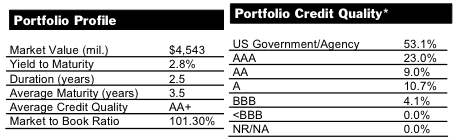
As you can see, there is a lot of things that can invalidate the guarantee. So, the next step is to understand the holdings, which in the event of a liquidation can help you imagine your worst-case scenario. You should be be able to see at least an overall breakdown of the assets, and a market-to-book-value ratio must be disclosed at least once a year. This will show any discrepancies between what the insurer says is worth $1 and what the market says. My TFLIC stable value fund’s market-to-book ratio was 101.30% as of March 31s, 2010 and here is their holdings summary:

Bottom Line

In good times, the stable value fund has a pretty easy job of maintaining an image of price stability and paying out the stated interest rate. However, when the poo hits the fan there are a lot of ways the insurance wrapper can be worth less than a bubble gum wrapper. The only real good news is that you are still left with some intermediate-term, investment-grade bonds. Even with the upheaval of 2009, the worst example I could find was a drop of 11%. Even Lehman Brothers investors ended up with a overall positive return for the year. These losses are not insignificant, but something the order of the drop in other similar bond funds during that time. The key is to understand the risks that you are taking, which oftentimes people don’t (including me).

As for my personal investments, after doing my bit of due diligence, I am going to put a small percentage (less than 5%) of my total assets in my stable value fund, given the limited alternatives in my 401k. I am willing to take the risk of a small loss in order to earn 3.50% for all of 2010 in this current interest rate environment.

Undo a Roth IRA Conversion For Profit – Tips & Tricks

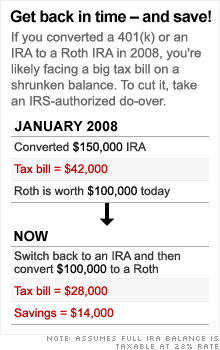
Did you know that if you do a Traditional to Roth IRA conversion, that you can undo it? This “do-over” process is called recharacterization, and can come in very handy if the value of your investments drop significantly after your conversion since you owe income taxes based on the value of the IRA at the time of conversion. With the recent market volatility, this may apply to many investors as it did previously in 2008/2009.

Take the example below, from a 2009 CNN Money article but still applicable. Let’s say you had a Traditional IRA valued $150,000 at conversion, which later on drops to $100,000. At the end of the year, you’d have to pay taxes on $150k of income and also be stuck with the lower account value. By performing an “undo” and “redo” the conversion, you could pay income taxes on only $100,000 of income instead of $150,000 – a savings of $14,000 at the 28% tax rate. (Find your 2010 tax bracket.)

There are some ground rules, however. The IRS says you can perform a recharacterization until October 15th of the year following the year you converted. So if you converted in April 2010, you have until October 15, 2011. If you want to re-convert, you have to wait either 30 days after the recharacterization or until the tax year after the conversion year, whichever is later. Again, if you converted in April 2010, you’d have to wait until January 1st, 2011 to reconvert. If you wait too long in between, it is possible your account value might be even higher than before. Still, something I’ll be keeping an eye on.

(You must still meet the Roth conversion eligibility rules, previously based upon your modified adjusted gross income. In 2010, there are no income limits. In 2011 and beyond, there currently are no income limits either, but it is unknown if this will remain the case. Also, only for 2010 conversions are you allowed to split the income over 2011 and 2012, which can lower your overall tax bill based on tax brackets.)

More Advanced: Multiple Roth IRAs

How can you set yourself up to best take advantage of this “redo” opportunity? I recently read in a sample issue of Kiplinger’s Retirement Report that you should split your Traditional-to-Roth conversion into multiple IRAs for each asset class you own.

For example, you might split a $200,000 IRA into $100k of stocks and $100k of bonds. If the stocks go down to $80k while the bonds go up to $120k, just to a “redo” on the stock IRA and leave the bonds IRA alone. Assuming the values stay the same upon re-conversion, that would save you income taxes on $20,000 ($5,600 at a 28% tax rate) as compared to not splitting up the IRA since if you just converted it a single IRA, the total value remained $200,000 ($80k+$120k). Tricky!

Traditional to Roth IRA Conversion at Vanguard

So, you’ve done your research, read the articles, crunched the numbers, and you want to convert your Traditional IRA held at Vanguard into a Roth IRA. But, how do you actually do it at Vanguard.com? There is no explicit “Convert” button or link to run this conversion. After some fumbling around, I managed to figure it out. But why not just share it here in mind-numbing detail and hopefully save folks some time.
You’ll need to have both a Traditional and Roth IRA set up at Vanguard first (mutual fund only). If you don’t have the Roth yet, click on the “Open an Account” link on the black bar on the top of every page and open an account first. Be sure to indicate that the funds you’ll use to open the new account are “At Vanguard”.

After you already have both a Vanguard Traditional IRA and a Vanguard Roth IRA:

  1. Log in to your account online. Click on “My Portfolio” so that you can view all your accounts.
  2. Under your Traditional IRA section, click on “Buy & Sell”.
  3. Next, click on “Exchange” on any of your funds.
  4. Now, you can choose to Exchange from all your Traditional IRA funds, to funds in your Roth IRA. You may need to add a new fund.
  5. For the exchange amount, if you are doing a complete conversion, chose All. You may be asked to verify and accept any redemption fees.
  6. You’ll also need to choose your tax withholding options. In order to maximize my balances in these tax-deferred accounts, I chose not to withhold and to pay the taxes separately myself later from a taxable account. Also, I can spread the taxes due for a 2010 conversion over two years.
  7. At the end of the next available business day, your mutual funds will be exchanged into your Roth at their net asset values. Your Traditional IRA will still show up with zero balances, which you can hide from displaying.
  8. Your conversion is complete! Keep your transaction confirmations for tax time.

Keep on reading below for some of the warnings and notifications that you’ll encounter during the conversion process.

A conversion is a taxable event. Generally, you’ll owe taxes on the amount you convert from your traditional, SEP-, or rollover IRA into a Roth IRA.

When you convert to a Roth IRA, you may elect to withhold Federal and certain state taxes. You can get the most benefit from the conversion if you don’t have taxes withheld and instead pay taxes from a separate nonretirement account. Keep in mind that the money withheld for taxes isn’t part of the conversion, and, if you’re under age 59½, you may have to pay a 10% federal penalty tax on it. You also can’t “recharacterize”, or restore to a traditional IRA, the amount you withhold. If you choose not to withhold, you may need to make estimated tax payments to avoid an underpayment penalty.

We encourage you to consult a tax advisor about your individual situation. For 2010 conversions only, you have the option of postponing the tax due and paying it off over two years. If you choose this option, taxable income from the conversion gets split evenly between 2011 and 2012. Alternatively, you can choose to pay all the conversion income in 2010.

Moving money out of a retirement account is a distribution, and all or a portion of your distribution may be subject to federal or state tax. You can elect to have either no federal income taxes withheld from your Vanguard IRA® distribution or a percentage between 10 and 100. If you don’t elect to have income taxes withheld from your IRA distribution, you’ll remain liable for income taxes. Tax penalties may also apply if your estimated income tax payments or income tax withholdings are insufficient under federal or state rules.

Is Generic Financial Advice Helpful or Hurtful?

Good financial advice is hard to come by. There are so many variables, such that you have to find the balance between providing enough information, and making things digestible enough that peoples’ eyes don’t glaze over.

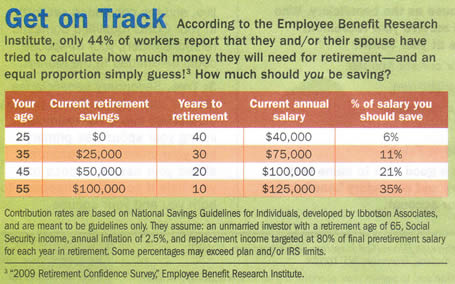
Check out this advice column found in the newsletter that comes in my 401k statement each month. Can you spot what’s missing?

There is no mention of what investment vehicle you should be sticking your money in, or even how much they estimate your future returns to be. Is it 100% stocks? 50% stocks/50% bonds? Orange juice futures? 6% returns? 12% returns? Who knows. Is this pre-tax or post-tax? Is it all in tax-sheltered accounts? Is my annual income supposed to rise as sharply as the chart seems to imply? I selfishly hope so!

Yet, I feel like this is what a large percentage of workers want to read. One impossibly simple chart that defines your retirement needs. So someone gives it to them. Maybe it gives them a general idea of where to start. But is a vague, possibly wrong answer better than guessing? I feel another poll coming on…

Is Such "One-Size-Fits-All" Financial Advice Helpful?

View Results

Loading ... Loading ...