2010 Non-Deductible Traditional IRA Contribution Made

I talked about taking some “action” in my last net worth update. We both contributed $5,000 each to a non-deductible Traditional IRA earlier this week. In doing so, I was reminded of how some folks can be intimidated by the amount of IRS fine print you must read every time you try to achieve some tax savings. Perhaps it is a small minority, especially of people reading this, but still significant.

Just to figure out if we were allowed to contribute took some searching. Per this IRS flowchart, because we are married filing jointly and will most likely have a modified adjusted gross income (MAGI) over $177,000, we are unable to contribute to a Roth IRA. How many people know what their MAGI is? In this world of spiraling credit card debt, how many people are willing to try to figure it out?

However, anyone can contribute to a Traditional IRA, even though it doesn’t explicitly state that anywhere. Then the question is whether it is tax-deductible. From this other IRS flowchart, because we are married filing jointly, covered by a retirement plan at work, and have an MAGI of over $109,000, I figure out that our contribution is not tax-deductible.

Finally, I happen to know in 2010, there is no income limit on the conversion from a Traditional IRA to Roth IRA. I must rely on the many mentions from financial media and investment brokers to know this. Even so, there are even more catches in terms of pre-tax and post-tax bits of the IRA to be converted.

I personally don’t mind all of this. But there must be a study somewhere that shows that every time a person has to walk themselves through an IRS flowchart, the overall IRA participation rate drops something like 5%.
Making an Early IRA Withdrawal From Vanguard

What if, for some reason, you really do need to make a withdrawal from your IRA before you are 59.5 years old? One example is withdrawing a Roth IRA contribution without penalty, which you can do at any time. Some folks were wondering how hard it would be to do so, so I just tried to withdraw $100 from my Roth IRA held at Vanguard. Would they put up a fight? Require forms signed by a notary public? Ask for a DNA sample?

It turns out, they simply subject you to a long series of confirmation screens. You can follow along yourself if you have an account too – just be sure not to click on that final “Submit” or you’ll actually do it!

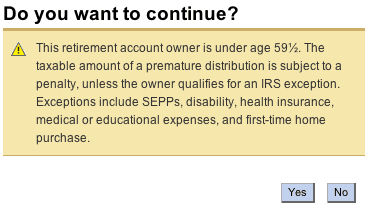
First, I logged into Vanguard.com, went to my IRA account, and clicked on “Buy & Sell” to try and sell some one of my mutual fund holdings (VEIEX for the curious). They immediately throw up a warning:

Bravely, I clicked “Yes”. On the next page, I could choose the amount to sell and how I’d like the proceeds sent to me:

  • Electronic bank transfer—Two business days if submitted before 4 p.m., Eastern time; three business days if submitted after 4 p.m.
  • Wire— The redemption proceeds will leave Vanguard by the close of business on the next business day; two days if processed after 4 p.m. Eastern time.
  • Check—Within 7 to 10 business days.

For some reason, the Wire option wasn’t available in the pulldown menu. Instead, I was given the option to exchange the money into a fund within my taxable account held at Vanguard. I went ahead and chose to send it directly to my linked bank account. This led me to the tax withholding page:

Tax withholding information
Moving money out of a retirement account is a distribution. Qualified Roth IRA distributions are not subject to federal income tax. All or a portion of nonqualified Roth IRA distributions may be subject to federal income tax.

You can either elect to have no federal income taxes withheld from your Vanguard Roth IRA distribution or request withholding at a rate between 10% and 100%. You will remain liable for payment of federal income tax on the taxable portion, if any, of your withdrawal. Tax penalties may also apply if your estimated income tax payments or income tax withholdings are insufficient under federal or state rules.

Since I am pretending to only withdraw a contribution, I chose not to withhold anything. Again, a warning screen appears:

Do you want to continue?
The transaction you have selected involves a premature distribution that is not due to death of the original IRA owner. This distribution will be coded and reported to the IRS as J—Early distribution from a Roth IRA.

Next up is a screen about whether you’d like a tax withholding notice sent to you via e-mail or snail mail.

Receive a tax withholding notice
Because you are completing a distribution from a retirement account, you may request a copy of the tax withholding notice. This notice is for informational purposes only.

Since my fund has a redemption fee, the next page reminds me that this fee will be taken out of the proceeds of the sale:

The Emerging Markets Stock Index Fund imposes a 0.25% redemption fee on the total amount of this redemption.

I acknowledge all this, which finally leads me at the last confirmation page.

Review & submit
Your Vanguard® fund redemption will be processed using the closing share price on the business day on which Vanguard receives your request. Requests received after the close of the New York Stock Exchange (usually 4 p.m., Eastern time) will be processed using the next business day’s closing price.

That’s it! I quickly click on Cancel, and no action was taken.

Summary

In less than 2 minutes, I was able to request an early withdrawal online from my Vanguard IRA. No humans, no forms to send in. Good to know. Taking 2-3 business days directly into my bank account seems fair enough. A wire transfer would be even faster, although there would likely be a fee involved.

Should I Dip Into Savings To Max Out Roth IRA?

It’s getting very close to April 15th, which in addition to tax returns is also the funding deadline for IRAs in the 2009 tax year. A reader wrote in asking whether they should dip into their savings in order to fully fund their Roth IRA contribution for the year. I would imagine this is a common scenario this time of year.
Let’s say that your income is under the phase-out limits and you can contribute the full $5,000. (See this IRS page for more info on limits.) Perhaps you’ve contributed $3,000 so far. You can either take the remaining $2,000 out of your other accounts (emergency fund, car repair fund, sell stocks, etc.) and fully fund the entire $5k, or simply stop where you are.

An important fact to know here is that anyone can withdraw their Roth IRA contributions at any time, without penalty. (This means just your original contributions, not any earnings on those contributions.) However, you cannot retroactively make contributions to past years. In my example above, you couldn’t just contribute $5,000 + $2,000 = $7,000 next year.

Thus, if you feel that you would likely be able to max out in future years, it may be better to simply make your contributions now. It would be quite sad to miss out on a one-time opportunity for tax-free earnings forever! If you do need the money later, you can always withdraw it again. The early withdrawal process is not that complicated, although you will have some additional paperwork to fill out come tax time.

More details about the actual IRS fine print in this post: Can I Really Withdraw My Roth IRA Contributions At Any Time Without Tax Or Penalty?

There are always some possible wrinkles, of course. If it is truly an cash-under-the-bed emergency fund, you should know it make take a few business days to make an IRA withdrawal. In addition, if you really do foresee needing the money, then you may want to invest in conservative options like CDs or money markets. If you are selling stocks, you may be subject to taxes on capital gains. But you buy the same stock in the Roth IRA, you’ll be able to defer taxes on future gains.

Changing 401k Contribution Rates During Year, Catch-Up Contributions

401k company matches are great ways to boost your retirement savings, but sometimes you have to be careful in order to capture it all. My wife’s company offers a 3% match, but only up to 3% of whatever you contributed that pay period. What if you contribute less than 3% for some period, and then a much larger amount a later period, with the overall total being much more than 3%? With some plans, you are simply out of luck and have missed out on potential money. Other plans offer what is called a “catch-up” or “true-up” contribution. Do you know which one you have?
I wrote about 401k true-up contributions and maxing out 401ks earlier, but finally got my hands on the employer’s Summary Plan Description which addresses it explicitly. Luckily, my OCR software was working, and I scanned it in below:

Is a year-end Matching Contribution provided if I changed my saving percentage during the year?

If you are employed by the Employer on the last day of the Plan Year, a true-up calculation is made so that your Matching Contributions will be maximized even if you changed the percentage of your Compensation that you elected to contribute during the Plan Year. The amount, if any, of the true-up Matching Contribution is the excess of (i) 100% of your Employee Contributions for the entire Plan Year that do not exceed 3% of your Compensation for the entire Plan Year that was paid to you while you were eligible for Matching Contributions, over (ii) the total amount of Matching Contributions already contributed to your Account for the Plan Year.

For example, John was eligible for Matching Contributions for all of 2010. John, who earned $40,000 evenly throughout the year, did not elect to contribute to the Plan from January 1 to June 30, 2010. From July 1 through December 31, 2010, John made Employee Contributions of 12% of his Compensation (12% of $20,000 = $2,400), and received Matching Contributions of $600. His year-end Matching Contribution is calculated as (i) minus (ii), as follows:

(i) 100% of John’s Employee Contributions to the Plan for the entire year that do not exceed 3% of his Compensation for the entire year. 100% x 3% x $40,000 = $1,200

(ii) The total amount of Matching Contributions already contributed to his Account for the year = $600

Year-end Matching Contribution to John’s Account for 2010 = 1,200 – 600 = $600

The year-end Matching Contribution generally is contributed to the Plan within a few months after the end of the Plan Year. hi some cases, IRS rules limit or reduce the amount of Matching Contributions the Employer can make on your behalf if you are Highly Compensated, as defined in Question 1, above. You will be notified if you are affected by this limit or reduction.

An important note here is that, at least for this plan, you must be employed on the last day of the Plan Year in order to be eligible for this catch-up contribution.

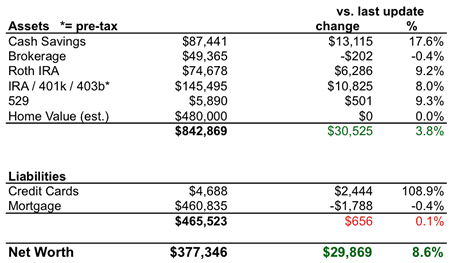
Net Worth & Goals Update – March 2010

Net Worth Chart 2010

Lack of Recent Updates
Up until last December, I had done regular monthly updates of our net worth for five consecutive years. However, recent personal events made me much less interested in detailed, analytic planning towards early retirement. As a result, I have barely checked any of my statements in the past few months, other than to make sure they weren’t negative. I think I made a few trades here and there, but for the most part haven’t bought or sold any stocks to maintain my asset allocation. I haven’t even converted my Traditional IRAs to Roth IRAs like I had planned, or made any IRA contributions for 2010.

Instead, reading blogs and other financial news has simply been a recreational escape for me, and I think my blogging has reflected that. I still had fun learning about ways to save money here and there, and enjoy keeping track of other market changes and various offers out there.

However, it’s time to catch back up a bit! Here we go…

Credit Card Debt
In the past, I have taken money from credit cards at 0% APR and placed it into online savings accounts, bank CDs, or savings bonds that earn 4-5% interest (much less recently), and keeping the difference as profit. However, given the current lack of great no fee 0% APR balance transfer offers, I am currently not playing this “game”. My balances are simply monthly charges that I have not yet paid in full when due.

If you’re looking for a competitive offer, Citibank is offering 0% APR for 15 months with a 3% balance transfer fee.

Income
We’re both still working, but will be taking some unpaid time off in April which will reduce income temporarily. Our monthly expenses are still much less than our (regular) income, so while we may eat into savings a bit, I expect to bounce back into the positive very quickly.

Retirement and Brokerage accounts
Near the end of last year, I had gradually moved $30,000 into a brokerage account at OptionsHouse to invest in ETFs due to their $3.95 trades. In my usual way, I then thought about switching instead to WellsTrade since I now had the $25,000 required to get 100 free trades per year. Stuff happened, the application process took too long, I got distracted, and the money is still sitting mostly non-invested. Grrr.

As stated above, besides our regular 401k contributions, we haven’t made any real moves in our retirement accounts either.

The stock market has done relatively well in the meantime, with the S&P 500 nearly hitting 1,200. Our total retirement portfolio is now $269,538 or on an estimated after-tax basis, $233,164. At a theoretical 4% withdrawal rate, this would provide $777 per month in after-tax retirement income, which brings me to 31% of my long-term goal of generating $2,500 per month.

Cash Savings and Emergency Funds
We continue to keep a year’s worth of expenses (conservatively set at $60,000) in our emergency fund. It’s still a nice warm safety blanket. I am thinking of moving a chunk of it into several separate 5-year CDs from Ally Bank, as they pay 1.60% APY (as of 10/25/13) and each would have a small early-withdrawal penalty of only 60 days interest.

Home Value
I am no longer using any internet home valuation tools to track home value. After using them for a year, I went back to simply taking a conservative estimate and focusing on mortgage payoff. After checking them again today, I am staying away. A house nearby sold recently for $500,000 but is listed at both Zillow and Coldwell Banker as being sold for $1,000,000. Needless to say, it is skewing my home value estimates!

It would seem that I am currently long on thoughts and short on action. Time to fix that.

Morningstar Lifetime Allocation Indexes

Morningstar recently started publishing their Morningstar Lifetime Allocation Indexes, which are designed as benchmarks for mutual funds that shift their asset allocation as a target retirement date nears. An example is the Vanguard Target Retirement 2045 fund (VTIVX), a buy-and-hold fund designed for those retiring around the year 2045.

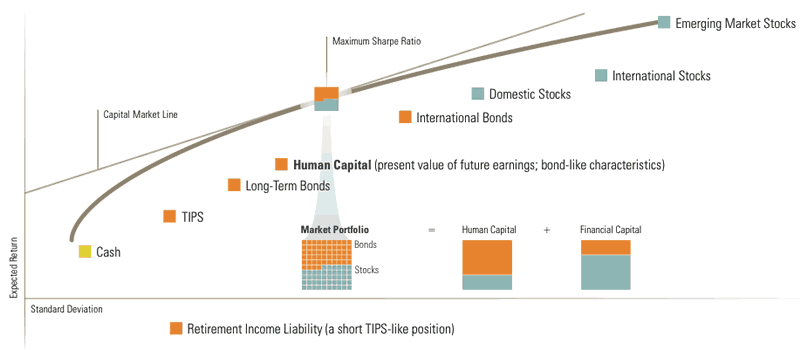
Created using historical performance data with Ibbotson Associates, the indexes provide asset allocations that are optimized based on Modern Portfolio Theory. The asset classes included are US and international stocks, US and international bonds, inflation hedges like TIPS and commodities, and cash. However, the interesting part is that their “efficient frontier” optimization model incorporates the idea of human capital, which is defined as the present value of a person’s future earnings.

Here is a chart from their factsheet explaining the idea (click to enlarge):

Accordingly, there are 13 indexes with three different risk profiles – aggressive, moderate, and conservative. It is recommended that you choose the proper profile not based on your love of risk-taking, but based on the quality of your human capital:

Human capital is defined as the present value of a person’s future earnings. This ability to work and earn money over time is like a giant bond that provides fairly stable cash flows. The human capital bond is not investment-grade for all investors however. Some investors have stable income streams and thus should have a higher capacity for market risk. Others have income streams that are more sensitive to economic conditions and should therefore have a more conservative financial asset allocation.

Without further ado, you can view all the asset allocations here. I’ll probably make a nice graph out of this later. For now, let’s say I wanted to retire at about age 50 in the year 2030, and I feel my human capital is moderately stable. The Moderate 2030 asset allocation looks something like this:

84% Stocks
— US 57%
— International 27%
10% Bonds
— US 10%
6% Inflation Hedges
— Treasury Inflation-Protected (TIPS) 1%
— Commodities 5%

I don’t really have any further thoughts on it, besides the fact that I don’t think we should necessarily base everything on historical returns. It might be better to try and figure out the source of those returns. Otherwise, it’s just another data point to add to the many model asset allocations out there.

2010 Roth IRA Income Limits Effectively Removed

Okay, let’s try this again. There are no longer any income phase-outs on Roth IRA conversions from Traditional IRAs. As in previous years, individuals or couples with a modified adjusted gross income (MAGI) over a certain limit are ineligible to contribute directly to a Roth IRA. In 2010, the phase-outs begin at $105,000 for single filers and $167,000 for those married filing jointly.
However, with no conversion limitations, people with any income can simply contribute to a Traditional IRA and then convert that to a Roth IRA immediately afterwards.

This is great news for those higher income earners who have been previously unable to contribute to a Roth IRA. In addition, if you have been contributing to a non-deductible Traditional IRA in previous years, you can now finally convert those already-taxed funds into a Roth IRA, which is almost as good as retroactively contributing to a Roth IRA. You’ll only have to pay taxes on any gains you earned on the contributions, not the actual contributions themselves since they were already taxed before. (With the recent market performance, that isn’t much of a problem for most of us…)

One additional wrinkle is that if you have a mix of pre-tax and post-tax contributions inside all of your combined Traditional IRA funds, you cannot convert them separately. For example, if you have a mix of 50% pre-tax and 50% already-taxed funds, then any converted amount will be assumed to be 50% pre-tax and 50% post-tax. You can’t just convert the post-tax part. This could be one reason not to roll over all pre-tax 401k funds into a Traditional IRA whenever possible.

More info: IRS Publication 590, “What’s New for 2010”

2010 Roth IRA Income Limits Removed

Due to stupid errors in my original post, I have gone ahead and written it over. Please see my updated post: 2010 Roth IRA Income Limits Effectively Removed.

15-Minute Resolution #5: Check the Asset Allocation of your Investment Portfolio

Here’s the next installment of my series on New Year’s Resolutions that can be done today, and not put off for “some day” in the future. We all know how that usually turns out…

Last year was definitely a roller coaster year when it came to the stock market, and you may have taken the “just don’t open the scary statements” solution. Well, it’s time to take a peek and see where you stand. I won’t pretend that recent performance has been great, but if you made regular contributions throughout, you may be surprised to see your portfolio balance higher than it was in 2007. (Maybe.)

Asset allocation is how your investments are split between different asset classes. The most generic examples are stocks and bonds, but you can also divide them further into categories like large companies vs. small companies, international vs. domestic stocks, or different safety grades of bonds. Other asset classes include real estate, commodities, or precious metals. Your mix of assets has a great impact on the volatility and expected future return of your portfolio.

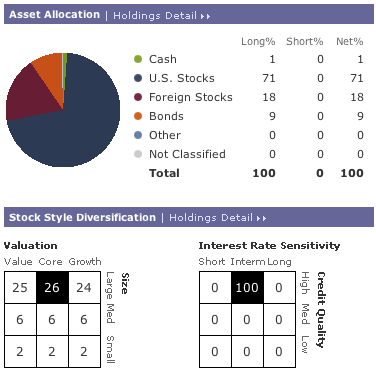
The easiest way is gather all your most recent financial statements and plug your holdings into the Morningstar Instant X-Ray tool.

(If you want it to remember your portfolio, you must sign up for a free site membership.) The site will then “x-ray” your holdings and break it down by asset class:

How do I know if my asset allocation is correct?

Well, ideally you would already have set your target asset allocation, and all you would need to do is to rebalance your assets to that target. Rebalancing is a way to maintain the risk/reward balance that you have chosen for your investments, and also forces you to buy temporarily under-performing assets and sell over-performing assets (buy low, sell high). How often one should re-balance their portfolio depends on a few factors. See this post on How often should I rebalance my portfolio?

Otherwise, setting an asset allocation can be a very complex topic. I recently pondered a very general rule-of-thumb where you set your stock percentage to double your tolerable loss in one year. So if you could only stomach a 30% stock, you should only invest a maximum of 60% of your portfolio in stocks.

Here’s a big collection of my posts that I did when deciding on my own target asset allocation:

Simplified Theoretical Stuff

  1. Disclaimer and General Philosophy
  2. Consider Simply Buying The Entire Market
  3. Efficient Frontier and Modern Portfolio Theory

Choosing An Asset Allocation

  1. Deciding On The Stocks/Bonds Ratio
  2. Deciding On The Domestic/International Ratio
  3. Considering The Diversification Benefits Of Small and Value Stocks
  4. Equity Asset Allocation: Comparison of 8 Model Portfolios
  5. Investing In Real Estate Through REITs?
  6. Interim Target Asset Allocation: Looking Back & Some Decisions

…See the rest of my 2010 Instant New Year’s Resolutions here!

15-Minute Resolution #1: Save More For Retirement

Do you feel you aren’t saving enough for retirement? Worse, do you feel like what you should be saving for retirement is some huge number you’ll never reach? I think such daunting numbers are what kept a lot of my younger co-workers out of the 401k plan completely.

How about 1% then? Let’s see how much 1% is for a household with a single earner making $50,000 gross per year. For simplicity, let’s say they live in a state without income tax like Texas. If you are paid bi-weekly, putting away $500 pre-tax annually (1%) into a Traditional 401k amounts to an additional $19 reduction per paycheck. If you do live in a state with income tax, the actual paycheck difference will be even smaller.

I know that even this may be hard for some families, but keep in mind this money is still yours and you’re just using the 401k or IRA container to save you taxes. Now, if you’re convinced that you can handle this (and I hope you are), then go right now and either fill out the proper form from Human Resources or go online and submit for a change. As for the investment choice, if you are undecided consider just going for the target-date option for now until you learn more.

Most importantly, increase your contributions by 1% today! Now you can say in 2010 you started saving more for retirement.

Fine Print
I kept things simple above so you don’t get bogged down. You might be satisfied with your current contributions, or you might want to put away more than 1%. Even better, you might get a matching contribution from your company, which will boost your savings even further. On the other hand, what if my 401k has horrible investment options? Or what if you don’t have a 401k/403b at all? You can start an IRA with just a $50 per month commitment with a low-cost provider.

What about Traditional vs. Roth? Check out this Video Post: Roth IRA vs. Traditional IRA.

You may find that if you haven’t maxed out your Roth IRA for 2009 or 2010, then you may want to do that instead of the 401k because Roth IRA contributions can be taken out at any time without penalty (but not earnings).

See all the 2010 Instant New Year’s Resolutions here.

80% off Restaurant.com: $25 Certificates for $2

Restaurant.com is offering a 80% off with the coupon code SANTA until 12/25 , resulting in a $25 “certificate” for just $2. (Update: Promo code CHEER is good until December 31st, 2009.)

Despite my initial skepticism about these things, many readers responded that they indeed found these certificates very useful in savings some money.

Here’s how the savings math might work out. You find a restaurant on the list that you like that usually runs around $20 + tip per person (~$48 for a couple). You buy a $25 certificate for $2, which usually comes with a $35 minimum purchase + 18% required gratuity on full price.

Dinner for two = $40 regular menu price
Minus $25 certificate = $15
Plus cost of certificate ($2) = $17
Plus 18% gratuity on menu price = $7.20Total price = $24.20, or $12 a person including tip

$12 including tip is pretty good for a dine-in restaurant, with the primary caveat being that you find one on their list that you like (or the gift recipient likes).

How Does Your Target Retirement Fund’s Glide Path Compare?

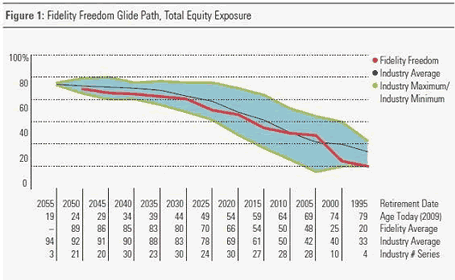
Inside this recent Morningstar article about the pros and cons of Fidelity’s Freedom Funds was an interesting chart that incorporated data from all of the target-date retirement funds. These funds were getting really popular as a set-and-forget type of investment, until many people found found out in 2009 that their risk tolerance didn’t necessarily mesh with the what the investment company thought it would be.

A fund’s “glide path” is how they shift their asset allocation to be more conservative as time goes on and they near the retirement target date. A very general way to measure this is to take the percentage of the fund invested in equities (stocks).

As you can see, there can be a significant variation between the industry maximums and minimums for each year. Fidelity’s fund tend to be near the average, perhaps a tiny bit below most of the time. I looked at Vanguard’s funds, and they are also very close to the average. TRP’s glide path is almost always above the average, but not by more than 5-10%.

You can see the specific glide path chart of other funds with a Morningstar Premium membership (see below). However, you can always use the free Instant X-Ray tool with the ticker symbols from your own series of funds and plot it yourself. How does yours compare?

This is just one component of what you should be looking at when choosing between fund choices, with other examples being cost (expense ratio?), equity breakdown (international exposure?), and bond breakdown (quality?). Of course, some of us are just stuck with one choice in our 401k/403b plans.

List of the 20 most popular target date funds:

* AllianceBernstein Retirement Strategies Target-Date Fund Series
* American Century LIVESTRONG Target-Date Fund Series
* American Funds Target Date Retirement Target-Date Fund Series
* DWS LifeCompass Target-Date Fund Series
* Fidelity Advisor Freedom Target-Date Fund Series
* Fidelity Freedom Target-Date Fund Series
* ING Solution Target-Date Fund Series
* John Hancock Lifecycle Target-Date Fund Series
* JPMorgan SmartRetirement Target-Date Fund Series
* MassMutual Select Destination Rtmt Target-Date Fund Series
* MFS Lifetime Target-Date Fund Series
* Oppenheimer Transition Target-Date Fund Series
* Principal LifeTime Series Target-Date Fund Series
* Putnam RetirementReady Target-Date Fund Series
* Schwab Target Target-Date Fund Series
* TIAA-CREF Lifecycle Target-Date Fund Series
* T. Rowe Price Retirement Target-Date Fund Series
* Vanguard Target Retirement Target-Date Fund Series
* Vantagepoint Milestone Target-Date Fund Series
* Wells Fargo Advantage DJ Target-Date Fund Series