People love pensions because of the security that they offer – a steady, guaranteed stream of income that you can’t outlive. Another way to achieve this reliability is to buy an immediate annuity, also called an income annuity. It lets you convert a lump-sum payment into a regular stream of income payments that can last for your lifetime, or the longer of you or your spouse’s lifetime.
Although there are many factors that come into play, very generally immediate annuities pay about 6-7% of the lump-sum back to you every year. So if you bought a $500,000 lifetime annuity, you might get $35,000 every year until you die. You can also play with the quotes at ImmediateAnnuities.com for different ages and survivorship scenarios.
This is much higher than the “safe withdrawal rate” of 4% that many financial folks quote as the amount of your nest egg that you can spend each each without running out of money before expiring. 4% of $500,000 is only $20,000 per year. More info on safe withdrawal rates can be found here.
But remember, with an annuity the $500,000 is gone. If you live another 50 years or just one, after you die there is nothing left to inherit. Also, annuity providers are like life insurance companies in that you really need to make sure they are stable enough that they’ll be around to pay you! Look for ratings from A.M. Best Company, Moody?s, and Standard & Poor?s.
The last article I mentioned when talking about how pensions will be gone soon also suggested annuities as a possible reform to current retirement plans:
If defined benefits are on their last legs, then it would make sense to try to incorporate their best features into 401(k)’s. The drawback to 401(k)’s, remember, is that people are imperfect savers. They don’t save enough, they don’t invest wisely what they do save and they don’t know what to do with their money once they are free to withdraw it. Quite often, they spend it.
Here there is much the government could do. For instance, it could require that a portion of 401(k) accounts be set aside in a lifelong annuity, with all the security of a pension. Behavioral economists like Richard Thaler have demonstrated that you can change people’s behavior even without mandatory rules. For instance, by making a high contribution rate the “default option” for employees, they would tend to deduct (and save) more from their paychecks. If you make an annuity a prominent choice, more people will convert their accounts into annuities.
If you think of pensions as annuities, you can use this to get a feel for how much those pensions are worth! For example, let’s say you’re a teacher and about to retire with a pension paying 70% of the average of your highest 3 years of income. If that number is $50,000, then you’ll be receiving $35,000 every year. If you refer back a few paragraphs, you’ll remember that’s the same as having saved up half a million dollars! Now you see how pensions are so expensive.
Although I’m still far from retiring, I have started considering using part of my savings to by an immediate annuity in order to cover my most basic spending needs and reduce the risk of retiring early in the event of a turbulent stock market. It would be almost like buying my own Social Security safety net 🙂 But I’ll also need to learn more about how this plan should affect my current asset allocation. Some papers that are on my (really, really, long) reading list can be found here.
(There are also probably some tax considerations that I’m ignoring here.)
 One
One 

 I’ve always thought of 403(b)s as identical to 401(k)s, just for non-profit and educational institutions. But upon discussing this with a teacher, I found out that they can have their own unique problems: primarily high-priced annuities. Did you know that 80% of 403(b) funds are currently invested in fixed or variable annuities? This is really surprising, considering that annuities are usually only a good idea for high-income people who’ve already maxed out all their other tax-deferred options – why put a tax-deferred product inside another tax-deferred product?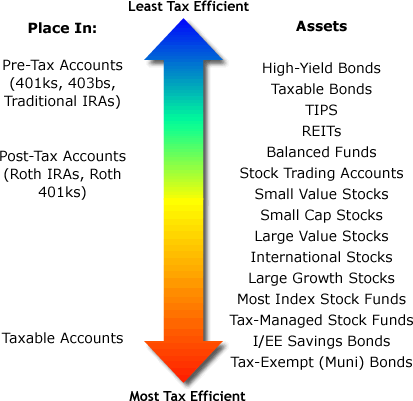
 Fidelity has a new tool called the
 The Best Credit Card Bonus Offers – 2025
 Big List of Free Stocks from Brokerage Apps
 Best Interest Rates on Cash - 2025
 Free Credit Scores x 3 + Free Credit Monitoring
 Best No Fee 0% APR Balance Transfer Offers
 Little-Known Cellular Data Plans That Can Save Big Money
 How To Haggle Your Cable or Direct TV Bill
 Big List of Free Consumer Data Reports (Credit, Rent, Work)