401k/403b Rollovers: Reasons To Stay Put With Your Old Employer’s Plan

One of the most common questions I get from people when they find out that I like personal finance is “What should I do with my 401k/403b/457 plan from my old job?” My own 401k rollover decision process was one of my first blogging topics. I eventually settled on rolling my 401(k) balance into an IRA at Vanguard, although I have since changed my specific investment choices. This time around, my wife has the ex-401k that needs to be addressed, and so I think it’s a good time to do a more in-depth series on 401k (and similar) rollovers.

To start off, should you really move your retirement plan somewhere else? I think you’ll see that in most cases the answer is yes, but there are some possible benefits to staying put. Here are a few:

Special investment options
While many 401(k) plans offer very limited or expensive options, some of them actually offer investments that you may not be able to get anywhere else. For example, your plan may give you access to a mutual fund that is normally closed to new investors, a special institutional or pooled fund with super-low expenses, or the ability to buy your company stock at discounted prices.

Lower minimum balances or fees
One benefit of many 401(k) is that there are often no minimum balance requirements to invest in an offered fund. For example, my wife might have as little as $10 in a Fidelity Spartan index fund with a tiny 0.10% annual expense ratio while it is in her 401(k), but in an IRA the minimum would be $10,000. At the same time, the account may continue to waive all maintenance fees even after you leave (check with your administrator.) Depending on where you move your money to, other brokers may charge fees for low balances.

Together, it may be a good idea to keep smaller portfolios in such a 401k until the balance grows enough to consolidate with other investments.

Ability to take out loans
Although not necessarily a good idea, many plans do offer the option of being able to borrow money temporarily from your 401(k). This option is not available in an IRA.

I probably missed something, so if you have some more reasons not to move your retirement plan into an IRA, please share in the comments below.

Dad’s Retirement Plan: Learning About The TIAA-CREF Traditional Annuity

While visiting the parents, I was also asked to provide some input on their retirement savings. I don’t want to invade their privacy, but I’m sure they share common concerns with others out there. My father, who is in the non-profit/education sector, has much of his retirement money with TIAA-CREF (Teachers Insurance and Annuity Association – College Retirement Equities Fund). They are one of the biggest financial services companies in the U.S., and are operated on a non-profit basis.
As you might guess from their name, a very popular option for members is the TIAA Traditional Annuity, holding over $163 billion. I was not at all familiar with this beast, so I decided to learn more about it. Here’s a quick rundown from the website:

A guaranteed annuity backed by TIAA’s claims-paying ability, TIAA Traditional guarantees your principal and a minimum interest rate, plus it offers the opportunity for additional amounts in excess of the guaranteed rate. TIAA has credited additional amounts of interest every year since 1948.

The annuity primarily invests in publicly traded bonds, commercial mortgages, direct loans to business, and real estate. It has no loads, no surrender charges, no maintenance fees, and very low annual operation expense ratios of about 0.25%. (Sources: SURS, Dixie State Univ. )

Accumulation Stage
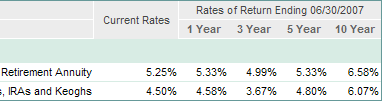
So you invest in this annuity, your account value will never decrease as long as TIAA is around. In fact, it will go up in value by at least 3% every single year, and most likely more depending on market conditions. Think of the savings on antacids during the next stock bubble! There are two tiers of performance – From what I understand, the higher paying tier is for money that is contributed directly by the employing company or group, whereas the lower paying tier is for voluntary contributions from the individual. Here are the historical returns:

altext

For comparison, the venerable Vanguard S&P 500 Index Fund (VFINX) has a 10-year trailing return of 7.05%, and the Vanguard Total Stock Market Index Fund (VTSMX) has a 10-year return of 7.60%. The Vanguard Total Bond Market Index Fund (VBMFX) has a 10-year return of 5.74%.

Withdrawal Stage
When you reach retirement and are ready to start take money out of your annuity, you have a variety of options. There are one-lifetime income options, two-lifetime income options, fixed-period (ex. 10-year) income options, interest-only payments, and also a few others involving taking a lump-sum or just the required minimum distributions.

Of course, all annuities are simply a promise, not a 100.00% guarantee. In this regard, TIAA does have the highest possible credit ratings from all the major agencies: A++ by A.M. Best, AAA by Fitch, Aaa by Moody’s, and AAA by S&P.

Summary
Overall, it was very interesting learning about this additional investment option. Here were my tentative opinions:

  • There is an expected trade-off of lower long-term performance in exchange for a guaranteed minimum return if you purchase this annuity. For those with longer time horizons and the discipline to ride out the market’s ups and downs, it may be better to invest in low-cost stock/bond mutual funds or ETFs instead. Those that are very risk-averse will love this investment.
  • The lifetime income options are nice and reliable, but you could also do the same with a portion or all of any retirement portfolio. Just cash out your stocks and bonds, and go buy an immediate annuity with a lifetime payout option.
  • Still, if you’re going to buy such an annuity, TIAA-CREF offers some of the best and safest returns along with the lowest fees available in the annuity marketplace.
  • As my father is nearing retirement and I think the safety of this investment is very comforting to him, I think this option will work adequately for him. The majority of his annuity holdings are also in the higher-paying tier. I am, however, providing him some guidance in the rest of his portfolio to provide some diversification, as well as telling him what questions to ask his group’s financial advisor.

Early Retirement Planning: Taking Early Withdrawals Without Penalty From Your 401(k) or IRA

A reader recently wrote me asking if there was any drawbacks to maxing out their 401(k) contributions as opposed to keeping the money in a taxable account. This is assuming you already have no debt, adequate insurance policies, and an emergency fund. Since his goal was to retire early, my initial concern was that the money would be stuck there until age 59 ½. (Why is it 59.5 anyways?) If you take money out of your retirement plans before then, you’d get hit with a fat 10% penalty on all withdrawals on top of the income taxes already owed. So perhaps it’d be a good idea to keep a chunk of money in taxable accounts for easy access?

But after some research it turns out that there are some exceptions to this penalty:

401(k) Early Withdrawals
If you have a 401(k), are at least 55 years old, and your employer allows it, you may be able to take out as much as you like without the 10% penalties. This is a case where you might want to keep your money in a 401(k), assuming that you are satisfied with the quality and costs of your existing investments. (You must quit at 55 years old or later, not any earlier. It’s a weird rule.)

IRA Early Withdrawals
Otherwise, once you stop working the best bet is to move your 401(k) funds into a Rollover IRA. A subsection of Internal Revenue Code Section 72(t) states that you can avoid early withdrawal penalties by taking “substantially equal periodic payments” (commonly referred to as SEPP or 72t withdrawals) for any type of IRA. The general rules for SEPP are as follows:

  1. You must make the withdrawals regularly, at least once every year.
  2. You must take them for either 5 years or until you reach age 59 ½, whichever is longer. Retiring at 40? You’ll need to make them for almost 20 years. Retiring at age 56? You’ll need to make them until age 61.
  3. You must wait until these equal payments end before you can start taking unrestricted amounts of money out of your IRAs.
  4. If you decide to do this, you can’t change your mind. If you do, you’ll owe a 10% penalty retroactive to your first withdrawal, plus interest!

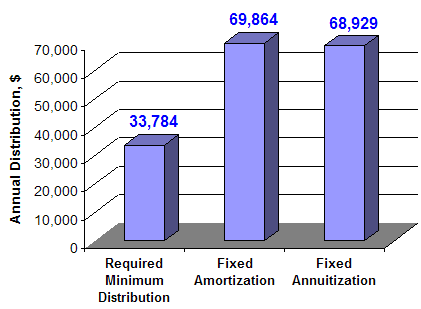
You must also calculate the amount of your SEPP according to three IRS-approved methods: required minimum distribution method, the fixed amortization method, or the fixed annuitization method. Let’s say you have a $1,000,000 IRA right now at age 55. Without going into the details here, here are the amounts according to this Dinkytown 72(t) calculator, for a single life expectancy at the current maximum “rate of reasonable return”:

altext

An added twist? If you have (or want to make) multiple, separate IRAs, you can take SEPPs from any or all of them. So in essence, you can withdraw anywhere from 0% to possibly 7% of your retirement balances annually. Naturally, you might not want to take too much out too early lest you run out of dough. But to me, this takes away much of the fear of having a large percentage of my money held hostage in my 401ks/IRA accounts if I decide to retire early.

I still need some huge balances to pull such a feat off though. For example, several studies suggest that a conservative withdrawal rate for a 40-year period is ~4% of one’s balances each year. I just need $3 million dollars in balances by the time I’m 55 to take out $120,000 a year (an estimated $56,000 a year in today’s dollars), and I’m all set! No problem…

For more information, here is one detailed resource I discovered from the Retire Early homepage.

June 2007 Investment Portfolio Snapshot: Paralysis By Analysis, Call For Suggestions

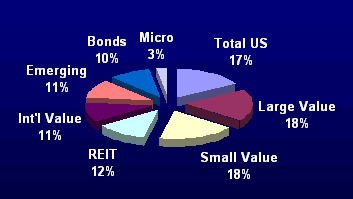
I haven’t posted my investment portfolio since April, mainly because it hasn’t really changed much. But here’s another snapshot:

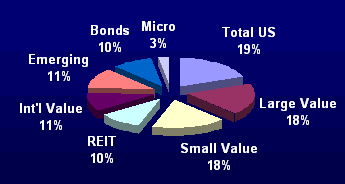
6/07 Portfolio Breakdown
 
Retirement Portfolio
Fund $ %
FSTMX – Fidelity Total Stock Market Index Fund $15,132 19%
VIVAX – Vanguard [Large-Cap] Value Index $14,567 18%
VISVX – V. Small-Cap Value Index $14,251 18%
VGSIX – V. REIT Index $8,163 10%
VTRIX – V. International Value $8,686 11%
VEIEX – V. Emerging Markets Stock Index $8,929 11%
VFICX – V. Int-Term Investment-Grade Bond $7,616 10%
BRSIX – Bridgeway Ultra-Small Market $2,126 3%
Cash none
Total $79,470
 
Fund Transactions Since Last Update
Bought $1,000 of FSTMX on 6/26/07 (23.759 shares)

Thoughts
Another couple of months have gone by, and my desire to re-define my asset allocation remains unfulfilled. All I did was buy some more of a Total US Market fund (FSTMX) through my self-employed 401(k). You’d think someone who writes about money on a daily basis would be on top of such things!

But really, I think I might actually be spending too much time on this. As Jack Bogle has stated, “The greatest enemy of a good plan is the dream of a perfect plan.” There is no perfect asset allocation, and I know that. I keep telling myself, I’m not looking for the perfect plan, just a better one which has been well-reasoned out, and one which I should have little reason to tinker with for a long time.

To achieve such a better plan, I have been re-reading each of my favorite investing books on top of many new ones (including All About Index Funds by Ferri, Unconventional Success by Swensen, Only Guide to a Winning Bond Strategy You’ll Ever Need by Swedroe), looking at their research, comparing their model portfolios, and trying to balance all the advice given. But after all these months, my slow deliberation has really just turned into what academics call “paralysis by analysis” and have been just been putting off making a decision for weeks. I do have some overall changes planned, including:

  • Increasing my allocation to international assets,
  • Decreasing my value tilt, and
  • Increasing my bond allocation.

I want to avoid trying to time the market, or chasing recent performance. But I also don’t want to base my decisions on simply trying to avoid the impression of trying to time the market. Although I’m always open to suggestions, I feel I need to some fresh input. Got an asset allocation suggestion? Ideas on a better value/size/country tilt? Another book to read? Throw it at me.

Does Living Longer Mean We Should Change Our Asset Allocation To Include More Stocks?

Recent articles by Bernstein Wealth Management [pdf] and Kiplinger’s Personal Finance suggest that as we continue to live longer lives, this should increase the percentage of our portfolios that we devote to stocks.

Living Longer…
A 2000 study by the Society of Actuaries states that a male who reaches age 65 has a 50% chance of living beyond age 85 and a 25% chance of living beyond 92. Women can expect to live two to three years longer than men. More importantly for couples, you are now looking at a 50% chance of one of you living beyond 92!

Means Some Potential Changes
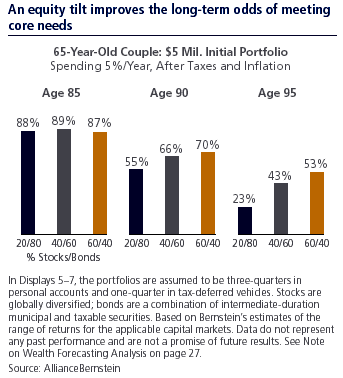
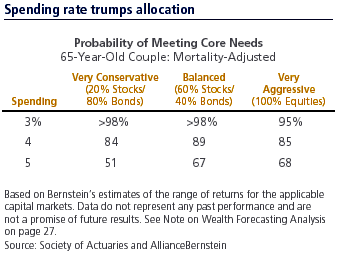
Bernstein then ran some Monte-Carlo simulations using historical data (for what years, I couldn’t tell) to “help quantify the impact of alternative allocation and spending decisions over varying time periods and markets.” The basic scenario was a couple who retired at 65. The variables were how aggressive the portfolio was (20%-100% in stocks), and how much you withdraw from the portfolio each year (2-7%). Here are two summarizing charts and some of their findings:

altext
altext
  1. If you’re going to spend a relatively high percentage like 5% of your portfolio, it is important to keep your stock percentage at least at 60%. But, increasing it to all the way 100% doesn’t help much, and increases the downside in a bear market.
  2. At a low spending rate, like 3%, then your stock percentage doesn’t matter that much either way.
  3. Although spending and allocation are both critical factors, the former tends to exert a more powerful influence. Simply working a bit longer in order to delay spending can increase your success rate significantly.

Conclusions
Taking into account these findings, the Bernstein paper concludes that although bonds are a traditional safe-haven for retirees, their increased longevity make the growth from stocks important throughout one’s lifetime. They suggest that a proper compromise between these factors is a portfolio of 60% stocks and 40% bonds, along with a 4% spending rate. This gives the couple an 85% chance of having their money last till death.

Glassman of Kiplinger also makes his own suggestions:

Bernstein emphasizes that individual clients’ needs differ. Certainly, but based on this report and other research, I have decided to raise my suggested quick-and-dirty stock allocations for retirement accounts this way: If you’re under 40, there’s no reason not to own a 100%-stock portfolio. Between ages 40 and 60, you can move to an 80-20 stock-bond ratio. Between age 60 and retirement, shift to keep at least 60%, and in most cases closer to 70%, in stocks.

This is much more aggressive than almost all the Lifecycle or Target-dated Funds (see here for a comparison between Vanguard and T. Rowe Price Target Retirement funds.)

My concern would be that with so much in stocks, when people “fail”, they fail by a lot, whereas with bonds it might be easier to compensate for a slow stock market by working part-time. I’m undecided as to if this study will cause me to make any changes.

OpenCourseWare: Fundamentals of Personal Financial Planning

While reading this month’s issue of Kiplinger’s Personal Finance magazine, I found that UC Irvine offers a free online course on the Fundamentals of Personal Financial Planning:
This course was produced by a generous grant from the Certified Financial Planner Board of Standards and by the Distance Learning Center at the University of California, Irvine under the OpenCourseWare Initiative. The purpose is to make widely available to the general public a course designed to provide a comprehensive but easily understood overview of personal financial planning.

This course is not intended to replace the professional financial planner, but to help to make the general public better consumers of financial planning advice. It tries to help those who cannot afford extensive planning assistance to better understand how to define and reach their financial goals and provides basic understanding so they can make informed decisions. The course can also be seen as a reference for individual topics that are part of personal financial planning.

While it seems to be a pretty good basic resource for novice investors, I was actually disappointed as I was hoping to see some of the actual courses one would have to take to become a Certified Financial Planner (CFP). Is it heavy on the math? Mostly memorization? I’ve toyed with the idea of becoming a financial planner before, but it always seems like it would be hard to start out anywhere else besides a commission-based sales job.

Realistic Goal For Graduates: Accumulate Double Your Annual Salary By Age 40

Enough with the fluffy stuff, how about some firm numbers. Imagine that a young college grad actually has the forethought to even think about what they need for retirement. They check out an online retirement calculator, and see their needed amount is… 5.7 bajillion dollars!1 Shocked, they shake their head, walk away, and promise themselves to revisit it again in a few years… hopefully.

A more attainable goal: You should aim to accumulate double your salary by age 40. Doesn’t that sound more reasonable? This is the solution proposed by this Wall Street Journal article A $1 Million Retirement Fund: How to Get There From Here. (Thanks Don for the tip.) Why double?

Let’s say your salary has hit that $80,000, you have amassed $160,000 in savings, you are socking away 12% of your pretax income each month and your investments earn 6% a year. Over the next 12 months, your $160,000 portfolio would balloon to $179,518, or $19,518 more. Your monthly savings would account for $9,600 of that growth. But the other $9,918 would come from investment gains.

In other words, you’ve got to the crossover point, where the biggest driver of your portfolio’s growth is now investment earnings, not the actual dollars you’re socking away.

My only beef is that the math in the article is a bit vague. First, the article means double your expected salary at age 40, by age 40. Now, is the 6% assumed return supposed to be real or nominal? Are we assuming this is all in a 401(k)? How much inflation-adjusted money will this give you at age 65?

However, the main points remain. Money saved now will be worth a lot more than money saved later. Once you generate a “critical mass” in your retirement funds, they really do seem to gain a life of their own.

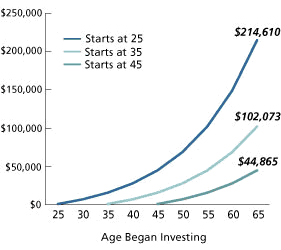
The graph on the right shows three investors, each of whom invests just $1,000 a year until age 65. However, one begins at age 25, investing a total of $40,000; one at age 35, investing a total of $30,000;
and one at age 45, investing a total of $20,000. Each earns 7 percent per year and, for purposes of this illustration, the effects of taxes and inflation are ignored.

The result? The early bird ends up with more than double the one who waits until age 35 and more than four times the one who waits until age 45.2

I’ve certainly experienced this. As our own retirement balances have grown, the recent stock gains alone are often thousands of dollars each month. So what are you waiting for? Get started with just $50 per month!

1 Actually if you plugged in 21 years old and $40,000, the goal would be $2,591,000. Still big!
2 Source: Investment Company Institute

Trying To Avoid Lifestyle Inflation

Most of this post was originally published last year when I was a guest writer at the Get Rich Slowly blog. I have since made some revisions and added some more material below.

One common thread through my How much house should I buy? post is that whatever size house you get, you’ll expand to fill it up. This reminded me a lot about what I call “lifestyle inflation” – the phenomenon where no matter how little or how much someone earns, their spending tends to match their income.

When you were a student, your friends were also broke, and it was easy to eat frozen pizza for dinner and manage without a car. That was probably one of the funnest periods in your life! But when you have more money, you start looking to upgrade: a nicer car, a bigger house, brand name clothes, cooler gadgets. Why? Call it peer pressure, entitlement, or simply money burning a hole in your pocket.

As we progress along our career paths, here are a couple of things that my wife and I are trying to do in order to keep our lifestyles in check:

  • Put saving first. You?ve heard it before, but that?s because it?s works. Pay yourself first. If you get a raise, immediately increase the percentage going into your 401k, IRA, or brokerage account. The less that?s ending up in your bank account, the less you?ll have the urge to spend.
  • Put debt last. Making more does not mean you should borrow more, contrary to what the credit card companies or other lenders may suggest. If you have debt, pay it down. If you don’t, keep it that way.
  • Living on one income. Our dream goal has always been to be able to both work half-time in order to have more time to raise our future children. If this can?t happen, then one of us will work while the other stays home. This is a conscious decision to actually make less money, in order to focus on the more important things in our life. Of course, we’ll have to work double-hard now in order to make our hourly income high enough to pull it off!

    In the meantime, even though both of us are currently working, we are still trying to live as if we only had one income. Over the last 12 months, we saved 43% of our after-tax income.

  • Buy an affordable house. For most people their largest monthly expense is housing. Affordable does not mean what the bank will let you borrow! By simply buying the biggest house possible, you?re also inflating many other things. You have to furnish all those extra bedrooms, heat them every winter, cool them every summer, and insure them. As we plan to live in a very expensive area, this rule will probably be the hardest for us not to break, especially on one income.
  • Be realistic about cars. Probably the second largest monthly expense for many, I am always amazed when people’s car payments are more than half of their housing payments!! But I also know that a new luxury car means more than just higher monthly payments. It means higher insurance premiums, maintenance costs, and repair costs. It also likely has a bigger engine, which means less fuel economy, and may even require premium-grade fuel. Neither of us have ever owned a new car before, which helps keep our expectations low.

It may seem contradictory that we are moving to an area where the median home price is over $600,000, but that choice is predominantly due to a desire to live near family. In the end, we are trying to define a comfortable, simple lifestyle that focuses on what is really important to us. (Of course, we will won’t lead completely spartan lives…) The things that we buy on a $75,000 salary shouldn?t be much different than if we had a $750,000 salary. For example, my wife cuts my hair because I like having a simple haircut, it?s not difficult, and she does it how I like it. Even if we become millionaires someday, I think she?ll still cut my hair. I’ll let you know when we get there 😉

Vanguard Simplifies Low-Balance Fees, and Even Eliminates Them With Electronic Statments

Vanguard has just announced some changes to their fee schedule, which includes some great news for us smaller investors who like Vanguard but kept getting dinged by their low-balance fees.

Before, you had to dodge the following $10 fees:

  • The maintenance fee on index fund accounts with a balance of less than $10,000.
  • The custodial fee on traditional IRAs, Roth IRAs, and SEP?IRAs with a balance of less than $5,000.
  • The low-balance fee on all nonretirement accounts with a balance of less than $2,500.

These have all been replaced with a single account service fee of $20 annually for each Vanguard fund with a balance under $10,000. Okay, that’s not too special. The good news is that if you agree to get electronic versions of statements and other documents, all the fees are waived!

The waiver is available immediately, so switch now 🙂 If you have $100,000 in total balances, you’re also fee-free. I already have everything set to deliver electronic format, so I’m all set. (Also you save lots of trees! Those prospectuses are thick.) In addition, you can still choose the “E-delivery and mail year-end-statement” option and get the fee waiver. That’s perfect for me.

I’ve always felt the $10 fees were justifiable, as if you were paying for things a la carte, because otherwise at 0.20% of say $5,000, that’s just $10 a year for IRS filings, paper, printing, postage, great customer service, and so on. Still, they were annoying. Even though my wife and I together have over $60,000 invested with Vanguard, we were still being hit with fees.

Now I’m less likely to switch to Vanguard’s ETF offerings, as I was considering for the future when I start putting money into taxable accounts. I prefer the simplicity of mutual funds.

April 2007 Investment Portfolio Snapshot

It’s time for another bi-monthly update on my investment portfolio.

4/07 Portfolio Breakdown
 
Retirement Portfolio
Fund $ %
FSTMX – Fidelity Total Stock Market Index Fund $12,599 17%
VIVAX – Vanguard [Large-Cap] Value Index $14,082 18%
VISVX – V. Small-Cap Value Index $14,146 18%
VGSIX – V. REIT Index $9,229 12%
VTRIX – V. International Value $8,294 11%
VEIEX – V. Emerging Markets Stock Index $8,040 11%
VFICX – V. Int-Term Investment-Grade Bond $7,726 10%
BRSIX – Bridgeway Ultra-Small Market $2,086 3%
Cash none
Total $76,202
 
Fund Transactions Since Last Update
Bought $1,500 of FSTMX on 4/5/07 (36.773 shares)

Thoughts
Not much going on, I have been contributing a $500 a month to my Solo 401k while trying to build up my cash hoard for a house downpayment. I still plan on tweaking my asset allocation, but I’ve just been distracted by other things and kind of want to wait a full year before making any changes.

All of our Vanguard funds are held at Vanguard.com, where there are no commissions for trading their mutual funds. Currently, everything there is in Roth IRAs, one each for my wife and I. Even though Roth IRAs rock, we haven’t contributed to one this year yet because we might be over the income limits for 2007.

The Fidelity fund is also held in-house at Fidelity, where I have my Self-Employed 401k. Funds are also no transaction fee (NTF) there. It’s a bit annoying that both their Spartan Total US and International funds have high $10,000 minimums, but the 0.10% expense ratio is nice. I could also trade ETFs, but at $20 a trade it’s a bit expensive.

You can see some older posts on how this portfolio came to be here, as well as my previous portfolio snapshots here.

Six Key Principles of Saving for Retirement

Ben Stein has an good read on Yahoo Finance about what he terms the Six Key Principles of Saving for Retirement. Although I agree with all six main ideas, I question some of the specific numbers. Here are some excerpts and my comments:

1. How much you save.
Simply put, if you’re a typical American (who happens to save close to zero right now), you have to save more. When you’re young, 10 percent of your income will get you there. If you don’t start saving until middle age, aim closer to 15 or 20 percent. If you don’t start until later than middle age, save every penny you can.

Interesting. Is 10% really enough? If so, maybe I really am saving too much for retirement. 🙂 To what degree of certainty is that true?

2. How long you give your savings to compound.
A thousand dollars socked away when you’re 20 and growing at 10 percent per year will be almost $73,000 when you’re 65. The same sum saved when you’re 50 will grow to $4,200 at age 65. That’s a stunning truth that should compel any young person to start saving early — and the rest of us to start right now.

As for timing your retirement, Ray advises that if you can push it back by even five years you’ll allow your money to grow and have fewer years to need it.

Compound interest is truly powerful. A dollar saved now is worth more than a dollar saved later.

Although it hasn’t been helping me control my spending as much as I’d like either, I did make the horribly unpopular true cost of frivolous shopping calculator. 😉

3. How you allocate your assets.
Typically, for those who start early, stocks are the answer. Over long periods, a diversified basket of common stocks wildly outperforms bonds, cash, and real estate. The differences are breathtaking.

But, as we’ve seen lately, there’s also a lot of volatility in stocks. As you age, you’ll want more of your money in bonds and money market accounts. These have lower returns than stocks, but they also have far lower volatility.

Phil DeMuth recommends that, as a basic portfolio, you have half of your savings in the broadest possible common stock index such as the Vanguard Total Stock Market Index (VTSMX) and half in the Vanguard Total Bond Market Index (VBMFX)… To me, that’s a bit conservative if you’re young. I would have more in stocks and also a good chunk in international markets.

Here is a compilation of various model asset allocations from other respected sources. Pretty pie charts included!

4. How much your investment returns annually.

Now, this is largely unknown from year to year. But over long periods, stocks return close to 6.5 percent after inflation, and about 10 percent before inflation.

Can we expect 6.5% real returns in the future? Lots of conflicting opinions out there on this, but I really want to look into this more.

5. How low you keep your fees and costs.

This principle is largely about using index funds and no-load mutual funds, which makes perfect sense.

Costs matter, whether you go actively or passively managed. I’ve seen some really expensive index funds. Always look up the expense ratios and any commissions you have to pay either when you buy or when you sell for all the investments you own.

6. How closely you keep an eye on taxes.
Finally, Ray advises maxing out your tax-protected accounts like IRAs and 401(k)s; keeping high-dividend stocks in accounts that are tax-deferred; and, when retiring, carefully considering what bracket you’ll be in and drawing out your funds to remain in the lowest possible one.

Ah, taxes. Here is a discussion on where you should place investments for maximum tax-efficiency.

J.D. of Get Rich Slowly also shared his thoughts on these six points, and believes the most important factor in retirement savings is psychological.

A Warm Slice Of Humble Pie

slice of pie, image credit: http://www.mcpies.comI’ve been trying recently to try and make some minor adjustments to the target asset allocations of my portfolio. I want to create something that I won’t be tempted to change again for many years. While attempting this, I keep noticing how hard it is for a beginning investor to try and figure out where to put their hard-earned money. So many websites, books, magazines, television shows… and the amount of information being thrown at you just seems to multiply daily. Everybody has an opinion, including me. Am I right?

Who knows? I don’t. I’m simply doing the best anyone can do – read a steady stream of books, academic studies, participate in discussions, and then making a decision based on that information. I try look at the bigger picture and draw conclusions based on historical studies going back from the 1920s and not five-year historical returns. But none of us can predict the future.

What is accepted as common knowledge often changes with time. My own views shift as I read more. I also see a lot information out there that I disagree with. Therefore, I encourage everyone to do their own due diligence, keep their minds open, question things, and try to separate the wheat from the chaff for themselves. All I can do is to promise that I will try to keep doing the same.

(This will be added to my compilation of posts about managing money called My Rough Guide To Investing.)