 Still no house yet. But I have been reading about mortgages, and one common debate amongst mortgage holders is whether to send in extra money towards the principal in addition to the required monthly payments. Usually, the argument evolves into these two opposing views:
No, you shouldn’t pay extra because:
If you put that money in stocks instead, you would most likely get a higher return on your money in the long term. Mathematically, paying down a mortgage is like leaving money on the table.
Yes, you should pay it down because:
Stock market returns aren’t guaranteed, whereas paying down the mortgage is guaranteed savings. Debt is a burden, and it’s hard to put a price tag on the psychological benefit of owning your house free and clear.
Now, I understand both of these views, and in the big picture, I really think if this is what you’re worrying about then you’re already ahead of the game. You might even think you already know which view I personally lean towards. But what if there was another perspective that satisfied both sides?
What happens when you pay extra towards your mortgage?
With a mortgage, your monthly payments are amortized, which means each one includes a portion that goes to pay interest and a portion to pay down your remaining loan balance, or the principal. If you make an extra payment towards principal, then this in turn directly decreases the amount of interest you’ll be paying in the future.
So if you pay $1,000 towards your mortgage with an interest rate of 6%, then you’re saving $60 of interest that you would have otherwise had to pay every single year for the rest of your mortgage term.
Put differently, it’s like you’re earning an after-tax return of 6% every year on your money.
But wait, what about the tax benefits of mortgage interest?
Yes, mortgage interest is tax-deductible, but you have to temper this with a few realizations:
- Everyone already gets the standard deduction, which in 2007 is $5,350 for singles, and $10,700 for married folks. Only the amount that your itemized deductions exceed this amount actually saves you money.
- The amount of interest you pay on your mortgage decreases every year, so your tax benefit will decrease as well over time.
For example, let’s say you are a married couple with a $250,000 mortgage loan balance for 30 years at a fixed 6% rate, and in the 25% income tax bracket. $250,000 x 6% is only about $15,000 of interest paid in the first year. Subtract out the standard deduction of $10,700, and your additional deduction is only $4,300. So you’re only saving 25% of $4,300 and not the whole $15,000. This means your 6% interest rate only goes down to the equivalent of about 5.6%. In addition, according to the standard amortization schedule your annual interest paid will go down to less than $11,000 in year 15. So after 10-15 years, your mortgage deduction will be less than the standard deduction, leaving you with possibly no benefit at all.
Now, if you have a large mortgage or have lots of other itemized deductions, then your tax benefits may be much more significant. In this case, your equivalent interest rate may be extraordinarily low. But for many homeowners, it’s not as large as they might think. (If you have a ton of other itemized deductions, also be wary of the AMT.)
For this example, you could be conservative and say that paying extra towards your mortgage is only earns about a 5.5% annual after-tax return for the rest of the scheduled term of the loan.
A fixed rate of return, every year, for a long time. Hmmm… that sounds like a bond! In comparison the 30-year Treasury bond is currently yielding only 4.88%. After a 25% federal tax, that return is only 3.66%! I choose Treasury bonds because they also contain essentially zero risk of default.
In other words, paying down your mortgage can very similar to holding an attractively-priced long-term bond. (If you have a rock-bottom rate, it could also be an unattractive bond.) So maybe that’s how we should treat it. Just like you don’t compare stocks directly to bonds because they have different risk/reward relationships, perhaps we shouldn’t compare paying down a mortgage to stocks either.
Right now, I currently hold about 10% bonds in my retirement investment portfolio. My prospective interest rate is around 6% if I get a mortgage. I could simply decrease my position in bond mutual funds and put that money instead towards paying extra towards a mortgage. When looking solely at my mutual fund accounts, this would result in my percentage of stocks increasing. This way, I can potentially get the best of both worlds:
- I’m improving my overall investment portfolio. I am essentially buying a bond that brings me a return higher than what is otherwise available, perhaps by up to 1-2 percentage points. I do lose some liquidity as I can’t get my money out without taking a home equity line of credit and paying additional fees. But as long as it’s not my whole bond allocation, I can still rebalance as needed. My intended bond allocation will only increase as I get older, in any case.
- I also pay my house off earlier, complete with all the happy fuzzy feelings attached. 😀
What if you don’t own any bonds? Well, if you’re the type of person who’s 100% stocks, then you’re probably so confident in the markets that you wouldn’t want to pay down your mortgage early anyhow. If you do want to pay it down, then consider it a small allocation to bonds that will lower the overall volatility of your portfolio.
Now, this doesn’t mean that paying down a mortgage should be a higher priority than things like maxing out your IRA, paying down higher-interest debt, or even an emergency fund. But it does provide me a way to pay down my future mortgage without having to worry that I am losing money somewhere else.
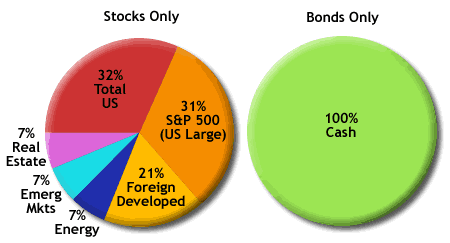
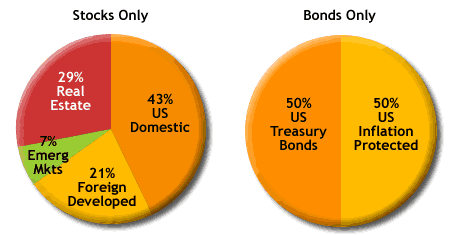 (Hurrah, I found my software disks so I can make pretty pie charts again!)
 It’s time to examine my mom’s 401(k) plan. The first thing that I wanted to do was to get an idea of what kind of fees she was paying. There are three basic types of fees, according to the Dept. of Labor:
 Let’s continue with the 401k/403b Rollover discussion. Previously, I explored some
  The Best Credit Card Bonus Offers – 2025
 Big List of Free Stocks from Brokerage Apps
 Best Interest Rates on Cash - 2025
 Free Credit Scores x 3 + Free Credit Monitoring
 Best No Fee 0% APR Balance Transfer Offers
 Little-Known Cellular Data Plans That Can Save Big Money
 How To Haggle Your Cable or Direct TV Bill
 Big List of Free Consumer Data Reports (Credit, Rent, Work)