Choosing An Asset Allocation, Step 2: Deciding On The Domestic/International Ratio

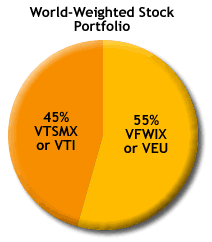
I don’t know if this is the proper next step, but after deciding on a stock/bond ratio for myself, I want to think about the specific breakdown of stocks (equity). As mentioned when talking about investing in total markets, you could simply “own the world” using just two funds or ETFs and weighting them according to market capitalization – using one Total US fund and one All-World Except-US fund:
altext

If you use the ETFs, the total weighted expense ratio would be a mere 0.17% annually!

Concerns About Investing Abroad
However, according to various surveys the average US investor has much less than 55% of their equity portfolio in international stocks. Here are a few reasons that have been cited:

  • Country/political risk – This includes the possibility that the economy of certain countries could collapse due to war or other internal strife. Also many governments have less oversight and transparency than the US and other developed countries.
  • Currency risk – These days it seems like people want to hedge against a falling dollar, but only recently people were worried about a strengthening dollar affecting international investments. Either way, it does add an element of risk.
  • Added cost – Investing in international mutual funds usually cost more in management fees.
  • Existing exposure – Some statistics show that a very large chunk of revenue from US-based companies now come from outside our borders, so even without adding international companies we are already being exposed to many of the same effects. This also explains the recently increasing correlation between domestic and international stocks.
  • Performance-chasing – Recently international funds have been on a very good run. Some believe this is the main factor in increasing foreign exposures, as opposed to fundamental factors.

Historical Risk/Reward Relationship – Benefits of Diversification
On a very general level, the reason to invest in international stocks as it pertains to Modern Portfolio Theory is that you get a diversification benefit. Historically, international stocks in general have had higher average returns, but also higher risk (volatility). But due to low-ish correlation, mixing domestic and international stocks has resulted in less risk and greater return.
[Read more…]

Choosing An Asset Allocation, Step 1: Deciding On The Stocks/Bonds Ratio

Last time I did a really simplified overview of Modern Portfolio Theory. Much of the credit for this is due to a fellow name Harry Markowitz, who figured out that if you combine two assets with the same return that aren’t perfectly correlated, this diversification can result in reduced risk without reducing return. Even if you don’t combine two assets with the same return, combining two assets that have low correlations (don’t move together) will get you a better reward/risk ratio. Markowitz later won a Nobel Prize for his work in this area.

Stocks vs. Bonds
Studies have shown that somewhere between 77% and 94% of the variability in portfolio returns are determined by asset allocation. So our goal is to use asset classes with low correlation to get the best reward/risk ratio. One of the most popular examples of assets that have low correlation is stocks and bonds. Accordingly, adjusting your ratio between stocks and bonds is one of the most basic ways to adjust the amount of risk you wish to take in a portfolio.

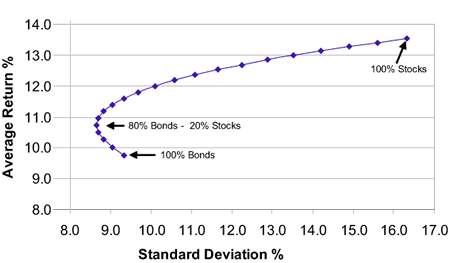
The chart below shows the risk/return trade-off between bonds and stocks for 1980-2004. The stock portfolio is represented by the S&P 500 index, while the bond portfolio contains 60% five-year Treasury notes and 40% long-term Treasury bonds. The portfolios range from 100% bonds, to 95% bonds/5% stocks, 90% bonds/10% stocks, all the way to 100% stocks. (via this AAII article)

altext

[Read more…]

Building My Portfolio: Efficient Frontier and Modern Portfolio Theory

Building upon the idea of investing in broad markets, next up is Modern Portfolio Theory. This is another advanced topic that entire careers can be built around, but here is my attempt to explain it in one quick digestible chunk.

Risk vs. Reward
As far as investing goes, the most basic component we have is cash. If we invest it in a Treasury bill from the government (as riskless as possible), then we will end up with a return after inflation of zero. You just keep up with inflation. No risk, no reward. In order to increase our reward we, must take on more risk. But it’s not a linear relationship. We want to find the mix of investments that offer the best mix of risk and reward. So again we turn to history and whip up some math. (I’ll go easy on the numbers here.)

Reward = Return
The idea of reward is usually represented by the historical average annual return of the investment. Sounds good to me.

Risk = Standard Deviation
The idea of risk has many possible definitions. Stocks are seen as riskier as bonds, because their prices have historically fluctuated much more wildly. For example, for domestic stocks, your best year would be +39% while your worst year would be -28%. In contrast, for a broad bond portfolio, your best year would have been +31% while your worst year would be -8%. (Source: Vanguard) A mathematical way to measure this volatility is standard deviation. The larger the standard deviation, the higher the risk.

Mix ‘Em Up
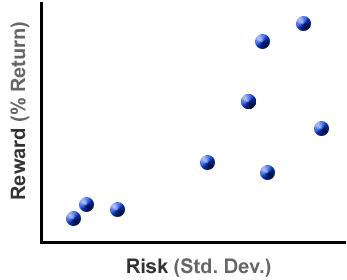
An asset class is a group of investments that exhibit similar characteristics. If we plot their historical returns vs. historical standard deviations, we might get something like this:

altext

One dot might be the S&P 500. Another dot might be 1-Year Treasury Bonds. Now, what if we starting mixing them up into in various ratios. Like taking 50% S&P 500, 25% US Small Cap, and 25% 5-Year Treasury Bonds. We’ll get a whole lot more dots, err… data points:
[Read more…]

Building My Portfolio: Disclaimer and General Philosophy

I am starting a new series of posts that describes how I will reconstruct my current investment portfolio from scratch, from general theory to the actual purchasing of specific mutual funds. Here I want to reiterate the point of this blog – This is how I am thinking of investing my money, not necessarily how I think you should do it. In other words, I don’t claim to be an expert, I just think sharing is fun and hopefully there will be a good debate and overall knowledge will be increased. You don’t really often get to see someone juggling a real portfolio across a multiple Roth IRAs, 403bs, 401k, and taxable accounts. It will also keep me organized and motivated as I’m been putting this off 🙂

General Philosophy
Here are some quick insights into how I approach investing. You’ve all read this ominous phrase before:

Past Performance Does Not Guarantee Future Results

Well, you know what? All we have is past performance. The important thing is to look back at all the data available, and try to extract useful information that has the greatest chance of persisting into the future. This won’t be easy, and there will be eternal debate as to how where we draw the line between “likely to persist” and “unlikely to persist”.

Based on this life expectancy chart, if I’m lucky I’ll have another 50 years of investing ahead of me. However, much of the data I read about in studies only dates back no further than 1975. Even the really far-reaching ones only date back to 1926. So I’m supposed to use at best 80 (and often only 25) years of data and extrapolate that out for another 50 years? That doesn’t seem like a huge mountain of evidence, especially considering events like World War II which had huge consequences and occurred only 50 years ago. Wouldn’t it be nice to have something like 800 years of investment data to make decisions upon?

As a result, I will try to keep my portfolio simple and stick to things that I believe are the most reliable, including supporting articles and data. Most of this will come from my readings of books and various studies.

Read more: Index of Posts On Building My Portfolio

What Percentage of My Income Should I Contribute To A 401k Plan?

Actually, a better question is what percentage of your income should you contribute to all types of retirement plans? But the 401(k) plan is one of those cases when you have to choose something to start out with, and many people just never get around to changing it again. Too much, and your cashflow will get tight and uncomfortable. Too little, and you’re not taking full advantage of the tax benefits.

Start With The Match
As everybody says, matching contributions from your employer will probably offer the best return-on-investment you’ll ever get. Most companies have a cap after which the match stops, and my guess is that most people contribute up to that cap and then forget about it. Certainly, this number provides a floor, but most of us will have to chip in some more to accumulate a happy nest egg. (I’ve never heard of a match above 6% of pay, although I’m sure some exist.)

Take Into Account Other Accounts Like Roth IRA
The reason people like Roth IRAs is that if you think your tax situation now will be about the same as in retirement, the Roth IRA has a lot of extra advantages like the ability to make early withdrawals for a variety of reasons, as well the ability to never make any withdrawals and leave it to your heirs still compounding away. However, if you have a Roth 401(k) the difference gets a lot slimmer, you may just go with which one offers you better investment choices. Either way, it’s good to consider the whole picture.

Mint.com allows you to compare different IRA accounts available online … if you want to see how your IRA stacks up against what’s available, you should check them out.

Taken all together, I would say 10% would be good place to start unless you have a pension or other sources of retirement income lined up. But that’s just me… what do you think?

Each 1% More Can Make A Big Difference
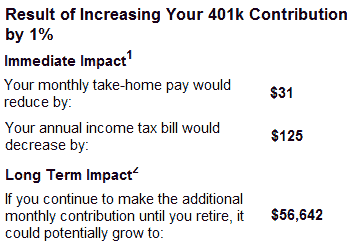
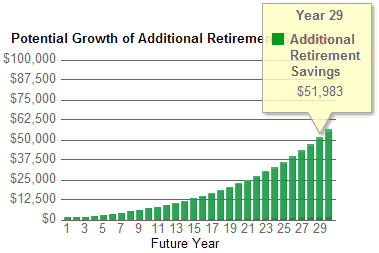
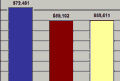
On top of that 10%, it’s interesting to see how much difference nudging it up another 1% can do. I used this Increase 401k Contribution Calculator from Wachovia and ran some numbers. Assuming you make $50,000 gross annually, you’re 35, you retire at 65, 8% annual return, and a 25% income tax bracket, here’s what happens if you increase your contribution percentage by 1% (unmatched):

altext
altext

Not too bad for giving up just $31 per month; if you’re younger the payoff is even better. (Almost good enough to bump up your contributions by 1% today?) Still, start taking enough $31s out and it’ll start to hurt.

Give Until It Hurts?
To find the nice balance, there are a couple of ways to do it:

  1. Analyze your finances, estimate a percentage, and just adjust from there. (More work.)
  2. Start at match %, and keep increasing the % until it starts to hurt.
  3. Start at a high amount (20%? 25%?), and keep decreasing it until your take-home pay is a manageable amount.

Each person probably has a different preference. But again, we go back to the real-life aspect – Will you remember to change your percentages later? Life gets busy, and each month you just keep forgetting and forgetting… In that case perhaps the third option is best, assuming you have some cushion to pay with.

Roth IRA Contribution vs. Emergency Fund Savings

altext

Earlier this week I explored how the performance of money invested in a 401(k) should compare to a regular brokerage account. This brought to mind a different debate:

If you had to choose between contributing $4,000 to a Roth IRA or keeping/putting it towards your Emergency Fund, which would should you choose? We’re assuming you don’t have the funds to do both. Many people put Emergency Fund near the top of their priority lists, just below taking advantage of any “free money” 401(k) match, but above all other retirement accounts. This is because you don’t want to have to dip into retirement accounts and face stiff penalties, or otherwise be faced with other forms of high interest debt like credit cards or personal loans if you need money urgently.

However, the annual $4,000 Roth IRA contribution limit is a “use it or lose it” proposition. You can’t put nothing in this year, and then $8,000 the next. Once April 15th rolls around, you’ve missed out on potential tax advantages that may extend several decades (even to your heirs). This may be mitigated somewhat if you also have a Roth 401(k) or other similar account available.

I used to be in the Emergency Fund First camp, but now I think I’ve changed my mind, mainly thanks to commenter Jbo. Here’s my reasoning. Let’s say you go ahead an contribute $4,000 to a Roth IRA but leave it invested in something safe like a money market fund. Many banks also allow you to open IRA accounts holding certificates of deposit. Now, there are basically two possible resulting scenarios after you do this:

You end up needing the money
No problem, you can always withdraw your Roth IRA contributions without any penalty. Just take out what you need (up to $4,000), and leave the rest in the account. Since it’s in a safe investment it won’t have decreased in value due to stock market volatility. You’ll still lose the tax advantages on any withdrawals, but you’d have missed out anyways.

You don’t need the money
More likely than not, you won’t need all the money, and hopefully within a year or so your emergency fund will be replenished from other sources. Now, you can start really taking advantage of the Roth IRA’s tax benefits and move to riskier investments.

Using the same assumptions as before, a $4,000 post-tax Roth IRA contribution would theoretically end up being worth $40,251 after 30 years. If the $4,000 was placed in a taxable account, you’d only end up with $32,834. Even if you assume inflation will run 3% a year, that’s still $3,000 more in today’s dollars that you made on your initial contribution of only $4,000 by putting it in a Roth.

Am I missing anything? It would seem like putting money in the Roth IRA is a pretty safe bet. The downside is very small, and the upside is very high. One key thing to remember is to keep the Roth IRA money in a safe investment while you are treating it as a emergency fund, as stocks have been known to drop as much as 40% in one year. You don’t want to be having to sell your stocks to get cash after that happens!

  • Make sure your current IRA is charging you as little in fees as possible.  Visit Mint.com and their IRA wizard for a quick look into the best discount brokers offering IRA’s.

How Much Better Is Your 401k Than A Regular Taxable Brokerage Account?

Everybody loves 401k plans for their tax advantages. But exactly how good are they, really? What if your 401k only offers limited, more expensive options than you can find from a regular brokerage account? I wanted to explore this using some estimated numbers, just to see how it works out. I know my assumptions won’t fit everyone, but people can adjust them to be closer to their own situation.

Assumptions

  1. Start with a $10,000 pre-tax contribution for each
  2. Both plans have the same imaginary investments for 30 years
  3. Annual return on those investments is 8%, broken down into 6% from capital gains, and 2% in qualified dividends. This is to approximate the amount of dividends currently being paid on stocks in general.
  4. 28% ordinary tax bracket both now and upon withdrawal in retirement
  5. 15% tax bracket for long-term capital gains and qualified dividends
  6. Any company matching is ignored, as everyone should contribute up to the match. 🙂

401k Calculations
The calculations for the final value of the 401(k) are relatively simple. You start with $10,000, it grows at 8% annually without any tax consequences for 30 years, and then upon withdrawal it is taxed at ordinary income tax rates. With our assumptions, the math would look like this:
[Read more…]

Fidelity Self-Employed 401k Account Review

I’ve mentioned several times I have a Self-Employed 401k account. It’s a somewhat unique thing, so here’s a little bit more about it.
What’s a Self-Employed 401(k) and who’s eligible?
A Self-Employed 401(k) is a tax-advantaged 401(k) retirement account that is available to self-employed individuals or business owners with no employees other than a spouse, including sole proprietors, partnerships, corporations, and S-corporations. It is also referred to as an Individual 401(k) or a Solo 401(k). You can even get them in Traditional or Roth versions.

For more details, see these other posts:

I chose a Solo 401k over other options like SEP-IRA due to the increased contribution limits for those with relatively low self-employed incomes. I ended up picking Fidelity Investments as my plan administrator, and here are my experiences after using it for the last year:

Application Process
It’s been a while, so I don’t have a rundown of dates or anything, but I remember the application being a bit long, but very straightforward. You can either print the forms out online, or have them mail you a nicely bound copy. I mailed it in, they set it up, and I had my own Solo 401k. No hassles.

Account Fees
There were no setup fees, no maintenance fees, no minimum balance requirements, no annual fees. I only thing I’ve ever paid is for the expense ratios in the mutual funds I bought. As you’ll see below, that’s barely added up to $20 so far!

[Read more…]

Choosing Between Limited 401(k) Investment Options

Many of us are faced with the dilemma of putting money into a 401k due to the tax-advantages, but only being presented with limited investment options. Personally, up until now to have 401k’s all run by the giant Fidelity, but this time around we were faced with smaller company. I’ve never heard of them before, so I’ll just call them “In House” funds.

Here’s how I systematically picked out the best funds from my menu of choices. It follows my investment belief that the best long-term performance can be gained with primarily passive, low-cost, and asset-allocated portfolios.

As a preface, I should say that I treat all my accounts as one – 401ks, 403bs, Traditional IRAs, Roth IRAs, SEP-IRAs, and any taxable accounts meant for retirement. Even between my wife and I, all of it is taken together. I then try to make them follow the asset allocation I chose.

I’m not a financial professional, so don’t take this as financial advice, ya hear? It’s just what I did:

1) Make a list of each mutual fund, including the name, the asset class it represents, any front-end or back-end loads, and the net annual expense ratio. You may need to read the prospectus for each fund, or at least grab the ticker symbol and use the quote from Morningstar.com to determine these values. Here’s my list, luckily all of them were no-load funds:

 
Available 401(k) Options
Fund Name Asset Class Expense Ratio
Guaranteed Pooled Fund
(Fixed Interest Rate of 4.65%)
Stable Value 0.60%
PIMCO Total Return Admin (PTRAX) Intermediate-Term Bond 0.68%
Dodge & Cox Stock (DODGX) US Large Cap Value 0.52%
In-House S&P 500 Index Fund S&P 500 / Large Cap Blend 0.30%
In-House Equity Growth Fund US Large Cap Growth 0.90%
Lazard Mid Cap Open (LZMOX) Mid Cap Blend 1.18%
Columbia Small Cap Value II
(NSVAX)
Small Cap Value 0.97%
Baron Small Cap (BSCFX) Small Cap Growth 1.33%
In-House International Equity Fund International Stock 1.15%
5 Different Asset
Allocation Funds
Varying Fixed Asset Allocations, from 90% Bonds/10% Stocks to 10% Bonds/90% Stocks 0.79-0.99%

2) Throw out any asset classes that aren’t included in your chosen asset allocation. For example, I am not interested in any stable value/money market funds, or any Small Cap Growth funds for my retirement portfolio right now.

[Read more…]

September 2007 Investment Portfolio Snapshot

9/07 Portfolio Breakdown
 
Retirement Portfolio
Fund $ %
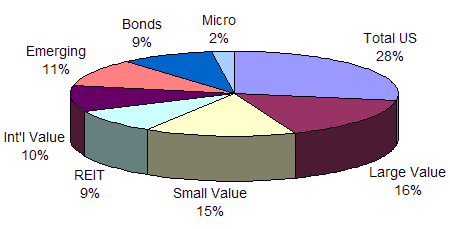
FSTMX – Fidelity Total Stock Market Index Fund $23,971 28%
VIVAX – Vanguard [Large-Cap] Value Index $14,273 16%
VISVX – V. Small-Cap Value Index $13,230 15%
VGSIX – V. REIT Index $8,100 9%
VTRIX – V. International Value $8,392 10%
VEIEX – V. Emerging Markets Stock Index $9,408 11%
VFICX – V. Int-Term Investment-Grade Bond $7,821 9%
BRSIX – Bridgeway Ultra-Small Market $2,015 2%
Cash none
Total $87,210
 
Fund Transactions Since Last Update
Bought $10,000 of FSTMX on 9/17/07 (240.327 shares)

Summary and Performance
This is my first update in almost 3 months (June update), as between the move and new jobs, there hasn’t been much activity to report. I finally managed to deposit some money and bought $10,000 more of a Total US Stock Market fund yesterday in a lump sum, despite some hesitation. It will be interesting to see what happens in the financial market today and the next few months.

I did manage to calculate my portfolio’s personal rate of return, which were 3.2% year-to-date, and 4.5% annualized for 2007. Positive returns came from the Emerging Markets and International stocks, while my REITs and US Small-Cap Value funds haven’t been doing so hot.

Why do I continue to neglecting my asset allocation? The reasons remain the same. The first part is that many of my intended moves might be considered performance-chasing, such as a desire for a larger international allocation and slightly more bonds. Sometimes it’s hard to tell if the change is actually warranted or if you’ve just been listening to too much CNBC or mainstream personal finance media. The second part is that I don’t want to be one that changes asset allocations every other week, so if I do change things I want to it with lots of research and justifications… and I’ve been a bit disinterested in reading about asset allocation recently.

401k Lump Sum Contribution: Dollar Cost Averaging Looking Good Right Now

I’ve been really bad at regularly making contributions to my Self-Employed 401k from Fidelity. I had only planned to put $500 a month into it for the first part of the year, since I wanted to keep as much liquid cash as possible in case I bought a house. Now that it seems like (1) we’ll have enough money both buy a house and contribute to the 401k, (2) we’ve may not buy right away anyhow since we can’t agree on what we want, and (3) the year is quickly coming to an end, I went ahead and sent in a lump sum of $10,000 to catch up!

My problem: The money just showed up on my account today, so I will have to wait until Monday to trade. This is the same day Mr. Bernanke plans on making his Fed Funds rate announcement, which will either calm the market down (drop 0.25%), make it really unhappy (keep it the same), or make it really happy (drop 0.5%). Even with the subprime mess, I am definitely still going invest my money into the stock market… but should I do it all at once?

Usually, in the arena of dollar cost average vs. lump sum my position has been:

If you already have all the money available (not if you’re just taking a set amount out of each paycheck) and you are well away from retirement, you should just invest the lump sum all at once.

This is supported by several studies, including this FPA Journal article Lump Sum Beats Dollar-Cost Averaging, which concludes:

Given a lump sum, is it better to invest the entire amount immediately, or spread it out in equal installments? Based on historical evidence, the major conclusion of our study is that the odds strongly favor investing the lump sum immediately. This conclusion emerges after comparing annualized monthly returns for both DCA and LS strategies for all possible 12-month periods from 1926 to 1991. For the entire 65-year period, the LS strategy produced superior returns approximately two-thirds of the time, and the superior returns were statistically significant.

So it turns out 2/3rds of the time you win out, and 1/3rd of the time you lose. Not bad. The next argument that some people make is DCA is more of a risk-reduction method than anything else. Again, multiple academic articles suggest that DCA may not be a very efficient way to reduce risk, either! Bummer.

Still, given the Bernanke situation, I am considering dollar-cost-averaging $1000 a day over the next two weeks instead of $10,000 all at once on Monday. Prudent idea, or backtracking?

401k to IRA Rollover Decision Process, Prosper Lending Review

I’m swamped today, so here are some posts from the past that fill requests from my suggestion box:

My 401k to IRA Rollover Decision Process
Part 1 – Stay put with old 401k?
Part 2 – Roll over into Fidelity?
Part 3 – What about Vanguard?
Part 4 – My Final Decision

Although this was done two years ago with my previous job, I think it still contains a lot of pertinent information. Note that Vanguard has since gotten rid of their low-balance fee if you accept electronic delivery of statements.

Also, since then there are now brokers that have free ETF trades, most prominently Zecco Trading (no minimum balance, $30 IRA annual fee) and WellsTrade ($25,000 minimum equity, no annual fee).

About Prosper.com – Person-to-Person Lending
Prosper Lending Review, Part 1: First Looks
Prosper Lending Review, Part 2: The Numbers
Prosper Revisited: Will Returns Drop As Defaults Increase Over Time?

I’m still not sold on Prosper’s risk/return characteristics to consider it a prudent part of my investment portfolio, but it can certainly be a fun diversion if you like that sort of thing.