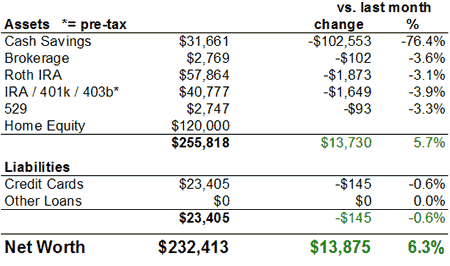
March 2008 Financial Status / Net Worth Update

Net Worth Chart March 2008

“Good” Credit Card Debt
If you’re a new reader, you may have some concerns about my high levels of credit card debt. I’m actually taking money from 0% APR balance transfer offers and instead of spending it, I am placing it in high-yield savings accounts that actually earn me 4% interest or more, and keeping the difference as profit! :D Along with other deals that I blog about, this helps me earn extra side income of thousands of dollars a year. Recently I put together a series of step-by-step posts on how I do this. Please check it out first if you have any questions. This is why, although I have the ability to pay the balances off, I choose not to.

Cash Savings, Home Purchase
If my posting has been a bit light lately, it has been because I’ve been bogged down by a combination of illness, travel, and the home-buying process. Also, I didn’t want to do it in real-time because there were some snags along the way… but we’ve finally closed!! I have lots of house-related posts coming about mortgages, inspections, and so on… but first here are a few details that will help explain this net worth update.

Purchase price $600,000
Down payment (20%) $120,000
Discount points paid (1%) $6,000
Buyer’s agent rebate (1.5%) $9,000
Closing Costs ~$3,000 (rest paid by lender)

Our purchase price of $600,000 was more than the $500,000 we estimated we wanted to spend a couple years ago, but we are now in a 4-bedroom single-family home that we can see ourselves living in forever. In addition, we didn’t stretch too far as we can handle the mortgage payment on either one of our incomes.

We believe we got a good deal even though the short-term market looks bad, and the house has tons of potential. We’re even going to rent out a room to a relative. Our home appraisal actually came in at $640,000 – we’ve been told an appraisal coming in higher than purchase price doesn’t happen very much in this scared housing market. Using this value would actually leave our home equity at $160,000 instead of just the down payment of $120,000. However, I’m just going to be conservative and leave it at $120,000 for now.

As you can see, our 50% buyer’s agent rebate helped offset our closing costs and the points on the loan. Of course, mentally we are using the $9,000 rebate towards all the home improvement projects we have brewing. 😉 Finally, adding back in the $5,000 earnest deposit that I had marked as spent last month makes the numbers look a lot better than they really were.

Emergency Fund?
Our net cash balances have taken a big hit to less than $10,000, and that makes me nervous given that our monthly expenses just shot up drastically. Our foreseeable mid-term goal will definitely need to be to build up a proper emergency fund, which we’ve never officially had since we basically treated our downpayment funds as such. Visiting Brazil and Australia will have to be placed on the backburners for now…

Retirement and Brokerage accounts
February is the fourth month is a row that our IRAs and 401k/403bs have dropped by 3%. We may need to start setting up some regular monthly investments in order to help force ourselves to keep investing.

It’s been a wild month! You can see our previous net worth updates here.

Rollover IRAs: Good Idea In General, But What About A Small 401k?

If you leave your job and have a 401k or 403b left behind, the common advice is to roll it over into a Rollover IRA. There are several benefits to doing so, but here are the biggies:

  1. You maintain the tax-deferred status of the investment. For a traditional 401k, you would still be subject to ordinary income tax upon withdrawal, but along the way it would continue to grow tax-free. If you took the money as a lump sum, you would be subject to both taxes and penalties right away (with specific exceptions).
  2. Increased flexibility in investments. Most 401k plans have relatively limited investment choices, but you can open up an IRA at a variety of places. You can the invest in individual stocks, different mutual funds, bonds, ETFs, annuities, or even just a bank certificate of deposit.
  3. Save money by paying less fees. Along the same vein, many 401ks contain mutual funds with relatively high expense ratios compared to what is available on the open market. Many would recommend switching to low-cost index funds.
  4. You can consolidate accounts. You can combine the Rollover IRA with your other IRAs of the same time (Roth or Traditional Pre-Tax). One less thing to manage.
  5. Estate Planning perks.With an IRA, you have the ability to create a “Stretch IRA”, where your child can inherit and IRA and have the distributions “stretched out” across their longer life expectancy. This allows for more time to tax-free growth.

But many of these perks get overshadowed when you have a small 401k balance. My wife has an old 401k with only $2,000 in it at Fidelity. She gets to choose from a variety of Fidelity funds, including their Spartan index funds with 0.10% expense ratios, all with no minimum investment requirements. In addition, I don’t believe she is being charged any sort of administrative fees. We haven’t rolled it over to an IRA because:

  • Lonely IRA. We have no Traditional-type IRAs to merge it with at this time. We’d just be left with a $2,000 IRA.
  • Flexibility? If we moved it to Vanguard with the rest of our IRAs, we would not meet the $3,000 minimum for most of the funds. The only fund we could buy would be the Vanguard STAR fund.
  • No money to be saved? At most brokers, paying a commission for every trade on only $2,000 would really eat into the balance. We could move it to Zecco, which has free trades but also a $30 annual IRA fee. We can do better staying put, although if our existing investment choices were worse, finding a low-cost brokerage and switching to buying ETFs might be an option.
  • Itty-bitty estate. Again for small balances, this isn’t much of a factor in my opinion. No kids, anyhow :)

We could also move it to her new 403b, but it also has less-than-ideal investment choices. For now, it seems like the best move is really to stay put at Fidelity until there is a better opportunity. However, I would agree that our situation is a relatively rare case.

Interim Asset Allocation: Existing Accounts, Fund Choices, and Implementation

Okay, so I’ve decided upon an asset allocation plan. Now for my least favorite part – juggling and cramming all those asset classes into several different accounts. First, I’ll list my existing accounts, their estimated current balances, and my flexibility in investment options.

Account Type Est. Value Fund Choices
Roth IRA #1 $46,000 Vanguard funds w/ no transaction fee (NTF)
Roth IRA #2 $13,000 All Vanguard funds
Traditional 401k #1 $23,000 All Fidelity funds+ ETFs w/ $20 commission
Traditional 403b #2 $14,500 Limited low-cost fund choices (S&P 500 index fund, DODGX)
Traditional 401k #3 (old job) $2,000 Select Fidelity funds
Total Value $98,500

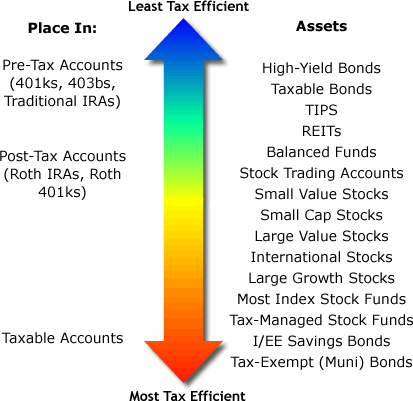
So I’ve got 7 asset classes to fit in 5 accounts. Below is a chart that shows the major asset classes sorted by tax efficiency:

Chart of Relative Tax Efficiency of Assets
(See my post on Tax Efficient Mutual Fund Placement For Maximum Return for sources and more information.)

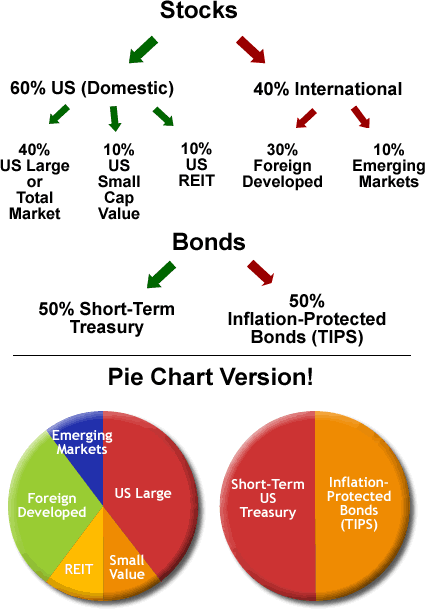
Next, I combine my chosen 86% stocks/14% bonds with my asset allocation to find the breakdown below:

Asset Class Percentage of Total Portfolio Est. Value
Short-Term Treasury Bonds 7% $7,000
TIPS 7% $7,000
Real Estate 8.6% $8,500
US Small Value 8.6% $8,500
Emerging Markets 8.6% $8,500
International Large 25.8% $25,500
US Large 34.4% $34,000
Totals 100% $99,000

For example, with 40% of all stocks as US Large, I get 40% x 86% = 34.4% US Large over my entire portfolio. You might notice that I also sorted them in the tax-efficient order given above.

But in this case, I also need to consider the availability of low-cost index funds as well as placement, especially since all my money is already in tax-deferred accounts. My Roth IRAs are all with Vanguard with a wide variety of index choices, but my Traditional 401ks are limited to a few select index funds. After spending some time with a pencil, paper, and good eraser, here is the compromise I have worked out:

Roth IRA #1
$7,000 Vanguard Short-Term Treasury Fund (VFISX)
$3,000 Vanguard REIT Index Fund (VGSIX)
$8,500 Vanguard Small-Cap Value Index Fund (VISVX)
$8,500 Vanguard Emerging Markets Stock Index Fund (VEIEX)
$19,000 Vanguard Total Stock Market Index Fund (VTSMX)

Roth IRA #2
$7,000 Vanguard Inflation-Protected Securities Fund (VIPSX)
$6,000 Vanguard REIT Index Fund (VGSIX)

Traditional 401k #1
$23,000 Fidelity Spartan International Index Fund (FSIIX)

Traditional 403b #2
$14,500 Diversified [S&P 500 Index] Fund (DISFX)

Traditional 401k #3 (old job)
$1,000 Fidelity Spartan Total Market Index Fund (FSTMX)
$1,000 Fidelity Spartan International Index Fund (FSIIX)

On additional reason for this particular set up is to accommodate future growth. As the year progresses, I can continue to buy more shares of the largest asset classes (FSIIX and DISFX) in our 401ks. To retain the target asset allocation if things get out of whack, I can sell VTSMX in my Roth IRA and buy other funds as needed, with only a $3,000 minimum for most funds. I avoid any other low-balance fees at Vanguard by choosing electronic delivery of statements. In the future, I may switch my IRAs to an brokerage account to simply buy ETFs, but I don’t think that is necessary quite yet. I like the current simplicity and good service.

(By the way, I have such large Roth IRA balances because I did a Traditional-to-Roth conversion while our tax brackets were lower than they are now.)

Interim Asset Allocation: History, Decision, and Changes

Over the last year or so, I’ve learned a lot of new things about investing and asset allocation. At the same time, I know that changing your asset allocation too frequently is often a response to recent market activity (aka performance chasing, or market timing). In addition, I’m a highly analytical person and I love for things to have a correct answer to 5 significant figures before committing… which is pretty much impossible here. But at some point I know I just need to take action if I truly believe it is an improvement.

Previous Asset Allocation
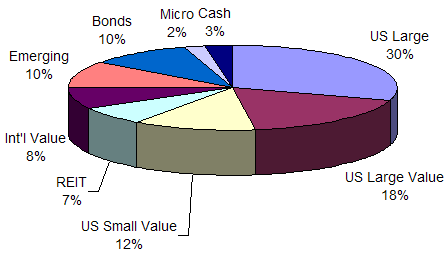
In April 2006, I moved from the all-in-one Vanguard Target Retirement 2045 Fund (VTIVX) to a portfolio with more asset classes in an attempt to better optimize risk/reward factors based on historical data. You can see the asset allocation breakdown here. This asset allocation is pretty much what I have right now, except that I added a Micro-Cap stock fund and we moved money into a 401k with limited investment options.

Interim Asset Allocation

altext

I’m still continuing my series on building my portfolio, so I won’t explain all my actions here, but here are some quick summaries:

  1. Stocks/bonds allocation. I am shifting to a age-based formula for my stocks percentage. Using 115 minus my age, I am at 86% stocks and 14% bonds.
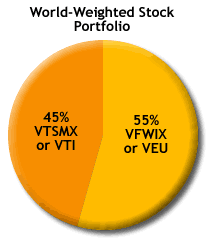
  2. Domestic/international allocation. I am increasing my international allocation to better match the world market. It’s essentially 50/50 if you think REITs are a separate asset class.
  3. Small/Value/Emerging Markets. These sub-classes are riskier than their overall market, but have been shown to have diversification benefits. Even if they don’t in the future, I am okay with them simply being more risky along with higher returns. Essentially, I am taking the total markets, and increasing the portion of one additional asset class which I think has the highest diversification benefits. For example, Small Value is a subset of Total US market, and Emerging Markets is a subset of the Total International market.
  4. Real Estate. I’m still holding REITs, as they are a way to invest in commercial real estate, and have also been shown to provide diversification benefits. Will give more references later.
  5. Micro-Cap, International Value, and Large Value. I think all of these potentially good asset classes to hold, but I think they are of lesser overall importance than the others. So in an effort to simplify, I am dropping them as separate funds. I still continue to have exposure the asset classes within other funds.
  6. New Bonds Allocation. I’ve been meaning to this for a while. I’ve been holding an intermediate-term corporate bond fund because it used to have a lower expense ratio after various fees. Inflation-protected bonds are still pretty new, but I’ve been convinced of their utility. I’ve also been convinced that bond ratings agencies just aren’t that good at their jobs, so I’m sticking with the highest quality bonds (Treasuries). The book Unconventional Success was a big influence here.

I call this my interim asset allocation because while I’m very confident this new setup fits my needs and preferences better than my previous asset allocation, I know that I will continue to learn and read. But just like with football coaches, this interim asset allocation might just become my permanent one.

In addition to all the books that I have read (and am still reading), I’d also like to say thanks to the many smart and helpful folks over at the Diehards.org forums for all the indirect and direct help. (I post anonymously at both forums.) Even though they sometimes feed my tendency towards complexity, I love the wealth of information that is available.

Rebuilding My Investment Portfolio: Index Of Posts So Far

I am a proponent and investor in low-cost, passive-managed mutual funds, but even within that philosophy there can be a dizzying array of choices. Although this has been taking a lot longer than I had hoped, but here is an updated compilation of posts about my thought process when re-building my portfolio.

Section 1: Simplified Theoretical Stuff

  1. Disclaimer and General Philosophy
  2. Consider Simply Buying The Entire Market
  3. Efficient Frontier and Modern Portfolio Theory

Section 2: Choosing An Asset Allocation

  1. Deciding On The Stocks/Bonds Ratio
  2. Deciding On The Domestic/International Ratio
  3. Considering The Diversification Benefits Of Small and Value Stocks
  4. Equity Asset Allocation: Comparison of 8 Model Portfolios

Investment Portfolio: 2007 Year-End Holdings And Performance Update

12/07 Portfolio Breakdown
 
Retirement Portfolio
Fund $ %
FSTMX – Total Stock Market (~Large) $24,006 23%
DISFX – S&P 500 Index Fund (Large) $7,437 7%
VIVAX – Vanguard Value Index (Lg Value) $13,782 13%
DODGX – Dodge & Cox (Lg Value) $13,782 5%
VISVX – V. Small-Cap Value Index $12,725 12%
VGSIX – V. REIT Index $7,637 7%
VTRIX – V. International Value $8,851 13%
VEIEX – V. Emerging Markets Stock Index $10,622 10%
VFICX – V. Int-Term Investment-Grade Bond $8,037 8%
PTRAX – PIMCO Total Return (Interm. Bond) $2,393 2%
Cash (to be invested) $3,000 3%
Total $105,323

Recent Transactions
In the last quarter of the year, we ended up putting in the maximum $15,500 salary deferral in both of our 401k/403b’s. I had already put in $12,500 already in my Solo 401k, so I sent in a last-minute check for $3,000. For my wife’s 401k, it was done in big salary deferrals in October, November, and December. We were lucky that the company allows almost 100% salary deferrals.

Summary and Performance
My last portfolio update was back in September, but I figured with the end of 2007 it was definitely time for an update. It was a late decision to go ahead and contribute a lot to our tax-deferred accounts and taking away a bit from our cash hoard, so I was more concerned with getting them in on time than what I was actually investing in. Lots of changes to come soon, so I’m just posting a snapshot of what we have for now.

I did go back and track the cash inflows, and calculated our time-weighted rate of return, which ended up being 2.49% annualized for 2007. For a very rough comparison, the S&P 500 via Vanguard 500 (VFINX) returned 6.13% YTD. Part of this low performance was just due to timing, as the latter half of 2007 was a lot worse than the 1st half, and that was when we invested a lot more money. (Remember, this is the exact performance of our money, not just the averaged returns of all the funds we hold.) In 2006, our portfolio return was calculated at 24.9%. How did you do in 2007?

What If You Had To Live Solely Off Of Social Security?

A lot of us younger folks are so disillusioned by our government that we don’t expect Social Security to even be around when we turn 65 (or likely 75 by that time…). But the fact is that today millions of people rely on Social Security as their primary – if not sole – source of income. Taking into account that the average benefit is only $963 a month, that’s not very much.
AARP asked retirees who rely primarily upon Social Security how the manage financially, and reprinted a selection of the responses. I enjoyed reading them, as they gave me a glimpse of what obstacles they face, and it showed many different ways they deal with them. Being on a fixed income and having a limited ability to make more money due to disability or illness would be very frustrating to me. Here are some excerpts, which I have organized by the major spending categories:

Housing

We built our own house on a lake stick by stick, or we wouldn?t have a house on a lake. It took us two years. Our son helped with the framing, and my son-in-law did the painting, but my husband did a fantastic job, only contracting out the roofing. [..] We planned ahead and paid off our house before retirement.

We put our home into a reverse mortgage several years ago, and I will realize very little if I sell. I have no children within 130 miles but can’t afford to sell because of the dwindling equity.

[I] live in a Section 8 apartment. In this area, a one-bedroom apartment is $700 to $1,300 per month. I cannot afford this and was lucky to get on Section 8. I must share the apartment with two roommates.

The largest portion of your income will be taken up with rent, utilities, phone, and maybe an auto (I had to get rid of mine), so be certain to apply for government-subsidized housing as soon as possible, as there is likely to be a lengthy waiting list. I waited 3 years! Previously, my rent alone was higher than the current total expense for rent, utilities, and phone.

Healthcare

[…] Our biggest expenses are the cost of our HMO, our Medicare and our medications. My $511 monthly pension pays for that. Our medications, although prescribed by HMO doctors, weren?t on the HMO?s formulary, so the cost wasn?t covered. Since we don?t live too far from Canada, we used to buy our most expensive medications through a Canadian clinic. However, now they will no longer serve Americans, so we did what others do on limited incomes?we just quit taking our two most expensive medications.

[Read more…]

What Are We Saving For, Anyways? Our Life Goals and Retirement Plans

I’ve talked about this in bit and pieces under the Goals category, but I thought I should organize our life goals into one post. Hopefully, this will outline our priorities and shed some light on why we choose to do the things we do.

First, I’d like offer what I am afraid people think our life goals are:

Incorrect Goals

  1. Find the highest paying job possible. Work long hours, but tolerate it for the money.
  2. Live a very spartan lifestyle, with minimal luxuries and worrying about money constantly.
  3. At age 65, abruptly stop working so hard, finally relax and begin enjoying our life. Hopefully live long enough to enjoy this period.

In fact, that’s not what we want at all:

Actual Goal #1 – Finding A Job That Fits
If your going to spend almost 50% of every weekday doing something, shouldn’t you enjoy it? Sure, even great jobs have their challenges – bureaucracy, boring meetings, office politics, the occasional annoying co-worker. But finding a job where you don’t dread getting out of bed in the morning was a huge priority for me. It took a few different degree programs, a couple of resignations, some stressful interviews, and several rejections, but we are definitely making progress in finding work that is challenging, enjoyable, and reasonably well-compensated.

I would also add that having a simple lifestyle initially allowed us to take some risks in order to get where we are now.

Actual Goal #2 – Less Work, More Life
[Read more…]

Equity Asset Allocation: Comparison of 8 Model Portfolios

I’m still planning on reshaping my investments and continuing my choosing an asset allocation series, but Thanksgiving and work has thrown me off a bit.

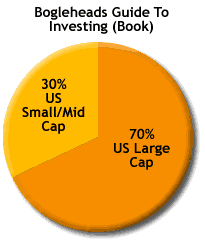
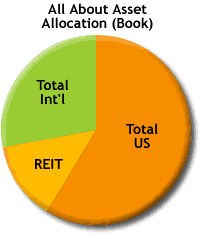
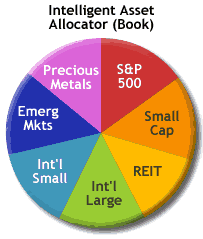
To skip ahead a bit, here are several sample asset allocations from various sources for the equity (stock) side of your portfolio. I thought it would be helpful to see them all side by side and compare how different authorities might split things differently between domestic and international stocks, how they deviate from the “total” market indexes, and whether they choose to incorporate additional asset classes like real estate or commodities.

For more information about any specific portfolio and the source, just click on the pie chart.

altextaltext

altextaltext

[Read more…]

Will Retiring Early Help You Live Longer?

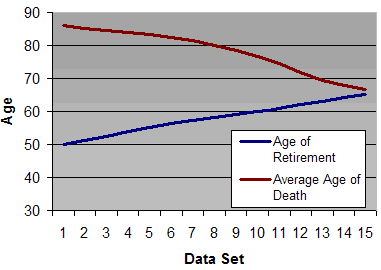
There are lots of reasons to retire early, but will it help you live longer as well? One study seems to suggest so, and is often cited in websites discussing early retirement. Dr. Sing Lin wrote a paper in 2002 called Optimum Strategies for Creativity and Longevity which studied the relationship between the age of retirement and the average of death for retirees of Boeing Aerospace. The results are startling:

altext

As the retirement age increases, the average age of death decreases almost linearly. The average person who worked until age 65 lived for only 18 months after retirement! In contrast, the person retiring at 50 lived for another 36 years.

There is some dispute as to the validity of this data, but I haven’t found anything solid either way. The author does make some very bold conclusions, though:
[Read more…]

Investment Gift Idea For Children: A Roth IRA?

A few very forward-thinking readers have asked me about ways to help their kids or other young folks by giving them a Roth IRA. This seems like an awesome idea to grab them some tax-sheltered action. I’ve thought about this in passing, but never really did the research into the technicalities of it. One good article on this subject is over at Fairmark called Roth IRAs for Minors. Combine this with official IRS publications and a few magazine articles about employing your children, and here’s what I found:
The Facts

  • There is no age requirement to open an IRA.
  • Many, but not all, IRA providers will allow you to setup an IRA account for minors.
  • The primary requirement is the child needs to have taxable earned income to make a contribution. So to make a $4,000 contribution, they would need $4,000 of income. Earned income means that dividend or interest payments don’t count.
  • An important difference between IRAs and 529s is that once the child reaches 18 or so, they get complete control over the money and can do whatever they want with it.

The Payoff
How much money are we talking about? Umm.. a lot! From the Kiplinger article:

Let’s assume you give your 15-year-old daughter $1,000 to fund a Roth IRA. If the money inside the account grows at an annual average rate of 8% — well below the long-term average return for stocks — that $1,000 will grow to about $47,000 over the 50 years it takes for today’s teen to reach retirement age. If you added another $1,000 a year until she turned 20 -? and never added another dime — that initial $5,000 investment would be worth nearly $250,000 by her 65th birthday. With a Roth IRA, the full amount will be tax-free when it’s withdrawn in retirement.

Now the question is how to obtain that taxable earned income?

Income From Non-Parental Employer
This is probably the most legitimate and straightforward way, also the hardest to get. Examples for small children might be acting or modeling from an agency not directly owned by the parents. For teens this could include money from tutoring, bagging groceries, or working at the movie theater. In addition, this income may be subject to payroll taxes like Medicare and Social Security Tax at 7.65%.

Income From Parents As Employer
Maybe you already run your own business, and could use the services of a child – web design? computer set-up or consulting? From the Fairmark article:
[Read more…]

Choosing An Asset Allocation, Step 3: Considering The Diversification Benefit Of Small and Value Stocks

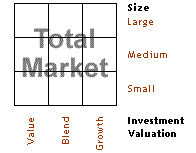
So far we’ve looked into the stock/bond ratio and the domestic/international ratio. Instead of taking these total stock markets as whole, you can further subdivide them into “styles” or additional asset classes. Although these vary in specific definition, in the general layout is shown by the Morningstar style box shown to the top right.

Value vs. Growth Stocks
Value stocks are those that tend to trade at a lower price relative to objective measures like dividend yield, earnings, sales, or book value. For example, you could screen by low P/E ratio. To generalize, value stocks tend to have low growth prospects or are in unglamorous industries. On the other side are growth stocks, which have high relative valuations. Again to generalize, these companies tend to have big growth expectations like Google or Apple.

If you look across long periods of history, it actually turns out that value stocks outperform growth stocks as a whole. People use different ways to explain this phenomenon. One camp says that value stocks are riskier because they are more likely to fail due to poor prospects, so obviously they should have higher return. Others use a behavioral view, saying that since they are “boring” or “ugly” stocks then they tend to be undervalued by investors in general.

Either way, including value stocks as part of a portfolio has also historically provided a diversification benefit, as can be shown by this graph from the excellent book All About Asset Allocation:
[Read more…]