DayDreaming Again About Early Retirement

There’s nothing like going back to work on a Monday after a nice long holiday weekend to make you daydream about leaving the rat race behind. I would like to think that I am already on the path to early retirement, but I often like to hash out “The Plan”.

Ages 30-45: Live simply. Buy a home you can afford with a 15-year mortgage. Yes, you can get approved for a larger loan with a 30-year amortization. Homes are a huge expense, and just because someone will let you doesn’t mean you should take on that much debt. If you artificially restrict yourself to what you can afford with a 15-year amortization, you’ll end up with something that can easily be paid off early.

Yes, taking advantage of low fixed interest rate for 30-year mortgage can be argued to be advantageous on a mathematical level. But I am still enamored with the simplified cashflow situation once this huge monthly expense is taken away. Right now, a full 2/3rds of my monthly expenses go towards housing costs.*

Live frugally, try to save regularly for retirement, advance in career and get pay hikes, raise kids, still enjoy life, yada yada.

Ages 45-65: Find consulting or part-time work which will cover remaining expenses. Now, after 15 years, I will only have to pay for everything else – property taxes, car, utilities, food, etc. This should only run about $35,000 a year. Lower required expenses means lower required income, which means I pay a lot less in income taxes. Split between my wife and I, we’d only need to find jobs that pay about $25,000 gross each per year. (Numbers will need to be adjusted for inflation.)

This opens up so much flexibility. Despite my beach bum aspirations, I already know that you can’t spend all day at the beach. There are so many alternative business and job ideas that we would enjoy doing, but currently wouldn’t dream of doing because we make so much more money doing what we do now. Jobs with less hours, less commuting, less dealing with stupid people. The money that we have saved up in tax-deferred accounts should remain untouched, and we will still add as possible.

Ages 65+: Work as possible based on health, start taking Social Security, withdrawing from retirement accounts I know that most young people are skeptical of Social Security, but in reality I doubt it is going to go away for people with moderate incomes. It will simply be too critical a safety net in the age of self-funded retirements. I can see there being a phase-out for high income earners (it’d be very difficult to phase out based on net worth) – but again, without a mortgage, we won’t need a high income. The current average Social Security check is $1,000 per month, or $12,000 per year. If both of us received that, that would already cover 50% of our expenses.

These are all rough numbers and you never know what life will throw at you, but it’s nice to have goals. 😀

* No, you don’t necessarily need to buy a house to retire early. But it fits into my Plan nicely.
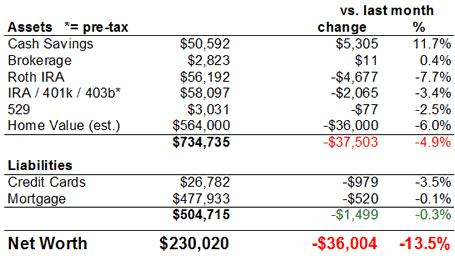

July 2008 Financial Status / Net Worth Update

Net Worth Chart July 2008

Credit Card Debt
If you’re a new reader, let me start out as usual by explaining the credit card debt. I’m actually taking money from 0% APR balance transfer offers and instead of spending it, I am placing it in high-yield savings accounts that actually earn 3-4% interest or more, and keeping the difference as profit. Along with other deals that I blog about, this helps me earn extra side income of thousands of dollars a year. Recently I put together a series of step-by-step posts on how I do this. Please check it out first if you have any questions. This is why, although I have the ability to pay the credit card balances off, I choose not to.

Retirement and Brokerage accounts
Apparently this was the worst June since the Great Depression, with the S&P 500, Nasdaq, and Dow all losing around 9 to 10% last month alone. But it was only the worst June, not the worst month ever. Our overall portfolio didn’t fair quite so poorly due to our diversification into international stocks and bonds, but still sank nearly $7,000 in one month.

However, I remain confident in the fact that a globally diversified portfolio will perform adequately well over my time horizon of 20+ years. Add in the fact that shuffling investments around only serves to worsen my chances, and you get my same old brilliant plan of… doing nothing. I seriously had to skip over half of my financial magazines this month, with all their suggestions for “recession-proof” stocks.

Cash Savings and Emergency Funds
Our mid-term goal is to have $30,000 in net cash put aside for emergencies, for example if both of us find ourselves unemployed for an extended period and even have to start paying for things like health insurance on our own. We are now nearly 80% there at $23,810. After this is done, then I will focus on more contributions to my Self-Employed 401(k) plan at Fidelity. My timing just happened to work out well so far, with us accumulating cash while the markets are dropping.

Home Equity
Another tiny ~$500 of loan principal paid off. Since this is a “bad” month, I decided to pile on and reduce our estimated home value by 6%. Six percent is the approximate amount charged by a real estate agent, so we might as well count that in. I don’t like how our net worth is overly affected by such home value guesses, and am looking for a better way to measure our progress towards financial freedom.

You can see our previous net worth updates here.

The Depressing Truth About Early Retirement

Excerpted from the interesting Early Retirement page of Philip Greenspun, a fellow who says he retired at age 37.

Ask a wage slave what he’d like to accomplish. Chances are the response will be something like “I’d start every day at the gym and work out for two hours until I was as buff as Brad Pitt. Then I’d practice the piano for three hours. I’d become fluent in Mandarin so that I could be prepared to understand the largest transformation of our time. I’d really learn how to handle a polo pony. I’d learn to fly a helicopter. I’d finish the screenplay that I’ve been writing and direct a production of it in HDTV.”

Why hasn’t he accomplished all of those things? “Because I’m chained to this desk 50 hours per week at this horrible [insurance|programming|government|administrative|whatever] job.

So he has no doubt that he would get all these things done if he didn’t have to work? “Absolutely none. If I didn’t have the job, I would be out there living the dream.”

Suppose that the guy cashes in his investments and does retire. What do we find? He is waking up at 9:30 am, surfing the Web, sorting out the cable TV bill, watching DVDs, talking about going to the gym, eating Doritos, and maybe accomplishing one of his stated goals.

Retirement forces you to stop thinking that it is your job that holds you back. For most people the depressing truth is that they aren’t that organized, disciplined, or motivated.

Could this be me? Nah, my goal is to be a beach bum and do nothing. 😉

Useful Information From Your Social Security Statement

I recently received a nice greenish pamphlet from the government, my Social Security Statement! I thought it would tell me how much to expect from them in retirement… instead it just says is that I haven’t accumulated enough work credits to get Social Security benefits. Gee, thanks… *toss*. But wait, a few recent events have shown me other ways that it can be useful.

How Do I Get A Copy? If you are 25 or older, you should automatically receive it annually about 3 months before your birthdate. Otherwise, people of any age can request a copy to be sent to them. Here’s a sample statement.

Use #1: Find Out How Much Money Have You Earned In Your Lifetime
One of the books I am currently reading is the much-praised Your Money or Your Life. In it, one of the first exercises is find out how much money you’ve earned in your lifetime. Under the Your Earning Record section of your SS statement, it will break down all the (taxed) income you’ve ever made by year. Add it all up, and you should have your lifetime income. Besides breaking out your old Quicken files or tax returns, this is probably the only place all this information is easily available.

Why do this? For one, you may be surprised by how much money you have been able to earn, and this should boost your confidence. Second, if you compare this number to your current net worth, you may also be surprised by how little you’ve actually kept so far. Hopefully this will motivate you to waste less money.

…Or it could be cool just to know how much money you’ve ever made. 😉

Use #2: Life Insurance Planning
I’m also (slowly) doing some research on life insurance. In calculating how much life insurance you’ll need, you may want to consider what sources you already have. Many people don’t know that Social Security offers survivorship benefits if you have kids, or spouses of retirement age. In fact, about 20% of all Social Security benefits are paid out to those younger than age 62.

Under the Your Estimated Benefits Section, there is information for your estimated survivor benefits if you die. Currently, it says that my child would get over $1,100 per month if I died, and my spouse caring for the child would get over $1,100 per month as well. Over $26,000 a year? Really? This is much more than I would have imagined. As far as I can tell, this until the child turns 18.

There are also disability benefits listed, but usually privately-bought disability insurance only covers up to 60% of your original income, so I would still try to buy all I could get.

Use #3: Realize The Whole Thing Might Be Wishful Thinking
Finally, there’s a happy message snuck in at the bottom:

Your estimated benefits are based on current law. Congress has made changes to the law in the past and can do so at any time. The law governing benefit amounts may change because, by 2041, the payroll taxes collected will be enough to pay only about 75 percent of scheduled benefits.

The Financial Freedom Ratio: A Better Way To Measure Your Net Worth?

Most of you are reading this right now because you want that elusive “financial freedom”. This usually revolves around net worth, and many of us (ahem) have a specific net worth goal they want to achieve. Various formulas and calculators abound. The popular book The Millionaire Next Door suggests this formula for a target net worth:

altext

In addition, there are various debates on how to measure net worth. Do you include your primary residence, or not? What about cars or jewelry? How do you properly account for pre-tax accounts? However, while reading this post at Early Retirement Extreme amongst others I realized that these are not the things I need to be focused upon.

Financial Freedom Ratio
If someone tells you that they have a net worth of $1,000,000, you might be impressed. But what if they spent $150,000 per year? If they stopped working, the money wouldn’t last very long. However, if they only spent $15,000 per year, they might already be set for life. In other words, your income doesn’t matter. Your expenses do. It may be assumed that the two are related, but that is not necessarily true. We all have the power to disconnect the two.

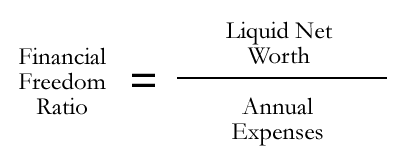
I’m sure somebody somewhere has already coined this term, but until told otherwise I will call it the Financial Freedom Ratio (FFR):

Liquid Net Worth divided by Annual Expenses

By liquid, I simply mean you can sell it for cash while not affecting your expenses. (Don’t count your car if you need it for work.) For example, if you had $200,000 but only spent $20,000 per year you would have the FFR value of 10 as someone with $1,000,000 but spent $100,000 per year. This also calls into focus how important spending patterns are when talking about financial freedom. Let’s say you had the 200,000 net worth and you wanted to increase your FFR from 10 to 11. You could either

  • increase your liquid net worth by $20,000 and spend the same,
  • decrease your annual spending by $1,820 and not earn any more money,
  • or some combination of spending less and accumulating more.

Sure, it can be very difficult to keep slashing expenses, but this ratio keeps you honest as to how close you are to financial independence.

What Is A Good Financial Freedom Ratio?
To find this, I went to the Vanguard Annuity website and looked up a price quote for their inflation-adjusted fixed immediate annuity (Lifetime income option, fixed payment, bottom right). This means that, if I give Vanguard a lump sum of money, they will give me a regular income that is adjusted every year for inflation per the CPI-U. (Annuities are subject to the claims-paying ability of the issuing insurance company, which is AIG Insurance.)

I input that I was 30 years old and wanted an inflation-adjusted $30,000 a year ($2,500 a month) for the rest of my life. The quote was $857,000. So a lifetime of my required income requires an FFR of 28.6 ($857,000/$30,000). As you get older, the number decreases.

Using the popular but controversial 4% safe-withdrawal-rate rule for a balanced stock/bond portfolio, you would need a FFR of 25 to have a good chance of living off of your investments without having to annuitize. Keep in mind the 4% value is not adjusted for inflation, so your buying power would decrease each year.

What’s My FFR?
I’m not sure exactly how much I spend per year. I need to fix this. I should be able to back out the numbers for 2007 pretty easily since I track our net worth and I just did my taxes, but I’d need to cancel out things like unrealized investment gains. Roughly, I would say that last year we spent somewhere between $25,000 to $30,000. This year, it will be much higher due to housing expenses, although one day the house will be paid off. My FFR is certainly less than 10 right now, more like in the 8 range. Single-digits! 🙁

Track Your Expenses
I like the FFR because it gives me a better idea of how close we really are to financial freedom. In addition, it reminds me that our expenses matter equally as much as our net worth. Do you know how much you spent last year? I am convinced that spending is a habit. If you spend modestly now, it will be easy to maintain this in the future. If you spend lavishly now, it will be very difficult to downgrade later on. We all have our luxuries which we hold dear, I know I certainly do, but it has to be weighed against how long you want to keep working and saving.

So, after all this I suppose I need to figure out how to gradually shift to a simpler and less costly lifestyle. Heck, forget cutting expenses, I spend a lot of effort simply trying not to accumulate more expenses these days…

April 2008 Investment Portfolio Snapshot

Since we just made our IRA contributions for 2007 recently and had made a few mutual fund exchanges, I figured this was a good time to post another portfolio snapshot. Since we have so many different accounts now, I changed the presentation layout a bit to clean things up.

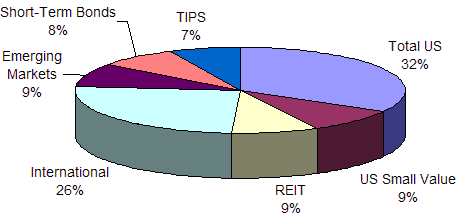
4/08 Portfolio Breakdown
 
Retirement Portfolio
Asset Class / Fund $ %
Broad US Stock Market $38,836 32%
VTSMX – Vanguard Total Stock Market Index Fund
DISFX – Diversified Stock Index Institutional Fund
DODGX – Dodge & Cox Stock Fund
US Small-Cap Value $10,480 9%
VISVX – Vanguard Small Cap Value Index Fund
Real Estate (REITs) $10,017 9%
VGSIX – Vanguard REIT Index Fund
Broad International Developed $29,925 26%
FSIIX – Fidelity Spartan International Index Fund
VDMIX – Vanguard Developed Markets Index Fund
International Emerging Markets $10,198 9%
VEIEX – Vanguard Emerging Markets Stock Index Fund
Bonds – Short-Term $8,989 8%
VFISX – Vanguard Short-Term Treasury Fund
Bonds – Inflation-Indexed $8,260 7%
VIPSX – Vanguard Inflation-Protected Securities Fund
Total $116,705
 

Contribution Details
Through the end of 2007, we maxed out the salary contributions of both of our 401k/403b plans and put in $15,500 each. We didn’t qualify for a Roth IRA contribution in 2007, but after exploring the options of a non-deductible contribution to a Traditional IRA, we decided to go for it and put in $4,000 each in early April. For 2008, my wife has contributed about $5,000 so far to her 403b and is on track to max out again. I’m lagging a bit behind, but should catch up later in the year.

YTD Performance
The 2008 year-to-date time-weighted performance of my personal portfolio is -1.96% as of 4/18/08. Although not necessarily a benchmark, the Vanguard S&P 500 Fund has returned -4.77% YTD, their FTSE All World Ex-US fund has returned –3.47% YTD, and their Total Bond Index fund has returned 1.32% YTD as of 4/18/08.

Portfolio Construction Details
We followed the general asset allocation plan outlined here. I went ahead and moved forward to a 85% stocks/15% bonds split since I base it on the formula [115-Age] and I’ll be turning 30 in a few months. Here is an example of how we implemented the asset allocation across multiple accounts, although I’ve since moved some funds around. It’s definitely not an exact science, we just did the best we could with the fund choices available.

You can view all my previous portfolio snapshots here.

Daydreaming: How Can I Retire In 10 Years?

After months of being stuck in the day-to-day issues of buying a house, moving, and work, I spent a lot of time today… daydreaming! Mainly because I am getting tired of only having 2-3 weeks of vacation per year, I went back to thinking about how early I can achieve financial freedom. Let’s say I really want to retire in 10 years by age 40. What do I need to do?
Part #1: Pay off the house
I’m not saying everyone should buy a house, but I have one and would psychologically love to have it paid off before I retire. For me, housing is by far my largest expense. Using this mortgage payoff calculator, I would need to increase my monthly payments by $2,500 per month to pay off my mortgage in 10 years. For a 20-year payoff, I would need only $600 per month in additional payments.

Part #2: Estimate remaining expenses
Things now simplify greatly. What else do I need to pay for in retirement? This is for two people, kids will increase some items. I will ignore scary things like college tuition. All costs are monthly with some padding.

  1. Food, both groceries and dining out: $600
  2. Communications + Utilities: $350
  3. Gas, not much need if retired: $100
  4. Transportation, amortized cost of one car: $150
  5. Housing maintenance plus property taxes: $350
  6. Clothing, Entertainment, Travel: $250
  7. Healthcare: ???

Total without healthcare: $22,000 per year. Note that this isn’t my barebones spending, this is about what we spend now, and what I’d be happy with indefinitely. Of course, we could do better.

So how much will health insurance cost? This is a huge unknown. We are relatively healthy now, but who knows. Let’s say you get an individual high-deductible health plan for $100/month per person and get cancer (knock on wood). Can the insurer drop you or raise rates? I don’t know the answer, but I’m guessing they can at least raise rates at some point.

It’s possible that within the next decade we will have some form of universal healthcare system. If not, we may need to investigate ways to get on a group plan somehow. I will put in a wild guess of $8,000 per year.

Total with healthcare: $30,000 per year (after-taxes)

Part #3: Set up portfolio to produce this income
Using current tax brackets, we will have to pay very little income tax to achieve an after-tax income of $30,000 per year. For federal taxes, the first ~$18,000 is not taxed at all, and the rest would be taxed at 10% (married filing jointly). That’s an overall tax rate of less than 5%. We have no pensions or other annuities, just maybe Social Security down the road.

(Side note: If I have no other income from sources like pensions or annuities, this means I should lean towards contributing to Traditional IRAs and 401(k)s exclusively right now instead of Roth’s since my tax rate in retirement should be very low – much lower than I might have guessed before.)

Anyhow, if I use a 4% withdrawal rate, I would need $750,000 in today’s dollars. I will start with the $120,000 I have now and estimating returns at 8% annually, with inflation at 3%. Using this savings calculator with a goal of $750,000 in 10 years, I would have to save $3,600 per month for 10 years, or $1100 per month for 20 years.

Bottom Line
I know this is all guesses upon guesses, but here’s what my back-of-the-envelope daydreams give me:

  • To retire in 10 years, I would need $6,100 in excess income every month.
  • To retire in 20 years, I would need $1,700 in excess income every month.

Retiring so early just doesn’t give compound interest enough time to work its magic. It will be tough to integrate all this with our actual goals. But this is still encouraging for me, as I love having even rough numbers in mind to provide something to reach for.

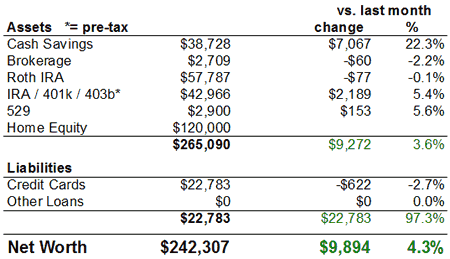
April 2008 Financial Status / Net Worth Update

Net Worth Chart April 2008

About My Credit Card Debt
If you’re a new reader, let me first explain my high levels of credit card debt. I’m actually taking money from 0% APR balance transfer offers and instead of spending it, I am placing it in high-yield savings accounts that actually earn me 4% interest or more, and keeping the difference as profit! :D Along with other deals that I blog about, this helps me earn extra side income of thousands of dollars a year. Recently I put together a series of step-by-step posts on how I do this. Please check it out first if you have any questions. This is why, although I have the ability to pay the balances off, I choose not to.
Cash Savings and Emergency Funds
As stated last month, our immediate goal is to replenish our cash savings in order to have at least a 6-month emergency fund. (9-months would be better.) It feels a bit scary not to have a big pile o’ cash right with such a big mortgage to pay. I’m even holding off on my Solo 401k contributions for the time being. However, we decided that we will start funding her 403b plan through a regular monthly withdrawal to reach the max of $15,500 for 2008 (about $1,500 per month). Currently, we are about halfway to this goal.

After the e-fund is created, we plan to start paying down our 2nd “piggyback” mortgage which is at nearly 8% interest. I feel that at 8% interest even with an interest itemized deduction that the payoff is worth it. With US Treasury bond yields so low right now, this also works well into the concept of treating additional mortgage payments as increasing your bonds allocation. Where else can I find a low-risk bond are paying a 8% coupon.

Lazy Home Equity
Previously, I considered a few different ways to track home equity, one of which was using the formula of Home value – Loan balance. My home value is subjective and probably going to decrease. My loan balance will inch up a small bit after each mortgage payment. I’m not too excited about tracking either one, so I’m only going to estimate this once every six months or so. So no change this month. Sound reasonable?

Retirement and Brokerage accounts
Not much action here, I’m boring. Market prices are still slightly down. I need to put together another portfolio update soon.

You can see our previous net worth updates here.

Should I Contribute To A Non-Deductible IRA, Part 2: Better Than Regular Taxable Account?

Continued from Part 1: Future Roth IRA Rollover. Now we’ll consider what happens if we don’t convert to a Roth.

To recap, an non-deductible IRA everything is the same as a Traditional IRA except that the initial contribution is not tax-deductible. This means that it grows tax free, but all earnings (dividends + capital gains) are taxed as ordinary income upon withdrawal. The original contribution isn’t taxed again.

This is in contrast to regular taxable account, where you can defer taxes on capital gains until you sell. Currently, if you hold stocks or bonds for at least a year before selling, you’ll be taxed at the long-term capital gains (LTCG) rate of 15% or less. Qualified dividends are taxed when received, but are also currently taxed 15% or less. Non-qualified dividends such as from bonds or REITs are taxed as ordinary income.

So which one’s better? I decided to run a few sample scenarios to find out. Here is the IRA scenario spreadsheet I used, which you can play with as well. I’ll be assuming that current tax rules stay the same when you withdraw, which is almost guaranteed not to be the case, but hopefully we’ll get something out of it.

Assumptions
Initial Balance: $4,000 after-tax
Ordinary income tax rate: 25%
Dividend tax rate: 15%
Time Horizon: Lump-sum withdrawal after 30 years

Scenario #1: Buy-and-Hold With Stock Index Funds
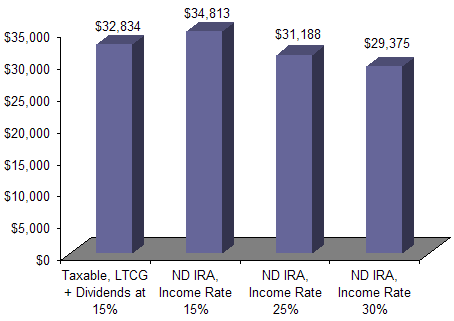
Let’s say you invest in an S&P 500 index fund, with very low turnover. You buy and hold until withdrawal. Total annual return is 8%, with 2% being in dividends each year. With a non-deductible IRA, it keeps growing as gets taxed at the end. After 30 years, you’ll end up with $31,188.

With a taxable account, you’ll get taxed 15% on those dividends every year, but the rest is accumulated as long-term capital gains. Upon selling it and paying 15% on those gains, you end up with $32,834. Taxable wins by $1,646 (5%).

If you lower the ordinary tax rate to 15%, then the non-deductible IRA wins by $1,979 ($34,813 vs. $32,834). If you raise your ordinary tax rate to 30%, then the taxable account wins loses by $3459 ($29,375 vs. $32,834). In general, taxable wins out when your tax rate at withdrawal is about 21%.

altext

Scenario #2: Active Trading With Stocks or Stock Funds
Now if you have lots of buying and selling in your portfolio, then you’ll be subject to short-term capital gains every year. Here, if you assume 100% turnover (holding stocks for just under a year) and you still earn 8% annually, taxable will never win regardless of ordinary tax rates. Even at 9% return in taxable vs. 8% return in IRA. The yearly drag of taxes kills your returns, so you should probably seek the shelter of a IRA if you plan on investing in moderate-to-high turnover funds.

Scenario #3: Buy-and-Hold With Bonds or REIT Funds
Holding a bond fund or REIT (real estate) fund is actually similar to Scenario #2, because most of the earnings from bonds and REITs are due to their interest yield or dividend distributions, and those are taxed at the higher ordinary income rates.

Let’s say you have an REIT fund that also gains 8% annually, and 100% of it’s gains are in the form of unqualified dividends. (REITs have a historical average yield of about 6-8%)

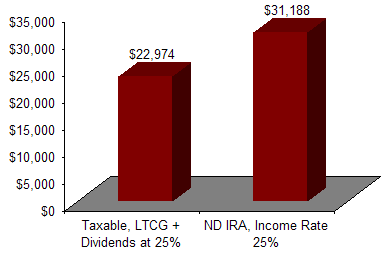
At 25% income tax rates, the taxable account just can’t keep up with an final value of $22,974 vs. $31,188 from the non-deductible IRA. That’s a 35% increase in value by going with the IRA. As income tax rate rises, the IRA’s advantage increases. A similar result occurs for bonds, although the difference is smaller due to lower expected returns.

altext

Liquidity or Early Withdrawal Concerns
A significant advantage of taxable accounts is that you can choose to access, or not access, the funds at any time. With an IRA, with a few exceptions you have to wait until age 59.5 to make a withdrawal without penalties. In addition, you’ll be required to make minimum distributions starting at age 70.5 even if you don’t need to. Some early retirees or those that want to leave a legacy might want to just stick with a taxable account.

Summary
Again, all of these are based on guesses as to what future tax laws will be, but for now my very general summary is:

  • IRAs have less liquidity and more restrictions in general. So if the expected net returns are equal, I’d pick the taxable account.
  • For low-turnover stock portfolios and index funds, the non-deductible IRA might lose out to a taxable account, but not by all that much. As your trading frequency increases, the taxable account gets less and less attractive. On the flip side, a tax-managed mutual fund might make things sway back in favor of the taxable.
  • If you plan on holding any significant amount of REITs, bonds, or other tax-inefficient investments, then a non-deductible IRA can have significant tax advantages over holding them in a taxable account.

Since I do have holdings of bonds and REITs in my portfolio and need all the tax-deferred space I can get, it looks like I’ll be contributing to a non-deductible IRA before the April 15th deadline.

Should I Contribute To A Non-Deductible IRA? Part 1: Future Roth IRA Rollover

As we’ve seen, after you reach a certain income, both Roth IRAs and tax-deductible contributions to Traditional IRAs are no longer available. After you max out your 401(k) or 403(b) plan at $15,500 per year, you start running out of tax-advantaged accounts quickly. One option is to contribute to a Traditional IRA anyways, even though the contribution will not be tax-deductible. Everything else is the same: your money will still grow tax-free, and withdrawals will be taxed at your ordinary income tax rate. You can sock away $4,000 for 2007 and $5,000 for 2008. So should you do it? I have less than three weeks before I need to decide!

There appear to be two primary ways to answer this question:

  1. Future Roth Rollover. In 2010, there will no longer be any income restrictions for Traditional-to-Roth IRA rollovers. Could this mean Roth IRAs for everyone?
  2. Compare Returns vs. Taxable Account. If you either can’t or don’t wish to convert to a Roth, will your performance at least be better than a regular taxable account?

Future Roth IRA Rollover

According to current laws, in 2010 the income restriction for Traditional-to-Roth IRA rollover will disappear. Since you’ve already paid taxes on your non-deductible IRA contributions, you will only have to pay income tax on the earning portion when you rollover. This can be seen as effectively allowing you a way to contribute to a Roth IRA down the road. Now, instead of having to pay ordinary taxes upon withdrawal, I don’t have to pay any taxes! I even avoid required minimum distributions.

Catch #1: The Law May Change
I have seen no indication that this Roth “back door” was intentional. Some people see this as simply an oversight that a busy (or lazy) Congress simply hasn’t gotten around to changing… yet. For example, the current low 15% long-term capital gains rate is also scheduled to go up in 2011. Others think that the lure of tax revenue now gained through Roth conversions might be appealing and they’ll let it stay. Now I’ve waited until the last minute to make my decision and it’s almost mid-2008, and nothing has changed, so maybe it’ll happen…

Catch #2: Mixing Deductible and Non-Deductible Contributions
Let’s say you have $10,000 in a Traditional IRA, $4,000 of which was a non-deductible contribution, and $6,000 of which was deductible contributions and earnings within the IRA. If you wanted to convert $4,000 of it over to a Roth IRA, you can’t simply pick out the non-deductible contribution. The $4,000 would be pro-rated to be 40% non-taxable and 60% taxable, in the same proportions as your total IRA.
The only way to convert all of your non-deductible contributions would be to convert everything together, which might not be ideal.

One way around this is to first roll over your deductible IRA money into another qualified retirement plan like your 401(k) if they allow such transfers (and you like your investment options). Then make your non-deductible IRA contribution. That way, the deductible and non-deductible parts can be separated. I don’t have any deductible IRA funds, but I think I could rollover into my Solo 401(k) if desired.

Catch #3: More Paperwork
If you make non-deductible contributions, conversions, or withdrawals you must document them each year using with IRS Form 8606. It’s probably a good idea to simply file the form every year so that you don’t end up forgetting and having to pay extra taxes later.

In general, I think the Roth conversion option is great if it’s available, but I am still not convinced it will still be around in 2010. So I’d better make sure that’s a non-deductible IRA is still a decent deal even without that option. To be continued in Part 2…

2008 Roth/Traditional IRA Phase-Out Limits For High Income Earners

For those people with increasing incomes, you may be wondering when either Roth IRAs and tax-deductible contributions to Traditional IRAs start being taken away from you. Here are the phase-out numbers for the 2008 tax year:

Roth IRA Phase-Out Limits
Once you reach the bottom of these phase-out ranges for your modified adjusted gross income (MAGI), your contribution limit of $5,000 starts getting reduced. At the top of the range, you can no longer contribute at all.

Tax Filing Status Phase-Out Range
Married filing jointly or qualifying widow(er) $159,000 to $169,000
Single, head of household $101,000 to $116,000
Married filing separately (and you lived with your spouse at any time during the year) $0 to $10,000

Traditional IRA Deductibility Phase-Out Limits
Once you reach the bottom of these phase-out ranges, your full deduction starts getting reduced. At the top of the range, you can no longer deduct taxes on any contributions at all. This table assumes that both you and your spouse are covered by an employer retirement plan.

Tax Filing Status Phase-Out Range
Married filing jointly or qualifying widow(er) $83,000 to $103,000
Single or head of household $52,000 to $62,000
Married filing separately $0 to $10,000

If you are single and are not covered by an employer retirement plan, or you’re married filing jointly and neither of you have a employer retirement plan, then there are no income limits for deductibility. If one spouse has a plan and the other does not, then the phase out range is $156,000 to $166,000.

Reference: See IRS Pub 590 for way too many details.

Test Driving The Financial Life You Want

Now that we have a fixed monthly mortgage payment for the foreseeable future, we are looking ahead to our true mid-term goal of living on one income. Specifically, we’d like to live on two half-incomes when we have children. We live in one of the most expensive areas in the country. Can we do it?

Both of our incomes are somewhat comparable, so our plan is to actually pretend that only one of us is working, deposit that person’s paycheck into a checking account, and work only from that checking account. The mortgage note, utilities, food, gas, all expenses will be deducted from that account. A reasonable percentage (15%? 20%?) for retirement will still be taken out. I have no idea what a child will cost, but maybe we’ll take out an extra $500 a month for food and diapers as well? The second person’s income will still be dealt with, but just separately.

This way, we will get as close as we can to simulating living on one income. If the checking account starts to shrink too fast, we’ll have to think of ways to cut expenses further. I think this is an interesting idea that could be applied to anyone who wants to stretch into a new financial goal. You may think you can do it, but failure might be costly.

  1. Buying a new home. Can you afford a mortgage payment that is significantly higher than your rent? You should be sure, otherwise you might be joining the million other people in foreclosure.
  2. Kickstarting your retirement contributions. Maybe you’re afraid of putting too much in a 401(k) or IRA and not being able to take it out. Why not just use savings account and stick your imagined contributions in there for a while? That way you won’t have to deal with penalties.
  3. Increasing your debt payments. Some people are afraid to pay off too much debt in case they need the money for later. An emergency fund would help solve this, but also the “pretend” debt account might be a good temporary solution.
  4. Going back to school, switching careers, etc. Again basically the same idea – how will you react to living on less income?