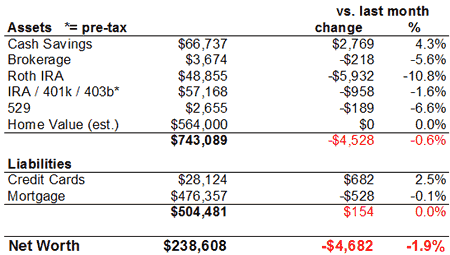
October 2008 Financial Status / Net Worth Update

Net Worth Chart 2008

Credit Card Debt
If you’re a new reader, let me start out as usual by explaining the credit card debt. I’m actually taking money from 0% APR balance transfer offers and instead of spending it, I am placing it in high-yield savings accounts that actually earn 3-4% interest or more, and keeping the difference as profit. Along with other deals that I blog about, this helps me earn extra side income of thousands of dollars a year. Recently I put together a series of step-by-step posts on how I do this. Please check it out first if you have any questions. This is why, although I have the ability to pay the credit card balances off, I choose not to.

Retirement and Brokerage accounts
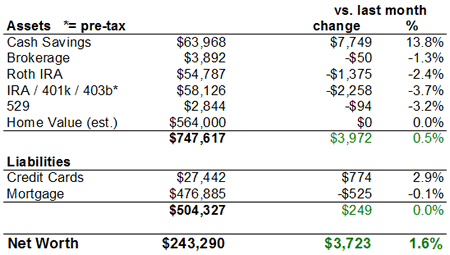
Whew! Ignoring new investments, the value of my holdings lost nearly $12,000. I won’t go into why, I think most people have heard the overall reasons. I did a portfolio update in mid-September to better understand what happened specifically. Accordingly, I am directing future contributions as I can to help rebalance my portfolio back towards the target asset allocations (mainly international developed and emerging markets stocks).

I did make an $5,000 contribution to my self-employed 401k, although I am still left in negative territory for the month. I do hope to contribute at least the $15,500 maximum salary deferral in 2008, as this has been my only contribution so far this year. My wife has already maxed out her 401(k).

Cash Savings and Emergency Funds
Last month, we achieved our mid-term goal of six months of expenses ($30,000) in net cash put aside for emergencies. Once my retirement accounts are funded, I may try to increase this cushion. An alternate reason for increasing cash is for potential real estate opportunities (way) down the road.

Home Mortgage
Another ~$500 of loan principal paid off. According to Zillow, the estimate of the value of my house is still higher than what I originally paid for it, but has also dropped 3% in the last month alone.

Big Expenses
We are taking a trip to Spain in November, which will cost us about $1,000 each. I wrote earlier about how we tried to save money on travel and how we manage cash and credit cards abroad. The airfare has already been paid for (charged on the credit cards to earn rewards, of course).

Basically, I still consider myself doing well, but I guess it is hard to avoid what everyone else is experiencing. Shrinking 401(k). Dropping house value. Rumors of potential layoffs for part-time employees at work (who’s next?). Lots of red in my net worth chart. 🙁 Fun times, eh?

You can see our previous net worth updates here.
Planning For Early Retirement Makes Me Happy

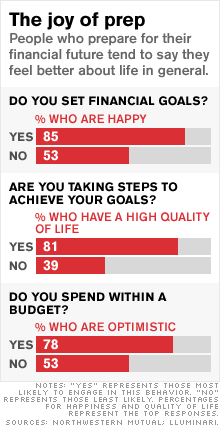
In a recent issue of Money magazine, Walter Updegrave shared the results of a recent survey by insurer Northwestern Mutual and health education company LLuminari. It showed that people who perform financial planning tend to feel happier than those who don’t. The article is also online here – Save for tomorrow, be happy today.

You have to be a little careful in reading the diagram provided, and realize that there are separate components going on (the colors help):

Economists, psychologists and others who study happiness find that people who have a sense of control over their lives cope better with stress and live more happily, while those who feel powerless are more likely to be depressed.

Now correlation doesn’t necessarily mean causation. It could be that those who are happy are more likely to budget. But in general, I agree that consciously choosing how I spend and invest my money makes me feel in control of my future, which makes me happy. Realizing the abundance of choices and alternatives out there is one of the best things I’ve learned from blogging.

(It also helps keep my mind off of all the things I can’t control, like a bailout bill with $150 billion of pork attached. Wooden arrows? Nascar race tracks? How is this related at all???)

September 2008 Investment Portfolio Update

Given recent events, I suppose I should take a look at how my investments are doing. I am also planning to make some large-ish 401k contributions and need to figure out which asset classes to buy in order to rebalance my portfolio.

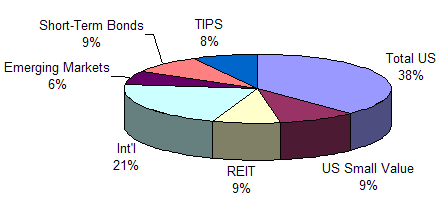
9/08 Portfolio Breakdown
 
Retirement Portfolio Actual Target
Asset Class / Fund % %
Broad US Stock Market 38.8% 34%
VTSMX – Vanguard Total Stock Market Index Fund
DISFX – Diversified Stock Index Institutional Fund*
DODGX – Dodge & Cox Stock Fund*
US Small-Cap Value 9% 8.5%
VISVX – Vanguard Small Cap Value Index Fund
Real Estate (REITs) 8.4% 8.5%
VGSIX – Vanguard REIT Index Fund
Broad International Developed 21% 25.5%
FSIIX – Fidelity Spartan International Index Fund*
VDMIX – Vanguard Developed Markets Index Fund
International Emerging Markets 6.5% 8.5%
VEIEX – Vanguard Emerging Markets Stock Index Fund
Bonds – Short-Term 9% 7.5%
VFISX – Vanguard Short-Term Treasury Fund
Bonds – Inflation-Indexed 8% 8.5%
VIPSX – Vanguard Inflation-Protected Securities Fund
Total Portfolio Value $105,654
 

* denotes 401(k) holding given limited investment options

Contribution Details
Throughout 2008, my wife has been making regular salary deferrals to her 401k, and has recently reached the annual $15,500 limit. I plan to start contributing to my Self-Employed 401k plan shortly.

YTD Performance
The 2008 year-to-date time-weighted performance of my personal portfolio is -27.9% as of 9/18/08. In fact, despite sizable additional contributions, my portfolio is down over $10,000 since my last update in April. Today might have been a bad day to run these numbers… 🙂

Although not necessarily a benchmark, the Vanguard S&P 500 Fund has returned -20.07% YTD, their FTSE All World Ex-US fund has returned –29.74% YTD, and their Total Bond Index fund is up 2.71% YTD as of 9/18/08. (My emerging markets fund is down nearly 40%!)

Rebalancing Details
First of all, I am not changing my asset allocation or moving into safer investments. In fact, I am doing the exact opposite and buying what has been dropping the most…

I am still following the general asset allocation plan outlined here, with a 85% stocks/15% bonds split [115-Age]. Here is an example of how we implemented the asset allocation across multiple accounts, although I’ve since moved some funds around.

So, it looks like I need to buy more Emerging Market and Broad International. I am now a bit overweight in Bonds and Broad US, so I need to sell those. Due to the limited index fund choices in my Fidelity Solo 401k account, I may start buying ETFs if I can justify the $10.95 commissions.

You can view all my previous portfolio snapshots here.

September 2008 Financial Status / Net Worth Update

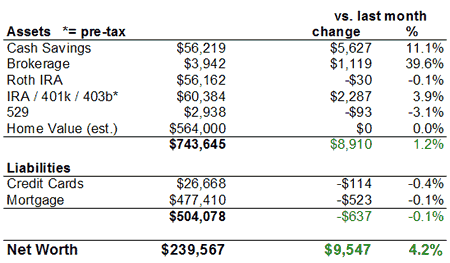
Finally got around to adding up the numbers for the last month:

Net Worth Chart July 2008

Credit Card Debt
If you’re a new reader, let me start out as usual by explaining the credit card debt. I’m actually taking money from 0% APR balance transfer offers and instead of spending it, I am placing it in high-yield savings accounts that actually earn 3-4% interest or more, and keeping the difference as profit. Along with other deals that I blog about, this helps me earn extra side income of thousands of dollars a year. Recently I put together a series of step-by-step posts on how I do this. Please check it out first if you have any questions. This is why, although I have the ability to pay the credit card balances off, I choose not to.

Retirement and Brokerage accounts
The bad news is that the market value of our investments went down over $3,500. And this is despite my wife being able to finally max out her 401k for 2008 (total of $15,500 as of this month). At least I don’t own much Fannie Mae stock…

The good news is that I am finally ready to make some big contributions to my Fidelity Self-Employed 401k, at the same time that the markets are near their 2008 lows. Buy low, sell high! Why now? I like to wait because my income fluctuates and this way I have a clearer idea of what my contribution limits will be, as they are based on gross income.

Cash Savings and Emergency Funds
Our mid-term goal was to have six months of expenses ($30,000) in net cash put aside for emergencies. This is now done. As mentioned, future cashflow will be put towards retirement accounts. Speaking of emergencies, with all these hurricanes, I have been checking out portable generators as well.

Home Mortgage
Another ~$500 of loan principal paid off. Housing prices are still dropping in my area. I will probably have to adjust my home value estimate in the future, a short-term goal might be to pick a simple benchmark to follow. After a few other financial priorities are taken care of, perhaps I’ll start a DIY biweekly mortgage plan.

We had some visitors and took a tiny bit of vacation this month, so it was a nice end to the summer. You can see our previous net worth updates here.
Helping Mom Transfer Old 401(k) To Vanguard IRA

My mom is trying to organize and simplify her financial accounts, which I applaud. A major part of this is to finally move her orphaned 401(k)s and IRAs into one location. I recommended Vanguard, since that’s where all my IRAs are. She was okay with sticking with low-cost and passive index funds, which is Vanguard’s specialty. They are also known to be investor-oriented and have high client loyalty.

If you intend to buy individual stocks or ETFs, I wouldn’t go with Vanguard Brokerage Services because they are relatively expensive. Open an account elsewhere – check out Zecco, TradeKing, or Sharebuilder.

Make A Phone Call To Old Administrator
There are a variety of ways these rollovers can happen. They may want to know the name of the company you’re going with, and also have some various paperwork to fill out. With some companies, you can request everything be done online. Even so, I think the easiest way is to simply call them and ask them the easiest way to do it (my mom didn’t like having to deal with the old company “Why are you leaving us? You can simply rollover to an IRA here…”).

You have to ask for a “direct rollover”, because otherwise you may be subject to a 20% automatic withholding, taxes, and also penalties. If the transfer can’t be done electronically, the old company will liquidate your account and send you a paper check made out to your new company. Be sure to send the check to your new company within 60 days.

Open An Account At Vanguard
Just go to Vanguard.com, click on “Open an account” at the top-right, and follow the guide. We went with “Invest for retirement” > “Roll over a 401(k) or other employer-sponsored plan” and then “Vanguard® mutual funds”.

Choosing Initial Investments
If you don’t know what to buy yet, just choose a conservative money market fund to get started. One popular option is the Prime Money Market Fund (VMMXX). You can switch into other mutual funds later easily as there are no transaction fees.

If you have over $100,000 in assets at Vanguard, you reach their Voyager level which includes a discounted financial plan. The pitch: “Pay just $250 for a plan developed by a Certified Financial Planner™ from Vanguard—a $1,000 value.” I haven’t actually paid for this myself, so I don’t know how customized it is.

Avoiding Fees
Don’t want mom getting hit with crazy fees! Vanguard charges a $20 annual fee for each Vanguard mutual fund in which your balance is under $10,000. Again, if you are at the Voyager level ($100,000+ in total assets at Vanguard) these are all waived. After that, the easiest way to avoid this fee is to sign up for electronic delivery of documents. Most people are willing to save a potential $20-$100 a year by printing out their own statements.

So now she has a funded Vanguard IRA. Next task is to provide her some investment options which fit within her overall portfolio.

Choosing Between Multiple Investment Options For 401k or 403b Plans

My mom has been asking me to look over her 401k plan, as she has been worried about its performance and suitability recently. In fact, she changed all the future contributions to 100% bonds a while back. As her 401(k) had somewhat limited choices (although they could definitely be worse), I had to make do with what was available. Usual disclaimer applies: I am not a financial professional.

1. Decide on an asset allocation.
This can be a complex topic, but I put most of my research in this series of posts on asset allocation. Given my mom’s age, years until retirement, other existing investments, and and risk preferences, I recommended an overall asset allocation of 60% stocks and 40% bonds. Currently, she is at 68%/32%. I would definitely like to have at least a broad US stock fund, a broad international stock fund, and a broad US bond fund. It might be nice to have Large-cap Value, Small-cap Value, Emerging Markets, Real Estate, or Inflation-protected Bond funds. The final ratios will be similar to the asset allocation breakdown here.

2. Make a list of fund options and characteristics
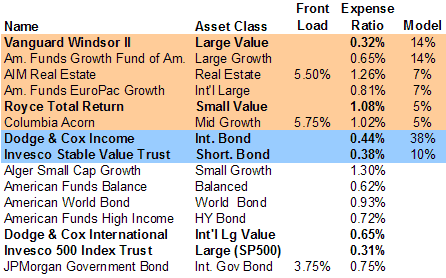
First up, you’ll want to gather a list of all your available investment options. Usually this includes about 5-30 mutual funds. If the fund details are not well organized, just ask for the ticker symbol and pull up their Morningstar.com snapshot. Put them in a spreadsheet, and include the each fund’s asset class, any front- or back-end loads, and annual expense ratio. Here are the 15 options in my mom’s 401(k) plan:

Now, I am completely ignoring Morningstar “star” ratings. They are based primarily on past recent performance, which have been shown to be a poor indicator of future long-term performance. You could buy a 5-star fund and have it end up a 1-star fund a few years later. Fund managers change all the time as well. I want to create a low maintenance portfolio that doesn’t involve chasing hot managers or performance.

3. Narrow down the options by cost and asset class.
If I don’t need the asset class, then I cross it out. If there are two similar funds, then pick the cheaper one with lower loads. In my “nice to have list”, if it is too expensive, then it becomes less useful as a diversifier and I cross it out as well. An example is the AIM Real Estate fund, with the 5.5% front load. The 6 bolded funds above are the ones that I am left with.

4. Decide if you are going to do a full asset allocation or cherry pick
It is often recommended that you implement your asset allocation across all your investment accounts (401ks, IRAs, brokerage) as one pie. For example, you might hold all your bond funds in tax-sheltered accounts for optimal tax efficiency. Or your 401k might only have one really good fund, and you can buy the other asset classes elsewhere. If this is the case, then you might want to cherry pick the funds you want for your 401k.

For other reasons, you might just want to implement your entire asset allocation as best you can within the 401k. I’m going to go ahead with this latter route for now.

5. Consider Target-date Funds or Pre-Set Model Portfolios
Many 401(k)s include an even simpler option, either all-in-one Target-dated funds or pre-set portfolio mixes. But all target-date funds are not made the same. Look at the prospectus and see what funds are included within them, and if they charge you an extra layer of management fees on top of the fees of the underlying funds. Many are crap, and you could do much better with your own custom mix. My mom’s 401k has no such option.

She does however, have a few options for pre-set model portfolios. These are basically a set ratio of selected funds (the pink and blue highlighted items above), which are are automatically rebalanced once a year. Shown above is the breakdown the “balanced model” option. However, I don’t like them because they include several expensive funds and exclude some of what I think are the best funds. Not including the large front-end loads of two of the funds, the average weighted expense ratio of the model portfolio was 0.59%.

6. Construct Your Custom Portfolio
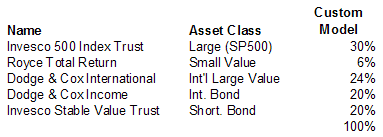
In the end, I chose the 5 funds below. I decided to leave out Windsor II (Large Value fund) for the sake of simplicity. I calculated the averaged weighted expense ratio to be 0.48%.

7. Explain and Implement
Now, I have to explain to my mom why I picked these funds, and how they may perform in the future. If she wants, I may shift it to 50% stocks/50% bonds. I’ll check in on it again after a year to show her how to rebalance. This is not the perfect portfolio, but it will be better than her previous hodgepodge, and also be easier to manage.

Comparison Of Different Ways To Generate Income In Early Retirement

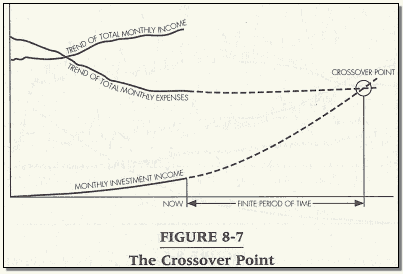
As outlined in this previous post about One Way To Track Your Progress Towards Financial Independence, you can say you’ve reached financial independence when your “passive” investment income equals your monthly expenses (“crossover point”):

The above chart was taken from the Your Money or Your Life, which also says the best way to generate income is by purchasing 30-year Treasury Bonds. But there are a variety of other ways that retirees generate income for retirement. Each one has their own pros and cons.

High-Grade Bonds or Certificates
U.S. Treasury bonds are a very safe and reliable way to generate regular income, as it is guaranteed by the U.S. government and they are very liquid. A similar situation results you invest in bank CDs or other investment-grade corporate or municipal bonds. The primary drawbacks are lower returns, especially relative to inflation. The 30-year bond is currently yielding somewhere around 4.5%. The current real (above inflation) yield for a 20-year TIPS (inflation-indexed bond) is only about 2.20%.

This means that if you want both the highest safety and you wish to only live off the interest of your money without ever touching the principal, you can only withdraw about 2.2% each year. That’s only $183 per month for each $100,000.

60/40 Asset Allocation with 4% Safe Withdrawal Rate
Although there is still much ongoing debate, the “4% rule” is based on on research by William Bergen:

William Bengen, a U.S. researcher, has back-tested a 4% withdrawal rate with a balanced portfolio of U.S. stocks and government bonds earning overall market returns and found that you would have been able to safely withdraw 4% of your portfolio over any 30-year period since 1926. [source]

The general idea is that if you have a portfolio with an asset allocation of 60% stocks/40% bonds, you can withdraw 4% of the portfolio each year with only a small chance of running out of money somewhere down the line. A 4% withdrawal rate would be $333/month for each $100,000. However, your portfolio will experience wilder swings, and this rigid method is very sensitive to the returns in the first years of retirement. If you have a bad decade upfront, your chance of going broke rises quickly.

Income-Focused Mutual Funds
These are mutual funds who primary objective is not growth, but to create a stable income stream from a combination of stock dividends and bond interest. The secondary objective is some capital appreciation, which ideally will help the income stream to keep up with inflation.

A passive index fund example is the Vanguard Target Retirement Income Fund (VTINX), which is currently yielding 4.05%. A popular actively-managed example is the Vanguard Wellesley Income Fund (VWINX), which is currently yielding 4.71%. Both of these funds hold roughly 35% in stocks/65% in bonds. Wellesley has been around since 1929, and many retirees swear by the reliable income it produces.

Managed Payout Mutual Funds
A new breed of mutual funds actually adjusts to help you spend your money as fast as you like. You choose how fast you wish to withdraw your money (3%? 5%? 7%?), and the fund does it’s best to accommodate that without going broke. Vanguard has their Managed Payout Funds, and Fidelity has their Income Replacement Funds.

These funds help you create regular monthly payments like an annuity, but still include risk from the stock market. They are also very new and could be seen as unproven.

Individual Dividend Stocks
I know of several retirees who manage their own portfolios of individual stocks. These people accumulate shares in companies with a history of reliable stock dividends, like General Electric and Coca-Cola, and live off the dividends. An ETF of top dividend producers, DVY, currently yields 5.14%.

I would be wary though that the share value of these stocks can vary widely without the cushion of bonds. DVY has dropped by over 20% so far this year, which is indicative of many similar dividend stocks.

Income Annuity
With a simple version of an immediate annuity, you hand over a lump-sum upfront in return for fixed income payments for life. Of course, if you die early then you don’t get your lump sum back. However, you could live until 110. It’s almost like life insurance in reverse. A special risk here is that your insurance company must stay solvent the entire time, so you must check credit ratings.

I went to ImmediateAnnuities.com and looked into a Joint Annuity, where the income payments keep coming as long as one of us are alive. A rough quote for a 40-year old says that each $100,000 paid will get me about $450 a month. That is the same as saying I can earn 5.4% interest forever, but remember that I lose the principal. Of course, this value goes up with age. For a 60-year old couple, you can get 6.4% forever. At age 70, you can get 7.5% forever.

How much income will a million bucks get you?
Based on these numbers, with $1,000,000 one could get anywhere from $1,830 a month (very little risk, no principal loss) to $5,833 per month (fixed annuity at age 65, all principal is given up). I’d probably end up going with something in between, but it is food for thought.

August 2008 Financial Status / Net Worth Update

Net Worth Chart July 2008

Credit Card Debt
If you’re a new reader, let me start out as usual by explaining the credit card debt. I’m actually taking money from 0% APR balance transfer offers and instead of spending it, I am placing it in high-yield savings accounts that actually earn 3-4% interest or more, and keeping the difference as profit. Along with other deals that I blog about, this helps me earn extra side income of thousands of dollars a year. Recently I put together a series of step-by-step posts on how I do this. Please check it out first if you have any questions. This is why, although I have the ability to pay the credit card balances off, I choose not to.

Retirement and Brokerage accounts
We added another $3,048 in 401(k) contributions, which given the numbers above means our retirement accounts actually lost about $1,000 in value. YTD performance numbers are… not good. I just hope that the prices stay low until I can start buying again now that I am done with the Emergency Fund.

In my brokerage accounts, I sold all of my “play money” stocks (only valued at ~$2,000) and instead participated in a minor arbitrage attempt. It worked out well, I made a gain of 10% in 17 days. It’s all in cash now and I again have no position in individual stocks at all.

Cash Savings and Emergency Funds
Our mid-term goal is to have $30,000 in net cash put aside for emergencies, for example if both of us find ourselves unemployed for an extended period and even have to start paying for things like health insurance on our own. We are basically done, with about $500 to go. Now to find better uses for our incoming cashflow.

Home Mortgage
Another ~$500 of loan principal paid off. I am debating whether to start paying extra towards my mortgage right now. In my mind, it would feel nice to have a home paid off as part of my grand early retirement plan. However, I also like the idea that such a long-term loan at <6% can act a nice inflation hedge. Besides healthcare costs, I view unexpected inflation as another scary unknown for early retirees.

You can see our previous net worth updates here.
Finding Local and Affordable Items On My Bucket List

As a successful early retiree points out, sometimes it may not be simply money keeping you from accomplishing your dreams:

Retirement forces you to stop thinking that it is your job that holds you back. For most people the depressing truth is that they aren’t that organized, disciplined, or motivated.

Many people have a list of 101 Things To Do Before I Die, also more recently known as a Bucket List. Much of my list includes travel, but I wanted to narrow it down to things that I could work on over weekends and cost less than $500. I should be able to accomplish these things without achieving financial independence.

Get Certified to Scuba Dive: $300
My sister recently got certified to scuba dive. The cost was between $300 and $400. This includes classroom materials (book/DVD), equipment rental, two pool sessions, and two ocean dives. You must supply your mask, snorkel, fins, and boots. Now, the trip to the Great Barrier Reef is gonna cost me…

Skydiving: $200
There is usually a skydiving place near most metro areas, although for obvious reasons it tends to be a drive. It costs around $200 for a single tandem-jump, and an additional $100 for a video of the jump (another person has to jump and film you). You pretty much just show up, watch a short video, and go for it. I’ve actually done this one already (photo credit, not me). I must say, if you are so inclined, it is quite a memorable experience. Remembering the feeling makes me want to do the rest of these items!

Fly an Airplane: $75+
Chances are you have a non-commercial airfield near you as well. Just look up “flying lessons + your city”, and many places will offer an introductory lesson for $50 to $100. During the lesson, the pilot will let you “fly” the airplane for a bit. Of course, if you have a pilot friend, they could take you up as well for free. My wife got to do this recently, it sounded awesome.

Learn a Foreign Language: Free to $$$
I would imagine the cheapest way to learn a language would probably be to check out some language books and tapes from your local library. After that, you’ll need to find some native speakers to practice conversing with and correct your pronunciation. I remember while in college you could setup lunches with international students. You have lunch together, and might spend 30 minutes speaking Spanish only, and then 30 minutes speaking English with them. For more money, you can always get a more refined computer-based course or go to an official language school.

Finish a Marathon: Free to $$$
The idea of running a marathon has always been appealing to me due to the sheer simplicity and purity of the accomplishment. There are many free online resources on how to train for your first marathon. I have tried none of them. 😉 The time needed to train would vary widely based on your current abilities. I bet I’d need at least 6 months. As for costs, I’ve been told to eventually buy a proper pair of running shoes, which you only use for running.

Better Example Against Double-Taxation Of 401(k) Loans

Okay, so I view my last post on 401k loans as a failure. I tried to use as little math as possible in explaining why 401k loans are not a bad idea due to the incorrect concept of “double taxation”. Instead, I probably managed to confuse many of you all further. I have tried to come up with a better example with the math thrown back in, and think I have found one. Please give me another chance! 🙂

The Method

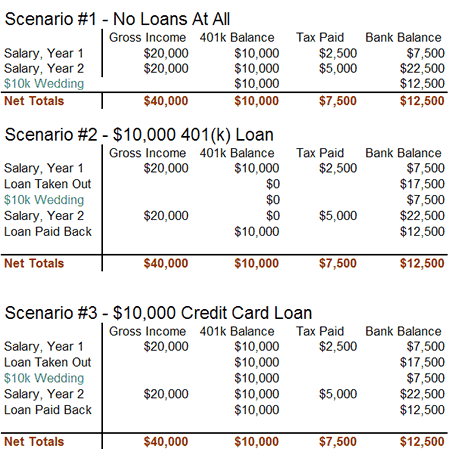
If double-taxation really occurs in 401k loans, that would mean that taking out such a loan somehow negates the inherent tax-advantages of the 401(k) plan. Certainly, taking a loan and paying it back would be worse than just leaving the 401(k) completely alone, right? I am going to walk slowly through three scenarios that will show that this is simply not true. The three hypothetical scenarios:

  1. Elton contributes $10,000 to a 401(k) and does nothing. He does not take any loans of any type. He waits a year and pays for his $10,000 wedding in cash.
  2. Elton contributes $10,000 to a 401(k). He then takes out a 401(k) loan of $10,000 to pay for his wedding, and then repays the $10,000 a year later using after-tax money earned from his job.
  3. Elton contributes $10,000 to a 401(k). He then takes out a credit card loan of $10,000 to pay for his wedding, and then repays the $10,000 a year later using after-tax money earned from his job.

Very Simple Assumptions

Annual gross salary is $20,000. Income tax is 25% of gross income. There is no interest charged on any loans, as I’m just trying to isolate the issue of double-taxation. There is no growth in the funds, either. He doesn’t need to eat or sleep, so no other expenses. 😉 (And yes, 401(k) loans are usually capped at 50% of total balances.)

The Results

Scenario #1: No Loans

  1. In Year 1, Elton makes a total of $20k gross. He contributes $10k pre-tax to his 401k, and pays taxes on the remaining $10k.
  2. In Year 2, he again makes $20k gross and does not make any additional 401k contributions.
  3. He spends $10k on his wedding. The 401k stays at $10,000 the whole time.

Scenario #2: 401k Loan

  1. In Year 1, Elton makes a total of $20k gross. He contributes $10k pre-tax to his 401k, and pays taxes on the remaining $10k.
  2. He then takes a $10k 401k loan out, and puts the $10k in his bank.
  3. He spends $10k on his wedding, and his bank balance goes down accordingly.
  4. In Year 2, he again makes $20k gross and does not make any additional 401k contributions.
  5. Finally, he pays back the borrowed $10,000 back into his 401k using the money he earned in Year 2.

Scenario #3: Credit Card Loan

  1. In Year 1, Elton makes a total of $20k gross. He contributes $10k pre-tax to his 401k, and pays taxes on the remaining $10k.
  2. He then borrows $10k via his credit card.
  3. He spends $10k on his wedding.
  4. In Year 2, he again makes $20k gross and does not make any additional 401k contributions.
  5. Finally, he pays back the borrowed $10,000 back into his credit card using the money he earned in Year 2. The 401k stays at $10,000 the whole time.

Recap
In all three scenarios, the amount of taxes paid is the same, and the final result is the same. Total taxable income over two years is $30k in all 3 cases. Final taxes paid: 25% of $30k, or $7,500. You end up with a 401k with $10,000 of pre-tax money in all 3 cases. No additional taxes are paid by taking out a 401(k) loan.

It does not matter even if he spends the $10,000 borrowed and pays it back later with after-tax money! Thus, I still conclude that there is no “double-taxation” on 401k loan principal.

Double Taxation and the Real Reasons 401(k) Loans Are Bad

I have noticed an increasing amount of discussion regarding 401(k) loans. While almost all sources denounce this as a bad idea, I take issue with one of the supposed reasons why: double taxation. Suze Orman explains it her way:

Suze says when you put money in a 401(k), it goes in with pre-tax dollars—you add from your wages before the government takes any income tax out. When you take a loan out of your 401(k), you’ll usually have to pay it back in five years—with other money that has been taxed. Then, when you get older and you take money out of your 401(k) plan again, you’ll pay taxes again. “You have just volunteered for double taxation. Why would you want to do that?” Suze says. “Do not ever take a loan from a 401(k) plan.”

So does MSN Money:

Whether you repay the 401(k) loan out of your salary or from a bank account, those payments are all made back into the 401(k) with after-tax dollars. So, let’s say your monthly interest payment is $300 and you’re in the 28% tax bracket. You’ll have to make $416 in gross earnings to make the $300 payment. Then, when you retire and take withdrawals, you pay taxes yet again.

I see this double-taxation argument over and over… These quotes seem to suggest that you’ll lose something like 25% of your principal (or whatever your tax rate is) if you dare take out a 401(k) loan. Why are such trusted sources still spreading this misleading information?

Let’s say you want to borrow $10,000 from your 401(k) plan for a year. Your plan charges an interest rate of Prime + 1% = 6%, which you must pay back to yourself. That $10,000 was a pre-tax contribution, so you never paid income taxes on it. You take it all out, leaving yourself with $10,000 in cash. You haven’t paid any taxes on that $10,000. You leave it under your mattress, and a year later pay back the same $10,000 plus $600 in interest. Still haven’t paid taxes on the $10,000. When you eventually withdraw the money, then finally must you pay taxes. So what was the only thing taxed twice? The part attributable to the $600. Not the $10,000.

Question: Does it matter if it turns out someone took your original 10,000 and then replaced it without you knowing? The answer is no. As long as you pay back the $10,000, that is all that matters.

The only part that is taxed twice is the interest. And since you are paying yourself the interest, this small double-tax is really the only cost of doing this loan. Using the example above and assuming a 25% marginal tax bracket, that means you only got taxed an extra $150 on that $10,000 loan. This is the same as getting a regular loan with a 1.5% interest rate. Dealing purely with the effective interest rate paid and assuming you pay back the loan in a timely manner, a 401(k) loan is actually quite a good deal.

This leaves you with the real reasons not to take a 401(k) loan:

  1. If you lose your job, you will have to repay the loan within 60 days or it will be considered an unqualified withdrawal. This means you lose any future tax advantages on that amount, and you will be subject to income tax plus a 10% penalty on the amount. This would boost your effective interest rate dramatically.
  2. 401(k) funds are protected from creditors, even in the event of bankruptcy. If you borrowed money on a credit card and don’t pay it back, your credit score will tank but nobody will take money out of your hands. Just like how home equity loans can be dangerous because you are risking your home, unsecured debt is always better than secured debt. If something is so bad that you need to sacrifice your retirement savings, then bankruptcy may not be that far-fetched. Is this a one-time need, or are you just putting off the inevitable?
  3. Some 401k loans do not allow new contributions if you have loan outstanding. So you could be losing out on some 401k matching contributions. This loss would also drive up the effective cost of a 401k loan.

Summary
401(k) loans can indeed offer you a very low effective interest rate given optimum conditions. However, there are important potential catches, enough that I would still personally take out an unsecured loan first if at all possible. Before taking on any debt, you should carefully examine your reasons for doing so. I think that only those with really bad credit (unable to get loan otherwise) and a short-term need with a quick payback schedule should take out a 401(k) loan.

Update: A lot of people still think double-taxation still occurs. As opposed to editing this post, I went ahead an made up a better example against the theory of double-taxation. Please check it out before making up your mind.

One Way To Track Your Progress Towards Financial Independence

Another more conventional definition of financial freedom is when you have “passive” income that covers your expenses so that you no longer have to work. Usually, this comes from paper investments like stocks, bonds, or annuities. In the book Your Money or Your Life, the authors outline a somewhat unique way to track your progress towards financial independence (FI).

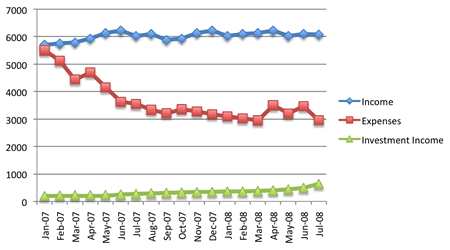
First, you should go out and buy a huge wall-sized piece of graph paper and put it up somewhere you’ll see every day. Create a chart with the horizontal axis being time, and the vertical axis being money. Each month, you should record the following items:

  1. Your monthly income
  2. Your total monthly expenses
  3. Estimated investment income

Here is a sample of what it might look like:

Line 1 – Graphing Your Income Each Month
While many personal finance articles focus on spending less, the book does a good job of reminding us that income matters and we can always do something to increase it. It also tells us that the path towards a happier life and a career you enjoy of also tends to increase your income. The book summarizes this with the following:

“Increase your income by valuing the life energy you invest in your job, exchanging it for the highest pay consistent with your health and integrity.”

Line 2 – Graphing Your Expenses Each Month
Note that we are not making a budget here. A budget often seems to suggest a goal of “I will spend this much”. Instead, here you are first making an assessment of your situation from last month. You then attempt a few (or several) changes, and re-assess again a month later. This continual feedback should ideally help you see what is working and what’s not.

For those dealing with debt, the Expenses line might even be higher than your Income line at first. This should provide a nice incentive to get to the first “crossover point” where you at least earn what you spend. Gradually, we can shave off those lower priority expenditures as we keep seeing that gap between income and expenses grow wider and wider.

Line 3 – Graphing Your Expected Income From Investments
Here, the simple formula given for finding the income you can derive from your investments is this:

savings x interest rate / 12 = monthly investment income

The suggested investment here is to use is that of the 30-year U.S. Treasury Bond, currently yielding somewhere around 4.5%. This means if you bought $100,000 of these bonds with your savings, you would earn $375 reliably every month for 30 years without risking your principal. Other people might use dividend payments from stocks, or use a historically-safe withdrawal rate.

Either way, the big goal is to make this third line meet up with the expenses line. As time goes on this line will hopefully curve up exponentially, providing inspiration to reach this “crossover point”. The idea of working for only a finite period of time can be very motivating.

Given that this book was written in 1992, I am going to guess that doing this using a spreadsheet program like Excel is also acceptable. While a physical chart may work better for some people and provide a more constant and tangible reminder, I think perhaps making the chart your Desktop wallpaper might serve a similar purpose. (Or you could create blog about it…)

This is a pretty cool idea. Perhaps I should stop tracking net worth and simply do this? For us, as mentioned before, once our mortgage is paid off the expense line should drop dramatically. Separating out the non-housing expenses into a separate line might help me focus better.