
Here is my 2025 Year-End portfolio update that includes all our combined 401k/403b/IRAs and taxable brokerage accounts but excludes our house and small side portfolio of self-directed investments. Following the concept of skin in the game, the following is not a recommendation, but a sharing of our actual, imperfect DIY portfolio.
“Never ask anyone for their opinion, forecast, or recommendation. Just ask them what they have in their portfolio.” – Nassim Taleb
How I Track My Portfolio
Here’s how I track my portfolio across multiple brokers and account types:
- The Empower Personal Dashboard real-time portfolio tracking tools (free) automatically logs into my different accounts, adds up my various balances, tracks my performance, and calculates my overall asset allocation daily. Formerly known as Personal Capital.
- Once a quarter, I also update my manual Google Spreadsheet (free to copy, instructions) because it helps me calculate how much I need in each asset class to rebalance back towards my target asset allocation. I also create a new sheet each quarter, so I have a personal archive of my portfolio dating back many years.
2025 Year-End Asset Allocation and YTD Performance
Here are updated performance and asset allocation charts, per the “Holdings” and “Allocation” tabs of my Empower Personal Dashboard.
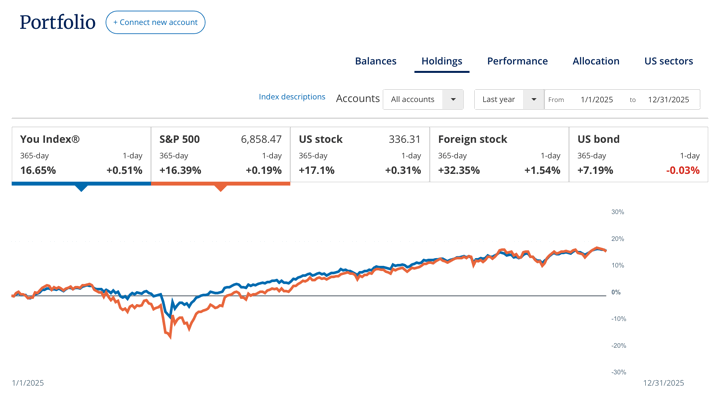
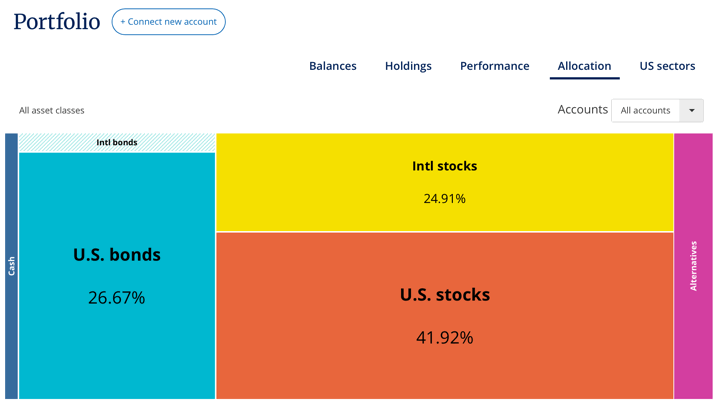
The major components of my portfolio are broad index ETFs. I do mix it up a bit around the edges, but not very much. Here is a model version of my target asset allocation with sample ETF holdings for each asset class.
- 35% US Total Market (VTI)
- 5% US Small-Cap Value (AVUV)
- 20% International Total Market (VXUS)
- 5% International Small-Cap Value (AVDV)
- 5% US Real Estate (REIT) (VNQ)
- 20% US “Regular” Treasury Bonds and/or FDIC-insured deposits (VGSH)
- 10% US Treasury Inflation-Protected Bonds (SCHP)
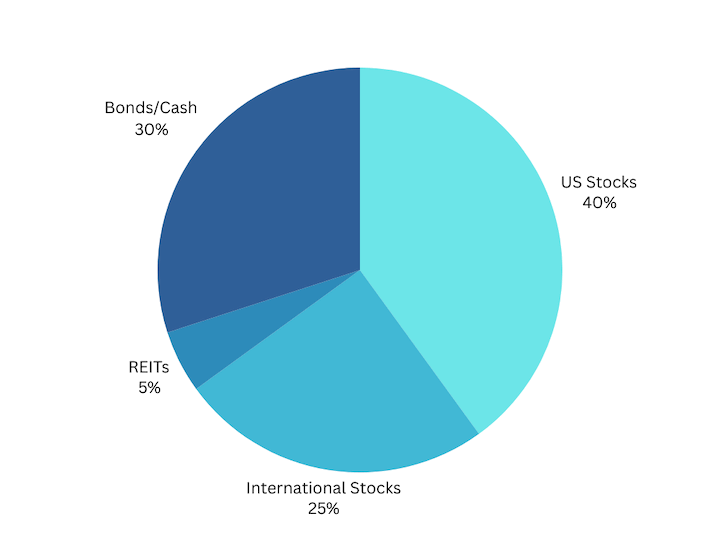
Big picture, it is 70% businesses and 30% very safe bonds/cash:
By paying minimal costs including management fees, transaction spreads, and tax drag, I am trying to essentially guarantee myself above-average net performance over time.
I do not spend a lot of time backtesting various model portfolios. You’ll usually find that whatever model portfolio is popular at the moment just happens to hold the asset class that has been the hottest recently.
The portfolio that you can hold onto through the tough times is the best one for you. I’ve been pretty much holding this same portfolio for 20 years. Check out these ancient posts from 2004 and 2005. Every asset class will eventually have a low period, and you must have strong faith during these periods to earn those historically high returns. You have to keep owning and buying more stocks through the stock market crashes. You have to maintain and even buy more rental properties during a housing crunch, etc. A good sign is that if prices drop, you’ll want to buy more of that asset instead of less. I don’t have strong faith in the long-term results of commodities, gold, or bitcoin – so I don’t own them.
Performance details. Here’s an updated YTD Growth of $10,000 chart courtesy of Testfolio for some of the major ETFs that shows the difference in performance in the broad indexes:
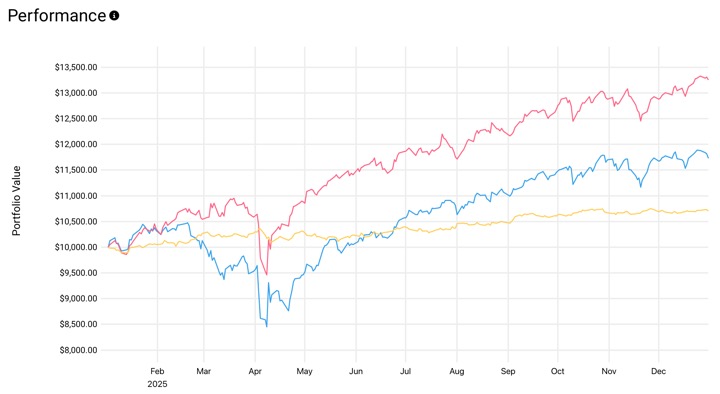
Nearly everything went up in 2025. I doubt 2026 will be boring. I’ll share about more about the income aspect in a separate post.
 The Best Credit Card Bonus Offers – 2025
 Big List of Free Stocks from Brokerage Apps
 Best Interest Rates on Cash - 2025
 Free Credit Scores x 3 + Free Credit Monitoring
 Best No Fee 0% APR Balance Transfer Offers
 Little-Known Cellular Data Plans That Can Save Big Money
 How To Haggle Your Cable or Direct TV Bill
 Big List of Free Consumer Data Reports (Credit, Rent, Work)
I’ve been reading you for years. Some concerns about VTI and VXUS and risk. One of the things that concern me is that VTI like S&P 500 index funds appear to be very concentrated in American Tech. VTI 38.5% invested in Tech and its the same culprits NVIDIA, Apple, Google, Broadcom. Which increasingly makes VTI a tech index, and not reflective of the overall American economy (which is 70% consumers). Making VTI at high risk of pull back if there is an AI bubble. Also VXUS appears to invest in mostly European “developed” economies. 38% Europe, and 8% in Canada and Mexico. I think the idea of VXUS is to invest in assets that are not correlated to the US as a diversification. Unfortunately, I don’t think VXUS achieves this as when the US does poorly so does Europe and Canada/Mexico. When the US does well those countries may do well. Suggesting that VXUS doesn’t have the negative correlation (especially on the downside) people are looking for when investing in outside the US. Aka it doesn’t seem to be a good risk hedge. I’m not saying these are bad choices, but I’m not sure people who read this recognize there is a lot of tech concentration in VTI and VXUS tends to do the same thing as the US economy. I think this strategy has significantly more risk in it than say 20-30 years ago when there was not such a concentration in tech and how dependent Europe has become on selling to the US economy.
I think those are legitimate concerns, but mostly the question is “what is a better alternative?” What should to overweight? Underweight relative to market cap? What’s the extra cost of that? The elegance of this approach is that whatever ends up winning, you will own it. The biggest companies in the 1980s were IBM, AT&T, Exxon, and Standard Oil. Each decade afterward there were changes, and I don’t have to pay attention to any of it, because I know I will own the top companies of the 2030s and 2040s, which will quite possibly/even likely not be Apple or NVIDIA.
You make a good point about the changing stock allocation of the index funds, but its not much protection against the immediate impacts of a stock bubble popping. I have been pondering this a lot recently. I suspect the best corollary to today, is Japan in the late 1980s everything bubble. In common we have high stock, real-estate and commodities prices, we have a Central Bank (FED) and treasury loosening interest rates and regulations to encourage more lending. We have a system that rewards asset owners. Our differences are we have low personal savings, limited ability to borrow more money to juice the economy, and a push by the world to de-dollarize. So if I lived in Japan in the 1980s, and know that the US rewards asset owners (assuming we don’t get socialists who ex-prorate private property). Then your best bet is to carry on, own US assets, and diversify into foreign assets, ideally foreign assets that can’t be sized by a government desperate for money. So I think owning foreign real-estate, foreign stocks, gold (not bitcoin), as well as a state in the US for continued growth offers protection from government seizure, and a collapse of the market. Also possibly seeking lower tax jurisdictions for asset storage.
Not sure why you wouldn’t want commodities or gold. We are in a bull market for each currently.
I agree, and the drivers for commodity apperciation, essentially the world trade decoupling and countries wanting to secure resources will continue to play on for the foreseeable future. As long as central banks continue to buy gold in a push to de-dollarise and diversify gold will continue its bull run. Gold is not an investment, its really best thought of as insurance against falling dollar values. So like all insurance is offers protection (and a lot of risk if you physically possess it). But its also clear that bitcoin is a risk on asset, it is not a safe store of wealth, it goes up when the market does.