Bank of America Overdraft Fee Refund

boansfUpdated. Although I originally wrote this post a few years ago, it (unfortunately) still gets regular traffic. Bank reforms instituted in 2010 made overdraft “protection” only applicable on an opt-in basis on ATM/debit card usage. Despite this fact, U.S. banks still collected over $6 billion dollars in overdraft fees in 2015.

The advice below on how to get a BofA overdraft fee refunded still works, as many positive e-mails and comments will attest. But you should also ask to turn OFF your overdraft protection as many people are confused on the actual meaning of the service. If you opt-out of overdraft protection and try to use your debit card with an insufficient balance, you will simply get denied with no fee. If you opt-in to overdraft protection and try to use your debit card with an insufficient balance, your purchase will go through but you will get charged a fee of roughly $35 on each instance. Now you know why I put quotation marks around “protection”.

Just Ask!

I was hit with an overdraft fee from Bank of America when I was trying to close out an account. Luckily, I was able to get it refunded to me. The answer is always no if you don’t ask, so don’t give up the opportunity to save hundreds of dollars with a 10-minute phone call! A few tips:

  • Be nice but firm. Customer service reps are people. This is not the time to outline all the reasons why their overdraft system is unfair. The employee is never going to be able to admit “Yes, they are unfair!”, and you’re only going to put them on the defensive.
  • Admit you made a mistake, and include your personal story. Perhaps you and your spouse had a miscommunication and lost track of the bank balance. Your contractor finally cashed a check from 8 months ago that you forgot about. A spokesperson from Bank of America said they “may waive unemployed consumers’ fees on a case-by-case basis.”
  • Help them find a reason to help you. Are you a first-time offender? Are you a long-time customer? Do you have other accounts with Bank of America? Credit card, loans, or business accounts? Show them you are a profitable customer worth keeping.
  • Try different communication avenues. I used to visit my local branch a lot, and have had some good success with going directly there. Your mileage my vary, but also try any combination of Live Chat, E-mail, and Telephone.

“Hi, I was recently charged an overdraft fee when an old check got cashed. I totally forgot about it and it was my fault. However, I’ve been with BofA for X years, and this is my first overdraft fee. I am calling to see if I am able to get this waived.”

Denied? Escalate!

If you’re not satisfied with your response, it has paid off for many customers to escalate your request to the “Executive Customer Relations” division of Bank of America. Read the many relieved comments below.

Call Executive Customer Relations:
Executive Customer Relations general line: 704-386-5687

E-mail a Bank of America Customer Advocate:
Melissa Russell
Customer Advocate
Office of the Chairman
800-669-2443 Ext 2809
melissa.d.russell@bankofamerica.com

Crystal R. Peterson
Customer Advocate
Office of the CEO and President
336-805-3126
crystal.peterson@bankofamerica.com

A sample success story:

Emailed the office of the chairman 2 weeks ago and received a call today from that office. They credited back $440 in overdraft fees. Issue was my fault since i made the purchases but the merchant submitted all transactions for 3 months on one day. Pretty happy with the result.

Write a snail-mail letter to the CEO:
Brian Thomas Moynihan
100 N. Tryon Street
Mail Code NC-1-007-18-01
Charlotte, NC 28255

Another success story:

Thank you, thank you, thank you. After reading the post about the BoA customer who got $280 in NSF fees refunded, I wrote BoA myself. They had charged me 7 NSF fees in succession (which sucked ass) and was my fault. […] So I wrote a formal letter of complaint to Kenneth Lewis. This past Saturday, they refunded all of the fees – even though it was my fault. I can’t believe it. That rocks. People do have the power.

MaxMyInterest.com Review: Automated Interest Rate Chasing

mmi_logoHere is an updated link to the Best Cash Rates for 2019. But with the growing popularity of “robo-advisors” that manage your retirement portfolio using automated software, what if there was a robo-advisor for rate chasing?

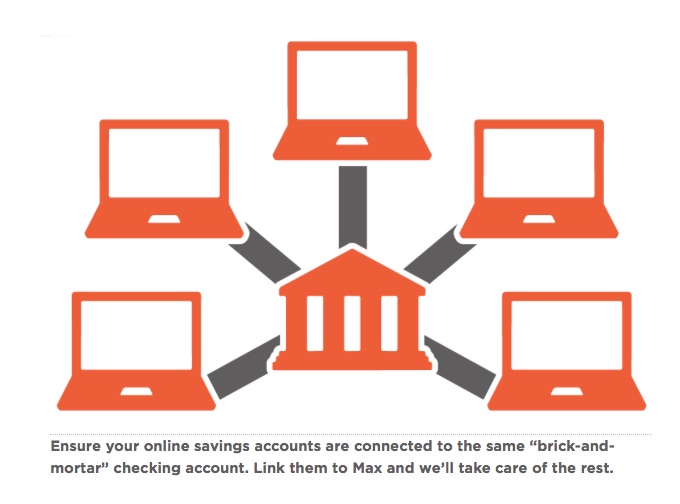
That’s the basic idea behind MaxMyInterest.com (Max). You set a Target Value you’d like to keep in your standard “brick-and-mortar” checking account. Max will then sweep any excess funds into whatever online savings bank has the highest yield. If their rates change, Max can move your money again. If your checking account balance gets low, Max will move money back into your checking account for you. The ole’ hub and spoke graphic:

mmi_spoke

If your balance exceeds the FDIC insurance limits of $250,000 per account type, Max will move the rest into the bank with the next-highest yield, and so on. T

What banks does it work with? They officially support checking accounts from the following big banks. Their application suggests that they may support other checking accounts. (The official list has also expanded a bit since their launch.)

  • Bank of America
  • Citibank
  • First Republic Bank
  • JPMorgan/Chase
  • Wells Fargo
  • Charles Schwab Bank
  • US Bank

Max will use one of these five online banks as your spokes (others may be added in the future, but only these work right now):

  • Ally Bank
  • American Express
  • Barclays
  • Capital One 360
  • GE Capital

You can have them open already, or you can only open a few, or you can use their “common application” to apply for all of them at once.

The cost? 0.02% per quarter, or 0.08% per year.

You can get an idea of their target audience from their marketing materials. I didn’t even know Hermes sold ties, let alone that they cost $200 a pop!

mmi_hermes

Recap. I certainly think the idea is a neat one. But considering the cost and restrictions to the specific five online banks, the greatest appeal of MaxMyInterest is probably to people with $250,000+ balances that want the maintain the safety FDIC-insurance without having to juggle multiple accounts on their own. For most people that don’t have that much sitting around in cash, simply picking a single online savings account with a good track record of offering high interest rates should be good enough.


Consumers Credit Union Free Rewards Checking Review: Up to 4.09% APY on up to $10,000

ccu_logo_200Updated May 2020. Consumers Credit Union (CCU) has a Free Rewards Checking account that offers a high interest rate between 2.09% and 4.09% APY if you meet certain requirements. As with similar accounts elsewhere, the catch is if you don’t jump through all of the hoops, you effectively won’t earn any interest at all that month (0.01% APY).

Membership
To open a Rewards Checking account, you must be a member. However, CCU has a very open membership policy; basically anyone nationwide can join if they do the following:

  • Join the Consumers Cooperative Association with a one-time $5 fee.
  • Open and maintain a share savings account with a minimum $5 deposit.

Earn 2.09% APY on up to $10,000 + ATM Fee Refunds if you:

  • Make at least 12 debit card purchases each month. (Reduced to 6 during April and May 2020.) Don’t use your personal identification number [PIN]. In stores, select to run it as a “credit” purchase.
  • Direct deposits, mobile check deposits, or ACH credits totaling $500 or more monthly.
  • Receive e-Documents (enroll and accept the disclosure)

Earn 3.09% APY on up to $10,000 + ATM Fee Refunds if you:

  • Complete all of the tier requirements above, plus
  • Make $500 or more in CCU VISA Credit Card purchase transactions (no minimum number of transactions)

Earn 4.09% APY on up to $10,000 + ATM Fee Refunds if you:

  • Complete all of the tier requirements above, plus
  • Make $1,000 or more in CCU VISA Credit Card purchase transactions (no minimum number of transactions)

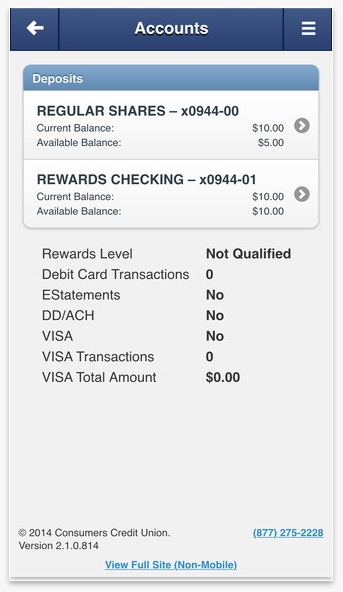
A nice feature is that their online interface has a progress tracker, updated daily, telling you number of debit card transaction and the total spend on your CCU credit card. Tracking is also available via their smartphone app (Apple/Android).

ccu_trackerapp

All tiers will also receive:

  • Unlimited reimbursement for any and all ATM fees + 30,000 surcharge-free ATMs nationwide.
  • No minimum balance. No monthly service fees.
  • Free online Bill Pay.
  • Mobile check deposit via smartphone app.

Qualifying Credit Cards
If you don’t have a CCU credit card, the best you can do is the 2.09% APY tier. Here is a list of their credit cards. It looks like the best one is their Visa Signature Rewards card, which offers a 3% cash rebate on up to $6,000 in “Grocery/Convenience Store” purchases annually, 2% cash rebate for “Gas” purchases, and 1% cash rebate for all other purchases. No annual fee.

Note that I would try to take advantage of the Grocery 3% and Gas 2% cash back categories in order to not miss out on the potential cash back from a 2% cash back card.

Cost/Benefit Analysis
Keep in mind that most checking accounts pay very little, leaving you to try maximizing your savings balance while avoid overdrafts. So you might not max out that savings account rate completely.

  • $10,000 times 2.09% APY would be $209 per year, or $17.40 per month in interest.
  • $10,000 times 3.09% APY would be $309 per year, or $25.75 per month in interest.
  • $10,000 times 4.09% APY would be $409 per year, or $34.08 per month in interest.

An extra $100 to $300 a year in interest sounds pretty good. Note that to qualify for the top two tiers, you’d also have to apply for a new credit card, which would entail a credit check. There is an opportunity cost here, as there are other new credit cards that offer close to $500 in sign-up incentives within a few months. You can apply for multiple new credit cards, but once you reach a certain number it will hurt your chances for getting the next one.

These types of checking accounts are not for everyone. Not only do you have to jump through hoops each month to get a reward (higher interest than no-hassle account), if you don’t you’ll actually get punished in a way (lower interest than a no-hassle account). Try to create a reliable system where you satisfy the requirements early on in the month, for example putting some automatic insurance, phone, or utility bills on the credit card. My favorite feature is their qualification tracking; I wish all rewards checking accounts had this feature. CCU has been running this rewards checking account now for well over 10 years (with several tweaks), so hopefully they have crunched the numbers and set the rates at sustainable levels.

Bottom line. Consumers Credit Union (CCU) has a Free Rewards Checking account that offers a high interest rate if you meet certain requirements. This is a unique account, but CCU has been running it for nearly a decade now. It would work well if you want to one single high-interest checking account and your balance rarely exceeds $10,000.

FileThis App Review: Automatically Backup Your Online Statements

Update 2023: FileThis is shutting down.

Old post:

filethis_applogo

A few months ago on my post about Paperless vs. Paper Statements, I received this helpful comment from reader Daveraham:

I like the services FileThis.com. It’s setup similar to MInt, where it stores account information, but instead of fetching dollar amounts and transactions, it grabs every statement available and stores them where you direct. Personally I store it an evernote account and then periodically pull it off to store on a removable HD that get’s stored in a fireproof box. Overkill?? Sure…. But its the point. You want to keep that snapshot of data for a long period of time.

I made a mental note to check the site out and… promptly forgot. I was again reminded in this Liz Weston article about apps to organize your financial life. In November 2015, FileThis announced their 2.0 version with new features. You can use the FileThis.com website, iOS app, or Android app (1.0 version only for now).

FileThis is now one of many “bill organizers” that ask for your account passwords in order to sift through your accounts and remind you of due dates. Personally, I don’t need or use due date reminders. I sit down at the end of every month, read through all my paper statements, track expenses, and pay my bills. I’m an old fart like that (although I do use free online billpay).

I previously shared that I maintain physical statements for critical financial accounts and have it mailed to a secure PO Box. But I also have several other financial accounts which are either dormant, temporarily opened for reviews or experiments, or have low balances which are set to paperless. Ideally, I would still log in and download those PDF statements every month and back them up. But I never do.

FileThis will log in and automatically download all your paperless statements and then save them to your cloud service of choice: Evernote, Dropbox, Google Drive, Box, Amazon Cloud, and more. You can even use their in-house storage (500 mb free). The cost options:

  • Free for up to six (6) connections. Checks weekly.
  • $2 a month ($20 a year upfront) for up to 12 connections. Checks weekly.
  • $5 a month ($50 a year upfront) for up to 30 connections. Checks daily.

Besides things like bank accounts, credit cards, and brokerage statements, FileThis will grab stuff from your mortgage provider, car loan servicer, cell phone bill, utility bills, insurance bills, and even online shopping accounts like Amazon. An added bonus is that they will even grab tax documents like 1099 forms.

I linked up a few accounts, the list is relatively extensive but it couldn’t find a local credit union. Here are some screenshots from my website and smartphone app.

filethis1

filethis2

Remember that the actual files are on your cloud service. Here’s a screenshot from my Dropbox app. The files are stored in the folder Dropbox > Apps > FileThis.

filethis3

This is pretty cool. The initial download basically grabbed all the older documents that were available as well (up to last 3 years, supposedly). They’ll even grab PDF statements if you also get mailed paper statements (assuming they are available), giving you an additional backup copy.

By allowing backups directly to a third-party cloud service (Dropbox in my case), I will still have all of my online statements even if FileThis shuts down some day (remember Manilla?).

The trade-off here is that another FinTech startup has your account logins and passwords. Their security measures seem fair enough (encrypted SSL transmission, passwords are encrypted on server, the documents can be stored at your cloud service). I already track my paperless accounts in real-time with Mint, but I am willing to make this trade-off as I think it’s worth it to have my old statements backed up for me. (Why can’t Mint do this for me too?) The only other service I know that offers something similar is Finovera, but I think they store the statements on their own servers as opposed to your personal Dropbox.

As an existing user, if you sign up using my referral link, both you and I will receive an additional free connection (so you’d have a total of 7 free to start) and an additional 250 mb of free in-house cloud storage.

Square IPO, Direct Deposit Loans, and Controlling Your Cashflow

squaredongleAs you’ve probably heard, the Square IPO was completed last week. For a while, I didn’t understand how a company could have a $4 billion valuation when they basically offer a simplified merchant account. They let small businesses accept credit cards, which means they skim a tiny bit off the 2.75% they charge while most of it goes straight to the networks. (Add in their other expenses, and Square has never made a profit.) Wouldn’t you rather own Visa or American Express directly?

Then I read this Bloomberg Businessweek article How Two Guys Lost God and Found $40 Million (And sold Wall Street on a shady new kind of finance). Although I try my best to avoid carrying any debt, I do try to keep up with the industry. With a normal credit card, you are waiting around for the borrower to pay you back your principal + interest. The borrower gets their paycheck, pays for rent and food and whatever else, and hopefully gets around to pay you some interest. Here’s a cashflow visual:

cashflow_classic

What these guys profiled in Businessweek did is give struggling small businesses a merchant account, and also lend them money. The key difference of their “merchant cash advance” service is that they would take the loan payments (including interest) directly from their gross credit card receipts! They were lending to horrible credit risks at sky-high rates (because nobody else would lend to them), but they knew they’d be fine because were first in line to snatch any incoming money before the business owner could even touch it. Here the modified cashflow visual:

cashflow_square

Hmmm… if Square can pull something like that off on a big scale, maybe they can be worth billions. It turns out that both Square and Paypal do this same sort of lending. They lend to small businesses and taking money out from the incoming transactions. From a WSJ article dated May 2015:

Paypal said it has doled out $500 million in loans in the first year-and-a-half since it introduced the lending program. And rival Square recently said it had extended more than $100 million in cash advances in the year since it started its own version. […] PayPal, like Square, deducts money from merchants’ accounts based on their receipts, so that they aren’t on the hook if business slows.

From another WSJ article dated September 2015:

At both PayPal and Square, payments are taken as a portion of transaction volume, meaning merchants repay more when sales are high and don’t pay on days without sales. That allows for easier repayments, but makes it difficult to calculate an annual interest rate.

Wow. Ingenious or evil genius? It would be like lending to everyday people but being able to intercept their paychecks before they even landed in their bank accounts. You’d get the money before people could even have the chance to default (or pay for food). Some banks already have something called “direct deposit loans” allow them direct access to bank accounts, taking payments almost immediately after your paycheck arrives. It is possible for motivated people to switch off their direct deposit or move banks, but you’re giving the lenders a built-in advantage.

(A problem for Square is that competitor PayPal also does the free credit card swiper thing, but PayPal can avoid paying Visa and Mastercard whenever a user buys something with their existing PayPal balance. They just move some money around internally and pocket the savings.)

So what’s my point? For one, Square may have a growing profit source from these first-in-line loans to small businesses. Second, as a smart consumer, you should be careful to stay in control of your cashflow. I’d never give a lender permission to withdraw money at any time from my bank account. They should have to wait for me to pay them.

Capital One 360 Savings Promo – Earn Up to a $500 Bonus

Capital One 360 Savings has a limited-time sign-up bonus for up to $500 for new customers, tiered depending on your opening deposit. Here’s a quick recap of the features of 360 Savings accounts:

  • No monthly fees or minimum balance requirements.
  • No minimum deposit required to open an account.
  • Free electronic fund transfers to a linked checking account.
  • 24/7 online and mobile access, or talk to a real person 7 days a week 8AM-8PM.
  • % APY as of 2/10/16

Bonus instructions.

  1. You must open your first 360 Savings Account by the promotion expiration date, 11/30/2015 at 11:59 PM EST. (If you’ve had a Savings product with Capital One 360 or ING DIRECT before, you won’t be eligible for the bonus.)
  2. To qualify for a bonus, your account must be funded within the first 10 days of account opening. Deposits from an existing Capital One 360 account will not qualify for the bonus.
  3. The amount of your bonus will be determined based on the highest amount you deposit within the first 10 days of account opening and maintaining that balance on a daily basis for the next 90 days following the 10 day period. You must deposit a minimum of $5,000 and maintain a daily balance of $5,000 for 90 days after the initial 10 day period to qualify for any bonus. The amount of the bonus you actually earn will be determined based on the following balance tiers during the initial 10 day period and the 90 day period after that: $5,000+ earns a $50 bonus, $10,000+ earns a $100 bonus; $20,000+ earns a $200 bonus; $30,000+ earns a $300 bonus; $40,000+ earns a $400 bonus; and $50,000+ or more earns a $500 bonus. The maximum bonus you can earn is $500.

Essentially, if you deposit an amount exactly on the tier level, you will earn 1% of your deposit (i.e. $50 on $5,000 or $500 on $50,000) with a minimum holding period of 90 days following the 10-day deposit window. This is in addition to the existing interest rate.

For more details on the account interface and such, please check out my 360 Savings account review.

Disclosure: I will receive a referral if you open an account via one of the links above, as a paid endorsement. To my knowledge, this is also the best publicly-available 360 Savings bonus offer out there. I won’t be participating myself because I’ve had an account (ING Direct) since 2005. Please refer to my full advertising disclosure.

Ally Bank Savings Account Review

allyreview_logo

Update. I’ve done a significant amount of my banking with Ally for years (checking, savings, and multiple CDs), but the “gateway drug” for me and probably most people will be their Ally Online Savings Account. You can use this savings account as a companion account to your existing primary checking account (perhaps at Chase, BofA, Wells Fargo, etc), or as a companion to the Ally Interest Checking account.

The Ally Online Savings Account has no minimum balance, no monthly fees, and currently pays 1.45% APY (as of 4/2/18). Their interest rates may not be the absolute highest, but they have consistently been within 0.10% of the temporarily top banks, making it not worthwhile to move my money. (See my rate chaser calculator). Let’s go through the important factors.

User Interface. Below is a screenshot of the main page after logging in (click to enlarge). I can see all of my accounts and their balances at a glance. The overall design is clean and minimalist, and it was recently updated to be more mobile-friendly.

allyosa1

Customer Service. Ally Bank differentiates itself with their customer service. First of all, they are available 24/7 at 1-877-247-ALLY (2559). When you use their smartphone app or log into their website, you can see the wait time beforehand. Even better, if you don’t want to call them you can just use their Live Chat feature.

Security. Ally Bank supports two-factor authentication with security codes sent via either e-mail or text message. They ask for a security code when you log in from a computer they don’t recognize. However, if you’ve logged into that computer before with a security code, they may not ask you again and you can’t choose to have two-factor authentication to always be in effect.

Awards. Ally Bank was named “Best Internet Bank” and “Best for Millennials” by Kiplinger’s Personal Finance Magazine in July 2017. Ally Bank was named “Best Online Bank” for the 5th year in a Row by MONEY® Magazine in 2015.

FDIC Insurance. Ally Bank is a member of the Federal Deposit Insurance Corporation, FDIC Certificate #57803. As with other FDIC-insured banks, this means your Ally deposits are insured by the FDIC up to $250,000 per depositor, for each account ownership category.

Funds Transfers. With no physical branches, online savings accounts should have maximum flexibility as they are often secondary accounts (given most megabank checking accounts pay either no interest or a sad 0.01% APY). Ally Bank allows you to link any other external bank account using the standard routing number and account numbers. As long as you initiate the transfer before 7:30 pm Eastern Time, transfers both in and out are free and can take as little as 1 business day. You can link up to 20 different accounts (it used to be unlimited; but other banks limit to 3 or even just 1). This is about as good as it gets for online banks. Here’s their updated timing chart (see details here):

ally1day1

The transfer limits are also relatively high. On my accounts, I see that I have a $150,000 daily limit outbound and $250,000 daily limit inbound, with a total monthly limit of $600,000 outbound and $1,000,000 inbound. Keeping in mind that all savings accounts from any bank are limited to six withdrawals per month.

ATM Debit Card. You don’t get a debit card with their Online Savings Account. You can get a debit card with either their Checking or Money Market accounts, but note that those have lower interest rates.

Mobile check deposit. You can use the Ally smartphone app to deposit checks using your smartphone camera. (This is in addition to using your computer scanner and/or free postage-paid deposit envelopes.) I’m not sure if this is the same for everyone, but my deposit limit is $50,000 which is higher than many other electronic deposit programs. I’ve used the app to deposit multiple checks without issue. Screenshot below.

allyreview_echeck1  allyreview_echeck2

Mobile app. Available for iOS and Android… you can do all the important stuff – see transactions, transfer funds, deposit checks, pay bills. It can remember your username, but you must type in your password every time. I usually just use my Personal Capital app for checking balances. The overall design is acceptable, and the ATM locator is helpful if you have the Ally Checking account with free AllPoint ATMs and $10 in fee rebates each statement cycle for any ATM.

Details

  • Interest Compounding: accrued daily, compounded daily, credited monthly
  • Minimum to open: $0
  • Minimum requirements to avoid monthly service charge: None
  • Number of external bank account links allowed: 20
  • Routing Number: 124003116

Bottom line. The Ally Online Savings Account is a solid offering with with no monthly fees, no minimum balance requirement, and a historically competitive interest rate. Additional features like a flexible funds transfer system and solid 24/7 customer service help differentiate themselves from the competition. It works fine on its own as a “piggyback” or companion account to your existing checking account.

You can also combine it with the Ally Interest Checking Account (my review) which offers ATM fee rebates (up to $10 per statement cycle), free online billpay, and the ability to use the savings account as a free overdraft source. Ally also has certificates of deposit which offer competitive rates at times.

Best Interest Rates for Savings Accounts and CDs – Updated October 2015

percentage2Rates checked as of October 3rd, 2015. Our family keeps a year’s worth of expenses (not income) put aside in cash reserves; it provides financial insurance with the side benefits of lower stress and less concern about stock market gyrations. In my opinion, emergency funds can have a better return on investment than what you see on your bank statement.

I don’t chase rates nearly as much as I used to, but it still pays to shop around. Too many places are paying ZERO or close to it – most mega banks, short-term US Treasuries, and money market sweep funds. Chase offers on a 1-year CD? 0.02% APY. Bank of America on their 10-year CD? 0.15% APY. Meanwhile, the rates below vary from 1% up to over 3% annualized.

Best Currently Available Interest Rates
Here is a brief roundup of the best interest rates available on deposits backed by the full faith and credit of the US government (FDIC-insured, NCUA-insured, US Treasury Bonds, US Savings Bonds). I will try to sort them from the shortest to longest maturities.

    High-yield savings accounts

  • Online savings accounts, everyone’s got one these days. Currently, the ones with a history of competitive rates are around 1% APY. These savings accounts can change their interest rate at any time, so if you’re going to just pick the highest one, be ready to move your money.
    Short-term guaranteed rates (under 1 year)

  • Everbank Yield Pledge Money Market and Interest Checking account both offer 1.60% APY guaranteed (balances up to $150k on the Money Market) for the first 6 months for new accounts. Since it is fixed, this is essentially a 6-month CD with a higher rate than any other 6-month CD rate out there and with no early withdrawal penalty to worry about.
    Flexible Savings Bonds

  • Series I Savings Bonds offer rates that are linked to inflation. Unfortunately, “I Bonds” bought right now will earn nothing for the first six months, and then a variable rate based on ongoing inflation after that. For new money, I would wait until mid-October when the next rate adjustment is announced. More info here.
    Prepaid Cards with Attached Savings Accounts

  • There is a special subset of prepaid debit cards that have the option of an “attached” FDIC-insured savings account with high interest rates. Balances are usually capped. Some of these have monthly fees and other fees for things like ATM withdrawals, so you should read the terms carefully.
  • I am currently experimenting with the NetSpend Prepaid Visa and the Brink’s Prepaid Mastercard, both of which offer 5% APY on up to $5,000 each. (Having both means I have $10k at 5% interest.) If you are referred by an existing user (links above are mine), we can both get an additional $20 bonus after depositing at least $40. (You can only get one $20 bonus even if you open both, as they are from the same company.) Detailed review upcoming.
    Rewards checking accounts

  • These unique checking accounts pay above-average interest rates, but with some risk. You have to jump through certain hoops, and if you make a mistake you won’t earn any interest for that month. Rates can also drop quickly, leaving a “bait-and-switch” feeling. But the rates can be high while they last.
  • Consumers Credit Union offers up to 5.09% APY on up to a $20k balance, although 3.09% APY is easier to achieve unless you satisfy a long list of requirements. The rate is guaranteed until December 31, 2015, although that’s only 3 months away
    Certificates of deposit

  • If you have a large cushion, it’s quite likely to just sit there for years. Why not put some money in longer-term investments where you can still take it out in a true emergency and pay an early withdrawal penalty. For example, Synchrony Bank (formerly GE Capital Retail Bank) is offering a 5-year CD paying 2.25% APY $25k+ balances (2.20% APY for $2k+) with an early withdrawal penalty of 180 days interest. For example, if you withdraw from this CD after 2 years and pay the penalty, your effective rate earned will still be 1.69%.
  • Northwest Federal Credit Union has a limited-time CD offering 3.04% APY for 3-year term. $10,000 minimum and $100,000 maximum. Limited to new deposits only and limit 1 certificate per member. Early withdrawal penalty is 366 days of interest. Check if you qualify for free membership, but anyone can pay $10 to join a partner association and obtain membership that way. More details from Ken at DepositAccounts.
    Longer-term Instruments

  • Willing to lock up your money for 10+ years? Did you know that you can buy certificates of deposit via Vanguard’s bond desk? These “brokered CDs” offer the same FDIC-insurance and are often through commercial banks like Goldman Sachs. As of this writing, you can get a 10-year CD maturing 10/2/2025 that pays 2.85% APY. Prices will vary regularly.
  • How about two decades!? Series EE Savings Bonds are not indexed to inflation, but they have a guarantee that the value will double in value in 20 years, which equals a guaranteed return of 3.5% a year. However, if you don’t hold for that long, you’ll be stuck with the normal rate which is quite low (currently a sad 0.50% APY). Think of it as a huge early withdrawal penalty. You really want to be sure you’ll keep it for 20 years.

All rates were checked as of 10/3/15.

Best Interest Rates for Savings Accounts and CDs – Updated August 2015

percentage2Our family keeps a year’s worth of expenses (not income) put aside in cash reserves; it provides financial insurance with the side benefits of lower stress and less concern about stock market gyrations. In my opinion, emergency funds can actually have a better return on investment than what you see on your bank statement.

I don’t chase rates nearly as much as I used to, but it still pays to shop around. Too many places are paying ZERO or close to it – the Megabanks, short-term US Treasuries, and money market sweep funds. Do you know what Chase offers on a 1-year CD? 0.02% APY. Bank of America on their 10-year CD? 0.15% APY. Meanwhile, the rates below vary from 1% up to over 3% annualized.

Best Currently Available Interest Rates
Here is a brief roundup of the best interest rates available on deposits backed by the full faith and credit of the US government (FDIC-insured, NCUA-insured, US Treasury Bonds, US Savings Bonds). I will try to sort them from the shortest to longest maturities.

    High-yield savings accounts

  • It seems every bank has their own online savings account, with the best accounts with long-term competitive rates earning around 1% APY. These savings accounts can change their interest rate at any time, so if you’re going to just pick the highest one, be ready to move your money.
    Short-term guaranteed rates (under 1 year)

  • Everbank Yield Pledge Money Market and Interest Checking account both offer 1.60% APY guaranteed (balances up to $150k on the Money Market) for the first 6 months for new accounts. Since it is fixed, this is essentially a 6-month CD with a higher rate than any other 6-month CD rate out there and with no early withdrawal penalty to worry about.
    Flexible Savings Bonds

  • “Series I” US Savings Bonds offer rates that are linked to inflation. Unfortunately, “I Bonds” bought right now will earn nothing for the first six months, and then a variable rate based on ongoing inflation after that. For new money, I would wait until mid-October when the next rate adjustment is announced. More info here.
    Rewards checking accounts

  • These unique checking accounts pay above-average interest rates, but with some risk. You have to jump through certain hoops, and if you make a mistake you won’t earn any interest for that month. Rates can also drop quickly, leaving a “bait-and-switch” feeling. But the rates can be high while they last. Consumers Credit Union offers up to 5.09% APY on up to a $20k balance, although 3.09% APY is easier to achieve unless you satisfy a long list of requirements. I list this one because the rate is guaranteed until December 31, 2015.
    Certificates of deposit

  • If you have a large cushion, it’s quite likely to just sit there for years. Why not put some money in longer-term investments where you can still take it out in a true emergency and pay an early withdrawal penalty. Synchrony Bank (formerly GE Capital Retail Bank) is offering a 5-year CD paying 2.25% APY $25k+ balances (2.20% APY for $2k+) with an early withdrawal penalty of 180 days interest. For example, if you withdraw from this CD after 2 years and pay the penalty, your effective rate earned will still be 1.69%. Capital One 360 also has a similar 5-year CD.
  • Other notable CDs… USAlliance FCU has a limited-time, callable 25-month CD paying 2.27% APY (anyone can donate to eligible charitable organization to gain membership). E-Loan Bank has a 5-year CD paying 2.45% APY but with a big early withdrawal penalty of two years of interest.
    Longer-term Instruments

  • Willing to lock up your money for 10+ years? Did you know that you can buy certificates of deposit via Vanguard’s bond desk? These “brokered CDs” offer the same FDIC-insurance and are often through commercial banks like Goldman Sachs. As of this writing, you can get a 10-year CD maturing 8/12/2025 that pays 3.05% APY. Prices will vary regularly.
  • How about two decades!? “Series EE” US Savings Bonds are not indexed to inflation, but they have a guarantee that the value will double in value in 20 years, which equals a guaranteed return of 3.5% a year. However, if you don’t hold for that long, you’ll be stuck with the normal rate which is quite low (currently a sad 0.50% APY). Think of it as a huge early withdrawal penalty. You really want to be sure you’ll keep it for 20 years.

How about my money? In terms of the opportunities above, I have opened an account at Everbank in the past for the promo rate and I have usually try to buy the max in US Savings I Bonds each year (no EE bonds, too long of a commitment). I don’t currently juggle any rewards checking accounts nor do I have any deposits with any other banks mentioned above. It’s just not worth it me to switch right now.

Besides some older CDs at higher rates, I keep a good chunk of my money at Ally Bank because right now they are the all-around “good enough” bank for me. Sure I could eek out 1.05% in a savings account somewhere, but Ally Online Savings is paying a 0.99% APY (as of 8/6/15) which serves as a no-fee overdraft companion to my Ally Interest Checking with ATM fee rebates. Along the same lines, I could get 2.25% in an outside bank’s 5-year CD, but Ally has 2.00% APY on their 5-year CDs and a relatively short 150-day early withdrawal penalty. A rate difference of 0.25% on $10,000 over a year is $25, and I’m not sure that’s enough to open a CD at another bank when my current Ally CDs mature.

All rates were checked as of 8/6/15.

Ally Bank Interest Checking Account Review

allyreview_logoUpdated. If you are looking for a flexible alternative to a megabank account with tiny interest but convenient ATM network, here is my review of the Ally Interest Checking Account which I use in conjunction with the Ally Online Savings Account and also Ally CDs. I think they represent a reasonable compromise from your neighborhood credit union with only a few ATMs sprinkled across town. I’ve used this combo for years, and here are my experiences:

User Interface. Below is a screenshot of the main page after logging in (click to enlarge). I can see all of my accounts and their balances at a glance. The overall design is clean and minimalist, and it was recently updated to be more mobile-friendly.

allyosa1

Customer Service. Ally Bank differentiates itself with their customer service. First of all, they are available 24/7 at 1-877-247-ALLY (2559). When you use their smartphone app or log into their website, you can see the wait time beforehand. Even better, if you don’t want to call them you can just use their Live Chat feature.

Security. Ally Bank supports two-factor authentication with security codes sent via either e-mail or text message. They ask for a security code when you log in from a computer they don’t recognize. However, if you’ve logged into that computer before with a security code, they may not ask you again and you can’t choose to have two-factor authentication to always be in effect.

Awards. Ally Bank has won “Best Online Bank” from Kiplinger’s Personal Finance magazine in 2014 and “Best Online Bank” from Money Magazine from 2011-2014.

FDIC Insurance. Ally Bank is a member of the Federal Deposit Insurance Corporation, FDIC Certificate #57803. As with other FDIC-insured banks, this means your Ally deposits are insured by the FDIC up to $250,000 per depositor, for each account ownership category.

Funds Transfers. With no physical branches, online savings accounts should have maximum flexibility as they are often secondary accounts (given most megabank checking accounts pay either no interest or a sad 0.01% APY). Ally Bank allows you to link any other external bank account using the standard routing number and account numbers. As long as you initiate the transfer before 7:30 pm Eastern Time, the transfer will take 2 business days. You can link up to 20 different accounts (it used to be unlimited; but other banks limit to 3; I have 7 myself).

So if I initiate a transfer on Monday afternoon by 7:30pm ET, the money will be debited first thing on Tuesday, and credited to the destination account first thing Wednesday. But know that if you initiate on a Saturday, you’ll get the same result. Even bank computers really don’t like working weekends, it seems. Overall, free transfers within 2 business days during the week is about as good as it gets for online banks.

allyosa2

The transfer limits are also relatively high. On my accounts, I see that I have a $150,000 daily limit outbound and $250,000 daily limit inbound, with a total monthly limit of $600,000 outbound and $1,000,000 inbound. Keeping in mind that all savings accounts from any bank are limited to six withdrawals per month.

ATM Rebates. As of August 15, 2015, Ally Bank will no longer offer unlimited ATM rebates in the US. Here is the new structure:

  • Ally Bank continues to not charge ATM fees on their side of the transaction.
  • Ally Bank has added the Allpoint ATM network, with locations such as CVS and Walgreens pharmacies, Target stores, and 7-11 convenience stores. (Certain other online banks like Capital One 360 Checking also partner with Allpoint).
  • Ally Bank will now limit ATM fee reimbursements to $10 per statement cycle for fees charged by other institutions or ATM owners nationwide.

This is definitely a reduction in the benefit, but honestly I was surprised that it lasted so many years. Ally eliminated their international ATM rebates in August 2011. I used it a few times at a Las Vegas casino at $5 a pop; can you imagine their annual cost if someone did that every few days? For me, if I can find convenient ATMs that charge around $2.50 each, that means I can still go 4 times a month. Their online app also has an ATM locator that works pretty well (see below) .

I’ve made a few ATM withdrawals at random ATMs, and the surcharges have been credited at the end of the month as promised. (I wish they were credited immediately.) International ATMs are not eligible.

Free Overdraft Transfers from Savings. The checking account pays less interest than savings, so it is best to open both and keep as much money as you can in the savings. The Ally Online Savings account pays 0.99% APY as of 7/14/15, and is one of the places I keep my emergency cash reserves.

With their free Overdraft Transfer Service, Ally will automatically transfer the required funds from savings if your checking goes negative. I usually use this service whenever I write a relatively big check or make a large transfer:

allycheck1

Ally transferred an amount equal to a round number near the overdraft amount plus $100. Alternatively, you can set it to auto-transfer a preset amount over if your checking balance dips to a certain threshold. Remember, you can only do 6 withdrawals from savings each money due to banking regulations.

Mobile check deposit. You can use the Ally smartphone app to deposit checks using your smartphone camera. (This is in addition to using your computer scanner and/or free postage-paid deposit envelopes.) I’m not sure if this is the same for everyone, but my deposit limit is $50,000 which is higher than many other electronic deposit programs. I’ve used the app to deposit multiple checks without issue. Screenshot below.

allyreview_echeck1  allyreview_echeck2

Mobile app. Available for iOS and Android… you can do all the important stuff – see transactions, transfer funds, deposit checks, pay bills. It can remember your username, but you must type in your password every time. I usually just use my Mint app for checking balances, as that only requires a 4-digit PIN. The overall design is acceptable, and the ATM locator is helpful to find those free AllPoint ATMs or stores that allow cash back with purchase with no fees.

Paper checks. Even though they are an online-only bank, Ally still provides free paper checks. You get a set of 50 to start, but you can always order more online for free. Cashier’s checks are free as well.

Paper statements. If you prefer physical statements via snail mail, you’ll be happy to know that Ally still offers those free of charge. Of course, you have the option of paperless statements as well.

Ally Perks. Ally discontinued their Ally Perks Debit Card Rewards program in 2013.

The Stats

  • Current interest rate: 0.60% APY for daily balance $15,000 or more, 0.10% APY for daily balances under $15,000 (last checked 7/14/2015)
  • Interest Compounding: accrued daily, compounded daily, credited monthly
  • Minimum to open: $0
  • Minimum requirements to avoid monthly service charge: None
  • Number of external bank account links allowed: 20
  • Routing Number: 124003116

Bottom line. The Ally Interest Checking Account is a solid offering with with no monthly fees, no minimum balance requirement, ATM fee rebates (up to $10 per statement cycle), free online billpay, and the ability to use the savings account as a free overdraft source. Additional features like a flexible funds transfer system and solid 24/7 customer service help differentiate themselves from the competition.

I would highly recommend pairing this account with the Ally Online Saving Account, as you can keep the majority of your fund in the savings account at a higher interest rate. You can then set up the savings account as a free overdraft source, allowing you access to all your funds with no fees to worry about. Ally also has certificates of deposit which offer competitive rates at times.

Navy Federal Credit Union Youth Week $100 Bonus

navyfedlogoNavy Federal Credit Union has solid bank and loan products, including checking accounts with ATM rebates, competitive mortgage rates, and limited-time 0% balance transfer promotions. Membership eligibility for NavyFed is primarily restricted to Marine Corps, Navy, Air Force, and Coast Guard regular Active Duty and reservists, and Army and Air National Guard personnel, but also includes family and household members of existing NavyFed members and some civilian employees in the Department of Defense.

If you’re a member, the exclusive perks mean that you should sign up your kids sometime… and right now you can get $100 for doing so! As part of their Youth Week 2015 promotions, you can get:

  • $25 for signing up your child (under 18) for membership.
  • $25 for opening a Campus Checking Account for your child (age 14-17), which has no minimum balance requirements and up to $10 in ATM fee rebates per statement period.
  • $25 for opening a SaveFirst Account for your child (under 18) with as little as $5.
  • $25 for opening a reloadable prepaid Visa® Buxx Card for your child (age 10-17).

Expires soon on April 18th, 2015. Thanks to reader Charles for the tip.

Best Interest Rates for Cash Reserves – Updated April 2015

percentage2Our family keeps a year’s worth of expenses (not income) put aside in cash reserves; it provides financial insurance with the side benefits of lower stress and less concern about stock market gyrations. In my opinion, emergency funds can actually have a better return on investment than what you see on your bank statement.

I don’t rate-chase nearly as much as I used to, but it still pays to shop around. Too many places are basically paying ZERO – the Megabanks, short-term US Treasuries, and money market sweep funds. Do you know what Chase offers on a 1-year CD? 0.02% APY. Bank of America on their 5-year CD? 0.15% APY. The highest money market mutual fund in the country yields 0.06%. My Vanguard Prime is at 0.01%.

Best Currently Available Interest Rates
Here is a brief summary of the best interest rates available on deposits backed by the full faith and credit of the US government. I will try to sort them from the shortest to longest maturities.

  • High-yield savings accounts. There are a variety of online savings accounts out there nowadays, with the highest ones earning around 1% APY. GE Capital Bank has an FDIC-insured Online Savings account paying 1.05% APY with no maintenance fees, no minimum balance, and no minimum to open.
  • Short-term guaranteed rates. Everbank Yield Pledge Money Market and Interest Checking account both offer 1.40% APY guaranteed (up to $50k each) for the first 6 months for new accounts. Since it is fixed, this is essentially a 6-month CD with a higher rate than any other 6-month CD rate out there and with no early withdrawal penalty to worry about. Salem Five Direct has an eSavings account that pays 1.10% guaranteed until 1/1/16 (~8.5 months left) but the rate is only available to new customers.
  • “Series I” US Savings Bonds offer rates that are linked to inflation. “I Bonds” bought right now will earn 1.48% total for the first six months, and then a variable rate based on ongoing inflation after that. You must hold them for a year, and if you redeem them within 5 years you lose the last 3 months of interest. While future rates are unknown, the net rate after a year is likely to be competitive with top 1-year CD rates at a minimum, while offering upside if inflation spikes. More info here.
  • Rewards checking accounts pay above-average interest rates, but with some risk. You have to jump through certain hoops, and if you make a mistake you won’t earn any interest all that month. Rates can also drop quickly, leaving a “bait-and-switch” feeling. But the rates can be high while they last. Consumers Credit Union offers up to 5.09% APY on up to a $20k balance, although 3.09% APY is easier to achieve unless you satisfy a long list of requirements. I list this one because the rate is guaranteed until December 31, 2015.
  • Certificates of deposit. If you have a large cushion, it’s quite likely to just sit there for years. Why not put some money in longer-term investments where you can still take it out in a true emergency and pay an early withdrawal penalty. Synchrony Bank (formerly GE Capital Retail Bank) is offering a 5-year CD paying 2.25% APY for $25k+ balances (2.20% APY for $2k+) with an early withdrawal penalty of 180 days interest. For example, if you withdraw from this CD after 2 years and pay the penalty, your effective rate earned will still be 1.69%.
  • Willing to lock up your money for 10+ years? Did you know that you can buy certificates of deposit via Vanguard’s bond desk? These “brokered CDs” offer the same FDIC-insurance and are often through commercial banks like Goldman Sachs. As of this writing, you can get a 10-year CD maturing 4/22/2025 that pays 2.95% APY. Prices will vary regularly.
  • How about two decades!? “Series EE” US Savings Bonds are not indexed to inflation, but they have a guarantee that the value will double in value in 20 years, which equals a guaranteed return of 3.5% a year. However, if you don’t hold for that long, you’ll be stuck with the normal rate which is quite low (currently a sad 0.50% APY). Think of it as a huge early withdrawal penalty. You really want to be sure you’ll keep it for 20 years.
  • Finally, how about something out-of-the-box? You can earn up to 2.25% APY within a 529 college savings plan (which can be opened with you as the beneficiary for now). FDIC-insured, and the rate is still pretty good even after a 10% penalty for non-qualified withdrawals.

How about my money? In terms of the opportunities above, I have opened an account at Everbank in the past for the promo rate and I have usually try to buy the max in US Savings I Bonds each year (no EE bonds, too long of a commitment). I don’t currently juggle any rewards checking accounts nor do I have any deposits with any other banks mentioned above. It’s just not worth it me to switch right now.

Besides some older CDs at higher rates, I keep a good chunk of my money at Ally Bank because right now they are the all-around “good enough” bank for me. Sure I could eek out 1.05% in a savings account somewhere, but Ally Online Savings is paying a 0.99% APY (as of 4/12/15) which serves as a no-fee overdraft companion to my Ally Interest Checking with unlimited ATM fee rebates. Along the same lines, I could get 2.25% in an outside bank’s 5-year CD, but Ally has 2.00% APY on their 5-year CDs and a relatively short 150-day early withdrawal penalty. A rate difference of 0.25% on $10,000 over a year is $25, and I’m not sure that’s enough to open a CD at another bank when my current Ally CDs mature.

All rates were checked as of 4/12/15.