Low Cost Stock Broker Alternatives 2011

If you’re thinking about switching online stock brokers, perhaps due to a price increase, here are some low-cost options. To avoid the common $50 to $75 ACAT transfer-out fee for moving your entire portfolio somewhere else, you can sell all your positions, transfer out the cash, and then have them close the account. You may be subject to capital gains taxes. Otherwise, look for a broker that will cover your transfer-out fee.

Still want free trades? WellsTrade still offers 100 free trades per year with assets of at least $25,000. They may be feeling squeezed as well, but with the ability to cross-sell with other Wells Fargo products like checking accounts and credit cards, they are probably still making money. Bank of America also offers free trades, but with a $25,000 cash balance only.

If you’re looking to build a low-cost, index fund portfolio, I would recommend opening a Vanguard Brokerage Services account with their unlimited free trades for all Vangaurd ETFs. Indeed, many other brokers offer some sort of free trades on a limited list of ETFs including Fidelity, Schwab, and TD Ameritrade. I personally like the selection at Vanguard the best.

If you want to trade individual stocks, the rock-bottom low-cost broker appears to be Just2Trade at $2.50 a trade. They never seem to do any promotions.

I also have an account with OptionsHouse at $3.95 a trade which uses the same Penson clearing firm. A FW member TheHimalayas posted that they were allowed to switch over to OptionsHouse with no ACAT fees because of this, but I haven’t verified this myself. I am happy with my OptionsHouse account, and the fact that they grandfathered us existing members at $2.95 a trade doesn’t hurt.

OptionsHouse also has a bunch of promos going on. If you open a new account with at least $3,000 and use the code FREE100, you’ll get 100 commission-free trades for stock or option trades executed within 60 days of funding the new account. Alternatively, you can get up to $100 in ACAT fees rebated to you when you transfer your account with a minimum value of $3,000 with the promo code ACAT100REFUND. They also have a 100 free trades + $125 in transfer fee rebates offer for IRAs with the promotion code IRAFREE.

Finally, another solid option at the $4.95 price point is TradeKing. TradeKing will credit your account transfer fees up to $150 charged by another brokerage firm when completing an account transfer for $2,500 or more when you send them a copy of your account statement with proof of the transfer charge.

Zecco Trading Ends Free Trade Offer, Now $4.95 Per Trade

Discount brokerage Zecco Trading announced this weekend that effectively immediately, they will no longer offer 10 free trades per month for those with assets of $25,000 and over. Here is partial text from the e-mail:

Starting on March 30, 2011, our new commission rates will be:

* Equity trades: $4.95 per trade*
* Options trades: $4.95 per trade, plus $0.65 per contract

With this change we are no longer offering 10 free trades per month. As before, there are no minimum balance requirements or inactivity fees to open or maintain a Zecco Trading account.

The change is effective immediately for all new customers who have not fully opened their account.

Thus ends the final chapter of their “free trades” motto. Let’s not forget that Zecco stood for Zero Cost Commissions. Starting out in 2006, we got 40 trades per month for a balance of $1,000 or $2,500 (I forget). Then that was lowered to 10 free trades per month to balances of $2,500+. Then it was 10 free/mo for balances of $25,000+. I had a lot of hope for the business model behind the free trade community vision of Zecco, and it’s sad to see it end.

But here’s the harsh reality. If you’re going to offer free trades, you’re gonna have to make the money up elsewhere. Historically, a huge source of revenue for discount brokers has been earning interest on idle cash balances. With interest rates being so low, this source of income has dried up. Trading volume is down, so there are less people exceeding the 10 per month limit and paying up for additional trades.

2011 TradeKing New Account Referral: $100 Bonus

Online broker TradeKing.com has brought back their $100 sign-up bonus for new accounts. If you get a referral from an existing account holder, open a new account with at least $1,000, and make a trade, both people will get $100.

TradeKing offers $4.95 trades (market & limit) with no minimum balance requirement. I’ve had an account for years now, and they’ve gotten the job done without issues. They were recently rated #1 in customer service by SmartMoney magazine in 2010. The details:

  • New customer must fund new non-IRA account with a minimum of $1,000 within 30 days of new account opening.
  • Must execute one trade in the new account within 180 days of new account opening.
  • The minimum funds of $1,000 must remain in the account (minus any trading losses) for a minimum of 180 days of new account opening or the credit may be surrendered.

If you’d like a referral just contact me, and I’ll be happy to send you one. I only need your e-mail address. There is no promotion code, but you’ll need to click on the specific link in the e-mail for tracking purposes. Offer expires March 31st, 2011. Update: Alive again from 9/1 to 9/30/11.

Also, if you want to move your stocks over from another broker… If you transfer an account of $2,500 value or greater over to TradeKing, they will also refund up to $150 in account transfer fees charged by your old broker.

Stable Value Fund 2011 Interest Rate Announced

If you have a 401(k), 403(b), or similar retirement plan, you may have an investment option called a stable value fund. Sometimes it goes by a different name like Guaranteed Pooled Fund, but they are always marked as a conservative investment. The pitch is basically the higher interest rate of longer-term bonds, with the relatively liquidity and stable principal value of a money market fund. I explored the risks and rewards of stable value funds before and currently hold them as part of my bond allocation.

My specific stable value fund is run by Transamerica Financial Life Insurance Company (TFLIC) and offered an interest rate of 3.5% for all of 2010, which was much higher interest than any other similar bond investment was going to pay me. Then they told me that until February 28th, 2011, the interest rate would be 3.0%. Finally, I just received a letter that told me that the interest rate from March 1st to December 31st, 2011 would be lowered to 1.8%.

So, should I stay or should I go? Interest rates continued to drop in 2010, so I did expect them to lower their rate.

Online savings accounts like Capital One Consumer Bank are paying around a low 0.75% APY, and I have no access to something like that in my 401k. They recently announced a self-directed option through Schwab, although I need to find more details about how much transaction costs would be. The Vanguard Short-Term Treasury Fund (VFISX) is currently yielding only 0.66%. Taking a look at current Treasury yields shows the 2-year at 0.78% and the 5-year at 2.30%.

So the interest rate itself is still pretty competitive relative to other “safe’ investment options. My other bond alternative inside the account is the huge PIMCO Total Return fund (PTTRX) with a 3.12% yield and 4.8 year duration, which did pretty well for me when I had it but I worry about asset bloat with $240 billion is assets, manager risk, and interest rate risk.

In the absence of any significantly better options, it looks like I’m staying put.

Prosper P2P Lending 1% Cashback + Potential Market Inefficiency

I kinda missed the boat last Thursday 2/17 because peer-to-peer lending site Prosper.com had a promotion going on for borrowers that stated that they would make a entire month’s loan payment for you. A quote from their e-mail:

It’s our fifth birthday, and to celebrate we have a special gift just for you! If you apply for a loan and submit a listing on our site today, February 17th, we will make your second loan payment (up to $300)*!

Astute borrowers realized that they could simply take out a loan and pay it back after 2-3 months since there was no pre-payment penalty. After all loan initiation and other fees, the borrower could still net a little over a hundred bucks. Not bad for “borrowing” money!

However, this also meant that somebody had to fund their loans. I’m sure some potential investors found it weird that Prosper suddenly had a lot of AA-rated loans from folks with very good credit and peculiar descriptions like “I really don’t need this money for anything, and intend to pay this loan off in 3 months.” 🙂 The requested loan amounts will also be very close to $3,500, the ideal amount for profit maximization.

To top it off, I just got this e-mail from Prosper regarding getting 1% cash back on any bids placed on Monday, February 21, 2011. Here’s the e-mail text. No special link or promo code was given, so I can only assume it is open to all.

This offer is as straight-forward as they come: invest in any listing on the site today, and you’ll earn 1.0% cash back*! With a cash back offer and returns averaging 10.1%**, why wait?

* The promotional period begins at 12:01 AM PT and ends at 11:59 PM PT on Monday, February 21, 2011. 1.0% cash back will be paid on all bids placed during the promotional period that ultimately become funded loans. Cash bonus will be deposited to your Prosper account by March 31, 2011.

Update: Promotion extended to end of 2/23:

* The promotional period began at 12:01 AM PT on Monday, February 21, and will end at 11:59 PM PT on Wednesday, February 23, 2011. 1.00% cash back will be paid on all bids placed during the promotional period that ultimately become funded loans. Cash bonus will be deposited to your Prosper account by March 31, 2011.

Now, if you could technically find and fund several of these high-quality borrowers who have an incentive to pay off their loan in 3 months, you could have an investment that would return around 1% in interest + 1% cash back over a period of just around 3 months. That’s a lot better than a savings account.

I know that some of you readers got in on this. If you’re still looking to get funded, share your loan listing below using your usual commenter e-mail. This is not risk-free as you are still lending money to strangers, but if you’re an AA borrower on Prosper who initiated a loan listing on 1/17th or shows as early on 1/18th for ~$3,500, then I am more willing to take the risk. I am relatively comfortable with P2P lending with certain criteria, and already have over a few thousand dollars in highly-rated loans on LendingClub.

FDIC-Insured Bank Accounts Holding Chinese Renminbi (CNY) (RMB)

Reader Jonathan wrote in the tell me that the Bank of China (BoC) is offering FDIC-insured bank accounts that are denominated in renminbi, the official currency of China. Also referred to by the primary unit yuan, you may have heard about how China tightly controls this currency in the news. Since many sources view the yuan as being undervalued relative to the dollar due to artificial exchange rates, some people view holding yuan as a good investment. Here’s how the Bank of China news has played out in financial websites.

  • 1/12 – The Financial Times blog BeyondBRICs brings up the ability to open accounts in yuan, but says “No need to rush out and open a renminbi account just yet.” They note that this ability has actually been around since February 2010, but nobody in the media really noticed.
  • 1/12 – The Reuters blog by Felix Salmon picks it up and brings it a step further, pointing out that US officials have said the yuan is overvalued, so that “Chinese revaluation is going to happen at some point, and when it does, you’ll make money”, and “the downside is limited”. More excitement.
  • 1/14 – The Wall Street Journal blog ROI joins the fray, stating (1) It’s very unlikely to go down. (2) It’s very likely to go up. (3) You won’t miss out on a lot of interest elsewhere, as nowhere else is paying a lot of interest. (4) It will diversify your portfolio. (5) It may offer you and your family something of a hedge against the decline of the U.S. economy. Can you feel the buzz?
  • 2/7 – Time Magazine blog Curious Capitalist has another post on the topic a few weeks later. It provides more detail on what this account does not offer: interest, the ability to withdraw yuan, deposit yuan, write checks, or use debit cards. Basically you can speculate on the conversion rate of USD-CNY and that’s it. More below.

So, should you go out and open an account? Well, first you must go in person to a Bank of China branch in New York City, either at Madison & 48th St or in Chinatown. Some of the articles erroneously reported that you can open up an RMB account at the Los Angeles branch. According to the Bank of China website, this is not true. The branch does not offer FDIC-insured accounts, and doesn’t offer personal account of any kind.

The limit a U.S.-based individual customer can exchange is $4,000 a day. From what I have gathered, you open an account and “buy” RMB from Bank of China using your U.S. dollars. Your deposits are FDIC-insured against bank failure, but not losses from currency fluctuations. If you wish to withdraw, you must again exchange your RMB back to USD, leaving you again with dollars. You can’t withdraw any RMB, here or in China. The savings account earns no interest. So any difference will be due to the exchange rate.

According to the Wikipedia entry for Remminbi, academic studies have shown then yuan to be undervalued relative to the dollar using “purchasing power parity analysis”. The Treasury Secretary called it “substantially undervalued” a month ago. Per this article, the rate of 6.5855 CNY to 1 USD set just yesterday (2/16) is a record high, leaving the yuan up 3.6% since last June.

I honestly don’t pay enough attention to currency markets and all the politically-related news to really weight the pros and cons properly. Even if it does seem like the yuan is undervalued right now, but who knows when or how it will be corrected? China sets the exchange rate for the most part, so it could be years or more. During that time, its economy could experience high inflation as well which could make RMB even weaker relative to USD.

I see no sure bet here, just a speculative investment. But if you have a “play money” account capped at 5% of your portfolio like I do at times, this might be one idea that you could drop some bucks on. What do you think?

Update: You can get basically the same thing online at Everbank WorldCurrency Access deposit account. It doesn’t currently earn any interest, and unfortunately there are no interest-bearing CD options available right now either. But it does let you get it renminbi-denominated.

Magazines Decoded: Best Mutual Funds of 2011

I’m catching on some personal finance magazine reading and find myself again rolling my eyes at their respective “Best Mutual Funds” lists. I’ve had subscriptions to all the major magazine for about 5 years now. Here’s how I translate them through my jaded eyes:
Best Mutual Funds of 2011

Here are our picks for the best mutual funds. We don’t chase performance like those other guys. We put tons of hours into finding the best mutual funds with good management skill and experience and other things that sound good in theory. Oh, and they have to have really good performance over the last several years. But again, no performance chasing here. Nuh-uh.

Where were we? Oh yeah, so to start we had to drop some funds from our list this year, due to their recent drop in performance. I’ll also add some other tangential reasons to hide this fact a bit. We really don’t know how that happened, sorry about that. It was completely unforeseeable.

Oh, but not to worry, we replaced them with other excellent funds that did some really smart things during the last crisis/boom/cycle. Now, if we could just have told you before they did awesome, instead of recommending those crappy funds we dropped in the last paragraph…

Finally, we decided to add more low-cost index funds to our list. For some reason, they keep performing well over long periods of time and are gaining customers as a result. The Vanguard Group recently became the largest mutual fund company in the world by assets, surpassing even Fidelity with their 401k monopoly and their famous Magellan and Contrafund-style active funds. Shh… here’s the secret that nobody else knows: low costs are important.

— Love, your favorite personal finance magazine.

Suggestion

Any magazine with a Top Stocks or Top Funds list should always have to include the same list from 10 years ago. So with the Top Funds of 2010 you’d have to see the Top Funds of 2000. That would be interesting.

I just realized I was similarly disillusioned a few years ago and wrote Anatomy of a Personal Finance Magazine Article.

Better Inflation Chart with CPI Component Breakdown

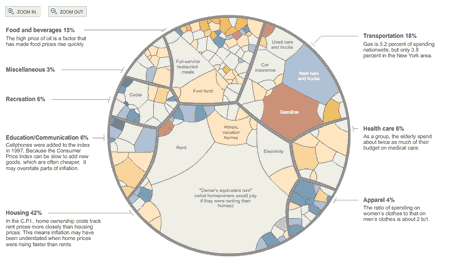
In my last post, reader Greg shared a better chart that illustrates the components of the Consumer Price Index, which is supposedly to track what the average consumer spends and thus is used to gauge inflation. Definitely worth archiving for later.

Source: New York Times. Click to visit. It’s interactive, so you can zoom in and out to see all the little details.

Do You Believe In Your Asset Allocation?

asset allocation image from wikipedia

Mark Cuban recently had a post on his blog called Wall Street’s new lie to Main Street – Asset Allocation. In it, he quotes a recent newspaper article that presents this model asset allocation:

15% in an S&P 500 index fund
5% in a small-capitalization value fund
20% in a diversified international stock fund
5% in an emerging markets international fund
5% in Real Estate Investment Trusts
10% in stocks with a history of paying competitive and increasing dividends
10% in a diversified portfolio of convertible securities
5% in a U.S. Treasury inflation-indexed bonds and notes
15% in an international bond fund with traditional fixed coupon bonds
5% in an international bond fund for inflation-indexed bonds
5% in cash equivalents.

To which he translates as:

I want you to invest 5pct in cash and the rest in 10 different funds about which you know absolutely nothing. I want you to make this investment knowing that even if there were 128 hours in a day and you had a year long vacation, you could not possibly begin to understand all of these products. In fact, I don’t understand them either, but because I know it sounds good and everyone is making the same kind of recommendations, we all can pretend we are smart and going to make a lot of money. Until we don’t

Now, I don’t rely on Cuban for investing advice, but I do think he has a point. Over the past couple of years, I have to come value simplicity and also belief in investing. Now, I think asset allocation is important. To me, asset allocation is owning different assets that (1) all have good prospects for long-term returns above inflation, and (2) don’t necessarily move in the same direction. This allows you to reduce volatility when one things zigs while the other zags.

However, this also means you have to own said assets both when they are up and down. If the only reason you own something is because it’s in some financial newspaper article, then you’ll just sell it when the same newspaper starts touting the next new thing. This will likely lead to worse returns than just holding cash. You should only invest in asset classes that you understand and have strong reasons to hold in both good times and bad.

Here are the asset classes that I have strong beliefs in. This is of course my own personal opinion, but I’ll try to share my reasoning as well.
[Read more…]

Target Retirement Funds Increasing International Exposure

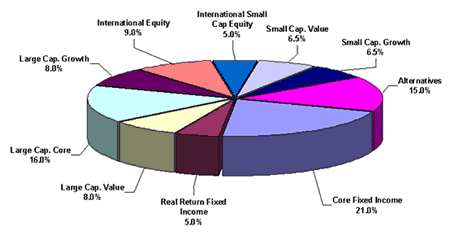
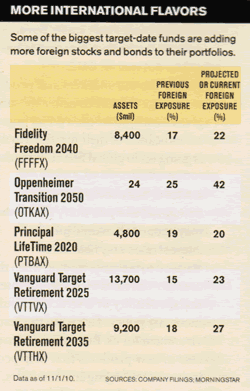
The January 2010 issue of SmartMoney magazine had a nice little article Target-Date Funds Retool — Again about how those all-in-one Target Retirement funds that nearly all 401k plans have now are almost all increasing the percentage of stocks that are international. They all say this not performance-chasing, but at the very least it’s sentiment-chasing. People just aren’t all that confident in an predominantly-US portfolio anymore. I like the quote “Were you wrong before, or are you wrong now?”.

In any case, the online version left out my favorite part of the handy graphic, so I scanned it in here:

Vanguard announced back in October that it was also following the herd and increasing international exposure for its funds, and a quick look on the Vanguard Target 2025 fund shows the international holding at 20.8% as of 12/31/10. Seems like they are rolling out the change gradually.

I’m always on the fence on these funds. If having one fund keeps people from jumping from one fund to another, these funds can be a net positive. I like simplicity. But you have to watch out for high costs because that will eat away at your return. On the other hand, you can construct your own retirement portfolio out of just a few funds now, and not have to watch these guys follow each other around. Even the Vanguard Target 2025 fund only has 3 funds inside of it.

Where I Keep My Emergency Fund Cash – January 2011

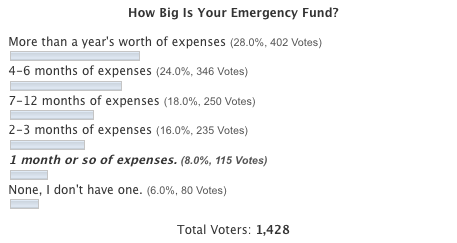
The results of my Emergency Fund survey are in, and appears that there are a lot of big savers out there! 28% of respondents had cash reserves of over 12 months of expenses, and 24% of you had the more-often recommended 4-6 months of expenses.

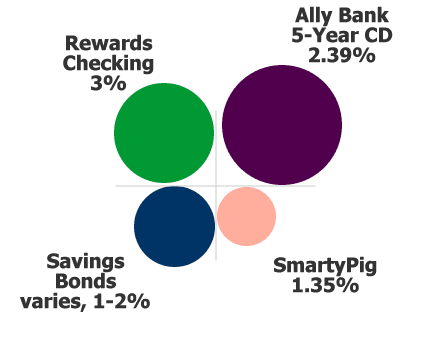
With such sizable cash reserves, where you do guys put it all? I figured I’d share my stash-the-cash choices, which may not be perfectly optimal but I’m open to talking about it. The size of the circles are proportional to how much of my money I keep in each respective account.

With interest rates so low across the board and still dropping it seams, it’s been hard to get really excited about many new options. But remember, it can be better to be earning 2% with low inflation than 5% interest in a high inflation environment. Every basis point helps.

Rewards Checking Accounts

You’ve likely heard of these by now. Usually through local credit unions, these checking accounts pay a higher interest rate if you jump through some hoops each month. However, if you make a mistake you’ll forfeit virtually all your interest for that month, so it can be tricky. More coverage here.

One nationally-open example is DanversBank, which offers their Free Rewards Checking currently paying 3.01% APY on balances up to $25,000, provided you satisfy the following each month:

* perform at least 12 debit card transactions (excluding ATMs);
* receive their monthly statement electronically;
* access Online Banking, and
* sign up for direct deposit or receive a recurring ACH transfer

To find a local rewards checking account limited to your area, check out DepositAccounts and use the filters. Sadly, my local account recently dropped their rate significantly.

Long-Term CDs – Ally Bank

If you have a large cushion, it’s quite possible (if you’re lucky) to not have to touch it for years or more. Therefore, I think it’s okay to put some of it in safe investments but slightly less liquid.

With the Ally Bank certificates of deposit, you can still access your money as long as you pay a early withdrawal penalty of 60 days interest. That’s significantly less than at other banks. I have a 5-year CD paying 3% APY, but the current rate for new deposits is 1.60% APY for a 5-year CD (as of 10/25/13).
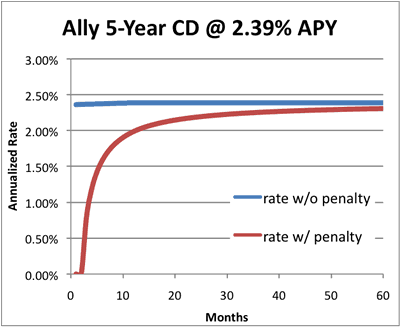

Rates change constantly, but let’s assume you have a certificate of deposit from any bank paying 2.39% APY with an early withdrawal penalty of the last 60 days of interest. (2.39% APY ~= 2.26% rate compounded daily.) Here’s how your actual annualized interest rate would fluctuate given your holding period.

After just 6 months, you’ll already be earning 1.58%, more than a comparable 12-month CD. If you somehow had to withdraw after 1 year, you’d still have earned 1.99% APY. Basically, after just 6 months I have nothing to lose and a lot to gain, so I keep a sizable chunk here.

Savings Bonds

I have some older Series I Savings Bonds, but they aren’t a very good buy right now. The total rate consists of a fixed rate and a variable rate that adjusts with inflation every 6 months. If you bought a bond now, you’d get a 0% fixed rate and only 0.74% from inflation. However, my older bonds have higher fixed rates, and according to my TreasuryDirect statement they are earning 1.74%, 2.25%, and 2.75% right now. The annual purchase limit is now $5,000 in paper I-bonds and $5,000 in online I-bonds per Social Security Number. I’ll keep them for a while, as I like the tax deferral benefits and inflation may come back to bite us.

Online Savings Accounts

Rewards checking account and savings bonds have deposit limits, and you only want to lock up a certain amount in longer-term CDs, so the rest goes into the now-popular online savings account. There are a lot of players out there now, but many of them are packed together with very similar features and interest rates.

Right now the rest of my cash is over at SmartyPig.com, an FDIC-Insured bank account that lets you save for specific goals like an online piggy bank. However, they’ve added so much flexibility that you can pretty much use them like any other savings account. Their rate has dropped recently from 1.75% APY to 1.35% APY for balances up to $50,000. This is still amongst the top rates, but I’ll be watching them closely.

Alternatively, Everbank has their Yield Pledge Money Market paying 1.10% APY for the first 6 months for new accounts. This rate is higher than any 6-month certificates of deposit currently available, while still being available for withdrawals at any time. The rate is guaranteed stay in the top 5% of competitive accounts. Evantage Bank has their Mega Money Market account paying 1.75% APY for balances up to $35k. Most other banks are clustered around the 1% to 1.2% mark.

So… where’s your cash?

What Is Your Portfolio’s Current Asset Allocation?

If you haven’t been keeping close track of it, your portfolio’s asset allocation may have shifted significantly over the past year. Your relative mix of assets like stocks, bonds, or real estate has a great impact on the volatility and expected future return of your portfolio.

Morningstar has a bunch of helpful tools for managing your investment portfolio, but many of them require a paid membership. However, one handy trick is that anyone can use many of these premium features for free at the T. Rowe Price website by signing up for a free account with nothing but an e-mail address.

Portfolio Manager
This tool lets you enter all your portfolio holdings, which it then stores for you and allows you to track it with automatically updated prices. You can either track all your future transactions as you go, or just input your updated holdings every few months like I do.

Portfolio X-Ray
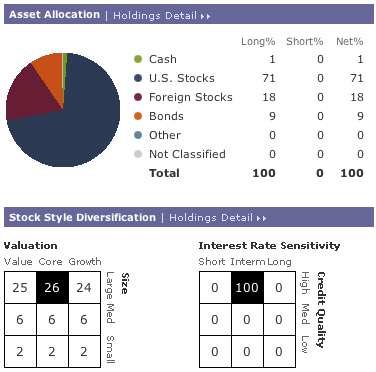
Once you enter your holdings, simply look for the Portfolio X-Ray tab and you’ll have a complete breakdown of the true asset allocation of your overall portfolio. Does your “small cap” fund really own a bunch of mid-caps and large-cap funds? X-Ray will reveal your true exposure to stock style (i.e. Small/Mid/Large, Growth/Blend/Value), geographical regions (i.e. Japan, US) , stock sectors (i.e. Telecom, Energy), average expense ratio, and more.

If you’d rather have a quick peek without needing to register at all – but also without the ability to save your portfolio – try the Morningstar Instant X-Ray tool.

If you already have a target asset allocation in mind, now might be a good time to to rebalance your assets back towards that target. Rebalancing is a way to maintain the risk/reward balance that you have chosen for your investments, and also forces you to buy temporarily under-performing assets and sell over-performing assets (buy low, sell high). If you are looking for a bit more guidance, here are my favorite posts on investing.