TradeKing “New Year, New Broker” $50 Sign-up Bonus

Online discount broker TradeKing has brought back their on-again, off-again $50 sign-up bonus for new accounts. You must open with at least $2,500 and make one trade within 30 days. TradeKing offers $4.95 trades with no minimum balance requirement or inactivity fees. I’ve been happy with them, they are a good basic broker for ETFs and dollar-cost-averaging. Offer expires 1/31/11.

This can also be a good time to switch away from your current broker if you’re unhappy. If you transfer an account of $2,500 value or greater over to TradeKing, they will also refund up to $150 in account transfer fees charged by your old broker.
[Read more…]

2010 Investment Returns by Asset Class

Vanguard has the year-to-date returns up to 12/31/2010 for all of their mutual funds available right now, so I made a table with all of the funds and asset classes that I like to track for my records. These are almost all passively-managed funds, so they should track their respective indexes closely. 2010 ended up being a relatively good year for most investors, as nearly all the major stock and bond indexes ended up in positive territory. I’ve listed the mutual fund versions for simplicity, even though there is usually an ETF equivalent with similar returns.

Fund Ticker Asset Class 2010 Total Return
Stocks
VFINX S&P 500 14.91%
VTSMX US Total Market 17.09%
VISVX US Small Cap Value 24.82%
VGSIX US Real Estate (REIT) 28.30%
VFWIX International Total Market 11.69%
VGTSX International Total Market 11.12%
VFSVX International Small Cap 17.09%
VEIEX Emerging Markets 18.86%
Bonds
VFISX Short-Term Treasury 2.64%
VIPSX Inflation-Protected Bonds 6.17%
VBMFX Total Bond Market Index 6.42%

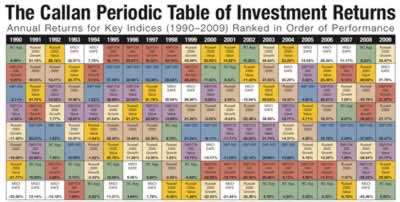
As a reminder that being this year’s best performing asset class is no guarantee of for future years, here’s the Callan Periodic Table of Investments that shows the relative performance of 8 major asset classes over the last 20 years. You can find the most recent one below (click to view PDF), which covers 1990 to 2009. (No update to include 2010 yet.) You can find previous versions here.

As you can see, the top performing asset classes is nearly impossible to predict, so holding multiple, low-correlation asset classes and rebalancing can be beneficial.

2010 Year-End Financial Goal Progress Update

As 2010 draws to a close and the champagne is all gone, here’s an update on the status of our personal financial goals. I’ve been on the fence for a while about whether to continue our detailed net worth updates, and I’ve decided to reclaim some privacy and stop doing them in the previous format. Instead, I’d like to keep tracking our progress but in a opaque manner where I think everyone can still calculate their own and compare with us if desired. I’m not sure exactly how to do this, but here is a rough outline.

Credit Card & Consumer Debt

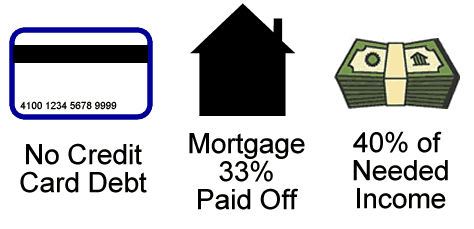
I think the first part of any healthy financial status should be to outline and pay off any consumer loans. We do use credit cards, but we pay our balances in full each month. We don’t have any auto loans or other forms of consumer debt.

I used to take money from credit cards at 0% APR and place it into online savings accounts, bank CDs, or savings bonds that earned 4-5% interest, and keeping the difference as profit while taking minimal risk. (By this I meant that the risk was dependent on my own actions.) I could have also used such 0% loans instead of other debt like student loans. However, given the current lack of great no fee 0% APR balance transfer offers, I am currently not playing this “game”.

Retirement Portfolio

As far as financial freedom goes, there are a number of ways to fund your living expenses without working. Pensions, Social Security, stocks, bonds, real estate, and so on. For us, I have boiled down “financial freedom” to be two things:

Part 1: Accumulate 25 times annual (non-housing) expenses

Part 2: Own my house / Pay off mortgage

I think it’s important to note that these two parts don’t necessarily have a number attached to them. Minimizing expenses are just as important as increasing portfolio size, as well as minimizing the amount of house that you “need”. More detail can be found in this post entitled A Quick & Dirty Plan To Reach Financial Freedom.

For Part 1, the basic idea is to assume that a portfolio can return 4% annually with adjustments for inflation. So if you have $1,000,000, that would create $40,000 a year. The exact implementation of this is more complicated, as there are several ways to help avoid portfolio depletion like annuities and adjusting your withdrawals during market downturns. Most folks won’t need a million dollars, though, if they have already paid off their house. For example, if your non-housing expense are only $1,000 per month, then you’d only need 12 x 25 = $300,000.

Back in July I was 33% of the way to reaching this goal. We are now 40% of the way. At this pace, we could finish Part 1 in less than 10 years, but we will likely scale back our income when we have kids. We’ll have to keep a close eye on those expenses as well.

Housing & Mortgage

Owning a house isn’t for everyone, but I think that if you are geographically stable, it can be a great way to become financially independent. Once you pay off the house, then your housing “expense” is mostly taken care of. (There is still maintenance and property taxes.)

We have owned our house for about 3 years now, having taken out a 30-year fixed rate mortgage initially with a 20% downpayment. Since I want to retire before I’m 50, I need to speed things up. Over the past year, we have made additional payments toward principal, as well as lowered the interest rate to 4.75%. These prepayments have been irregular lump-sum amounts, although I agree an automated plan is easier to maintain. The outstanding loan principal is now 67% of the purchase price. If we were to continue the original minimum-required payments, our home would be now be paid off in 21 years. This is good, as we can support that payment on one income.

MIT’s Real-time Inflation Calculator

A lot of people are worrying about inflation or deflation in the future. The most widely used definition of inflation is the Consumer Price Index, which is published monthly by the Bureau of Labor Statistics and is based on a basket of consumer goods using price surveys from cities around the country. This takes a while, so the CPI for December would be published in mid-January.

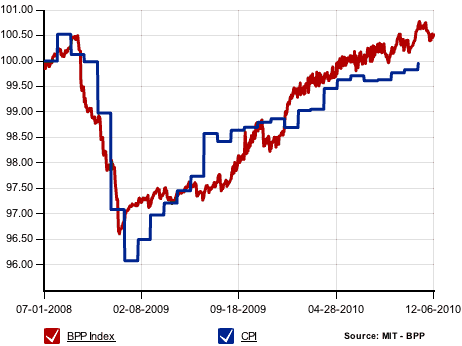
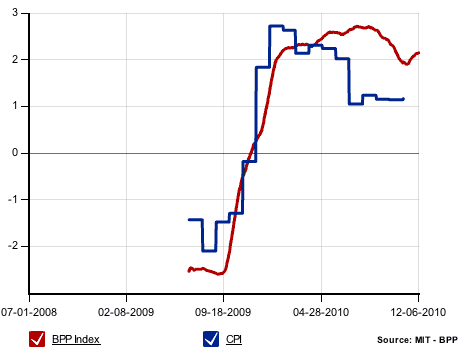
Professors Roberto Rigobon and Alberto Cavallo at the MIT Sloan School of Management started the Billion Prices Project which, directly pulls data from online retailers from around the world. In the US, the software is tracking 550,000 items from 53 retailers. The best part – since it’s all automated, the numbers are updated daily! The goal is to predict the CPI before they even announce it. You can see from the charts below that the two track reasonably well together.

Daily BPP Index vs. CPI

.

Annual Inflation (over last 365 days)

If they start to vary widely, which one should be considered inaccurate? Via the NY Times.

Sharebuilder New Account $50 Bonus

I just noticed that discount stock brokerage Sharebuilder is offering a $50 cash bonus as long as you open a new account with $50 by December 31st with promotion code 50WS10. (The code is also mentioned on the promo page.) It doesn’t appear that you even need to make a trade. Fine print:

** You must open a new account with ShareBuilder and deposit $50 or more to be eligible for this promotion. Initial deposit must be completed by 12/31/2010. ShareBuilder will deposit a $50 bonus approximately 4-6 weeks after your first $50 deposit. The $50 bonus offer is available for Individual, Joint and Custodial accounts only. Offer not valid for IRAs or ESAs. The $50 bonus from ShareBuilder is not available for withdrawal for 90 days after it is awarded to your account. This offer is not valid with any other offers and is non-transferrable. Limit one ShareBuilder account bonus per unique customer or custodial beneficiary. […] Offer expires 12/31/2010.

If you open it quickly, you should be able to take combine this with these several promotional codes worth over a hundred dollars in free trades, both real-time and automatic. Automatic trades differ from the real-time market/limit trades that most brokerages offer, as they are market orders that only execute in batches once a week on Tuesdays. In most cases, this is best suited for people regularly investing a constant amount (i.e. $50 a month) into ETFs or widely-traded stocks. The commissions start at $4 for each automatic trade, and $9.95 for a real-time trade.

Vanguard Total International Stock Index Fund Now Has Admiral Shares

If you own shares of the Vanguard Total International Stock Index mutual fund, you may be interested to know that Vanguard recently announced that Admiral shares of the fund now available to those with balances of $10,000 or more. Here are their respective pages:
Vanguard Total International Stock Index Fund Investor Shares (VGTSX)
Vanguard Total International Stock Index Fund Admiral Shares (VTIAX)

Admirals shares are a separate share class in addition to the standard Investor shares. While owning the same underlying investments, they take advantage of the cost savings of larger accounts and thus have lower annual expense ratios. Back in October, Vanguard reduced the minimum amount required to qualify for Admiral Shares on most of their index funds from $100,000 to $10,000.

Vanguard Total International Stock Index Investor shares have an annual expense ratio of 0.32%, while the Admiral shares are at 0.20%. That’s a difference of only $12 annually per $10,000 invested, but with compounding over time that can become significant. If you qualify, Vanguard says they will convert you automatically sometime “early next year”, but you can do so manually right now with a few clicks. Here’s a step-by-step guide [pdf], so why not?

After the conversion, you will remain invested in the same Vanguard fund. We’ll transfer your account options and cost-basis information to your new Admiral Shares automatically. When the change is complete, we’ll send you a confirmation of the transaction. We’ll also send you a separate confirmation for any account options that we carried over to your new Admiral Shares.

Also worth mentioning again is the fact that the Total International Stock Index Fund itself is making some changes soon. Its benchmark index will switch to the MSCI All Country World ex USA Investable Market Index, which differs from the previous index by adding exposure to Canada and Israel, as well as adding a ~13% allocation to small-cap international companies.

The combination of the benchmark change and this new Admiral shares option, in my opinion, makes the holdings more comprehensive and even cheaper than my current holdings of the Vanguard FTSE All-World ex-US ETF (VEU). I’m going to direct all my new investments into VGTSX/VTIAX. I’m not selling my existing shares of VEU right away though, as I already have some capital gains. I suppose that’s a good thing.

Chart: The S&P 500 Stock Index Priced In Terms Of Gold

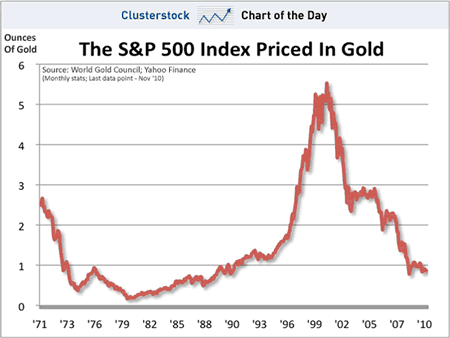
I don’t know what if anything this chart tells me, but for some reason I was compelled to post it here for posterity. Below is the S&P 500 index priced in terms of ounces of gold, from 1971-2010. Via BusinessInsider.

It has become popular to refer to gold as “real money” these days (and thus mock paper currencies like the dollar and euro). I don’t know about that. As a non-correlated asset to own as a certain percentage of your portfolio (and rebalance regularly), then maybe. But as a way of pricing things, gold values are way too volatile, and while the price of gold does relate to the falling dollar, it also relates strongly with speculation and fear.

I also feel that the newly found ease of buying gold in a brokerage account via an ETF like GLD has helped the price skyrocket. Click, click, and now you own gold. If you haven’t heard, gold ATM machines are coming here as well. Hmm.

In any case, if you do think of gold as money, then according to this chart the S&P 500 is at a reasonable historical price.

New: Vanguard International Real Estate Fund & ETF

On November 1st, Vanguard announced the initial trading of their new international real estate index fund, both in mutual fund and ETF share form:

Per their release, the fund invests in real estate investment trusts (REITs) and real estate operating companies (REOCs) in non-U.S. developed and emerging markets. The benchmark index is the S&P Global ex-U.S. Property Index, which includes 425 international real estate securities from 35 developed and emerging markets. Vanguard will assess a 0.25% fee on both purchases and redemptions for mutual fund shares (none for ETF).

I am glad to see a lower-cost option for international real estate investment, although I’m not really familiar with REOCs and how they differ structurally from REITs. I would assume these are best placed in a tax-sheltered account. I need to do more research, but am considering replacing part of my Real Estate portion (currently all US REITs) of my target asset allocation to this fund.

New Morningstar Study: Interesting Facts About 529 College Savings Plans

Morningstar recently released its annual 529 College Savings Plan study [pdf] for 2010. You can read about the final product Top 5 plans here (using some subjective judging components), but the paper also had some stats that I felt were note-worthy for those not wanting to read all 48 pages of it.

Broker-sold plans make up 52% of all 529 plan assets, direct-sold make up the other 48%. I guess I shouldn’t be, but I was surprised that only half of assets are by parents not going through a broker or financial advisor.

The average 529 balance was $9,700, which is a bit more than one year of tuition at a in-state public university (average $7,020) and much less than half a year of tuition of an out-of-state public school ($18,548) or a private college or university ($26,273). I wonder what the median is, to negate the effect of the tiny accounts.

Parents typically open accounts for their children when they are between the ages of 7 and 10, giving most families about a decade to save before their first tuition bill comes due. With only a decade, I would be wary of putting a big chunk in stocks. Many providers have already changed their “age-based” portfolios to hold less stocks. Only after the market drop, of course…

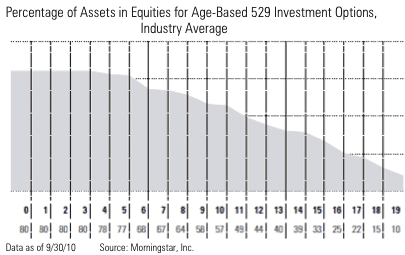
Here is a chart showing the industry average “glide path” for age-based investment options:

Roughly estimating, I see about 60% stocks for an 8-year old with a decade left before college. Before choosing such an option in your own 529, it’s important to see what your specific age-based glide path is. Many now have multiple options for conservative, moderate, and aggressive.

The asset-weighted total average expense ratio for direct-sold plans is between 0.49-0.64% annually, depending one if the plan allows investment options outside the program manager’s. The asset-weighted total average expense ratio for advisor-sold plans is between 1.16%-1.52%.

The five cheapest direct-sold 529 plans, ranked by asset-weighted total expense ratios, are:

  1. New York’s Direct 529 Program (0.25%)
  2. Utah Education Savings Plan (0.28%)
  3. The Vanguard 529 College Savings Plan, Nevada (0.28%)
  4. CollegeAdvantage 529 Savings Plan, Ohio (0.29%)
  5. College Savings Iowa 529 Plan (0.34%)

Keep in mind that this is based on actual assets held by savers, not just based on the cheapest option available in a plan. Many of these plans offer some actively-managed options for those that wish to partake.

The Story of My First Property Purchase

The following is a guest post from Investor Junkie, who shares the details of his first condo purchase. His blog discusses all things related to investing and being an entrepreneur.

The time was 1998. I was 28 years old, and still living with my parents in Long Island, New York. I did so, not because I had to, but because I wanted to. Even my girlfriend at the time was bitching I should move out as I made enough money. Needless to say that girlfriend wasn’t my girlfriend for much longer.

Unlike all of my other friends who enjoyed paying rent, I was on a mission. I wanted to own a condo as to me real estate is one of the best ways to increase my wealth. I made many sacrifices and pinched every penny I could. I knew exactly the area I was in the market for, and what type of property. There was a 134 unit condo complex next to the local train station. This made a primary location for New York City commuters like myself since, by railroad it was only an hour away. I got a hold of a friend of the family who was a real estate agent, and asked for comps of sold units for the previous year. The two bedroom, one and half bath units all sold for around $125k, plus or minus $5,000. With these condos the primary variable was how much was renovated since all had the same layout. These units were built in 1973, and were at the ripe age of needing must done improvements. I spotted an inefficiency in the market, and knew my target.

I looked at 5 other units in the condo complex before I found “the one”. After a few months after my initial research I spotted a unit for sale in the local newspaper. It was for sale by owner, and had an open house that Friday. After work I quickly hopped over to the place to take a look. As I entered the unit the first thing I noticed was an older couple walking out in disgust. I walked into the unit, and quickly figured out why. There was the distinct smell of an animal’s wet fur. I found from the presenter this unit had been a rental property since it was built. Everything was original, and nothing had been upgraded since it was built. Too my surprise the smell came from the living room, which had a caged ferret in it. After I inquired about the ferret, the presenter of the property explained to me the tenant had his two sons living all living in this two-bedroom apartment. This explained why the living room ceiling had pinholes in it. It appeared the tenant used a blanket to cordon off the living room into a makeshift bedroom for the oldest son. The story gets better from here.
[Read more…]

Current TD Ameritrade Sign-Up Promotions (Updated 10/2010)

With their new commision-free ETF list, there might be a renewed interest for a TD Ameritrade account (though not from me). Here are the current promotions available. They have different opening balance requirements, different expiration dates, and some are valid for IRAs and some are not, so I’ll leave it to you to see which one fits best.
Trade Free for 60 Days + Up to $500 Cash Bonus
Open a new account with at least $2,000. Only the free trades are valid for IRAs. Technically you can get up to 500 free trades for the first 60 days after account funding. The cash bonus depends on your funding amount, from $100 to $500. Selected fine print:

Offer valid for one new Individual or Joint TD Ameritrade account opened by 12/31/11 and funded within 30 days of account opening with $2,000 or more. Funding with minimum of $25,000 – $99,999 receives $100 cash, funding with minimum of $100,000 – $249,999 receives $250 cash, funding with minimum of $250,000 or more receives $500 cash. IRAs and other tax-exempt accounts are not eligible to receive the cash bonus. Offer is not transferable and not valid with internal transfers, accounts using the Amerivest service, TD Ameritrade Institutional accounts, current TD Ameritrade accounts or with other offers. Commission-free trades will be limited to a maximum of 500 Internet equity, ETF or options trades. Qualified orders must execute within 60 days of account funding. Contract, exercise, and assignment fees still apply. Limit one offer per client. Account must remain open with minimum funding required for participating in the offer for 9 months, or TD Ameritrade may charge the account for the cost of the cash awarded to the account. TD Ameritrade reserves the right to restrict or revoke this offer at any time. This is not an offer or solicitation in any jurisdiction where we are not authorized to do business. (Offer Code: 201)

$5 trades for 12 months
New accounts opened with at least $2,000 can get $5 market/limit trades for 12 months. Valid for IRAs. Selected fine print:

Offer valid for new TD Ameritrade IRAs, Individual and Joint accounts that are opened by 11/30/10 and funded within 30 days of account opening with a minimum deposit of $2,000 or more. Internet equity or option trades are $5 for market or limit orders during the 12-month introductory period. Interactive Voice Response (IVR) trades will be $5 for market or limit orders. Broker-assisted trades will be $24.99 for a market order or $29.99 for a limit order during this period. Contract, exercise, and assignment fees still apply. Commission rates are valid 12 months from qualifying deposit of $2,000 or more. At the conclusion of the 12-month introductory period, Internet equity or option trades will be $9.99 for market or limit orders, IVR trades will be $34.99 for market or limit orders, and broker-assisted trades will be $44.99 for market or limit orders. Your new account must remain open and funded with the minimum required funding for 12 months or the account will be reverted back to the standard commission schedule.

Up to 25,000 Delta Skymiles
Open with $2,500 and get 5,000 Delta miles, $10,000 for 10,000 miles, and $50,000 for 25,000 miles. Selected fine print:

Offer valid for one new Individual or Joint TD Ameritrade account opened and funded by U.S. residents with $2,500 or more by 12/31/2010. Not transferable and not valid for IRA or other tax-exempt accounts, internal transfers, current TD Ameritrade clients or with other offers. Limit one offer per client. […] Account must remain open with minimum funding required for participating in the offer for 9 months, or TD Ameritrade may charge the account for the cost of the SkyMiles. Allow 6-8 weeks from account funding for the first half of the miles to appear in your SkyMiles account. To qualify for the second half, TD Ameritrade account must remain open with minimum funding required for participating in the offer for 6 months from the first mileage posting date.

Up to 25,000 United Mileage Plus miles
Same idea as with Delta above, except for United miles. Selected fine print:

Offer valid for new Individual or Joint accounts opened and funded by U.S. residents with $2,500 or more by 12/31/2010. Not transferable and not valid for IRA or other tax-exempt accounts, internal transfers, current TD Ameritrade clients, or with other offers. Limit one offer per client. […] Account must remain open with minimum funding required for participating in the offer for 9 months, or TD Ameritrade may charge the account for the cost of the miles. Allow 6 weeks from account funding for the first half of miles to appear in the Mileage Plus account. To qualify for the second half, TD Ameritrade account must remain open with minimum funding required for participating in the offer for 6 months from the first posting date.

30 days free trades + $100, $250, or $500 Cash
If you fund with $25,000 minimum, you can get $100 cash. 100,000 minimum gets you $250 cash. Whopping $250k minimum gets you $500 cash. You also get 30 days of commission-free trades. Here’s basically the same offer valid for 401k rollovers. Selected fine print:

Offer valid for one new Individual or Joint TD Ameritrade account opened by 06/30/2011 and funded within 30 days of account opening with $2,000 or more. Funding with minimum of $25,000 – $99,999 receives $100 cash, funding with minimum of $100,000 – $249,999 receives $250 cash, funding with minimum of $250,000 or more receives $500 cash. IRA and other tax-exempt accounts are not eligible to receive the $100 cash bonus. […] Qualified commission-free Internet equity, ETF or options orders must execute within 30 days of account funding. Contract, exercise, and assignment fees still apply. Limit one offer per client. Account must remain open with minimum funding required for participating in the offer for 9 months, or TD Ameritrade may charge the account for the cost of the cash awarded to the account.

Vanguard Lowers Minimum Balance Requirements For Mutual Fund Admiral Shares

Vanguard made another announcement that effective today (10/6), the minimum amount required to qualify for Admiral Shares has been reduced to $10,000 for most of their index funds and $50,000 for actively-managed funds, significantly reduced from the previous $100,000 minimum.

Admirals shares are a separate share class of 52 mutual funds in addition to the standard Investor shares. While owning the same underlying investments, they also take advantage of the cost savings of big accounts and thus have lower annual expense ratios. According to their press release, the lowered requirements means that nearly half of all Vanguard clients can take advantage of at least one of these Admiral funds.

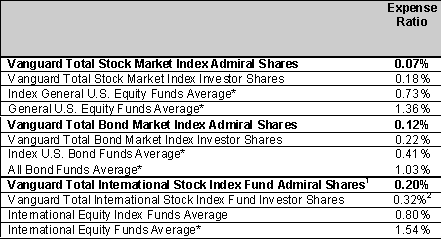
Here is a chart comparing Investor vs. Admiral shares costs for three major funds, along with the overall average across for all similar funds:

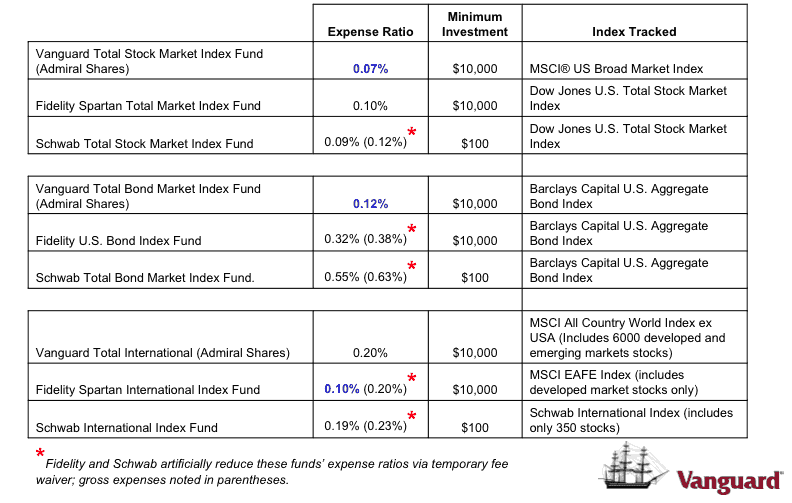
Here’s another comparison chart of the same broad funds with similar competitors from Fidelity and Schwab. Note that there are some differences in actual fund holdings, especially in the international funds (click to enlarge with more details):

Here’s a list of excluded index funds:

The minimum amount to qualify for Admiral Shares will remain at $100,000 for the following sector index funds: Consumer Discretionary Index Fund, Consumer Staples Index Fund, Energy Index Fund, Financials Index Fund, Health Care Index Fund, Industrials Index Fund, Information Technology Index Fund, Materials Index Fund, Telecommunication Services Index Fund, and Utilities Index Fund, and for the following tax-managed funds: Tax-Managed Capital Appreciation Fund, and Tax-Managed Growth and Income Fund.

I’m probably going to switch to the Admiral Shares of Vanguard Total International Stock (VGTSX, ER 0.20%) when it comes out, away from the Vanguard FTSE All-World ex-US ETF (VEU , ER 0.25%) which I just converted to. Their holdings are now pretty close. While I don’t mind ETFs that much, they are a bit more work because I like to make a limit order during stock market hours in order to get a proper fill. (I don’t like market orders in case there is another flash crash or similar.) If it’s both cheaper and easier, I gotta go for it.

This will also keep me from converting some of my other mutual funds to ETFs, as the expense difference will either be gone or significantly minimized. They say that the newly qualified folks will have their funds transferred over – with no tax consequences – automatically over the next few weeks. If you’re impatient like me, you can manually request it as well online. Just log into your account at Vanguard and look for the “Convert to Admiral Shares” link. It’s always nice to save some money without doing anything at all.