Vanguard Brokerage Services (VBS) Account Opening Process Review

Vanguard recently announced a much lower commission schedule for Vanguard ETFs (free!) and all other common stocks when using their Vanguard Brokerage Services (VBS) account. With VBS, I can now buy and sell stocks, bonds, ETFs, CDs, and non-Vanguard mutual funds. If you meet certain asset level requirements, this would allow folks to add a great deal of flexibility to buy to my account at no added cost. If you have less than $50k in total household assets, there is a $20 annual fee (although it still might be worth it).

Last week, I opened a new Vanguard Brokerage Services account in my existing Roth IRA, which previously only held Vanguard mutual funds. The process was straightforward and much like opening any other brokerage account, except that most of my personal information was already filled in. From the Vanguard Brokerage FAQ:

How do I open a Vanguard Brokerage Services account?
To open a brokerage nonretirement account, traditional IRA, Roth IRA, SEP-IRA, or education savings account, you can:

* Complete an application form online. Use an e-signature to sign it, and then submit the form.
* Download an application form. Complete the form and mail it to Vanguard Brokerage Services.
* Request a form by mail. Contact us and we will send you an account application.

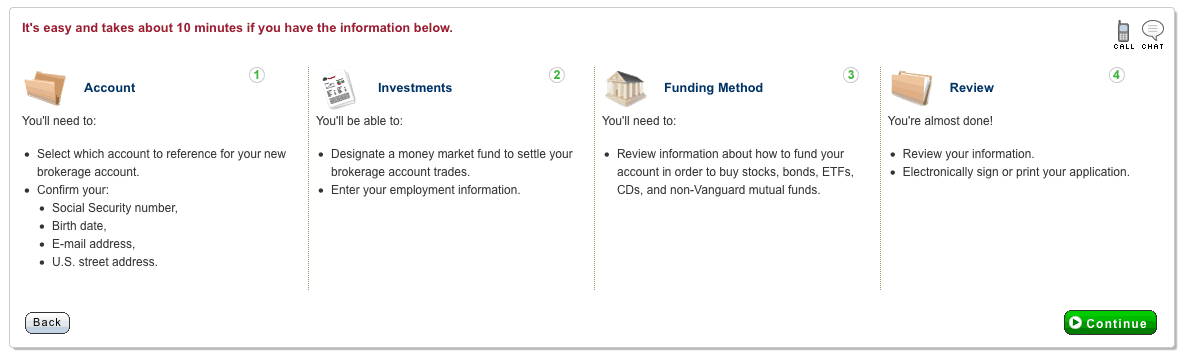
You can also call them up and have them start your application for you over the phone, although you’ll still have to finish it online. After logging in, I clicked on the “Complete an application form online.” option followed by “Add a new brokerage account to your existing Vanguard relationship.” This brought me to an overview screen (click to enlarge):
Application Highlights

  • I confirmed the Roth IRA account and my personal information. As an existing client, all of the information was pre-filled.
  • I chose whether I wanted to automatically reinvest dividends or transfer them to my money market settlement account.
  • I chose the money market fund that I wished to be my settlement account. The only choice was the Prime Money Market Fund (VMMXX), as this was a retirement account. For taxable account, I could have also chosen the Tax-Exempt Money Market Fund. Since this is the sweep account where all the cash sits when not invested, there is no minimum balance requirement.
  • I entered my employment information and industry affiliations, which is required on all brokerage accounts.
  • I reviewed funding information (bank transfer, check, wire, selling shares). Since I already have some bank accounts linked, I can fund later using those methods after the account is opened.
  • I chose to electronically sign the application. It took about a business day or so for the account to be approved. I did not need a notary, medallion signature guarantee, or any other physical paperwork.

In total, this took less than the 10 minutes suggested. I knew that my account was approved when I logged in the next day and was asked to sign various agreement for stock quotes from the NASDAQ, NYSE, and Options Price Reporting Authority. While viewing my accounts, I really didn’t notice much difference except for the new money market fund that popped up in my Roth IRA.

I haven’t made any trades yet, but since it is an IRA and I’ve already made my contributions this year, I will have to either sell or convert some of my existing mutual fund holdings. I did make a few test runs on the stock trading interface. There is a regular interface like all other brokerages and a “guided trading path” version which is a Q&A-based system for “investors with limited online trading experience.” Nothing terribly special to report there.

In summary, in my experience the VBS opening process for an existing customer was very easy with no surprises. If this was a taxable account, I could simply use an online bank transfer and start trading as soon the funds were available. I am still doing some research on funds availability and settlement times for when you want to make a trade quickly.
LendingClub Responds To Concerns About Investment Return

LendingClub requested an opportunity to clarify the Net Annualized Return measure and overall Lending Club performance discussed in my updated analysis based on historical return data. I’m just going to go ahead and share it in its entirety. The following is provided by from Renaud Laplanche (CEO) and Rob Garcia (Sr Director of Product Strategy).

Is Average Net Annualized Return Meaningful?
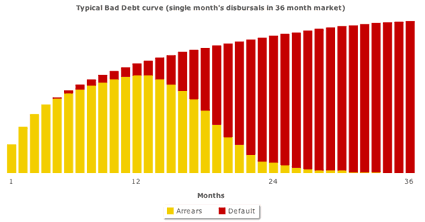
The first question raised was whether or not the aggregate 9.64% net annualized return is representative of a track record that is long enough to be meaningful, considering that it includes many loans issued recently. This is a valid question, and we believe the answer is positive: the average age of the Lending Club portfolio is around 12 months and, considering that it takes 4 months for a loan to default, a 12-month average age is really reflective of an 8-month track record. In a 3-year unsecured loans portfolio, defaults typically occur faster in the first 6 to 8 months, after which they start to level off. See for example data provided by our friends at ZOPA, who service a portfolio with characteristics similar to the Lending Club portfolio.

[Read more…]

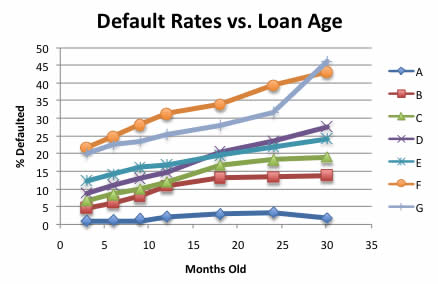
LendingClub Default Rates vs. Loan Age Graph

LendingClub is supposed to provide me with an official response to my updated analysis of their loan performance numbers. Hopefully it will shed more light on how their advertised returns are calculated.

While I’m waiting for it, here is another chart I put together for prospective lenders using data from LendingClubStats.com, which pulls directly from LendingClub’s own statistics database. The full term for LC loans are 36 months (3 years). This chart organizes all loans by their age, allowing you to compare new loans and old loans on a more equal basis. Only officially defaulted loans are included, not late loans with payments up to 120 days late. The numbers are sorted by credit grades A through G.

I’ll let the numbers speak for themselves for now, and save my opinions for another time.

New Lender Incentives – Free $25 to $250 Bonus
If you are interested trying P2P lending with no risk, you can still use this special $25 lender sign-up link to get a free $25 to try it out with no future obligation. There is no credit check and you don’t even have to deposit anything. After you are approved, the $25 will show up in your account balance, and you can lend it out immediately.

If you’ve done your research and are willing to jump in with both feet, those that are willing to invest at least $2,500 at once and link a bank account can get a $100 bonus when you get a referral from an existing member. (Yes, you must actually invest $2,500 in loans.) Send me an e-mail if interested.

You can also view my personal LendingClub portfolio details here.

InvestForLess: American Funds With No Load?

Although I don’t invest in any mutual funds with loads or sales charges, I know that many people like to buy American Funds. Although they don’t do any print advertising or press releases, they are the third-largest fund company in the world behind Fidelity and Vanguard. Buying $10,000 in the Class A shares of the American Funds Growth Fund of Americas (AGTHX) would normally cost you 5.75% ($575) in sales fees upfront. Or since American Funds are only sold through advisors, perhaps you’re paying them an annual management fee of at least 1% of assets instead, or some combination thereof?

But new website InvestForLess.com would like to charge everyone a flat $250 annual fee and grant you access without any sales charges (turn down the volume since there’s an annoying auto-loading video).

From this Kiplinger article, it sounds like they are officially registered advisors, trying to sell their bare-bones services (i.e. access to advisor-sold funds) on a volume-based model:

InvestForLess is sort of like the Costco of mutual funds. It charges $250 per year for membership in its platform. Once you join, you can buy the “adviser” or “institutional” share classes of funds on its platform for free. This is possible because InvestForLess, despite looking and smelling like a broker, is structured as a registered investment adviser, with Trade-PMR, a broker-dealer, as its custodian. So InvestForLess members will have access to the same share classes that are available to other advisers on the Trade-PMR network.

However, there is already some pushback from commission-based advisors, as both Charles Schwab and Scottrade have agreed to, and then since backed out, from being their custodian. Currently, their custodian is Trade-PMR. I don’t think the fight is over yet, but it’s an interesting development.

Vanguard Voyager Status Minimum Now $50,000

Another recent change at Vanguard is that their Voyager membership tier is now available to those with household assets totaling $50,000 or more. The minimum was previously $100,000. The minimum for Voyager Select remains at $500,000 and Flagship remains at $1,000,000.

Eligibility
Here’s the fine print from Vanguard. 401k plan assets also can count if they are administered by Vanguard and are invested Vanguard mutual funds. Households are also determined by address, so if your spouse or parents use the same address and have Vanguard assets, that can count as well.

Membership is based on total household assets held at Vanguard, with a minimum of $50,000 to qualify for Vanguard Voyager Services®, $500,000 for Vanguard Voyager Select Services®, and $1 million for Vanguard Flagship Services®. We determine membership by aggregating assets of all eligible accounts held by the investor and his or her immediate family members who reside at the same address, including investments in Vanguard mutual funds, Vanguard ETFs®, annuities through Vanguard, The Vanguard 529 Plan, and certain small-business accounts. Assets in employer-sponsored retirement plans for which Vanguard provides recordkeeping services may be included in determining eligibility if the investor also has a personal account holding Vanguard mutual funds. Note that assets held in a Vanguard Brokerage Services® account (other than Vanguard ETFs) aren’t included when determining a household’s eligibility.

If your assets nudge above $50k one day, Vanguard might not bump you up to Voyager immediately. It’s probably worth a phone call and they’ll change your membership level, which should stay that way even if your balances drop due to market fluctuations (and not withdrawals).

Voyager Benefits
Here are the main perks of Voyager when compared with a regular investor with less than $50,000 in assets.

  • Voyager representative. I believe you get a different phone number to call. (Look on the top right after you log in.) Perhaps this results in shorter hold times? I wonder if Voyager representatives are more experienced or otherwise “better”.
  • Possibly lower account fees. You no longer need electronic statements to waive their mutual fund account service fees. (Otherwise $20 per year for each Vanguard fund in which you have a balance under $10,000.) At Vanguard Brokerage Services, you also avoid the $20 annual account service fee.
  • Possibly lower commissions. You get $7 trades on all stock and non-Vanguard ETF trades, instead of for only the first 25 per year. (Otherwise $20 per trade afterward.)
  • A financial plan from a Certified Financial Planner (CFP) costs $250 instead of $1,000.

This is a nice change for us… I’m happy to report that I am a Voyager client now.

Commission-free Vanguard ETF trades in Vanguard Brokerage Accounts

Vanguard sent out an announcement today that they are responding to recent moves by Fidelity/iShares and Schwab by offering their own lowered commission costs, the highlights are of which are:

Commission-free Vanguard ETF transactions. Vanguard brokerage clients may make commission-free transactions in Vanguard’s entire line-up of 46 low-cost ETFs, which is the largest suite of ETFs available without commissions.

Ultra-low equity commissions. Most Vanguard brokerage clients will pay $7 or $2 to trade stocks and non-Vanguard ETFs®.

[…]Unlike competitors’ commission schedules, the same commissions apply to both transactions conducted on Vanguard.com and those executed with the assistance of a Vanguard brokerage representative.

Added: For the brokerage account, a $20 account service fee is charged annually. The fee is waived for Voyager, Voyager Select, and Flagship members.

The details of new price structure are based on the amount of assets held at Vanguard. But everyone gets at least free Vanguard ETF trades and $7 trades for the first 25 per year ($20 after that).

First impressions? Sweeeeeet. 🙂 Looks like it might be time for some mutual fund to ETF conversions.

LendingClub Updated 2010 Review: Historical Returns and Trends

I’ve been investing with LendingClub for over two years now. They securitize person-to-person loans so that you can lend money to other people in $25 increments, and you collect the interest after some fees. The stated interest rates are about 7-16%. On their home page, they boast of very impressive returns:

If you had invested $10,000 in Lending Club Notes in June 2007 (when we started issuing loans) and continued to reinvest your returns, you’d have made over 9.5% net annualized returns to date, outpacing a high yield corporate bond index, the NASDAQ, S&P 500 and even 1-3 year treasuries.

While I can only assume this statement is technically true, you have to remember that the way they state the numbers includes a lot of new loans that have not had a chance to “age” until maturity. LendingClub notes are all for a three year term. It would be more informative, in my opinion, to specifically look at the return of only loans that have completed. Since LC is so new, how about as old as possible.

For that, I go to the Statistics section. I should point out that the date range is for the origination date of the loans. The observation date is today. Accordingly, the default view of “Show All Time” shows every single loan from mid-2007 until today. Again, this includes a lot of new loans, many of which are impossible be classified as defaulted yet (must be 120+ days late). Instead, let’s narrow down the origination dates so we can look at loans of a set age.

June 1, 2007 to December 31, 2007
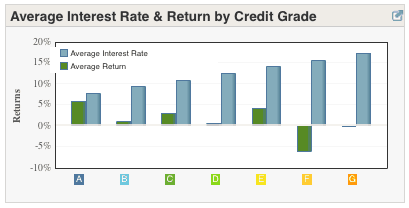
We’ll start with the loans that originated in 2007, their first year of operation. Even though these loans aren’t all completely done, they are the oldest loans available with an average age of about 2.5 years. Here are the average returns and average interest rates, sorted by credit grade:

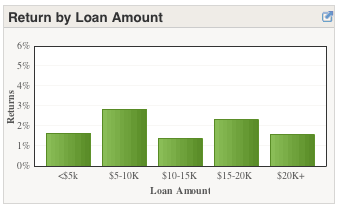
Here are the average returns by loan amount:

The interest rates being charged (blue) are predetermined by LC, and as you’d expect they increase as credit quality decreases. However, the returns (green) are not what you might expect. Grade A loans appear to have performed the best, but other than that there is no real direct relationship between return and credit grade. I see no clear relationship between loan size and return, either. Most importantly, by visual estimate, the average return for all of these loans is only approximately 2%. This is way off from 9% returns.

(Read on for more…)
[Read more…]

LendingClub P2P Loan Portfolio Performance Update

Wow… The last time I wrote about LendingClub was about 6 months ago. Since then, I haven’t really been keeping up with person-to-person lending, which in this case are unsecured credit card-like loans between individuals. Looks like they got a new logo and revamped their website! I kind of miss the old Halloween colors.

Lending Club Portfolio
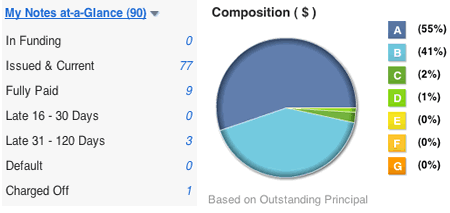
Back then, I had 62 loans outstanding, of which 58 were current, one was 30+ days late, and three were paid off early. Today, my portfolio has 90 loans, of which 77 are current, three are 30+ days late, one was charged off completely, and 9 have already been paid off early. My current invested principal is ~$1,800, and I’ve received over $1,100 in payments already (principal + interest). The new loans must have been acquired close to October, as I don’t even remember the last time I logged into this account. I suppose that’s good in terms of it being a low-maintenance investment. 🙂

Performance & Commentary
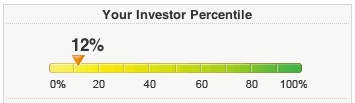
In the last 6 months, my portfolio’s “Net Annualized Return on Investment” based on my interest payments received went from 9.14% to 4.45%. LendingClub puts me in the sad 12th percentile of investors:

What happened? Some bad loan-picking, perhaps some bad luck, but mostly age. The sharp drop itself is due to my recently charged-off loan and how their return calculation takes into account late loans. A “late” loan will affect your calculated return because you’re not receiving those monthly payments. On a $100 loan that might be $3.xx a month. But most late loans eventually turn into defaults. After 120 days late or so, LC will officially recognize the fact that you’ll never see the rest of your $100, and your return will suffer accordingly. Quick example – If you have 50 equal-sized loans, and two go bad immediately, that’s 4% of your principal gone.

As I stated before, if you have loans that are younger than 1-2 years old, do not expect your current return number to be your final return to maturity. One major reason why the advertised average return is so high, is that the average investor has very young loans in their portfolios. My oldest loan was issued back in December 2007. If you just look at the loans that are already 2 years old (full term is 3 years), you’ll see that the average return is only about 4-5%.

This doesn’t mean investors won’t still capture some risk premium for their loans, but I wouldn’t expect 9% returns over 3 years. This is not a low-risk investment, even though I still like the idea of making some fun and helpful loans. With much more data now available, I’ll be looking more into performance trends in a future post.

New Lender Incentives – Free $25 to $250 Bonus
If you are interested trying P2P lending with no risk, you can still use this special $25 lender sign-up link to get a free $25 to try it out with no future obligation. There is no credit check and you don’t even have to deposit anything. After you are approved, the $25 will show up in your account balance, and you can lend it out immediately.

For those that have done their research and are willing to jump in with both feet, those that are willing to invest at least $2,500 at once and link a bank account can get a $250 bonus when you get a referral from an existing member. (Yes, you must actually invest $2,500 in loans.) Send me an e-mail if interested.

If you’re looking to borrow at LendingClub, it’s relatively straightforward. Give some information, and see what interest rate they offer you. Compare it with your credit card, Prosper, or other financing options. If you like it, fill out your application carefully (verify income if possible) and go for it. If you don’t like the rate or the full amount is not funded, you can either accept partial funding or walk away with no obligation.

Portfolio Check: Do You Need Investment Management Help?

I received a thought-provoking comment last week on my Fidelity Portfolio Advisory Service review. Since this post is a couple months old by now, I doubt most readers saw it. After reading it, my first guess was that somehow the visitor was interested about Fidelity PAS and also read up about my own investing activities.

Even thought the comment wasn’t blatantly baised, on a gut instinct, I checked the IP. As I suspected, the visitor came from a Fidelity Investments internet domain. Still, that doesn’t mean the person is necessarily wrong, just most likely works for Fidelity. 🙂

Anyhow, the comment from “Ryan”:

I would ask yourself why you were “stuck” in cash and missed the market rally. Was it because you were emotionally involved? Trying to time the market and got in/out at the wrong time? Where you frozen to the point where you didn’t know what to do? Those kind of mistakes can REALLY hurt a portfolio’s return in the long run. I would say if you are ready to commit to a discipled strategy and stick to your asset allocation & rebalancing plan, you are ready to manage the portfolio on your own. You can also think about taking 10% of your portfolio to invest in individual stocks to see if you can get lucky with a few and boost your overall return. But you also have to be prepared to do your homework (jim cramer says an hour a week per stock, so thats 10 hr/week) on those stocks. If you are honest with yourself and don’t think you will have the time, expertise, or interest to keep up with the management of your portfolio, best to have someone do it for you whether it be through actively managed funds or professional management.

I both agree and disagree with parts of this comment.

Yes, I agree that it is one thing to set up and asset allocation and re-balancing plan, and it is another to execute it in times of uncertainty and market turmoil. This is your family’s future. Right now, with the S&P 500 at 1200, it would be good to look back over the last couple of years and see if you kept your stock/bond ratio at your desired targets when the markets were doing much worse. We you unsure? Scared to pull the trigger? Wanted the economy to get “just a bit better” before jumping back in?

However, I don’t agree that if you did have problems, the solution is “actively managed funds or professional management”. Well, not exactly. Why not go back to something simple and low-cost, like the Vanguard Target Retirement Funds? You will receive the power of passive investment into thousands of companies representing every industry around the world. You’ll also be invested in high-quality investment grade bonds from the US government, US agencies, and strong corporations. And you don’t have to worry about rebalancing, because they will do it for you. All at a rock bottom price of about 0.20% of assets annually ($20 a year for every $10,000 invested).

Take VTIVX, the fund for folks retiring around 2045. Want an IRA? Set up automatic investments into VTIVX. Got more to spare from the paycheck? Set up a automatic investment in a taxable account? Got a bonus? Throw it into VTIVX or similar. Scared? Just sit tight, VTIVX will rebalance for you. Don’t sell. Don’t buy anything else. Inaction is actually in this case. No, it won’t be perfect, but it will be a lot better that most of the other options out there. If you had trouble recently, perhaps it’s time to go back to simplicity?

In any case, there is no way I’d pay 1.74% in annual fees to Fidelity to manage my portfolio. Such crazy-high fees can also REALLY hurt a portfolios return, like facing a 50 mph headwind. I’d choose a Vanguard Target Retirement fund of comparable allocation over a 15+ year period vs. any Fidelity PAS portfolio any day of the week and twice on Sunday.

NY Times Financial Tune-Up: Interactive Checklist

The NY Times has a new series called the Financial Tuneup: Take a Few Hours and Unlock Some Cash. Essentially these are all the things that you probably know you should do, but never get around to. By compiling them all into a interactive checklist, they suggest setting aside a specific time each year to focus on these activities.

Here’s a quick excerpt of the To-Do’s that are included on their 31 item list. If you’ve read virtually any personal finance blog or magazine for longer than 10 minutes, you’re probably familiar with most of them and why they should be done.

  • Rebalance your investment asset allocation
  • Open an online savings account
  • Consolidate to a better rewards credit card
  • Lower your interest rate on existing debt
  • Check your credit reports
  • Check in on your Flexible Spending Account
  • Haggle or shrink your landline, cell phone, and cable bills
  • Update your life insurance to meet needs
  • Shop around for home and/or auto insurance

Reading through the list, it reminded me a lot of the 15-Minute New Year’s Resolutions that I introduced this January (but then lost a little steam). It also fits in well with the new Gladwell-esque book The Checklist Manifesto by Atul Gawande, which explores the power of checklists and how they can reduce mistakes in even simple areas like hand-washing and make complex tasks much more manageable. It easy to see how a checklist in this scenario can help you focus your energy and reduce oversights.

As long as it can reduce the barrier to action enough for people to check off a few more items, I’d say it was a great idea. Are you motivated yet?

Surviving the Great Baseball Card Bubble

From the 1630s tulip mania to the Roaring 1920s to the Dot-com Bust to Real Estate, I thought I had read about all the bubbles. But it seems that I forgot that I was right in the middle another one – the baseball card craze of the late 1980s and early 1990s.

I was about 10-14 during these years, in which I had just the right combination of a little bit of spending money, a love of sports, and greed. All my friends collected cards, and we traded them daily. Baseball cards were our form of currency. You could buy homework answers, protection from bullies, or even temporary popularity. I would secretly only spend half of my lunch money and go hungry for a few hours before running home to buy another pack of cards.

In the new book Mint Condition: How Baseball Cards Became an American Obsession, James Davieson tells the story of how this bubble formed and subsequently popped. This Slate article The Great Baseball Card Bubble includes a few excerpts. This one hit especially close to home:

American boys growing up in the 1980s approached Beckett Baseball Card Monthly with something like religious reverence. For many of us, it was the first magazine we bought and the only one we leafed through regularly. The magazine’s circulation eventually reached about 1 million, with many of those issues no doubt destined for the book bags of young boys. We walked the school hallways in the ’80s with our Becketts sandwiched between our textbooks, and we followed the price fluctuations of our favorite players with slavish devotion. Beckett’s valuations served as the foundation for all card trades.

To this day, I have about 3 years of worn out Becketts stacked up in my parent’s house. Looking back it was basically the stock market for kids, except instead of real-time quotes we only had monthly updates. Quality downgrades, riding momentum, pure speculation, it was all there. And just like mortgage-backed securities, when the mass media starts calling something a legitimate investment, a crash is soon to follow.

By the ’80s, baseball card values were rising beyond the average hobbyist’s means. As prices continued to climb, baseball cards were touted as a legitimate investment alternative to stocks, with the Wall Street Journal referring to them as sound “inflation hedges” and “nostalgia futures.” Newspapers started running feature stories with headlines such as “Turning Cardboard Into Cash” (the Washington Post), “A Grand Slam Profit May Be in the Cards” (the New York Times), and “Cards Put Gold, Stocks to Shame as Investment” (the Orange County Register). A hobby bulletin called the Ball Street Journal, claiming entrée to a network of scouts and coaches, promised collectors “insider scouting information” that would help them invest in the cards of rising big-league prospects. Collectors bought bundles of rookie cards as a way to gamble legally on a player’s future.

Of course I had to idea what inflation hedges were back then, but I did view them as an investment. Baseball cards were a store of value, and were sure to only increase as time went on, right? Even now, I still have a few unopened packs of 1989 Upper Deck, the first “premium” baseball card. I used to fight the urge to open them, balancing the curiosity of whether I had a Ken Griffey, Jr. rookie card, or whether it was better to keep it an unopened mystery.

I suppose I did learn a few things about personal finance in those days. But after reading all this, I figure I can complete my Nolan Ryan 1968-1993 Topps collection on the cheap. 🙂

Ohio CollegeAdvantage 529 Plan: Free $25 To Start

The Ohio CollegeAdvantage 529 Savings Plan is again offering a $25 refer-a-friend bonus if you open an account and deposit at least $25 by June 30, 2010. You can be a resident of any state, and there are no application or annual fees.

Rated a Top 529 Plan by Morningstar
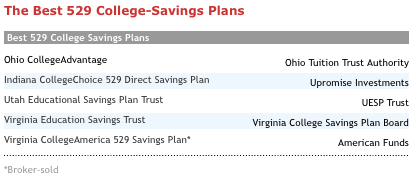
In a recent article The Best and Worst 529 College-Savings Plans by Morningstar, the Ohio CollegeAdvantage plan was rated in the top 5 plans:

Features they liked included having a wide variety of investment options (including active/passive, multiple age-based options, and even ultra-safe CDs), as well as low total expenses. In-state resident can also deduct up to $2,000 of contributions per year, with excess carryover allowed.

My Personal Experience
So far, I am quite impressed with the Ohio plan. The website itself is functional and fast, there are a variety of investment choices (cash, index funds, active funds), they are upfront with the fees, and the expenses are very competitive – either the lowest or near the lowest in the nation. There are no inactivity fees, minimum balance fees, or other bogus fees.

I have gotten the $25 bonuses plus several referrals, with no complaints from the people I referred. I have also started an auto-debit from my checking account for $50 a month. Right now, half of my 529 is in the Vanguard inflation-protected bond fund. This is an investment option that is unavailable in most state plans. I did an analysis of conservative inflation-linked 529 investment options here.

I feel that since college is only at most 18 years away with a big lump-sum payment, I would prefer less volatility while marching towards that goal. This is in contrast to saving for retirement, where I currently have 35 years until I turn 65, and hopefully another 20 years after that as well.

Referral Bonus Instructions
Currently the newly referred person gets $25, and the referring person gets $50, and I’d love for you to help fund my kid’s college dreams. 😀 Here’s how:

  1. You can enroll online or via mail. The online process was quick and easy, and I didn’t have to mail in anything.
  2. The first step is to input your personal info and choose a login/password. Next, you’ll verify your e-mail and complete the application.
  3. After that, you’ll choose your funding amount and select an investment fund. Your initial deposit must be a least $25, and is funded using the account/routing numbers of your bank account. At the bottom, you will need to enter a referral code to get the bonus. Enter 2439350.
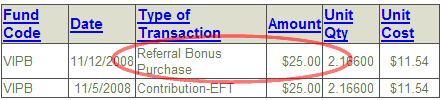
  4. In 1-3 days, your initial deposit will be taken from your bank account, and in 5-7 business days you will get your $25 bonus. The $25 will be deposited directly into the 529 account, and will be invested in the same thing as your initial deposit.

If a child has two parents, one parent may sign-up and then refer the 2nd parent to get another bonus, while both can list the same child as the beneficiary. If your child is not born yet or does not have a Social Security number yet, you can choose yourself or another family member as the beneficiary, and then later on fill out a Change of Beneficiary form.

Here is a screenshot of me getting my $25 bonus successfully and as promised: