Making an Early IRA Withdrawal From Vanguard

What if, for some reason, you really do need to make a withdrawal from your IRA before you are 59.5 years old? One example is withdrawing a Roth IRA contribution without penalty, which you can do at any time. Some folks were wondering how hard it would be to do so, so I just tried to withdraw $100 from my Roth IRA held at Vanguard. Would they put up a fight? Require forms signed by a notary public? Ask for a DNA sample?

It turns out, they simply subject you to a long series of confirmation screens. You can follow along yourself if you have an account too – just be sure not to click on that final “Submit” or you’ll actually do it!

First, I logged into Vanguard.com, went to my IRA account, and clicked on “Buy & Sell” to try and sell some one of my mutual fund holdings (VEIEX for the curious). They immediately throw up a warning:
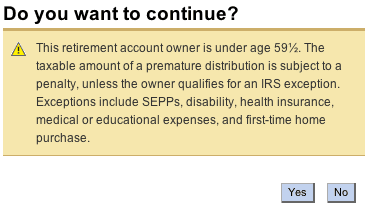
Bravely, I clicked “Yes”. On the next page, I could choose the amount to sell and how I’d like the proceeds sent to me:

  • Electronic bank transfer—Two business days if submitted before 4 p.m., Eastern time; three business days if submitted after 4 p.m.
  • Wire— The redemption proceeds will leave Vanguard by the close of business on the next business day; two days if processed after 4 p.m. Eastern time.
  • Check—Within 7 to 10 business days.

For some reason, the Wire option wasn’t available in the pulldown menu. Instead, I was given the option to exchange the money into a fund within my taxable account held at Vanguard. I went ahead and chose to send it directly to my linked bank account. This led me to the tax withholding page:

Tax withholding information
Moving money out of a retirement account is a distribution. Qualified Roth IRA distributions are not subject to federal income tax. All or a portion of nonqualified Roth IRA distributions may be subject to federal income tax.

You can either elect to have no federal income taxes withheld from your Vanguard Roth IRA distribution or request withholding at a rate between 10% and 100%. You will remain liable for payment of federal income tax on the taxable portion, if any, of your withdrawal. Tax penalties may also apply if your estimated income tax payments or income tax withholdings are insufficient under federal or state rules.

Since I am pretending to only withdraw a contribution, I chose not to withhold anything. Again, a warning screen appears:

Do you want to continue?
The transaction you have selected involves a premature distribution that is not due to death of the original IRA owner. This distribution will be coded and reported to the IRS as J—Early distribution from a Roth IRA.

Next up is a screen about whether you’d like a tax withholding notice sent to you via e-mail or snail mail.

Receive a tax withholding notice
Because you are completing a distribution from a retirement account, you may request a copy of the tax withholding notice. This notice is for informational purposes only.

Since my fund has a redemption fee, the next page reminds me that this fee will be taken out of the proceeds of the sale:

The Emerging Markets Stock Index Fund imposes a 0.25% redemption fee on the total amount of this redemption.

I acknowledge all this, which finally leads me at the last confirmation page.

Review & submit
Your Vanguard® fund redemption will be processed using the closing share price on the business day on which Vanguard receives your request. Requests received after the close of the New York Stock Exchange (usually 4 p.m., Eastern time) will be processed using the next business day’s closing price.

That’s it! I quickly click on Cancel, and no action was taken.

Summary

In less than 2 minutes, I was able to request an early withdrawal online from my Vanguard IRA. No humans, no forms to send in. Good to know. Taking 2-3 business days directly into my bank account seems fair enough. A wire transfer would be even faster, although there would likely be a fee involved.
Should I Dip Into Savings To Max Out Roth IRA?

It’s getting very close to April 15th, which in addition to tax returns is also the funding deadline for IRAs in the 2009 tax year. A reader wrote in asking whether they should dip into their savings in order to fully fund their Roth IRA contribution for the year. I would imagine this is a common scenario this time of year.
Let’s say that your income is under the phase-out limits and you can contribute the full $5,000. (See this IRS page for more info on limits.) Perhaps you’ve contributed $3,000 so far. You can either take the remaining $2,000 out of your other accounts (emergency fund, car repair fund, sell stocks, etc.) and fully fund the entire $5k, or simply stop where you are.

An important fact to know here is that anyone can withdraw their Roth IRA contributions at any time, without penalty. (This means just your original contributions, not any earnings on those contributions.) However, you cannot retroactively make contributions to past years. In my example above, you couldn’t just contribute $5,000 + $2,000 = $7,000 next year.

Thus, if you feel that you would likely be able to max out in future years, it may be better to simply make your contributions now. It would be quite sad to miss out on a one-time opportunity for tax-free earnings forever! If you do need the money later, you can always withdraw it again. The early withdrawal process is not that complicated, although you will have some additional paperwork to fill out come tax time.

More details about the actual IRS fine print in this post: Can I Really Withdraw My Roth IRA Contributions At Any Time Without Tax Or Penalty?

There are always some possible wrinkles, of course. If it is truly an cash-under-the-bed emergency fund, you should know it make take a few business days to make an IRA withdrawal. In addition, if you really do foresee needing the money, then you may want to invest in conservative options like CDs or money markets. If you are selling stocks, you may be subject to taxes on capital gains. But you buy the same stock in the Roth IRA, you’ll be able to defer taxes on future gains.

Mutual Fund Hidden Cost: Brokerage Commissions

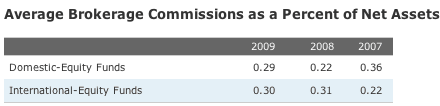
You might know the expense ratio of the mutual funds you own, but do you know how much of your money they spend on brokerage commissions? Yes, even huge billion-dollar fund managers have to pay someone to execute their stock trades for them, and it can sometimes involve a murky world of “soft” dollars where expenses are hidden from investors through inflated stock commissions.

Morningstar article A Big Fund Cost You Don’t See explored this hidden cost and found that the average equity fund pays approximately 0.30% of assets a year in brokerage commissions. If your equity reports an expense ratio of 0.90%, that would bring the total expenses including commissions to 1.20%. (When comparing performance numbers, those are usually reported after all expenses.)

However, these are just averages. Some funds have high turnover and thus lots of trades relative to their asset balances. The Morningstar article highlighted 10 funds that paid over 0.60% of assets in brokerage commissions recently. One of these is CGM Focus (CGMFX), which I seem to read about a lot in popular personal finance magazines. They spend 1.04% of assets on stock commissions, on top of the 1.23% official expense ratio. Overcoming a 2.27% total expense drag every single year is quite difficult – some would say nearly impossible over the long run.

I am not saying they do this, but you can see how it would be beneficial for a mutual fund to shift some of their costs onto the stock commission side and reduce the highly publicized expense ratio figure.

I also ran across this Mutual Funds’ Hidden Costs page at Retire Early Home Page, which was last updated in 2005 but provides some historical perspective. In 2004, Forbes magazine revealed that the Dreyfus Founders Passport Fund paid an “astonishing” 4.64% of assets towards brokerage commissions.

It also states (again back in 2004):

The average US domestic mutual fund pays about 5 cents in brokerage commissions for every share of stock bought or sold in the fund. Vanguard averages about 2 cents per share in its low-cost index funds.

What about Vanguard index funds?
This made me want to investigate Vanguard’s brokerage commission hit further. To calculate it yourself for any mutual fund, you’ll need two numbers. First, you’ll need the total net assets as of December 31st, found inside the fund prospectus. Second, you’ll need to track down the total brokerage commissions spent, found inside the fund Statement of Additional Information (SAI). Luckily, these are both easily found on Vanguard.com for any specific fund – just click on “View prospectus and reports”.

In 2004, the Vanguard Total Stock Market Index – Investor Shares (VTSMX) had an expense ratio of 0.19%, and brokerage commissions of only 0.0077% of net assets In 2008, the expense ratio was 0.18%, with the commission costs dropping to only 0.0069% ($5,643,000 divided by $82 billion). As the fund grows, the expenses per dollar are reduced – something I’ve come to see and expect from Vanguard.

This goes back to one of the structural features of index funds – they do not need to trade very much to maintain their goal of tracking an index based on market capitalization. If one company rises (or drops) even significantly in value, they simply represent more (or less) of the index accordingly. There is little need to buy or sell in response to market fluctuations. Instead, trades are made primarily due to new fund purchases and redemptions by investors, or due to the occasional change in the tracking index.

Net Worth & Goals Update – March 2010

Net Worth Chart 2010

Lack of Recent Updates
Up until last December, I had done regular monthly updates of our net worth for five consecutive years. However, recent personal events made me much less interested in detailed, analytic planning towards early retirement. As a result, I have barely checked any of my statements in the past few months, other than to make sure they weren’t negative. I think I made a few trades here and there, but for the most part haven’t bought or sold any stocks to maintain my asset allocation. I haven’t even converted my Traditional IRAs to Roth IRAs like I had planned, or made any IRA contributions for 2010.

Instead, reading blogs and other financial news has simply been a recreational escape for me, and I think my blogging has reflected that. I still had fun learning about ways to save money here and there, and enjoy keeping track of other market changes and various offers out there.

However, it’s time to catch back up a bit! Here we go…

Credit Card Debt
In the past, I have taken money from credit cards at 0% APR and placed it into online savings accounts, bank CDs, or savings bonds that earn 4-5% interest (much less recently), and keeping the difference as profit. However, given the current lack of great no fee 0% APR balance transfer offers, I am currently not playing this “game”. My balances are simply monthly charges that I have not yet paid in full when due.

If you’re looking for a competitive offer, Citibank is offering 0% APR for 15 months with a 3% balance transfer fee.

Income
We’re both still working, but will be taking some unpaid time off in April which will reduce income temporarily. Our monthly expenses are still much less than our (regular) income, so while we may eat into savings a bit, I expect to bounce back into the positive very quickly.

Retirement and Brokerage accounts
Near the end of last year, I had gradually moved $30,000 into a brokerage account at OptionsHouse to invest in ETFs due to their $3.95 trades. In my usual way, I then thought about switching instead to WellsTrade since I now had the $25,000 required to get 100 free trades per year. Stuff happened, the application process took too long, I got distracted, and the money is still sitting mostly non-invested. Grrr.

As stated above, besides our regular 401k contributions, we haven’t made any real moves in our retirement accounts either.

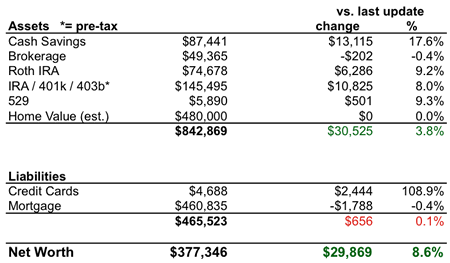
The stock market has done relatively well in the meantime, with the S&P 500 nearly hitting 1,200. Our total retirement portfolio is now $269,538 or on an estimated after-tax basis, $233,164. At a theoretical 4% withdrawal rate, this would provide $777 per month in after-tax retirement income, which brings me to 31% of my long-term goal of generating $2,500 per month.

Cash Savings and Emergency Funds
We continue to keep a year’s worth of expenses (conservatively set at $60,000) in our emergency fund. It’s still a nice warm safety blanket. I am thinking of moving a chunk of it into several separate 5-year CDs from Ally Bank, as they pay 1.60% APY (as of 10/25/13) and each would have a small early-withdrawal penalty of only 60 days interest.

Home Value
I am no longer using any internet home valuation tools to track home value. After using them for a year, I went back to simply taking a conservative estimate and focusing on mortgage payoff. After checking them again today, I am staying away. A house nearby sold recently for $500,000 but is listed at both Zillow and Coldwell Banker as being sold for $1,000,000. Needless to say, it is skewing my home value estimates!

It would seem that I am currently long on thoughts and short on action. Time to fix that.

Fidelity Portfolio Advisory Service Review w/ Actual Holdings

Have you seen those “follow the green line” ads from Fidelity? Well, they reminded that a reader sent me their retirement account holdings for review which was managed through the Fidelity Portfolio Advisory Service (PAS). This is a managed portfolio service, which means that you pay Fidelity a fee and they do all the research, selection, buying, and selling for you. Fidelity has two managed-portfolio tiers for individual investors, with the Portfolio Advisory Service for account balances of $50,000+, and the Private Portfolio Service for those with $300,000+ to invest.

At only a $50,000 minimum portfolio size, it appears that the PAS is targeted a relatively large portion of the generic public. Unfortunately, in the wealth management business such small balances usually also mean generic, cookie-cutter portfolios with little or no personalization. Here’s what Fidelity says:

In the Fidelity Portfolio Advisory Service product, customers are invested into model portfolios of Fidelity and non-Fidelity mutual funds based on their time horizon, risk tolerance and investment goals. These model portfolios are managed by a team of investment professionals that includes Portfolio Strategists and Mutual Fund Analysts.

Sounds like “we make you answer a short questionnaire and the computer spits out an asset allocation” to me. Let’s see how Fidelity constructs this person’s portfolio. I will mention here that this is an IRA account, so that taxes aren’t a huge concern.

Portfolio Comparisons

Benchmark Portfolio
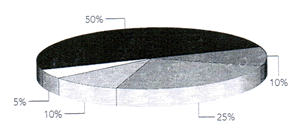
This particular account used the “Growth w/ Income Portfolio” benchmark, which has an overall 60% Stocks/40% Bonds balance. Other portfolio options are Conservative (20% stocks), Balanced (50% stocks), Growth (70% stocks), Aggressive Growth (85% stocks), and All Equity (100% stocks). Here are the indexes and asset allocation for this portfolio.

Stock
50% Total US (Dow Jones US Total Stock Market Index)
10% Developed International (MSCI EAFA Index)

Bond
25% US Investment Grade Bond (Barclays Capital US Aggregate Bond Index)
10% US High-Yield (Merrill Lynch US High Yield Master II Constrained Index)

Cash
5% Treasury Bills (Barclays Capital 3-month US T-Bill Index)

Hypothetical Index Fund Portfolio
As mentioned in the statement, you cannot invest in an index. So, I created below a portfolio consisting of actual investments that passively track the above indexes with minimal costs. I chose the cheapest ETF that tracks the exact index if possible, not the cheapest ETF that was similar. I also included the annual expense ratios.

50% SPDR Dow Jones Total Market ETF (TMW) 0.21%
10% Vanguard Europe Pacific ETF (VEA) 0.16%
25% Vanguard Total Bond Market ETF (BND) 0.14%
10% SPDR Barclays Capital High Yield Bond (JNK) 0.40%
5% SPDR Barclays Capital 1-3 Month T-Bill (BIL) 0.13%

The total weighted expense ratio was 0.20%.

Actual Fidelity-Managed Portfolio
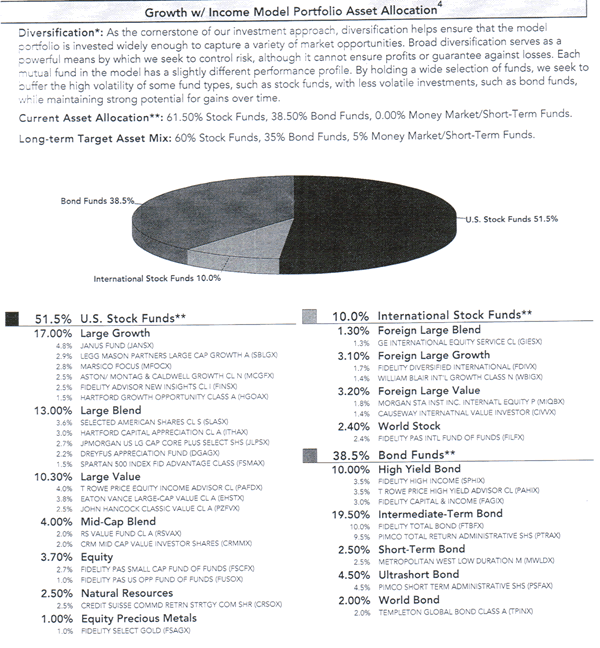
The actual choice of investments in this account matches the benchmark asset allocation closely, and included over 30 different mutual funds. You can view the entire mutual fund list here, but here is the overall breakdown:

51.5% US Stock Funds
10.0% International Stock
28.5% Investment-Grade Bonds
10.0% High-Yield Bonds
0% Cash

This includes a mix of twenty (!) different actively-managed domestic stock funds from both Fidelity and outside companies like Janus and T. Rowe Price (Okay, 1.5% was in one index fund – S&P 500 Fidelity Spartan.) The average expense ratio for these was approximately 1%. Six different international stock funds were included, with an average expense ratio of ~1.2%. The overall bond fund expense ratios were 0.8%. This brought the total weighted expense ratio to ~0.94%.

Performance Comparisons

Now for the important part, returns after all fees. This account was not ten years old, so the best long-term return number was the 5-year historical annualized returns. The statement was as of 6/30/09.

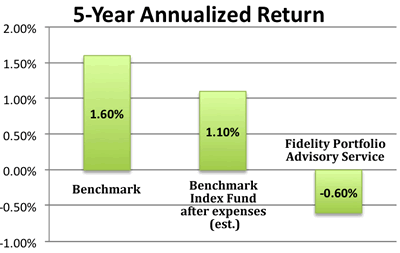
First up, we have the 5-year annualized of the Benchmark Portfolio, which as of 6/30/09 was 1.6%. Of course this is a benchmark, which doesn’t include any management fees or commissions.

I was unable to find performance numbers as of 6/30/09 for my Hypothetical Index Fund Portfolio as it is already 2010 (if someone knows how to do this please let me know). However, we can estimate the return since the total weighted expense ratio was 0.20%. If we estimate trade commissions to be $5 per trade x 5 ETFs = $25 per month… on a $100,000 portfolio that is 0.30%. (Such trade commissions would be zero if held at Zecco or WellsTrade, given the account size.) Assuming the ETFs follow the indexes closely, then the 5-year returns would be in the neighborhood of 1.1%.

Now, what was the actual 5-year annualized return on this fully-managed account? -0.6%. Yes, negative 0.6%.

Conclusion

Over the past 5 years, the Fidelity Portfolio Advisory Service managed to construct a portfolio that lagged a simple index fund portfolio by 1.70% annually. That’s a huge difference over time. Use any compound interest calculator and stick in two numbers that differ by 1.7%, and you’ll see the effect of compound interest working against you for a few decades. Why did this account perform so poorly relative to its benchmark? Isn’t it supposed to beat the benchmark?

Too many advisors. To me, if people choose to hire someone to manage their investments, it would be to tap into their expertise and special insight. I’d want him/her to make calculated bets that will beat the market. Putting my money in 34 different mutual funds, each with their own team of advisors, seems like everyone’s bets would cancel each other out.

While the reason given for so many funds was “diversification”, the only phrases that came to my mind were “overlap” and “lack of focus”. You don’t need to own a ton of funds to get diversification. With so many funds, you’d probably end up owning the same companies as the index fund anyway.

Costs matter. The actively-managed mutual funds are the first layer of expenses, which was a weighted 0.94%. Then there is the second layer of management fees charged by Fidelity, which includes all trade commissions and varies from .25%–1.7% based on asset levels. In this account, it was 0.8%. Thus, in order to simply match the benchmark, the investments chosen would need to outperform it by 1.74%. Every. Single. Year. That is a stiff headwind.

The really sad thing is, even if I just invested in the index funds through the Fidelity PAS and basically paid them to do nothing, I would have still done better than the funds they chose. 1.6% index – 0.2% index fund expenses – 0.8% Fidelity fee = gaining 0.60% a year. Compare that with losing 0.60% a year.

For a $200,000 portfolio paying 1.38% in portfolio management fees, that’s $2,760 a year. Don’t pay nearly 3 grand a year for a cookie-cutter asset allocation that doesn’t even match an index fund. It can be well worth your time to learn more about investments yourself. Here are some starting ideas.

Morningstar Lifetime Allocation Indexes

Morningstar recently started publishing their Morningstar Lifetime Allocation Indexes, which are designed as benchmarks for mutual funds that shift their asset allocation as a target retirement date nears. An example is the Vanguard Target Retirement 2045 fund (VTIVX), a buy-and-hold fund designed for those retiring around the year 2045.

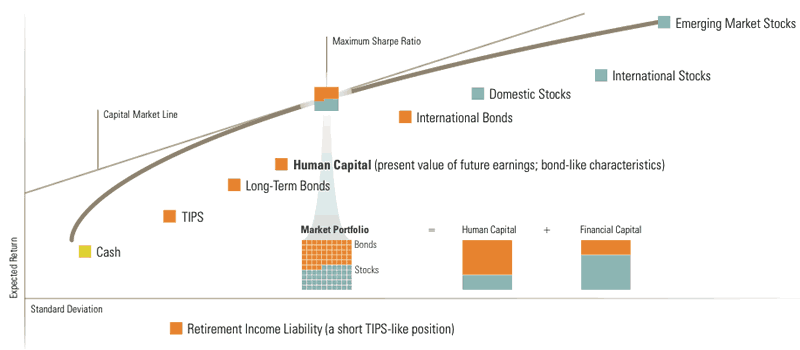
Created using historical performance data with Ibbotson Associates, the indexes provide asset allocations that are optimized based on Modern Portfolio Theory. The asset classes included are US and international stocks, US and international bonds, inflation hedges like TIPS and commodities, and cash. However, the interesting part is that their “efficient frontier” optimization model incorporates the idea of human capital, which is defined as the present value of a person’s future earnings.

Here is a chart from their factsheet explaining the idea (click to enlarge):

Accordingly, there are 13 indexes with three different risk profiles – aggressive, moderate, and conservative. It is recommended that you choose the proper profile not based on your love of risk-taking, but based on the quality of your human capital:

Human capital is defined as the present value of a person’s future earnings. This ability to work and earn money over time is like a giant bond that provides fairly stable cash flows. The human capital bond is not investment-grade for all investors however. Some investors have stable income streams and thus should have a higher capacity for market risk. Others have income streams that are more sensitive to economic conditions and should therefore have a more conservative financial asset allocation.

Without further ado, you can view all the asset allocations here. I’ll probably make a nice graph out of this later. For now, let’s say I wanted to retire at about age 50 in the year 2030, and I feel my human capital is moderately stable. The Moderate 2030 asset allocation looks something like this:

84% Stocks
— US 57%
— International 27%
10% Bonds
— US 10%
6% Inflation Hedges
— Treasury Inflation-Protected (TIPS) 1%
— Commodities 5%

I don’t really have any further thoughts on it, besides the fact that I don’t think we should necessarily base everything on historical returns. It might be better to try and figure out the source of those returns. Otherwise, it’s just another data point to add to the many model asset allocations out there.

Emerging Markets ETFs: EEM vs. VWO Comparison

One of the hottest asset classes in 2009 by far was Emerging Markets, which includes stocks from developing markets like China, Brazil, Korea, Taiwan, India, and South Africa. Two of the most popular ETFs in this category are the iShares MSCI Emerging Markets Index (EEM) and the Vanguard Emerging Markets ETF (VWO).

Which one should you choose?

Similarities. Both are primarily passively-managed and based on the MSCI Emerging Markets Index. EEM has been around longer but both currently have similar levels of assets, with $40B for EEM and $34B for VWO.

Differences. EEM is less expensive than most other actively-managed Emerging Markets mutual funds at a 0.72% annual expense ratio, but Vanguard is significantly cheaper still at 0.27%. EEM has a much higher average trading volume, as it has a higher popularity amongst institutional investors and active traders.

While they track the same index, both ETFs have their own sampling methods to replicate that index. EEM holds 439 stocks with an average market cap of $23.1 million, while VWO holds 816 stocks with an average market cap of $17.6 million. Unfortunately, Morningstar chose the MSCI EAFA Index as their benchmark for statistical comparison, so it’s hard to see exactly historically which one has been following the index more closely.

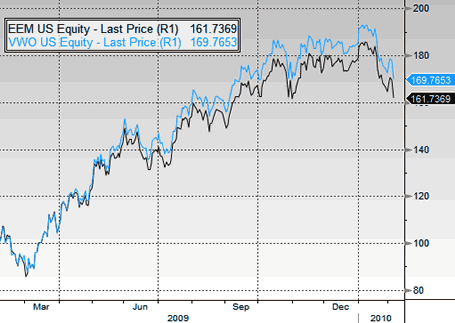
Performance-wise, iShares’ EEM has recently been lagging behind Vanguard, as was pointed out in this IndexUniverse post. In 2009, EEM rose 68.8% but VWO gained 76.3%, nearly 8 percentage points more.

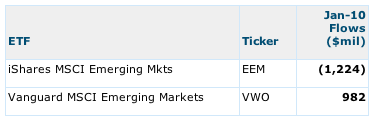
This has led to a significant outflow of funds recently from EEM into VWO:

However, if we look back to 2008 EEM dropped 48.9% while VWO dropped 52.5%. VWO isn’t old enough to compare 5- or 10-year historical returns, but if you compare 3-year annualized trailing returns VWO only beats EEM slightly at 2.69% vs. 2.60%. That’s actually surprising given the 45 basis point expense edge for VWO.

Conclusion. Due to their differences, either EEM or VWO may outperform each other in the short run. However, historically the significantly lower expense ratio of VWO has won out, and I would expect it continue to do so in the long run. VWO also holds more stocks and thus would seem to track the MSCI index more closely, while EEM offers more liquidity if you’re trading high amounts of shares at once.

Disclosure: I am or will be invested in VWO or the mutual fund equivalent (VEIEX). The reason I started this research is because I am currently trying to figure out how to switch to an ETF since the Vanguard fund VEIEX is both more expensive at 0.39% annually and has both a purchase fee of 0.50% and a redemption fee of 0.25%. Ouch! You can compare the total ongoing costs of VWO vs. VEIEX easily at this Vanguard calculator.

Fidelity Offers Free Commissions on iShares ETFs, Make Your Own Free Portfolio

In addition to their new $7.95 per trade price structure, Fidelity is also waiving commissions completely for 25 iShares ETFs. This appears to be a partnership where iShares partially compensates Fidelity themselves for promoting their ETFs.

Fidelity receives compensation from the ETF sponsor and/or its affiliates in connection with a marketing program that includes promotion of iShares ETFs and certain commission waivers. Additional information about the sources, amounts, and terms of compensation is described in the ETF’s prospectus and related documents. Fidelity may add or waive commissions on ETFs without prior notice.

Technically, you could make a relatively complete passive portfolio consisting entirely of these iShares ETFs. For example, if you wanted a stock portfolio encompassing the entire world in proportion to their current market capitalization share, you could go with

45% IWV (Broad United States)
40% EFA (Broad Developed Europe & Pacific)
15% EEM (Emerging Markets)

Since these ETFs have pretty good trading volume, the bid-ask spreads should also be reasonably small. For the bond portion, one possibility would be

50% AGG (Broad, Investment Grade Taxable US Bonds)
50% TIP (US Treasury Inflation-Protected Bonds)

assuming you had room in a tax-advantaged account like an IRA. Not a recommendation, just what I might buy for myself.

US Equity
iShares Russell 1000 Growth (IWF)
iShares Russell 1000 (IWB)
iShares Russell 1000 Value (IWD)
iShares Russell 2000 Growth (IWO)
iShares Russell 2000 (IWM)
iShares Russell 2000 Value (IWN)
iShares Russell 3000 (IWV)
iShares S&P 500 Growth (IVW)
iShares S&P 500 (IVV)
iShares S&P 500 Value (IVE)
iShares S&P Mid Cap 400 Growth (IJK)
iShares S&P Mid Cap 400 (IJH)
iShares S&P Mid Cap 400 Value (IJJ)
iShares S&P Small Cap 600 Growth (IJT)
iShares S&P Small Cap 600 (IJR)
iShares S&P Small Cap 600 Value (IJS)

Dow Jones U.S. Real Estate (IYR)

International Equity
iShares MSCI ACWI (ACWI)
iShares MSCI EAFE
iShares MSCI EAFE Small Cap (SCZ)
iShares MSCI Emerging Markets

Bonds
iShares Core Total U.S. Bond Market ETF
iShares Barclays TIPS Bond ETF
iBoxx $ Investment Grade Corporate (LQD)
JP Morgan USD Emerging Markets (EMB)
S&P National AMT-Free Municipal (MUB)

Fidelity Drops Trade Commission Price to $7.95

Fidelity announced today that starting February 3rd, 2010, the price of all online equity trades through their brokerage would cost $7.95, with no limit on the number of shares. Previously, the commissions ranged from $8 to $19.95 per trade depending on asset value and trading volume. This is great news for my Self-Employed 401k at Fidelity. Phone and broker-assisted trades cost a little more:

Customers placing trades through Fidelity’s Automated Service Telephone (FAST) will pay an additional $5 per trade ($12.95 total), and those placing trades through a representative will pay an additional $25 ($32.95 total) per trade.

This move makes Fidelity more competitive with the other discount brokers out there, for example I have an account with OptionsHouse which charges only $2.95 per trade.

They also announced commission-free trades for 25 iShares ETFs, which seems like a direct response to Schwab’s commission-free ETFs.

Fidelity U.S. Bond Index Fund (FBIDX): Trying To Beat The Benchmark?

Since I am expanding my portfolio to beyond just IRAs and 401ks, I will need to move my more tax-inefficient investments like bonds into those tax-deferred accounts. This way, I’ll put more of my stocks in a plain taxable account which is taxed at the more favorable long-term capital gains rates.

Fidelity is my Solo 401k provider, so I was looking through their bond offerings. Their only bond index funds are the Fidelity U.S. Bond Index Fund (FBIDX) and essentially a US Treasury bond index fund with different maturity lengths. Looking at FBIDX, its benchmark is the Barclays Capital U.S. Aggregate Bond Index. This index covers the all US bonds on the market that are investment grade and taxable, including Treasuries, corporate bonds, and mortgage-backed and asset-backed securities.

This is basically the same benchmark index as the Vanguard Total Bond Market Index fund (VBMFX), which follows the Barclays Capital U.S. Aggregate Float Adjusted Bond Index. (ETF version is ticker BND.) The “float-adjusted” part just accounts for all those Fannie Mae bonds that are now owned by the government and thus not actually available on the market anymore. They should be the same, right? Nope.

A perk of being a financial blogger is companies give you free stuff to try, and Morningstar offered me a free 1-year subscription to their paid Morningstar Premium service which offers stock and mutual fund research. Being a mostly a low-cost index fund investor, most of their content didn’t really interest me. However, I started reading the FBIDX Analyst Report and was surprised. The teaser line was:

Although this fund is designed to track the Barclays Capital U.S. Aggregate Bond Index, it lagged that bogy by more than 3 percentage points from mid-2007 through the end of 2008.

Lagging a benchmark by 3 full percentage points is a lot in the index world. Passive investors want low costs and low tracking error from the target benchmark! That’s how we get our greater-than-average return over the long run. It turns out that Fidelity had been making “modest” bets outside of the index in order to juice their returns, including minor exposure to subprime mortgages through an “ultra-short” bond portfolio*. FBIDX costs more than VBMFX by about 0.12% a year, so they would always lag if all other things were equal, and needed to take such additional risks in order to have better performance numbers.

The report goes on to report that the fund hired a new manager in February 2009, who says he’ll run a tighter ship:

Since joining the fund in February 2009, he [lead manager Curt Hollingsworth] has taken steps to ensure that it will closely track its benchmark from month to month. He thinks actively run internal bond portfolios have no place in this passively run offering, which should reduce the chance of things going awry. He also pared the fund’s exposure to out-of-index bonds from 8% to just 2% of assets lately.

Well, that’s nice to hear, but too late for me. When I see “index” in the fund name, I expect it to match the benchmark, not try to beat it like everyone else. Thus, I’m most likely going to construct my portfolio out of Vanguard bond ETFs instead. My transaction size should be great enough to counteract the hit from each individual stock trade. (Read about the Vanguard ETF vs. mutual fund cost comparison tool.)

Sharebuilder – $50 Bonus, IRAs Get Free Trades During 2010

Sharebuilder has a new promotion offering free window trades for all of 2010 if you open an IRA with them before April 15th (1,500 max). These usually cost $4 each, $12/month for 6, or $20/month for 20. Thanks to reader Ron for the tip.
Open an IRA before 4/15/10 to receive 1,500 Automatic Investment Plan credits. The trade credits will be posted to your account the next business day and will expire on 12/31/10. This offer applies to Individual Retirement Accounts only. AIP credits for mutual fund purchases apply only after the minimum investment has been met.

It is important to note that these Automatic Investments are not real-time market/limit trades that most brokerages offer, but market orders that only execute in batches once a week on Tuesdays. In most cases, this is best suited for people gradually dollar-cost-averaging into ETFs or widely-traded stocks. If you want to do an ACAT transfer out, it will cost you $75.

For taxable accounts, Sharebuilder is offering a $50 cash bonus as long as you open a new account with $50 by April 16th with promo code 50WCFA. It doesn’t appear that you even need to make a trade.

You must open a new account with ShareBuilder and deposit at least $50 to be eligible for this promotion. Initial deposit must be completed by 4/16/10. ShareBuilder will deposit a $50 bonus approximately 4-6 weeks after your first $50 deposit. The $50 bonus offer is available for Individual, Joint and Custodial accounts only.

For more background, you can see my slightly-dated Sharebuilder review as well as a follow-up post on a possibly better way to invest with them.

15-Minute Resolution #5: Check the Asset Allocation of your Investment Portfolio

Here’s the next installment of my series on New Year’s Resolutions that can be done today, and not put off for “some day” in the future. We all know how that usually turns out…

Last year was definitely a roller coaster year when it came to the stock market, and you may have taken the “just don’t open the scary statements” solution. Well, it’s time to take a peek and see where you stand. I won’t pretend that recent performance has been great, but if you made regular contributions throughout, you may be surprised to see your portfolio balance higher than it was in 2007. (Maybe.)

Asset allocation is how your investments are split between different asset classes. The most generic examples are stocks and bonds, but you can also divide them further into categories like large companies vs. small companies, international vs. domestic stocks, or different safety grades of bonds. Other asset classes include real estate, commodities, or precious metals. Your mix of assets has a great impact on the volatility and expected future return of your portfolio.

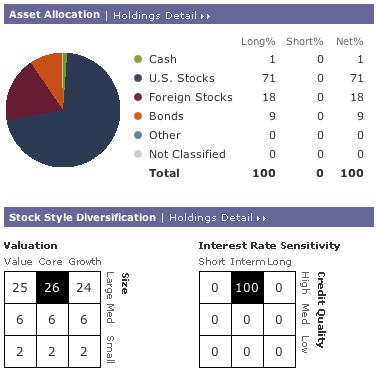
The easiest way is gather all your most recent financial statements and plug your holdings into the Morningstar Instant X-Ray tool.

(If you want it to remember your portfolio, you must sign up for a free site membership.) The site will then “x-ray” your holdings and break it down by asset class:

How do I know if my asset allocation is correct?

Well, ideally you would already have set your target asset allocation, and all you would need to do is to rebalance your assets to that target. Rebalancing is a way to maintain the risk/reward balance that you have chosen for your investments, and also forces you to buy temporarily under-performing assets and sell over-performing assets (buy low, sell high). How often one should re-balance their portfolio depends on a few factors. See this post on How often should I rebalance my portfolio?

Otherwise, setting an asset allocation can be a very complex topic. I recently pondered a very general rule-of-thumb where you set your stock percentage to double your tolerable loss in one year. So if you could only stomach a 30% stock, you should only invest a maximum of 60% of your portfolio in stocks.

Here’s a big collection of my posts that I did when deciding on my own target asset allocation:

Simplified Theoretical Stuff

  1. Disclaimer and General Philosophy
  2. Consider Simply Buying The Entire Market
  3. Efficient Frontier and Modern Portfolio Theory

Choosing An Asset Allocation

  1. Deciding On The Stocks/Bonds Ratio
  2. Deciding On The Domestic/International Ratio
  3. Considering The Diversification Benefits Of Small and Value Stocks
  4. Equity Asset Allocation: Comparison of 8 Model Portfolios
  5. Investing In Real Estate Through REITs?
  6. Interim Target Asset Allocation: Looking Back & Some Decisions

…See the rest of my 2010 Instant New Year’s Resolutions here!