Let’s say you’ve dutifully opened up a 529 college savings plan for your child and are looking for a suitable investment options. You’re not looking for a miracle, just a conservative investment to grow your savings for a while since college is coming up fast. You read the brochure for one of the funds:
The OIM Core Plus Fixed Income strategy is rooted in the idea that individual security selection produces the best opportunity for risk-adjusted excess returns over time. Through an extensive, bottom-up research process, our portfolio management team focuses on optimal bond selection of investment grade corporate bonds, mortgage-backed securities, US Government Treasuries and taxable municipal bonds. The team employs a tightly controlled duration discipline and closely manages all portfolio risk factors. The portfolio management team’s objective is to produce predictable, consistent excess returns net of fees over the Barclay’s Capital Aggregate Bond Index.
Sounds pretty good, all the buzzwords are hit. Risk-adjusted excess returns. Predictable, consistent, yup. Beat the average! This reminds me of the Money Magazine Mad Libs game.
Fast forward a couple of years:
In the Illinois BrightStart 529 plan, the Oppenheimer Core Plus bond fund lost 38% of its value in 2008, while the fund’s benchmark actually rose 5.24%. How’s that for “excess” returns? It turns out the fund used leverage and invested in mortgage-linked securities. After a lawsuit, Oppenheimer settled for $77 million, which amounts to only half of the losses.
In the Oregon College Savings 529 Plan, the Oppenheimer Core Bond fund made up 10% to 40% of the popular automatic age-based portfolios for the 529 plans. The fund dropped roughly 35% in 2008. Oppenheimer settled for $20 million, which is about 57% of the losses. In the New Mexico 529 Plan – you guessed it – the same thing happened and they recently settled for $67 million.
This means that in 2008 Oppenheimer lost roughly $300 million of people’s college savings across just three states in a fund that was supposed to be very conservative and sold to those with children within 5 years of college. I would never invest in any Oppenheimer fund after reading this. Not only did they mislead their investors – if not outright lied – they only partially reimbursed them after being sued and faced with a huge jury penalty.
Stories like this to keep me happily investing in low-cost passively-managed bond funds which are satisfied to carefully track a set benchmark. You really never know what a manager is doing when trying to “beat the benchmark”. When it comes to bond funds, it is very very hard to do so without taking on more risk, especially when they have to overcome their own high fees.
Resources
Found via: Mish’s Economics Blog, CNN More Money Blog.
News articles: AP, Star-Tribune, Oregon 529 Press Release
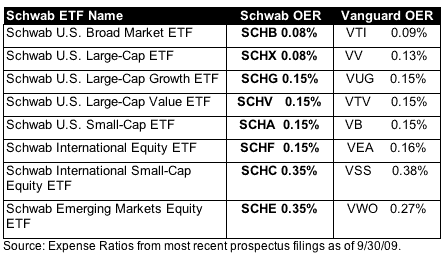
 On December 1st, Fidelity Investments made significant reductions to the management fees on the 529 college savings plans that they manage. From this AP article:

 Prosper.com was the first big name in the person-to-person lending space. Things have been quiet recently, as they took a while getting SEC approval for their investment notes. In addition, the problems with “old” Prosper included the fact that they let just about anyone apply for a loan in the beginning, including people with horrible credit who had been basically turned down everywhere else. Many lenders thought charging a 35% interest rate was enough – it wasn’t. But as this recent Washington Post article outlines, things are picking up in the P2P space.
 The Best Credit Card Bonus Offers – 2025
 Big List of Free Stocks from Brokerage Apps
 Best Interest Rates on Cash - 2025
 Free Credit Scores x 3 + Free Credit Monitoring
 Best No Fee 0% APR Balance Transfer Offers
 Little-Known Cellular Data Plans That Can Save Big Money
 How To Haggle Your Cable or Direct TV Bill
 Big List of Free Consumer Data Reports (Credit, Rent, Work)