DIY Inflation-Protected Pension: Fewer Retirees Claiming Social Security at Age 62

An important lever in building your retirement income is timing when you start claiming your Social Security benefits. While you can start as early as age 62, your monthly benefit increases each year that you delay claiming (up until age 70). For example, here is what my payout would be at various claiming ages if I stopped working today*:
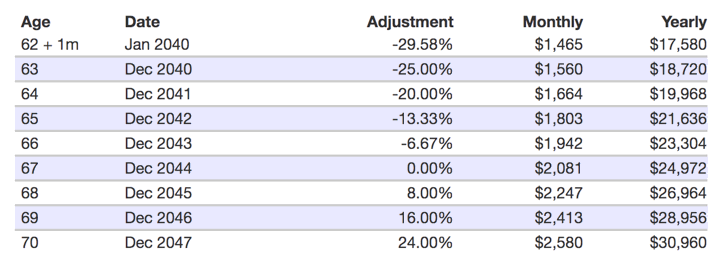
By forgoing the potential income during those initial years, I can “buy” a larger Social Security benefit for the rest of my life – essentially an inflation-adjusted lifetime annuity that happens to be backed the US government, as opposed to an insurance company that has a small-but-nonzero chance of failure. There is a big different between $100 a month and $100 month always adjusted for CPI inflation for the next 30 to 40 years. From this WSJ article:

“The very best annuity you can buy is to delay Social Security,” says Steve Vernon, an actuary who is a consulting research scholar at the Stanford Center on Longevity. Mr. Vernon, 67 years old, is himself working part time so he can delay claiming Social Security until age 70.

Did you know that there are now zero insurance companies that sell new annuities that pay lifetime income linked to inflation (CPI)? You can find some with fixed annual increases, but none will guarantee the increases to track inflation. Not a single for-profit company wants to take on the risk of future inflation. Think about that.

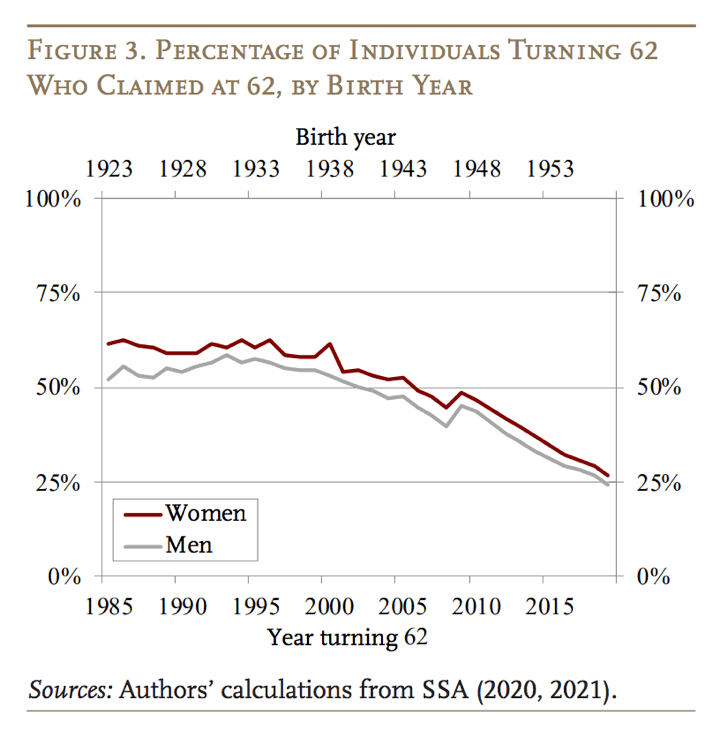
For a long time, the most common age of claiming was age 62, as soon as possible. However, this chart from the Center for Retirement Research at Boston College shows that the current trend is that fewer and fewer people are doing that, especially in the last 10 years (hat tip Abnormal Returns). The curve tracks the percentage of people turning 62 that start claim age 62. (This is different than percentage of all claimants, because there is a growing number of 62-year-olds overall.)
I haven’t found any official surveys about the reason for this trend, but here are some possibilities:

  • Fewer people “need” Social Security income right away, because they are healthier and/or able to find work for longer.
  • The stock market has been going up pretty consistently over the last 10 years, so fewer people need the income to start right away.
  • Fewer people “want” Social Security right away, because they expect to live longer or have been educated about the potential benefits of delayed claiming. They want the higher paycheck and are willing to wait.

There are definitely more free tools out there to help you make this decision. My payout chart above was based on mySocialSecurity.gov and SSA.tools and other free calculator is OpenSocialSecurity.com. OpenSocialSecurity actually told me that the optimal choice was for one of us to claim at 62 and the other to wait until 70, so early claiming isn’t always a bad thing.

* Wait, I’m less than 20 years from being able to claim Social Security?! 😱

Single Family Rental Homes: Asset Class with 8.5% Historical Returns

How about this housing market? A few weeks ago, the CEO of Redfin shared a viral Twitter thread about what he was seeing. Here’s just a snippet:

It has been hard to convey, through anecdotes or data, how bizarre the U.S. housing market has become. For example, a Bethesda, Maryland homebuyer working with @Redfin included in her written offer a pledge to name her first-born child after the seller. She lost.

Inventory is down 37% year over year to a record low. The typical home sells in 17 days, a record low. Home prices are up a record amount, 24% year over year, to a record high. And still homes sell on average for 1.7% higher than the asking price, another record.

What about single-family homes as an investment asset class? Larry Swedroe points to a recent academic study about the historical total returns of single family rentals. Here are some highlights from the paper:

  • The study covers the nearly 30-year period from 1986 to 2014, including zip codes across the largest 15 US metro areas.
  • Total return is broken down into two components: rental income (net of expenses) and house price appreciation, similar to the dividend income and price appreciation of stocks.
  • Across all cities, the total returns were approximately the same: 8.5% total annualized return. On average, this broke down to 4.2% rental income + 4.3% price appreciation.
  • In higher-priced cities, the total returns were composed of lower rental yields but higher price appreciation.
  • In lower-priced cities, the total returns were composed of higher rental yields but lower price appreciation.
  • On average, they found that net rental income is about 60% of gross rental income. In other words, for every $1,000 of gross rent, $400 was eaten up by operating expenses like maintenance, repairs, property taxes, etc.
  • Single family rentals represent 35% of all rented housing units in the US, and have a market value of approximately $2.3 trillion.

According to Swedroe, during the same period the S&P 500 returned 10.7% annualized but with more volatility.

I definitely acknowledge rental properties are the way that many people have built wealth. As individuals can combine cheap leverage from government-subsidized mortgages along with that 8.5% annualized return, that could make the overall return even better than stocks.

I’ve thought about purchasing a rental property (or four) as well, but I’ve always ended up using my time and life energy in other ways. In the end, I look at managing rental properties as more similar to running your own business. If you have the right personality and skillset, then managing rental properties is a great business and a great way to build wealth in terms of return on invested time. But for me, I’d much rather work on online businesses, what I call “digital real estate”. With excess cash from work, I invest in completely passive shares of businesses (stocks) and REITs which require zero ongoing work. When I am fully retired, the dividend checks will simply show up in my brokerage account. I don’t need to screen tenants, hassle them about late rent, argue about security deposits, or worry about evicting a family during hard times.

What about simply buying an REIT that owns single-family rentals? It appears the two biggest are Invitation Homes (INVH) with 80,000 single-family homes and American Homes 4 Rent (AMH) with 50,000 single-family homes. As you might expect, their recent returns have also been quite hot. The 5-year average return for AMH is 17.45%, per Morningstar, but it’s too young to have a 10-year return history. However, the current forward dividend yields of 1.80% (INVH) and 1.02% (AMH) aren’t terribly exciting.

Here’s a 5-year historical performance chart of American Homes 4 Rent alongside some other REITs and the S&P 500, from YCharts. Buying a specific REIT, even if it owns thousands of properties, can still result in a wide range of results.

If you own the broad Vanguard Real Estate ETF (VNQ), you’ll find that 14% of its portfolio is invested in residential REITs. This includes apartments, student housing, manufactured homes, and single-family homes. INVH is about 1.2% and AMH is about 0.65% portfolio weight in VNQ. The mutual fund version of VNQ is VGSLX, and has a 10.5% annualized average return since inception in 2001. That’s not too bad, either, and I’ve been pretty satisfied with my VNQ holding.

But again, single-family real estate is one of the original “side hustles” that helped folks build their own wealth over time. Sometimes, I wonder if I should work on building the required skills and knowledge base, just to keep my future options open and have something to teach my children.

Vanguard 10-year Asset Class Return Projections 2021

The advisor-facing parts of brokerage firms are often of interest to DIY investors. In the June 2021 Market Perspectives article of Vanguard’s advisor site, they included their asset class return projections for the next 10 years:

Our 10-year, annualized, nominal return projections, as of March 31, 2021, are shown below. Please note that the figures are based on a 1.0-point range around the rounded 50th percentile of the distribution of return outcomes for equities and a 0.5-point range around the rounded 50th percentile for fixed income.

These projections should not be used for market timing! GMO offers similar outlooks. Here’s how well their 7-year projections turned out from 2013-2020:

  • GMO forecast in 2013: US Large Cap equities will have a -2.3% annualized real return from July 2013 to July 2020. Reality today: The S&P 500 ETF (VOO) had an annualized real return of +9.9% from July 2013 to July 2020.
  • GMO forecast in 2013: Emerging Markets equities will have a +6.8% annualized real return from July 2013 to July 2020. Reality today: The Emerging Market ETF (VWO) had an annualized real return of +2.3% from July 2013 to July 2020.

That is a huge difference in real-world cumulative returns after 7 years! If you fully believe the forecast, you might have sold all your stocks. If the forecast was correct, that $100,000 would have shrunk to $75,000. Instead, every $100,000 invested in the S&P 500 ETF (VOO) turned into $223,000 during that 7-year time frame. (Source: ETFReplay, SmartAsset)

Limited takeaways. There is some value in these predictions, but not that much:

  • For equities, these outlooks partially assume that valuations will revert back toward their historical averages. Right now, valuations are higher than average due to low interest rates, and thus future returns for US stocks are lower than expected to be lower than average. Temper your expectations. Be prepared for both higher returns than the high end and lower returns than the low end.
  • For bonds, current yields are the best predictor of future returns, and they are low. The possible range is much smaller. You’re just trying to barely keep up and get return of principal after inflation.

In the end, I am mostly posting this for historical reference. Vanguard’s estimate at least offers a range to help illustrate that it’s only slightly better than a wild guess (but about the best anyone can do). I hope to check back in after another 10 years and see how things panned out.

Unifimoney App Review: Up to $1,000 Bitcoin Bonus Details

Unifimoney is a new “money super app” which promises to help manage all of your assets in a single mobile app. I should start by mentioning that the app is currently iPhone/iOS only. Here’s a quick rundown at what it includes:

  • High-yield checking account. Allpoint ATM network, Billpay, Remote Check Deposit, 0.20% APY. FDIC insurance through UMB Bank.
  • Cash back credit card. Launching later this year with “target” 1.5-2% cash back rewards.
  • Self-directed brokerage account. $0 commission stock trades. SIPC-insured through broker-dealer DriveWealth.
  • Crypto and precious metals trading account. Bitcoin + 30 others, gold, silver. Uses Gemini trust, regulated and reputable crypto custodians, same as the BlockFi promo.
  • Roboadvisor. 0.15% annual advisory fee. SEC-registered RIA.

That’s a pretty impressive bundle out of the gate, especially considering that most other companies start with one thing and then add on other features. For example, Robinhood started with free stock trades, then tried to add on high-yield checking. Ally Bank went many years before buying the brokerage firm TradeKing and renaming it Ally Invest. Unifimoney seems to have put a lot of different parts together and jumped through all the regulatory hoops, but will it work as a user-friendly package?

New user bonus details (Up to $1,000 Bitcoin). First, they need to attract some customers to try it out. I like trying out new apps, but a good bonus is always appreciated. They have a tiered bonus, starting with a $25 bitcoin bonus after depositing $1,000, going all the way up to a $1,000 bonus for a $100,000 deposit. Here is the full chart:

Here’s how those bonuses break down in terms of annualized return. Note some have a 30-day holding period and some have a 90-day holding period.

  • $25 BTC bonus for holding $1,000 for 30 days works out to the equivalent of 30% APY.
  • $100 BTC bonus for holding $10,000 for 30 days works out to the equivalent of 12% APY.
  • $250 BTC bonus for holding $20,000 for 90 days works out to the equivalent of 5% APY.
  • $500 BTC bonus for holding $50,000 for 90 days works out to the equivalent of 4% APY.
  • $1,000 BTC bonus for holding $100,000 for 90 days works out to the equivalent of 4% APY.

So far, those numbers are pretty good, and comparable to the transfer bonuses from many brokerages on the high end. If you kept $100,000 in a 0.50% APY savings account, you’d only have $500 after an entire year.

Here are the steps to earn that bonus (taken straight from their site):

  • Open a new Unifimoney account.
  • Deposit the minimum amount based on the tiers in the chart above between $1,000 and $100,000+ within 14 days of account opening.
  • To qualify, hold that same minimum amount in combined deposits/assets in the account for 30 days for Tiers 1-2 and 90 days for Tiers 3-5.
  • Your Bitcoin reward (shown in the tiers above) will be paid into your Unifimoney Crypto account within 14 days of qualifying.
  • Bitcoin Rewards are inclusive of transaction fees and calculated at the rate of Bitcoin at the time of purchase (see details in terms and conditions below)

Here is an important detail below about funding. I always fund using a push from my online savings account anyway (usually Ally Bank), but I’ve heard many complaints about push/pull from within a startup bank. At least here they tell you the limit upfront.

For single funding transactions greater than $10,000 we recommend these funds are pushed to your Unifimoney account from your existing bank either via ACH or Wire Transfer. Funding transactions initiated within the app are restricted to a maximum $10,000.

Sign-up process details. You will need to have the following things handy at account opening:

  • Cell phone number
  • US Citizens: Photo ID and SSN. Non-US Citizens: Passport and SSN.
  • Address listed on Photo ID should match your current mailing address.
  • Account and routing number for funding bank account. You’ll need to fund with at least $100 initially, and you can add the rest to reach your desired bonus tier above within the next 14 days.

Tip: If you are deep into the account opening process and go off to find your photo ID and your phone goes to “sleep”, it will look like you have to start everything over again. Simply tap on “Login” and type in your phone number, and it should let you resume the application from where you left off.

Bottom line. Unifimoney is an ambitious new fintech with a banking/credit card/stock trading/portfolio management/crypto/gold all rolled into one app. They have a new user bonus of up to $1000 in Bitcoin, depending on how much you deposit. I’ll update this review after I have a chance to play around with the various parts.

Best Interest Rates on Cash – Monthly Update June 2021

Here’s my monthly roundup of the best interest rates on cash as of June 2021, roughly sorted from shortest to longest maturities. I try to find lesser-known opportunities to improve your yield while keeping your principal FDIC-insured or equivalent. Check out my Ultimate Rate-Chaser Calculator to see how much extra interest you’d earn by moving money between accounts. Rates listed are available to everyone nationwide. Rates checked as of 6/2/2021.

Fintech accounts
Available only to individual investors, fintech companies oftentimes pay higher-than-market rates in order to achieve fast short-term growth (often using venture capital). I define “fintech” as a software layer on top of a different bank’s FDIC insurance. These do NOT require a certain number debit card purchases per month. Although I do use some of these after doing my own due diligence, read about the Beam app for potential pitfalls and best practices.

  • 3% APY on up to $100,000. The top rate is 3% APY for April through June 2021, and they have not indicated any upcoming rate drop. HM Bradley requires a recurring direct deposit every month and a savings rate of at least 20%. See my HM Bradley review.
  • 3% APY on 10% of direct deposits + 1% APY on $25,000. One Finance lets you earn 3% APY on “auto-save” deposits (up to 10% of your direct deposit, up to $1,000 per month). Separately, they also pay 1% APY on up to another $25,000 with direct deposit. New customer $50 bonus via referral. See my One Finance review.
  • 3% APY on up to $15,000. Porte requires a one-time direct deposit of $1,000+ to open a savings account. New customer $50 bonus via referral. See my Porte review.
  • 1.20% APY on up to $50,000. OnJuno recently updated their rate tiers, while keeping their promise to existing customers a grandfathered rate. If you don’t maintain a $500 direct deposit each month, you’ll still earn 1.20% on up to $5k. See my updated OnJuno review.

High-yield savings accounts
While the huge megabanks pay essentially no interest, it’s easy to open a new “piggy-back” savings account and simply move some funds over from your existing checking account. The interest rates on savings accounts can drop at any time, so I list the top rates as well as competitive rates from banks with a history of competitive rates. Some banks will bait you with a temporary top rate and then lower the rates in the hopes that you are too lazy to leave.

  • T-Mobile Money is still at 1.00% APY with no minimum balance requirements. The main focus is on the 4% APY on your first $3,000 of balances as a qualifying T-mobile customer plus other hoops, but the lesser-known perk is the 1% APY for everyone. Thanks to the readers who helped me understand this. There are several other established high-yield savings accounts at closer to 0.50% APY.

Short-term guaranteed rates (1 year and under)
A common question is what to do with a big pile of cash that you’re waiting to deploy shortly (just sold your house, just sold your business, legal settlement, inheritance). My usual advice is to keep things simple and take your time. If not a savings account, then put it in a flexible short-term CD under the FDIC limits until you have a plan.

  • No Penalty CDs offer a fixed interest rate that can never go down, but you can still take out your money (once) without any fees if you want to use it elsewhere. Marcus has a 7-month No Penalty CD at 0.45% APY with a $500 minimum deposit. AARP members can get an 8-month CD at 0.55% APY. Ally Bank has a 11-month No Penalty CD at 0.50% APY for all balance tiers. CIT Bank has a 11-month No Penalty CD at 0.30% APY with a $1,000 minimum deposit. You may wish to open multiple CDs in smaller increments for more flexibility.
  • Lafayette Federal Credit Union has a 12-month CD at 0.80% APY ($500 min). Early withdrawal penalty is 6 months of interest. Anyone can join this credit union via partner organization ($10 one-time fee).

Money market mutual funds + Ultra-short bond ETFs
Many brokerage firms that pay out very little interest on their default cash sweep funds (and keep the difference for themselves). Unfortunately, money market fund rates are very low across the board right now. Ultra-short bond funds are another possible alternative, but they are NOT FDIC-insured and may experience short-term losses at times. These numbers are just for reference, not a recommendation.

  • The default sweep option is the Vanguard Federal Money Market Fund which has an SEC yield of 0.01%. Vanguard Cash Reserves Federal Money Market Fund (formerly Prime Money Market) currently pays 0.01% SEC yield.
  • Vanguard Ultra-Short-Term Bond Fund currently pays 0.31% SEC yield ($3,000 min) and 0.41% SEC Yield ($50,000 min). The average duration is ~1 year, so your principal may vary a little bit.
  • The PIMCO Enhanced Short Maturity Active Bond ETF (MINT) has a 0.24% SEC yield and the iShares Short Maturity Bond ETF (NEAR) has a 0.36% SEC yield while holding a portfolio of investment-grade bonds with an average duration of ~6 months.

Treasury Bills and Ultra-short Treasury ETFs
Another option is to buy individual Treasury bills which come in a variety of maturities from 4-weeks to 52-weeks. You can also invest in ETFs that hold a rotating basket of short-term Treasury Bills for you, while charging a small management fee for doing so. T-bill interest is exempt from state and local income taxes. Right now, this section isn’t very interesting as T-Bills are yielding close to zero!

  • You can build your own T-Bill ladder at TreasuryDirect.gov or via a brokerage account with a bond desk like Vanguard and Fidelity. Here are the current Treasury Bill rates. As of 6/2/2021, a new 4-week T-Bill had the equivalent of 0.01% annualized interest and a 52-week T-Bill had the equivalent of 0.05% annualized interest.
  • The Goldman Sachs Access Treasury 0-1 Year ETF (GBIL) has a -0.08% SEC yield and the SPDR Bloomberg Barclays 1-3 Month T-Bill ETF (BIL) has a -0.12% (!) SEC yield. GBIL appears to have a slightly longer average maturity than BIL.

US Savings Bonds
Series I Savings Bonds offer rates that are linked to inflation and backed by the US government. You must hold them for at least a year. If you redeem them within 5 years there is a penalty of the last 3 months of interest. The annual purchase limit is $10,000 per Social Security Number, available online at TreasuryDirect.gov. You can also buy an additional $5,000 in paper I bonds using your tax refund with IRS Form 8888.

  • “I Bonds” bought between May 2021 and October 2021 will earn a 3.54% rate for the first six months. The rate of the subsequent 6-month period will be based on inflation again. More info here.
  • In mid-October 2021, the CPI will be announced and you will have a short period where you will have a very close estimate of the rate for the next 12 months. I will have another post up at that time.
  • See below about EE Bonds as a potential long-term bond alternative.

Prepaid Cards with Attached Savings Accounts
A small subset of prepaid debit cards have an “attached” FDIC-insured savings account with exceptionally high interest rates. The negatives are that balances are severely capped, and there are many fees that you must be careful to avoid (lest they eat up your interest). There is a long list of previous offers that have already disappeared with little notice. I don’t personally recommend nor use any of these anymore, as I feel the work required and risk of messing up exceeds any small potential benefit.

  • Mango Money pays 6% APY on up to $2,500, if you manage to jump through several hoops. Requirements include $1,500+ in “signature” purchases and a minimum balance of $25.00 at the end of the month.

Rewards checking accounts
These unique checking accounts pay above-average interest rates, but with unique risks. You have to jump through certain hoops which usually involve 10+ debit card purchases each cycle, a certain number of ACH/direct deposits, and/or a certain number of logins per month. If you make a mistake (or they judge that you did) you risk earning zero interest for that month. Some folks don’t mind the extra work and attention required, while others would rather not bother. Rates can also drop suddenly, leaving a “bait-and-switch” feeling.

  • The Bank of Denver pays 2.00% APY on up to $25,000 if you make 12 debit card purchases of $5+ each, receive only online statements, and make at least 1 ACH credit or debit transaction per statement cycle. The rate recently dropped. If you meet those qualifications, you can also link a Kasasa savings account that pays 1.00% APY on up to $50k. Thanks to reader Bill for the updated info.
  • Devon Bank has a Kasasa Checking paying 2.50% APY on up to $10,000, plus a Kasasa savings account paying 2.50% APY on up to $10,000 (and 0.85% APY on up to $50,000). You’ll need at least 12 debit transactions of $3+ and other requirements every month.
  • Presidential Bank pays 2.25% APY on balances up to $25,000, if you maintain a $500+ direct deposit and at least 7 electronic withdrawals per month (ATM, POS, ACH and Billpay counts).
  • Evansville Teachers Federal Credit Union pays 3.30% APY on up to $20,000. You’ll need at least 15 debit transactions and other requirements every month.
  • Lake Michigan Credit Union pays 3.00% APY on up to $15,000. You’ll need at least 10 debit transactions and other requirements every month.
  • Find a locally-restricted rewards checking account at DepositAccounts.

Certificates of deposit (greater than 1 year)
CDs offer higher rates, but come with an early withdrawal penalty. By finding a bank CD with a reasonable early withdrawal penalty, you can enjoy higher rates but maintain access in a true emergency. Alternatively, consider building a CD ladder of different maturity lengths (ex. 1/2/3/4/5-years) such that you have access to part of the ladder each year, but your blended interest rate is higher than a savings account. When one CD matures, use that money to buy another 5-year CD to keep the ladder going. Some CDs also offer “add-ons” where you can deposit more funds if rates drop.

  • NASA Federal Credit Union has a special 49-month Share Certificate at 1.40% APY ($10,000 min). Early withdrawal penalty is 1 year of interest. Anyone can join this credit union by joining the National Space Society (free). Note that NASA FCU may perform a hard credit check as part of new member application.
  • Abound Credit Union has a 59-month Share Certificate at 1.30% APY ($500 min) and a special 37-month Share Certificate at 1.15% APY ($500 min). Early withdrawal penalty is 1 year of interest (and only with the consent of the credit union, so be aware). Anyone can join this credit union via partner organization ($10 one-time fee).
  • Lafayette Federal Credit Union has a 5-year CD at 1.26% APY ($500 min). Early withdrawal penalty is 6 months of interest. Anyone can join this credit union via partner organization ($10 one-time fee).
  • You can buy certificates of deposit via the bond desks of Vanguard and Fidelity. You may need an account to see the rates. These “brokered CDs” offer FDIC insurance and easy laddering, but they don’t come with predictable early withdrawal penalties. Right now, I don’t see anything available at a 5-year maturity. Be wary of higher rates from callable CDs listed by Fidelity.

Longer-term Instruments
I’d use these with caution due to increased interest rate risk, but I still track them to see the rest of the current yield curve.

  • Willing to lock up your money for 10 years? You can buy long-term certificates of deposit via the bond desks of Vanguard and Fidelity. These “brokered CDs” offer FDIC insurance, but they don’t come with predictable early withdrawal penalties. You might find something that pays more than your other brokerage cash and Treasury options. Right now, I see a 10-year CD at 1.80% APY vs. 1.59% for a 10-year Treasury. Watch out for higher rates from callable CDs from Fidelity.
  • How about two decades? Series EE Savings Bonds are not indexed to inflation, but they have a unique guarantee that the value will double in value in 20 years, which equals a guaranteed return of 3.5% a year. However, if you don’t hold for that long, you’ll be stuck with the normal rate which is quite low (currently 0.10%). I view this as a huge early withdrawal penalty. But if holding for 20 years isn’t an issue, it can also serve as a hedge against prolonged deflation during that time. Purchase limit is $10,000 each calendar year for each Social Security Number. As of 6/2/2021, the 20-year Treasury Bond rate was 2.21%.

All rates were checked as of 6/2/2021.

Practical Portfolio Rebalancing Tips from Vanguard (+My Rebalancing Strategy)

Are stocks too overpriced? Is inflation coming to crush bonds? The media is not incentivized to tell you what is often the best advice: do absolutely nothing. If you still want to take action, consider rebalancing your portfolio. If you’ve stayed invested throughout the last several years, your portfolio may have shifted as in the scenario above:

For example, imagine you selected an asset allocation of 50% stocks and 50% bonds. If 4 years go by during which stocks return an average of 8% a year and bonds 2%, you’ll find that your new asset mix is more like 56% stocks and 44% bonds.

Here are some quick tips about rebalancing your portfolio back towards your target risk level, taken from Vanguard article #1 and Vanguard article #2.

Here are three possible rebalancing strategies:

  • Time: Rebalance your portfolio on a predetermined schedule such as quarterly, semiannually, or annually (not daily or weekly).
  • Threshold: Rebalance your portfolio only when its asset allocation has drifted from its target by a predetermined percentage.
  • Time and threshold: Blend both strategies to further balance your risk.

Here are three practical tips from Vanguard to rebalance with minimal tax drag:

  • Focus on tax-advantaged accounts. Selling investments from a taxable account that’s gained value will most likely mean you’ll owe taxes on the realized gains. To avoid this, you could rebalance within your tax-advantaged accounts only.
  • Rebalance with portfolio cash flows. Direct cash inflows such as dividends and interest into your portfolio’s underweighted asset classes. And when withdrawing from your portfolio, start with your overweighted asset classes. (If you’re age 72 or over, take your required minimum distribution (RMD) from your retirement account(s) while you’re rebalancing your portfolio. You can then reinvest your RMDs in one of your taxable accounts that has an underweighted asset class.)
  • Be mindful of costs. To minimize transaction costs and taxes, you could opt to partially rebalance your portfolio to its target asset allocation. Focusing primarily on shares with a higher cost basis (in taxable accounts) or on asset classes that are extremely overweighted or underweighted will limit both taxes and transaction costs associated with rebalancing.

These tips are very closely related to my own simple rebalancing system. Here’s what my process looks like these days:

  • Only peek once a quarter. I update my Google portfolio spreadsheet and log into Personal Capital once a quarter. Otherwise, try not to track daily movements in my portfolio or the stock market in general. Consuming more information is not always better, as you start to confuse noise vs. signal.
  • Rebalance first with available cash. In my Solo 401k and taxable brokerage accounts, this includes bond interest, dividends, and capital gains distributions. During the accumulation stage, this included regular savings from job income.
  • If the stock/bond ratio is still off by more than 5%, then rebalance more using tax-advantaged accounts. I have multiple asset classes, but for triggering rebalancing, I focus on the overall stocks/bonds ratio during my quarterly check-up. My equities are all “risk on” (including Small Cap Value, Emerging Markets, and REITs) and my bonds are all “risk off” (US Treasuries, TIPS, and FDIC/NCUA-insured CDs only). I can use my 401k balance (including brokerage window), IRAs, and Solo 401k brokerage plan to make adjustments with no capital gains.
  • If absolutely required in a rare case, make taxable sale using specific ID of tax lots. I select the “Specific ID” method at Vanguard to identify the tax lots when selling. I can thus choose to realize a bigger gain when my tax rates are low, and a lesser gain when my tax rates are high.

Rebalancing should be a relatively minor adjustment, but selling 5% can be enough to feel like you took some positive action. (I try to avoid large, sudden changes for any reason, even though I do feel the fear at times.) If stocks go down, you can be happy you sold some stocks while they were “up”. If stocks keep going up, you’ll still be mostly invested and participating in those gains.

Thank You, David Swensen, For These Important Investing and Life Lessons

unconventional180I was saddened to hear the news of the passing of David Swensen, a well-known investor, endowment fund manager, and educator. From the NY Times obituary:

David Swensen, a money manager who gave up a lucrative Wall Street career to oversee Yale University’s endowment and proceeded to revolutionize endowment investing, in the process making Yale’s the best-performing fund in the country over a 20-year period, died on Wednesday in New Haven, Conn. He was 67.

In addition to “revolutionizing” endowment investing, he also wrote a book for the average individual investor called Unconventional Success: A Fundamental Approach to Personal Investment which I read at a very formative period in my investing education. Even though he is best known for being an early adopter of alternative asset classes like hedge funds, private equity, and direct real estate ownership farmland and timber, he recommended something different for those without the time, skill, and existing money (access). From an interview with the Yale Alumni magazine:

That’s why the most sensible approach is to come up with specific asset allocation targets that you can implement with low-cost, passively managed index funds and rebalance regularly. You’ll end up beating the overwhelming majority of participants in the financial markets.

Here is a brief summary of the important lessons that I learned from his book:

Alignment of interests is key. There are many conflicts of interest in the financial world. Learning to spot them is an important skill. For example, in terms of asset classes, owning shares of businesses (equities) are good because your interests are aligned as a shareholder. However, in the case of high-yield bonds, your interests are not aligned. The borrower wants the lowest interest rate possible, so their job is to seem as safe as possible even if there are significant hidden risks. This is why Swensen recommends sticking only with FDIC-insured cash and Treasury bonds (nominal and TIPS). Take your risks as an owner.

Stick with these six core asset classes. Swensen identified core asset classes that you should invest in. These share three main characteristics:

  1. They rely on market-generated returns, not from active management skill (as it is a very rare attribute and hard to separate from luck).
  2. They add a valuable and differentiable characteristic to a portfolio.
  3. They come from broad, highly-liquid markets.

The six core asset classes he identified are:

  • US Equity
  • Foreign Developed Equity
  • Emerging Market Equity
  • Real Estate
  • U.S. Treasury Bonds
  • U.S. Treasury Inflation-Protected Securities (TIPS)

Swensen shared this sample model portfolio asset allocation:

30% Domestic US Equity
15% Foreign Developed Equity
10% Emerging Markets
15% Real Estate
15% U.S. Treasury Bonds
15% Inflation-Protected Securities

This also meant he was recommending against investing in the following:

  • US Corporate Bonds
  • High-Yield “Junk” Corporate Bonds
  • Asset-Backed Securities (like mortgage-backed bonds)
  • Tax-Exempt Bonds
  • Foreign Bonds
  • Hedge Funds
  • Private Equity

Not that they are horribly bad, it’s just that you don’t need them. They either have increased risk that isn’t adequately compensated, added management fees and costs that aren’t adequately compensated, or aren’t different enough to add extra return. Don’t make things more complex without a good reason.

Tips on active management. If you still want to pay someone to pick stocks for you, he recommended looking for the following in a manager:

  • Hold a limited number of stocks. Bet boldly on fewer companies (high “active share”), as opposed to being a “closet index fund”.
  • High rate of internal investment. The managers should have a high percentage of their own net worth in the same funds that they ask you to invest in. They should “eat their own cooking.”
  • Limit assets under management. If there is more money flowing in than they can invest efficiently, they should close the fund to avoid asset bloat. This requires them to turn down more money!
  • Reasonable management fees. Active management hash higher internal costs than a passive strategy, but you can still charge less than average.

Money isn’t everything. Find a purpose. Finally, David Swensen walked the walk. He could have made billions by staying on Wall Street instead of moving to Yale. He could have made tons of money being a “money guru” on CNBC, etc. The guy didn’t even bother to publish a second edition or “revised” edition of his book, even though that would have also been easy money. He found a mission. More quotes from Swenson (same NYT article):

Mr. Swensen was particularly proud of how the growing endowment had helped the university contribute to financial aid.

“One of the things that I care most deeply about is that notion that anyone who qualifies for admission can afford to go to Yale, and financial aid is a huge part of what the endowment does,” he said in an interview for this obituary in 2014.

“People think working for something other than the most money you could get is an odd concept, but it seems a perfectly natural concept to me.”

Morningstar Target Date Retirement Fund Report 2021: Getting Better But Still Under-Appreciated

There are now trillions of dollars held by Target Date Funds (TDFs) inside employer-sponsored retirement plans like 401k’s and 403b’s, but you still don’t see much coverage on them in the financial media. Perhaps they are too boring to grab clicks or too unprofitable to market to individuals. Morningstar just released their 2021 Target-Date fund report (email required), and this year it seems even more focused on the employer institutional side and less on the actual employees that use it. However, Christine Benz (also of Morningstar) makes up for this with her article In Praise of Target-Date Funds.

Oftentimes, target-date critics are selling some type of investment advice themselves; they may not admit it, but they view target-date funds as competition.

My second thought when I see target-date funds coming in for criticism is to wonder: Are you seeing what I’m seeing? Because from where I sit, target-date funds have been nothing short of the biggest positive development for investors since the index fund.

Here is a summary of the benefits of Target Date funds:

  • TDFs take advantage of the behavioral inertia that encourages inaction during times of crisis. There was relatively little TDF selling activity during the March 2020 market drop. In fact, the automatic rebalancing may have improved returns compared to self-directed investors.
  • TDFs provide reasonable investment advice for a very low cost, and investors actually follow it. You get an age-appropriate asset mix which gradually gets more conservative over time, and the default is that people follow the advice. Many people would otherwise not be able to afford or seek out similar quality advice, and many people who can afford it don’t follow it.
  • TDFs will automatically improve over time, thanks to the trend toward lower costs over time and the accessibility of new asset classes as technology and costs also decrease.

Here are some broad takeaways from the Morningstar industry report:

  • The COVID-19 pandemic lowered overall retirement savings contributions by an estimated 60% when you compare 2020 net contributions vs. 2019 net contributions. This unfortunate result was due to a combination of company’s suspending or lowering employer contributions and workers lowering their salary deferrals.
  • Assets continue to flow from higher-cost TDFs to lower-cost TDFs. For example, Fidelity Freedom Index funds have gained about $50 billion in assets over the last five years, while the more expensive, actively-managed Fidelity Freedom funds have lost $35 billion during those same five years.
  • Competition is good. The BlackRock LifePath Index series collected the most net new money among target-date series. 2021 is the first year since 2008 that Vanguard Target Retirement hasn’t won that title. There is now a lot of competition in the low-cost, well-diversified, index-based TDF arena.

Curious what’s inside your Target Date fund? Here is the average glide path across 53 different TDF series. (M* didn’t update this chart for 2021 again, so this is taken from 2019 report.) On average, most TDFs have an asset allocation close to 90% equity and 10% bonds in the early years, with the equity percentage dropping (and bond percentage rising) as time goes on. At the year of retirement, the average asset allocation is roughly 45% equity and 55% bonds.

One important option to remember is that you don’t have to choose the TDF corresponding to the date that you turn 65. If you wish, you can pick a different year to somewhat adjust your risk level.

Gold or Silver-rated Target Date Funds. A detailed explanation and full rankings are in the report. Here are the gold/silver-rated funds for 2021:

  • Blackrock LifePath Index
  • Blackrock LifePath Dynamic
  • PIMCO RealPath Blend
  • JPMorgan SmartRetirement Blend
  • JPMorgan SmartRetirement
  • T. Rowe Price Retirement
  • MassMutual Select Retirement
  • Fidelity Freedom Index
  • Fidelity Freedom
  • State Street Target Retirement
  • Vanguard Target Retirement
  • American Funds Target Date

Bottom line. Target Date funds (TDFs) are probably under-appreciated for the benefits that they provide. For the most part, workers don’t get to choose which TDF series they can invest in, so there is little point worrying about slight differences in glide paths, recent performance, or Morningstar ratings. As long as you have one from a reputable firm with reasonable costs, you are receiving the major benefits of TDFs listed above. People who “satsifice” by settling for “good enough” tend to be happier in life than “maximizers”, so perhaps that extends here as well.

(If your fund is one of the bottom-dwellers, you may want to send this report to the HR department. Employee activism are part of the reason that these options are getting better over time.)

Best Interest Rates on Cash – May 2021

Here’s my monthly roundup of the best interest rates on cash as of May 2021, roughly sorted from shortest to longest maturities. Included are some lesser-known opportunities to improve your yield while keeping your principal FDIC-insured or equivalent. Check out my Ultimate Rate-Chaser Calculator to see how much extra interest you’d earn by moving money between accounts. Rates listed are available to everyone nationwide. Rates checked as of 5/9/2021.

Fintech accounts
Available only to individual investors, fintech accounts oftentimes pay higher-than-market rates in order to achieve high short-term growth (often using venture capital). I define “fintech” as a software layer on top of a different bank’s FDIC insurance. These do NOT require a certain number debit card purchases per month. Although I do use some of these after doing my own due diligence, read about the Beam app for potential pitfalls and best practices.

  • 3% APY on up to $100,000. The top rate is 3% APY for April through June 2021, and they have not indicated any upcoming rate drop. HM Bradley requires a recurring direct deposit every month and a savings rate of at least 20%. See my HM Bradley review.
  • 3% APY on 10% of direct deposits + 1% APY on $25,000. One Finance lets you earn 3% APY on “auto-save” deposits (up to 10% of your direct deposit, up to $1,000 per month). Separately, they also pay 1% APY on up to another $25,000 with direct deposit. New customer $50 bonus via referral. See my One Finance review.
  • 3% APY on up to $15,000. Porte requires a one-time direct deposit of $1,000+ to open a savings account. New customer $50 bonus via referral. See my Porte review.
  • 2.15% APY on up to $5k/$30k. Limited-time offer of free membership to their higher balance tier for 6 months with direct deposit. See my OnJuno review.

High-yield savings accounts
While the huge megabanks pay essentially no interest, it’s easy to open a new “piggy-back” savings account and simply move some funds over from your existing checking account. The interest rates on savings accounts can drop at any time, so I list the top rates as well as competitive rates from banks with a history of competitive rates. Some banks will bait you with a temporary top rate and then lower the rates in the hopes that you are too lazy to leave.

  • T-Mobile Money is still at 1.00% APY with no minimum balance requirements. The main focus is on the 4% APY on your first $3,000 of balances as a qualifying T-mobile customer plus other hoops, but the lesser-known perk is the 1% APY for everyone. Thanks to the readers who helped me understand this. There are several other established high-yield savings accounts at closer to 0.50% APY.

Short-term guaranteed rates (1 year and under)
A common question is what to do with a big pile of cash that you’re waiting to deploy shortly (just sold your house, just sold your business, legal settlement, inheritance). My usual advice is to keep things simple and take your time. If not a savings account, then put it in a flexible short-term CD under the FDIC limits until you have a plan.

  • No Penalty CDs offer a fixed interest rate that can never go down, but you can still take out your money (once) without any fees if you want to use it elsewhere. Marcus has a 7-month No Penalty CD at 0.45% APY with a $500 minimum deposit. AARP members can get an 8-month CD at 0.55% APY. Ally Bank has a 11-month No Penalty CD at 0.50% APY for all balance tiers. CIT Bank has a 11-month No Penalty CD at 0.30% APY with a $1,000 minimum deposit. You may wish to open multiple CDs in smaller increments for more flexibility.
  • Lafayette Federal Credit Union has a 12-month CD at 0.80% APY ($500 min). Early withdrawal penalty is 6 months of interest. Anyone can join this credit union via partner organization ($10 one-time fee).

Money market mutual funds + Ultra-short bond ETFs
Many brokerage firms that pay out very little interest on their default cash sweep funds (and keep the difference for themselves). Unfortunately, money market fund rates are very low across the board right now. Ultra-short bond funds are another possible alternative, but they are NOT FDIC-insured and may experience short-term losses in extreme cases. These numbers are just for reference, not a recommendation.

  • The default sweep option is the Vanguard Federal Money Market Fund which has an SEC yield of 0.01%. Vanguard Cash Reserves Federal Money Market Fund (formerly Prime Money Market) currently pays 0.01% SEC yield.
  • Vanguard Ultra-Short-Term Bond Fund currently pays 0.37% SEC yield ($3,000 min) and 0.47% SEC Yield ($50,000 min). The average duration is ~1 year, so your principal may vary a little bit.
  • The PIMCO Enhanced Short Maturity Active Bond ETF (MINT) has a 0.29% SEC yield and the iShares Short Maturity Bond ETF (NEAR) has a 0.41% SEC yield while holding a portfolio of investment-grade bonds with an average duration of ~6 months.

Treasury Bills and Ultra-short Treasury ETFs
Another option is to buy individual Treasury bills which come in a variety of maturities from 4-weeks to 52-weeks. You can also invest in ETFs that hold a rotating basket of short-term Treasury Bills for you, while charging a small management fee for doing so. T-bill interest is exempt from state and local income taxes. Right now, this section isn’t very interesting as T-Bills are yielding close to zero!

  • You can build your own T-Bill ladder at TreasuryDirect.gov or via a brokerage account with a bond desk like Vanguard and Fidelity. Here are the current Treasury Bill rates. As of 5/7/2021, a new 4-week T-Bill had the equivalent of 0.01% annualized interest and a 52-week T-Bill had the equivalent of 0.05% annualized interest.
  • The Goldman Sachs Access Treasury 0-1 Year ETF (GBIL) has a -0.01% SEC yield and the SPDR Bloomberg Barclays 1-3 Month T-Bill ETF (BIL) has a -0.12% (!) SEC yield. GBIL appears to have a slightly longer average maturity than BIL.

US Savings Bonds
Series I Savings Bonds offer rates that are linked to inflation and backed by the US government. You must hold them for at least a year. If you redeem them within 5 years there is a penalty of the last 3 months of interest. The annual purchase limit is $10,000 per Social Security Number, available online at TreasuryDirect.gov. You can also buy an additional $5,000 in paper I bonds using your tax refund with IRS Form 8888.

  • “I Bonds” bought between May 2021 and October 2021 will earn a 3.51% rate for the first six months. The rate of the subsequent 6-month period will be based on inflation again. More info here.
  • In mid-October 2021, the CPI will be announced and you will have a short period where you will have a very close estimate of the rate for the next 12 months. I will have another post up at that time.
  • See below about EE Bonds as a potential long-term bond alternative.

Prepaid Cards with Attached Savings Accounts
A small subset of prepaid debit cards have an “attached” FDIC-insured savings account with exceptionally high interest rates. The negatives are that balances are severely capped, and there are many fees that you must be careful to avoid (lest they eat up your interest). There is a long list of previous offers that have already disappeared with little notice. I don’t personally recommend nor use any of these anymore, as I feel the work required and risk of messing up exceeds any small potential benefit.

  • Mango Money pays 6% APY on up to $2,500, if you manage to jump through several hoops. Requirements include $1,500+ in “signature” purchases and a minimum balance of $25.00 at the end of the month.

Rewards checking accounts
These unique checking accounts pay above-average interest rates, but with unique risks. You have to jump through certain hoops which usually involve 10+ debit card purchases each cycle, a certain number of ACH/direct deposits, and/or a certain number of logins per month. If you make a mistake (or they judge that you did) you risk earning zero interest for that month. Some folks don’t mind the extra work and attention required, while others would rather not bother. Rates can also drop suddenly, leaving a “bait-and-switch” feeling.

  • The Bank of Denver pays 2.00% APY on up to $25,000 if you make 12 debit card purchases of $5+ each, receive only online statements, and make at least 1 ACH credit or debit transaction per statement cycle. The rate recently dropped. If you meet those qualifications, you can also link a Kasasa savings account that pays 1.00% APY on up to $50k. Thanks to reader Bill for the updated info.
  • Devon Bank has a Kasasa Checking paying 2.50% APY on up to $10,000, plus a Kasasa savings account paying 2.50% APY on up to $10,000 (and 0.85% APY on up to $50,000). You’ll need at least 12 debit transactions of $3+ and other requirements every month. The rate recently dropped.
  • Presidential Bank pays 2.25% APY on balances up to $25,000, if you maintain a $500+ direct deposit and at least 7 electronic withdrawals per month (ATM, POS, ACH and Billpay counts).
  • Evansville Teachers Federal Credit Union pays 3.30% APY on up to $20,000. You’ll need at least 15 debit transactions and other requirements every month.
  • Lake Michigan Credit Union pays 3.00% APY on up to $15,000. You’ll need at least 10 debit transactions and other requirements every month.
  • Find a locally-restricted rewards checking account at DepositAccounts.

Certificates of deposit (greater than 1 year)
CDs offer higher rates, but come with an early withdrawal penalty. By finding a bank CD with a reasonable early withdrawal penalty, you can enjoy higher rates but maintain access in a true emergency. Alternatively, consider building a CD ladder of different maturity lengths (ex. 1/2/3/4/5-years) such that you have access to part of the ladder each year, but your blended interest rate is higher than a savings account. When one CD matures, use that money to buy another 5-year CD to keep the ladder going. Some CDs also offer “add-ons” where you can deposit more funds if rates drop.

  • NASA Federal Credit Union has a special 49-month Share Certificate at 1.40% APY ($10,000 min). Early withdrawal penalty is 1 year of interest. Anyone can join this credit union by joining the National Space Society (free). Note that NASA FCU may perform a hard credit check as part of new member application.
  • Lafayette Federal Credit Union has a 5-year CD at 1.26% APY ($500 min). Early withdrawal penalty is 6 months of interest. Anyone can join this credit union via partner organization ($10 one-time fee).
  • You can buy certificates of deposit via the bond desks of Vanguard and Fidelity. You may need an account to see the rates. These “brokered CDs” offer FDIC insurance and easy laddering, but they don’t come with predictable early withdrawal penalties. Right now, I see a 5-year CD at 1.00% APY vs. 0.77% for a 5-year Treasury. Be wary of higher rates from callable CDs listed by Fidelity.

Longer-term Instruments
I’d use these with caution due to increased interest rate risk, but I still track them to see the rest of the current yield curve.

  • Willing to lock up your money for 10 years? You can buy long-term certificates of deposit via the bond desks of Vanguard and Fidelity. These “brokered CDs” offer FDIC insurance, but they don’t come with predictable early withdrawal penalties. You might find something that pays more than your other brokerage cash and Treasury options. Right now, I see a 10-year CD at 1.80% APY vs. 1.60% for a 10-year Treasury. Watch out for higher rates from callable CDs from Fidelity.
  • How about two decades? Series EE Savings Bonds are not indexed to inflation, but they have a unique guarantee that the value will double in value in 20 years, which equals a guaranteed return of 3.5% a year. However, if you don’t hold for that long, you’ll be stuck with the normal rate which is quite low (currently 0.10%). I view this as a huge early withdrawal penalty. But if holding for 20 years isn’t an issue, it can also serve as a hedge against prolonged deflation during that time. Purchase limit is $10,000 each calendar year for each Social Security Number. As of 5/7/2021, the 20-year Treasury Bond rate was 2.17%.

All rates were checked as of 5/9/2021.

2021 Berkshire Hathaway Annual Shareholder Meeting Video, Transcript, and Notes

Here are my notes on the 2021 Berkshire Hathaway Annual Shareholder Meeting (YouTube, transcript). It was nice to see things nearly back to “normal” with Buffett offering up some lessons and going into some side details, while Munger just gets to the point (and says the stuff Buffett probably secretly wants to say but doesn’t due to the potential blowback).

Preshow comments. First up, a good observation by Karen Wallace of Morningstar during the Yahoo Finance Preshow (of the Super Bowl for Capitalist?!):

Buffett and Munger Don’t really like to speculate with their shareholders’ money. The thing about Warren Buffett is that he didn’t strike oil or develop software, inherit a big pile of money. He built his fortune by picking really solid businesses that generate a lot of cash and that he believes will continue to do well. And he takes the cash from that, he reinvests, he holds on for the longterm. He looks for new opportunities. He wants businesses that he can understand, which is a big part of it.

Here are a few more from William Green, author of the book Richer, Wiser, and Happier.

…think about the ways in which most of us mess up as investors. We’re impatient, we try to time the market, we speculate on things that we don’t really understand. We trade in and out. We’re we’re much too emotional. We get caught up in fads and here you have Charlie and Warren basically just avoiding all of those standard stupidities. And it’s as Charlie says, it’s actually easier to avoid being stupid than to be smart. And so I thought that was a wonderful paradox that you have the smartest guy alive just trying to be systematically less stupid.

And so if you look at a period like this, where everyone is saying I can’t believe they have $145 billion in cash, and they’re not doing anything, why don’t they do something? They’re just so blindly indifferent to those cries from the crowd. And Warren just says we’re not paid for activity, we’re paid for being right.

So there’s an-old fashioned sense of honor and decency and transparency and humor that I think is one of the reasons why we’ve all been coming back year after year and why we’re all happy to see Charlie back this year after being absent last year.

Guess what? Buffett and Munger both own their houses mortgage-free, which they have lived in for the last 62 years.

On my left, Charlie Munger, and I met Charlie 62 years ago. He was practicing law in Los Angeles. He was building a house at that time, a few miles from here and 62 years later, he’s still living in the same house. Now that was interesting because I was buying a house just a few months before 62 years ago, and I’m still living in the same house. So you’ve got a couple of fairly peculiar guys just to start with in terms of their love affair with their homes.

Indirect warning about Tesla. Buffett put up a huge list of automotive companies that went bankrupt. Even if you knew very early on that internal-combustion cars would take over the world, it was quite difficult to know ahead of time the best place to invest. Buffett:

So there was a lot more to picking stocks than figuring out what’s going to be a wonderful industry in the future.

My interpretation: Just because you know that electric vehicles will be huge in the future, doesn’t mean you can pick a big winning EV company (or even that there will be a single big winning EV company).

Why didn’t you buy more during the March 2020 crash bottom? My interpretation: Buffett basically said that they didn’t sell much (just the airlines, which accounted for 1% of all the businesses they own), while they did buy a lot of Berkshire stock via buybacks. They bought Berkshire because they knew BRK was cheap. Everything else, they weren’t as sure. Also, no BRK business took a PPP loan or other government bailout money. Munger adds:

Well, it’s crazy to think anybody’s going to be smart enough to husband money and then just come out on the bottom tick in some crazy crisis and spend it all. Always there’s some person that does that by accident, but that’s too tough a standard. Anybody who expects that of Berkshire Hathaway is out of his mind.

Do you think BRK will do better than the S&P 500 in the future? My interpretation: This question has been asked many times before. Buffett says that index funds are fine, they are what he recommends to others, and what his future widow will own (though still less than 1% of his estate). Upon his death, the rest of Buffett’s shares of BRK (much more valuable) will be donated and sold off gradually over 10+ years, so obviously he still has some faith in it. Munger has no intention of selling. Munger adds:

Well, sure. Well, I personally prefer holding Berkshire to holding the market. So I’m quite comfortable holding Berkshire. I think our businesses are better than the average in the market.

LOL about Munger’s response to the idea of Chevron being evil…

Well, I agree. You can imagine two things. A young man marries into your family, he’s an English professor at, say, Swarthmore, or he works for Chevron. Which would you pick? Sight unseen? I want to admit, I’d take the guy from Chevron. Yeah.

Low interest rates are like reduced gravity.

…it gets back to something fundamental in investments, I mean, interest rates, basically, are to the value of assets, what gravity is to matter, essentially.

[…] I mean, if I could reduce gravity, it’s pull by about 80%, I mean, I’d be in the Tokyo Olympics jumping. And essentially, if interest rates were 10%, valuations are much higher. So you’ve had this incredible change in the valuation of everything that produces money, because the risk-free rate produces, really short enough right now, nothing.

Munger hates Bitcoin.

I think I should say, modestly, that I think the whole damn development is disgusting and contrary to the interests of civilization, and I’ll let leave the criticism to others.

Munger hates SPACs.

I call it fee driven buying. In other words, it’s not buying because it’s a good investment. They’re buying it because the advisor gets a fee, and of course the more that you get, the sillier your civilization is getting, and to some extent, it’s a moral failing too, because the easy money made by things like SPACs and returned derivatives and so on, and so on. You push that to excess, it causes horrible problems with the civilization and reflects no credit on the people who are doing it, and no credit on the regulators and voters that allow it. So I think we have a lot to be ashamed of current conditions.

Munger hates Robinhood, day-trading, and speculating on options.

Well, that is really waving red flag of the bull. I think it’s just God awful that something like that would draw investment from civilized men and decent citizens. It’s deeply wrong. We don’t want to make our money selling things that are bad for people.

Buffett has more cash than ideal, but the prices aren’t right and he will be patient until the prices are right.

We’ve got probably 10 to 15% of our total assets in cash beyond what I would like to have just as a way of protecting the owners and the people that are our partners from ever having us ever getting a pickle. You know, we really run Berkshire and make sure that we don’t want to lose other people’s money who stick with us for years. We can’t help somebody who does and buys it today and sells it tomorrow. But we’ve got a real gene that pushes us in that direction, but we’ve got more than we… We’ve got probably 70 or 80 billion, something like that, maybe that we’d love to put the work, but that’s 10% of our assets, roughly. And we probably won’t get, we won’t get a chance to do it under these conditions, but conditions change very, very, very rapidly sometimes in markets.

Munger on high valuations today leading to lower returns in the future.

…with the, everything boomed up so high and interest rates, so low what’s going to happen is the millennial generation is going to have a hell of a time getting rich compared to our generation. And so the difference between the rich and the poor and the generation that’s rising is going to be a lot less.

On the failure to reform healthcare. My interpretation: When average people don’t directly pay for the service (healthcare), they don’t feel the appropriate pain and thus aren’t motivated to fix things.

My overall observation is one of the biggest skills that Buffett and Munger have is the ability to avoid being swept up in the current trends. They maintain a steady and reasoned mind. They aren’t overly bullish or overly bearish. People have been bugging them about their cash hoard for years, and well, things are too expensive right now, but they know that one day that will change. They still own a lot of businesses and are still net optimists.

If you were to try to copy them (not a recommendation), you might hold 10% more bonds than you held in the past, but still hold onto the rest in stocks. If you were 100% stocks, you might be 90% stocks and 10% bonds. If you were 80%/20%, you might be 70% stocks and 30% bonds. You’re still net optimistic about the future and exposed to more upside, but you realize valuations are high and there may be bargains if there is a crash. This assumes that you have the right personality to buy things during a crisis, however.

Savings I Bonds May 2021 Interest Rate: 3.54% Inflation Rate

May 2021 predictions confirmed. The fixed rate will indeed be 0% for I bonds issued from May 1, 2021 through October 31st, 2021. The variable inflation-indexed rate for this 6-month period will be 3.54% (also as predicted). See you again in mid-October for the next early prediction for November 2021. Don’t forget that the purchase limits are based on calendar year, if you wish to max for 2021. (I’m going to max out by the end of May.)

Original post:

sb_poster

Savings I Bonds are a unique, low-risk investment backed by the US Treasury that pay out a variable interest rate linked to inflation. With a holding period from 12 months to 30 years, you could own them as an alternative to bank certificates of deposit (they are liquid after 12 months) or bonds in your portfolio.

New inflation numbers were just announced at BLS.gov, which allows us to make an early prediction of the May 2021 savings bond rates a couple of weeks before the official announcement on the 1st. This also allows the opportunity to know exactly what a April 2021 savings bond purchase will yield over the next 12 months, instead of just 6 months. You can then compare this against a May 2021 purchase.

New inflation rate prediction. September 2020 CPI-U was 260.280. March 2021 CPI-U was 264.877, for a semi-annual increase of 1.77%. Using the official formula, the variable component of interest rate for the next 6 month cycle will be 3.54%. You add the fixed and variable rates to get the total interest rate. If you have an older savings bond, your fixed rate may be up to 3.60%.

Tips on purchase and redemption. You can’t redeem until after 12 months of ownership, and any redemptions within 5 years incur an interest penalty of the last 3 months of interest. A simple “trick” with I-Bonds is that if you buy at the end of the month, you’ll still get all the interest for the entire month – same as if you bought it in the beginning of the month. It’s best to give yourself a few business days of buffer time. If you miss the cutoff, your effective purchase date will be bumped into the next month.

Buying in April 2021. If you buy before the end of April, the fixed rate portion of I-Bonds will be 0%. You will be guaranteed a total interest rate of 0.00 + 1.68 = 1.68% for the next 6 months. For the 6 months after that, the total rate will be 0.00 + 3.54 = 3.54%.

Let’s look at a worst-case scenario, where you hold for the minimum of one year and pay the 3-month interest penalty. If you theoretically buy on April 30th, 2021 and sell on April 1, 2022, you’ll earn a ~1.88% annualized return for an 11-month holding period, for which the interest is also exempt from state income taxes. If you theoretically buy on April 30th, 2021 and sell on July 1, 2022, you’ll earn a ~2.24% annualized return for an 15-month holding period. Comparing with the best interest rates as of April 2021, you can see that this is higher than a current top savings account rate or 12-month CD.

Buying in May 2021. If you buy in May 2021, you will get 3.54% plus a newly-set fixed rate for the first 6 months. The new fixed rate is officially unknown, but is loosely linked to the real yield of short-term TIPS, and is thus very, very, very likely to be 0%. Every six months after your purchase, your rate will adjust to your fixed rate (set at purchase) plus a variable rate based on inflation.

If you have an existing I-Bond, the rates reset every 6 months depending on your purchase month. Your bond rate = your specific fixed rate (set at purchase) + variable rate (total bond rate has a minimum floor of 0%).

Buy now or wait? The question is, would you rather get 1.68% for six months and then 3.54% for six months guaranteed, or get 3.54% for six months plus an unknown value? If you think the next inflation adjust will be greater than 1.68%, then you may choose to buy in May. Either way, it seems worthwhile to use up the purchase limit for 2021 as the total rates will at least be higher than other cash equivalents. You are also getting a much better “deal” than with TIPS, the fixed rate is currently negative with short-term TIPS.

Unique features. I have a separate post on reasons to own Series I Savings Bonds, including inflation protection, tax deferral, exemption from state income taxes, and educational tax benefits.

Over the years, I have accumulated a nice pile of I-Bonds and now consider it part of the inflation-linked bond allocation inside my long-term investment portfolio.

Annual purchase limits. The annual purchase limit is now $10,000 in online I-bonds per Social Security Number. For a couple, that’s $20,000 per year. You can only buy online at TreasuryDirect.gov, after making sure you’re okay with their security protocols and user-friendliness. You can also buy an additional $5,000 in paper I bonds using your tax refund with IRS Form 8888. If you have children, you may be able to buy additional savings bonds by using a minor’s Social Security Number.

Bottom line. Savings I bonds are a unique, low-risk investment that are linked to inflation and only available to individual investors. Right now, they promise to pay out a higher fixed rate above inflation than TIPS. You can only purchase them online at TreasuryDirect.gov, with the exception of paper bonds via tax refund. For more background, see the rest of my posts on savings bonds.

[Image: 1946 Savings Bond poster from US Treasury – source]

Be Guaranteed to Own the World’s Most Valuable Companies in 2051

The 2021 Berkshire Hathaway Annual Shareholder Meeting was on May 1st, 2022 and is now available as a recorded video on Yahoo Finance and a handy Rev.com transcript. I expect the podcast version to be updated shortly. I recommend listening or reading on your own, as I always find valuable tidbits outside the media highlights.

Buffett started out with the 2021 version of his annual advice for the average investor that doesn’t read 10-K SEC filings, shareholder annual reports, and multiple newspapers in their entirety every day: buy index funds. Buffett created a few slides for those “new entrants” who might think stock market investing means trading 25 times a day on Robinhood.

Here are the 20 most valuable companies in the world as of March 31st, 2021. The list includes 13 from the United States, three from China, and one each from Saudi Arabia, Taiwan, South Korea, and France.

He then asks “How many of these companies do you think will be on this same Top 20 list in 30 years? (2051)”

8?

5?

Once you have the answer in mind, you can consider this list of the 20 most valuable companies in the world from ~30 years ago (1989).

There is zero overlap in the two lists in regards to actual companies. Some names might be familiar, but not a single company stayed in the top 20. The 1989 list includes 13 from Japan, 6 from the United States, and one from the Netherlands.

In 1989, the most valuable company was worth $100 billion. (That company, the Industrial Bank of Japan, later merged with another business and that new company is only worth $37 billion in 2021.) Meanwhile, the most valuable company of 2021 is worth over $2,000 billion, a 20X increase.

If you are under the age of 50, you are a time billionaire. Your time horizon is a billion seconds (30 years) or longer. Many things will change over that period. Hopefully you will enjoy a happy, fulfilling life. But if you own a low-cost, market-cap weighted index fund, you will be guaranteed to own the world’s largest companies in 2051. As the late Jack Bogle told us: “Don’t look for the needle in the haystack. Just buy the haystack.” He might have added “…and get on with your life!”.

This comparison also shows why I remain diversified internationally, even though it hasn’t paid off recently. Does anyone really know that the future holds in regards to world geopolitics? It’s possible the US companies will continue to outperform for another 30 years. I hope so, and if that happens then I’ll hold a large majority of US stocks in the future. It will work itself out.