Best ETFs For Each Asset Class – DFA Alternatives for Small, Value, International, Emerging Markets

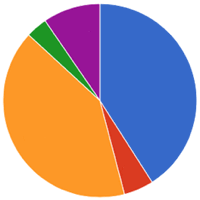
Some investors like to break down their investments into several different asset and sub-asset classes. For example, here is a pie chart showing the Ultimate Buy-and-Hold Portfolio recommended by Paul Merriman. You don’t need to hold every one of these asset classes, this is just an example with a lot of “slices”.

What is the best ETF to buy for each asset class? These days, there are multiple ETFs for nearly every sub-asset class or factor. The best ETF can depend on multiple factors, for example whether you buy it in a tax-deferred or taxable account. Established providers include Vanguard, iShares, Schwab, SPDR, and Invesco. (If you are planning to juggle this many ETFs, consider the automatic rebalancing “pie” feature of the brokerage firm M1 Finance.)

In the past, I have referred to this ETF list at Altruist Financial Advisors. As advisors affiliated with Dimensional Fund Advisors (DFA), they are able to use DFA mutual funds to build portfolios for their clients. Unfortunately, DFA mutual funds are not available to the public, and so we have to look for the best alternatives. The page is updated every so often.

Recently, I have found this ETF list at PaulMerriman.com. In 2021, Merriman started recommending a new provider of ETFs called Avantis, which was born when several DFA employees split off and formed their own company. Here is part of his rationale:

What’s changed is the inclusion of the five Avantis funds (AVUS, AVUV, AVDE, AVDV and AVEM). Avantis is relatively new to the ETF space, having been introduced a little over a year ago. The company was founded by former DFA employees and follows a philosophy very consistent with the design of Paul’s portfolios. Over the course of the past year, their funds have matured to where we decided it was time to include them in our evaluation.

Here are the recommended Avantis ETFs:

  • Avantis US Equity ETF (AVUS)
  • Avantis US Small Cap Value ETF (AVUV)
  • Avantis International Equity ETF (AVDE)
  • Avantis International Small Cap Value ETF (AVDV)
  • Avantis Emerging Markets Equity ETF (AVEM)

DFA recently announced that they are also expanding into ETFs, which can be bought and sold by the general public in any brokerage account. These ETFs just started trading in late 2020:

  • Dimensional US Core Equity Market ETF (DFAU)
  • Dimensional International Core Equity Market ETF (DFAI)
  • Dimensional Emerging Core Equity Market ETF (DFAE)

My own portfolio has only a little bit of this added complexity, with a goal of adding some extra exposure to asset classes with a relatively long history of high risk-adjusted returns. These are interesting developments if you also invest in this way, but I don’t necessarily recommend you do so, as I also agree with Merriman in this regard:

In the end, it’s probably more important that you have an investment strategy you believe in and can stick with than that you have exactly the right funds for that strategy.

Do your research, and find an investment strategy that fits with your psychological temperament and investment beliefs. Being able to “keep the faith” and stick with your strategy through the inevitable ups and downs is the most important thing. For example, even if dividend income investing isn’t academic-theory-optimal, it may be psychologically-optimal for many people and has successfully funded many comfortable retirements. For many other people, the best option is something that they can set-and-forget. Accordingly, many people can create a comfortable retirement with a simple-yet-powerful Vanguard Target Date Retirement fund.

How Robinhood Really Makes Money, and Why It No Longer Matters

While it seems that Robinhood and Gamestop are officially the new gambling version of a multiplayer online video game (CNBC, BI, Bloomberg), this story reminded me of this past Matt Levine article which is my favorite detailed-yet-understandable explanation of how Robinhood makes money. There have been many similar attempts to explain their business model, but this felt the most balanced. Even the footnotes are educational.

For example, he explains how the biggest brokers like TD Ameritrade used to handle payment for order flow, which you could equate to a discount on the stock price (“price improvement”):

“We’ll buy stock for you, you’ll pay us $5 to do it, we’ll get a discount on the stock and we’ll pass on 80% of the discount to you.”

Compare this with how Robinhood chose to do handle payment for order flow:

“We’ll buy stock for you, you won’t pay us to do it, we’ll get a discount on the stock and we’ll pass on 20% of the discount to you.”

Robinhood also happens to get paid more for their order flow than other brokerage firms. I’ve also explored this question back in 2018: Does Robinhood Brokerage Make Money in Shady or Questionable Ways? My basic conclusions were that:

  • Robinhood would be breaking the law if they broke the SEC rule of National Best Bid and Offer (NBBO) that requires brokers provide the best available bid and ask prices when buying and selling securities for customers. They wouldn’t do that, would they?
  • The order flow from Robinhood is probably more valuable because it is from small, retail investors (“dumb money”).

Well, it turns out that:

If you don’t read Matt Levine’s entire explanation, here is the bottom line: Robinhood customers were essentially being charged an extra roughly 3 to 5 cents a share through poorer execution prices. If you only traded a few shares, then you still basically paid nothing. If you traded 100 shares, that might add up to $3 to $5 total. Roughly breakeven. If you traded 1,000 shares, that might add up to $30 to $50 total. For some people, Robinhood’s “free trades” were a better deal. For others, Robinhood’s “free trades” were a much worse deal.

Supposedly, Robinhood doesn’t do this anymore and satisfies NBBO again. But it still shows the general way in which Robinhood makes money today. High-frequency trading firms pay somewhat higher prices for the trading flows from Robinhood users, and Robinhood keeps as much of that money as possible while still barely satisfying NBBO. Perhaps a smaller number on the order of a half-penny a share. Other firms like Fidelity proudly boast of how they do better than NBBO (“price improvement” again), which is also a quiet dig at Robinhood.

[Fidelity’s] price improvement can save investors $18.53 on average for a 1,000-share equity order, compared to the industry average of $4.25.

All this no longer matters because Robinhood is no longer the sweet spot for newbie traders. People like to make fun of the Robinhood name because in a way they secretly stole from the “poor” average traders and sold their orders to the “rich”. However, they also forced everyone from Fidelity to Schwab to all offer commission-free trades. Robinhood did deliver something to us common folk!

The important difference is that firms like Fidelity and Schwab still have wealthy clients that demand phone numbers with helpful humans that answer after only a few rings. Meanwhile, Robinhood only provides an overwhelmed e-mail address than can take days or weeks to finally address your problems.

When Robinhood first came on the scene, they were the new sweet spot for cheap trades for small balances. However, now that free trades are everywhere, the sweet spot in my opinion has now shifted to something like a Fidelity or Schwab account. You get total commission costs either equal to or lower than Robinhood, plus better customer service from more knowledgable reps. If you still prefer a trendy new app over a stuffy old broker, check out my Big List of Free Stocks For New Commission-Free Brokerage Apps. Most of them have a phone number, and they’ll be less busy. (WeBull, M1 Finance, and Firstrade for sure have phone numbers.)

Best Interest Rates on Cash – January 2021

Here’s my monthly roundup of the best interest rates on cash for January 2021, roughly sorted from shortest to longest maturities. I track these rates because I keep 12 months of expenses as a cash cushion and there are many lesser-known opportunities to improve your yield while still being FDIC-insured or equivalent. Check out my Ultimate Rate-Chaser Calculator to see how much extra interest you’d earn by moving money between accounts. Rates listed are available to everyone nationwide. Rates checked as of 1/6/2021.

Fintech accounts
Available only to individual investors, fintech accounts oftentimes pay higher-than-market rates in order to achieve high short-term growth. I will define “fintech” as an app software layer on top of a different bank’s FDIC insurance backbone. You should read about the story of the Beam app for potential pitfalls and best practices. Below are some current options with decent balance limits:

  • 3% APY on up to $100,000. New customers should be happy to see the top rate staying at 3% APY for January through March 2021. HM Bradley requires a recurring direct deposit every month and a saving rate of at least 20%. See my HM Bradley review.
  • 3% APY on 10% of direct deposits. One Finance lets you earn 3% APY on auto-save deposits (up to 10% of your direct deposit, up to $1,000 per month). See my One Finance review.
  • 3% APY on up to $15,000. Porte requires a one-time direct deposit of $1,000+ to open a savings account. See my Porte review.
  • 2.15% APY on up to $5k/$30k. Limited-time offer of free membership to their higher balance tier for 6 months with direct deposit. See my OnJuno review.

High-yield savings accounts
While the huge megabanks pay essentially no interest, it’s easy to open a new “piggy-back” savings account and simply move some funds over from your existing checking account. The interest rates on savings accounts can drop at any time, so I list the top rates as well as competitive rates from banks with a history of competitive rates. Some banks will bait you with a temporary top rate and then lower the rates in the hopes that you are too lazy to leave.

  • T-Mobile Money has the top rate at the moment at 1.00% APY with no minimum balance requirements. The main focus is on the 4% APY on your first $3,000 of balances as a qualifying T-mobile customer plus other hoops, but the lesser-known perk is the 1% APY for everyone. Thanks to the readers who helped me understand this. There are several other established high-yield savings accounts at closer to 0.50% APY for now.

Short-term guaranteed rates (1 year and under)
A common question is what to do with a big pile of cash that you’re waiting to deploy shortly (just sold your house, just sold your business, legal settlement, inheritance). My usual advice is to keep things simple and take your time. If not a savings account, then put it in a flexible short-term CD under the FDIC limits until you have a plan.

  • No Penalty CDs offer a fixed interest rate that can never go down, but you can still take out your money (once) without any fees if you want to use it elsewhere. Marcus has a 7-month No Penalty CD at 0.45% APY with a $500 minimum deposit. AARP members can get an 8-month CD at 0.55% APY. Ally Bank has a 11-month No Penalty CD at 0.50% APY for all balance tiers. CIT Bank has a 11-month No Penalty CD at 0.30% APY with a $1,000 minimum deposit. You may wish to open multiple CDs in smaller increments for more flexibility.
  • CommunityWide Federal Credit Union has a 12-month CD at 0.80% APY ($1,000 min). Early withdrawal penalty depends on how early you withdraw. Anyone can join this credit union via partner organization ($5 one-time fee).

Money market mutual funds + Ultra-short bond ETFs
If you like to keep cash in a brokerage account, beware that many brokers pay out very little interest on their default cash sweep funds (and keep the difference for themselves). The following money market and ultra-short bond funds are NOT FDIC-insured and thus come with a possibility of principal loss, but may be a good option if you have idle cash and cheap/free commissions.

  • The default sweep option is the Vanguard Federal Money Market Fund which has an SEC yield of 0.02%. Vanguard Cash Reserves Federal Money Market Fund (formerly Prime Money Market) currently pays 0.02% SEC yield.
  • Vanguard Ultra-Short-Term Bond Fund currently pays 0.49% SEC yield ($3,000 min) and 0.59% SEC Yield ($50,000 min). The average duration is ~1 year, so there is more interest rate risk.
  • The PIMCO Enhanced Short Maturity Active Bond ETF (MINT) has a 0.28% SEC yield and the iShares Short Maturity Bond ETF (NEAR) has a 0.50% SEC yield while holding a portfolio of investment-grade bonds with an average duration of ~6 months. Note that there was a sudden, temporary drop in net asset value during the March 2020 market stress.

Treasury Bills and Ultra-short Treasury ETFs
Another option is to buy individual Treasury bills which come in a variety of maturities from 4-weeks to 52-weeks. You can also invest in ETFs that hold a rotating basket of short-term Treasury Bills for you, while charging a small management fee for doing so. T-bill interest is exempt from state and local income taxes. Right now, this section isn’t very interesting as T-Bills are yielding close to zero!

  • You can build your own T-Bill ladder at TreasuryDirect.gov or via a brokerage account with a bond desk like Vanguard and Fidelity. Here are the current Treasury Bill rates. As of 1/6/2020, a new 4-week T-Bill had the equivalent of 0.09% annualized interest and a 52-week T-Bill had the equivalent of 0.11% annualized interest.
  • The Goldman Sachs Access Treasury 0-1 Year ETF (GBIL) has a -0.01% SEC yield and the SPDR Bloomberg Barclays 1-3 Month T-Bill ETF (BIL) has a -0.06% (!) SEC yield. GBIL appears to have a slightly longer average maturity than BIL.

US Savings Bonds
Series I Savings Bonds offer rates that are linked to inflation and backed by the US government. You must hold them for at least a year. If you redeem them within 5 years there is a penalty of the last 3 months of interest. The annual purchase limit is $10,000 per Social Security Number, available online at TreasuryDirect.gov. You can also buy an additional $5,000 in paper I bonds using your tax refund with IRS Form 8888.

  • “I Bonds” bought between November 2020 and April 2021 will earn a 1.68% rate for the first six months. The rate of the subsequent 6-month period will be based on inflation again. More info here.
  • In mid-April 2021, the CPI will be announced and you will have a short period where you will have a very close estimate of the rate for the next 12 months. I will have another post up at that time.
  • See below about EE Bonds as a potential long-term bond alternative.

Prepaid Cards with Attached Savings Accounts
A small subset of prepaid debit cards have an “attached” FDIC-insured savings account with exceptionally high interest rates. The negatives are that balances are severely capped, and there are many fees that you must be careful to avoid (lest they eat up your interest). Some folks don’t mind the extra work and attention required, while others do. There is a long list of previous offers that have already disappeared with little notice. I don’t personally recommend nor use any of these anymore.

  • One of the few notable cards left in this category is Mango Money at 6% APY on up to $2,500, along with several hoops to jump through. Requirements include $1,500+ in “signature” purchases and a minimum balance of $25.00 at the end of the month.

Rewards checking accounts
These unique checking accounts pay above-average interest rates, but with unique risks. You have to jump through certain hoops which usually involve 10+ debit card purchases each cycle, and if you make a mistake you won’t earn any interest for that month. Some folks don’t mind the extra work and attention required, while others would rather not bother. Rates can also drop suddenly, leaving a “bait-and-switch” feeling.

  • Consumers Credit Union Free Rewards Checking (my review) still offers up to 4.09% APY on balances up to $10,000 if you make $500+ in ACH deposits, 12 debit card “signature” purchases, and spend $1,000 on their credit card each month. The Bank of Denver has a Free Kasasa Cash Checking offering 2.50% APY on balances up to $25,000 if you make 12 debit card purchases and at least 1 ACH credit or debit transaction per statement cycle. (BoD now says debit transactions must be $5 minimum each and must reflect “normal, day-to-day spending behavior”.) If you meet those qualifications, you can also link a savings account that pays 1.50% APY on up to $50k. Thanks to reader Bill for the updated info. Presidential Bank has another competitive offering. Find a locally-restricted rewards checking account at DepositAccounts.

Certificates of deposit (greater than 1 year)
CDs offer higher rates, but come with an early withdrawal penalty. By finding a bank CD with a reasonable early withdrawal penalty, you can enjoy higher rates but maintain access in a true emergency. Alternatively, consider building a CD ladder of different maturity lengths (ex. 1/2/3/4/5-years) such that you have access to part of the ladder each year, but your blended interest rate is higher than a savings account. When one CD matures, use that money to buy another 5-year CD to keep the ladder going. Some CDs also offer “add-ons” where you can deposit more funds if rates drop.

  • Affinity Plus Federal Credit Union has a 5-year certificate at 1.50% APY ($500 minimum). Early withdrawal penalty is 1 year of interest. 4-year at 1.20% APY, and 3-year at 0.95% APY ($500 minimum). Anyone can join this credit union via partner organization ($25 one-time fee).
  • Hiway Federal Credit Union has a 5-year certificate at 1.35% APY ($25k minimum) and 1.25% APY with a $10,000 minimum. Early withdrawal penalty is 1 year of interest. 4-year at 1.20% APY, and 3-year at 1.10% APY ($25k minimum). Anyone can join this credit union via partner organization ($10 one-time fee).
  • You can buy certificates of deposit via the bond desks of Vanguard and Fidelity. You may need an account to see the rates. These “brokered CDs” offer FDIC insurance and easy laddering, but they don’t come with predictable early withdrawal penalties. I see nothing special right now, but it might still pay more than your other brokerage cash and Treasury options. Be wary of higher rates from callable CDs listed by Fidelity.

Longer-term Instruments
I’d use these with caution due to increased interest rate risk, but I still track them to see the rest of the current yield curve.

  • Willing to lock up your money for 10 years? You can buy long-term certificates of deposit via the bond desks of Vanguard and Fidelity. These “brokered CDs” offer FDIC insurance, but they don’t come with predictable early withdrawal penalties. You might find something that pays more than your other brokerage cash and Treasury options. Watch out for higher rates from callable CDs from Fidelity.
  • How about two decades? Series EE Savings Bonds are not indexed to inflation, but they have a unique guarantee that the value will double in value in 20 years, which equals a guaranteed return of 3.5% a year. However, if you don’t hold for that long, you’ll be stuck with the normal rate which is quite low (currently 0.10%). I view this as a huge early withdrawal penalty. But if holding for 20 years isn’t an issue, it can also serve as a hedge against prolonged deflation during that time. Purchase limit is $10,000 each calendar year for each Social Security Number. As of 1/6/2021, the 20-year Treasury Bond rate was 1.60%.

All rates were checked as of 1/6/2021.

What If You Invested $10,000 Every Year For the Last 10 Years? 2021 Edition

Instead of focusing only on what happened in 2020, how about stepping back and taking the longer view? How would a slow-and-steady investor have done over the last decade? Most successful savers invest money each year over a long period of time, these days often into a target-date fund (TDF). You may not find yourself buying Bugattis with Bitcoin, but we should not take for granted the ability for everyday folks to own a basket of successful businesses for tiny fees. Don’t pass up the opportunity right in front of you.

Target date funds. The Vanguard Target Retirement 2045 Fund is an all-in-one fund that is low-cost, highly diversified, and available both inside many employer retirement plans and to anyone that funds an IRA. During the early accumulation phase, this fund holds 90% stocks (both US and international) and 10% bonds (investment-grade domestic and international). It is a solid default choice in a world of mediocre, overpriced options. These “simple” funds have made substantial wealth for millions of investors.

The power of consistent, tax-advantaged investing. For the last decade, the maximum allowable annual contribution to a Traditional or Roth IRA has been roughly $5,000 per person. The maximum allowable annual contribution for a 401k, 403b, or TSP plan has been over $10,000 per person. If you have a household income of $67,000, then $10,000 is right at the 15% savings rate mark. Therefore, I’m going to use $10,000 as a benchmark amount. This round number also makes it easy to multiply the results as needed to match your own situation. Save $5,000 a year? Halve the result. Save $20,000 a year? Double the numbers, and so on.

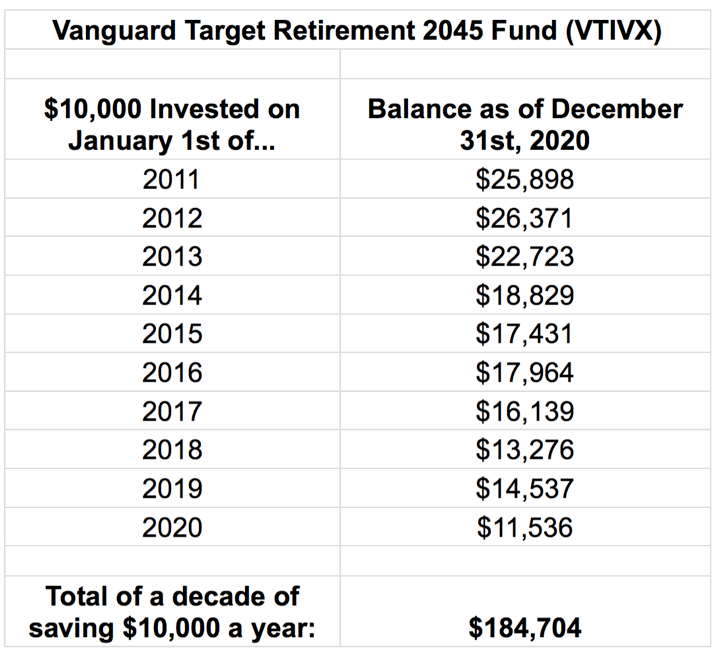
The real-world payoff from a decade of saving $833 a month. What would have happened if you put $10,000 a year into the Vanguard Target Retirement 2045 Fund, every year, for the past 10 years? You’d have put in $100,000 over time, but in more manageable increments. With the interactive tools at Morningstar and a Google spreadsheet, we get this:

Investing $10,000 every year for the last decade would have resulted in a total balance of $184,000. That breaks down to $100k in contributions + $84k investment growth.

Extended edition: 15 years of real-world savings. What would have happened if you put $10,000 a year into the Vanguard Target Retirement 2045 Fund, every year, for the past 15 years instead? (Now $150,000 total.) Here are the extended return numbers:

Investing $10,000 every year for the last decade and a half would have resulted in a total balance of $324,000. That breaks down to $150k in contributions + $175k investment growth. Your gains are now officially more than what you initially invested.

Real-world path to becoming a 401(k) millionaire. Not theoretical numbers from a calculator! Are you a dual-income household that can put away more? If you were a couple that both maxed out their 401k and IRAs at roughly $20k each or $40k total per year for 10 years, you would have a total balance of over $735,000. You would be 3/4 of the way to millionaire status after a decade. That breaks down to $400k in contributions + $335k investment growth.

If you did this for the last 15 years, you would be a 401(k) millionaire household. If you started when you were 30 years old, your account statement would show a balance just shy of $1,300,000 by the age of 45. (This doesn’t include the 401k company match, which is how many people reach millionaire status even faster.)

Timing still matters, but not as much as you might think due to the dollar-cost averaging and longer time horizon. Yes, the last decade has been a great run for US stock markets. But Vanguard Target funds also own a lot of international stocks, which haven’t been nearly as hot and have maintained lower valuations. More importantly, you can’t control that part. You have much more control over how much you save. Here are my previous “saving for a decade” posts:

Work on improving your career skills (or start your own business), save a big chunk of your income, and then invest it in productive assets. Keep calm and repeat. The only “secret” here is consistency. We have maxed out both IRA and the 401k salary deferral limits nearly every year since 2004. No inheritances, no special access to a hedge fund, no stock-picking skill. You can build serious wealth with something as accessible and boring as the Vanguard Target Retirement fund.

Major Asset Class Returns, 2020 Year-End Review

yearendreview

In terms of your retirement accounts, 2020 was definitely a year where it helped to simply ignore the constant market news and hold onto the assets that you believe have long-term promise. It was also a good year to own the entire haystack. Here are the annual returns for select asset classes as benchmarked by ETFs per Morningstar after market close 12/31/20.

Commentary. This NYT article explains Why Markets Boomed in a Year of Human Misery. A big part of that is the huge amount of money the US government and Federal Reserve will be spending around a trillion dollars on unemployment insurance benefits, stimulus checks, and forgivable PPP loans. The Federal Reserve also kept it easy for corporations to borrow money with liquidity and near-zero interest rates, but whether this keeps working for every future crisis is a big question.

The second major lesson is that we are bad at forecasting, so why listen to forecasts again at the beginning of 2020? Returns for 2021 could very well be much worse than 2020, even as we are soon able to see our family and friends in person again. I plan to focus on preparation instead of forecasting in all part of my life. In terms of investing, how can I make my portfolio and future income more resilient?

Investing at all-time highs might seem like a bad idea, but it actually hasn’t been historically. All asset classes were up at the end of 2019 as well. What I wrote last year applies again this year:

I won’t lie – I am pleasantly surprised at my brokerage statement this year, but I’m also wary about future returns. What keeps me owning a big chunk of stocks is that I am confident that the hundreds of business that I own through these ETFs and mutual funds will collectively make a profit, reinvest some of it to keep growing, and distribute some of it to me in the form of cash dividends. I am also confident that my US government bonds, municipal bonds, and FDIC/NCUA-insured bank certificates will keep the panic if a market drop does come.

The Vanguard Target Retirement 2045 fund (roughly 90% diversified stocks and 10% bonds) was up 16.3% in 2020. The benchmark for our personal portfolio, a more conservative mix of 70% stocks/30% bonds as we are closer to retirement, was up 11.5% in 2020.

Bitcoin. I didn’t list BTC because I don’t see it as a major asset class. The total value of all BTC in the world is now $600 billion (even at the current price of $32,000). The total market cap of gold is about $10 trillion. I have no well-researched predictions of about the long-term prospects of BTC. I’d only go as far as saying there is a case for a lottery-ticket-style investment of BTC, but I’d avoid nearly all the other random cryptocurrencies. (As in, I’d rather own BTC than spend what the average American does on lottery tickets, which adds up to over $250/year for every adult!) The appeal of BTC is that there is a finite amount (especially after the recent halving), and all these additional coins go against that. I own about 0.25 BTC via the Voyager app from a couple years back ($25 referral bonus).

GMO 7-Year Asset Class Return Forecast Check-in: 2020 vs. 2013

Although I avoid daily stock market quotes, I have been reading Jeremy Grantham’s quarterly letters and the GMO 7-Year Asset Class Return Forecasts for over 10 years now. These projections are based on their proprietary models, with a strong focus on historical valuation. Each year, I can now compare their current forward-looking forecast against how their past forecasts have turned out. Here’s the GMO forecast looking forward as of November 2020:

Here was their forecast back in July 2013:

Using the S&P 500 as US Large Cap, we see that the forecast of -2.1% annualized real return was quite far off. ETFReplay shows that both the IVV and VOO S&P 500 ETFs returned +117% between July 30, 2013 to July 30, 2020. That is an annualized return of 11.7%. SmartAsset shows annual inflation ran 1.8% during that time. That results in a 7-year annualized real (inflation-adjusted) return of 9.9% between July 2013 and July 2020.

One takeaway here is that making investment moves (market timing) based on valuation can be quite unreliable and painful. If you’re out of the market and get it wrong, when do you go back in? You’ll have to swallow your pride and admit a mistake. In my experience, it is simply easier to do nothing than to jump in and out. Instead, I use these forecasts to help me remain a buy-hold-and-rebalance investor. Here’s how:

  • They usually temper the urge to put all your money in hot and popular asset classes. They help keep your expectations reasonable. For example, right now it is unreasonable to expect another 7 years of 10% annual returns from the S&P 500.
  • They usually provide support for rebalancing and buying more of beaten-down and currently unpopular asset classes. Manage your risk.
  • They remind you that future 5/7/10-year bond returns will be very close to current 5/7/10-year bond yields.

Free Investing Book PDF – 12 Simple Ways to Supercharge Your Retirement (Two Funds for Life)

Paul Merriman is a long-time financial advisor known for his “Ultimate Buy-and-Hold Portfolio” that utilized a more complex 10-fund version of a low-cost index fund portfolio. Although now retired from advising, he continues to add new content to his website for the Merriman Financial Education Foundation that is geared more towards to DIY investors.

He has published a new book called We’re Talking Millions!: 12 Simple Ways to Supercharge Your Retirement by himself and co-author Richard Buck. For a very limited-time, you can download this book in PDF format for free. I would recommend downloading it now and saving it to read later. I haven’t read it yet, but a quick skim shows that it appears to be a condensed version of everything on his site.

This book is designed to show you how you can change your life by making a handful of smart choices. It’s a recipe for potentially accumulating millions of dollars you can spend in retirement and leave to your heirs. […] But one thing is new: an action plan that applies them in a single solution that can be carried out easily by just about anybody who has a job. We call this plan Two Funds for Life.

Much of the 12 steps are based on common personal-finance advice, and they are still good advice. But if you’re looking for what Merriman offers that is different, that’s the “Two Funds for Life”. It appears that Merriman is still a strong believer in the future outperformance of small-cap value stocks. Here are the bare basics:

The basic Two Funds for Life recommendation for your 401(k) plan is pretty simple:

• Multiply your age by 1.5.
• Use the result as the percentage of your portfolio that should be in a target-date retirement fund. The rest goes into a small company value fund.
• As you get older, rebalance these two funds periodically, ideally once a year, based on your age at the time. This will gradually reduce your small-company value exposure.

Based on this formula, a 30 year-old today would hold 55% of their portfolio in a low-cost US Small-Cap Value index fund and 45% in a Vanguard Target 2055 Retirement Fund (assuming retirement at age 65). The Small-Cap Value percentage decreases each year by 1.5%. By the time they are 65 years-old, they would effectively transitioned to 100% Vanguard Target Retirement (Income) fund.

I appreciate the simplicity as this is much easier than juggling 10 funds yourself (Merriman also recommends M1 Finance to manage your DIY portfolio automatically). Still, 55% is a lot to hold in Small Value and you will definitely want to have read enough about company size and value factor investing and have faith in the fundamental reasons behind this approach before implementing this plan. I’m sure the book will contain his supporting evidence, but you should read about all the drawbacks as well before making the final decision. I own a small-cap value fund myself, and you must accept that small value stocks have gone through very long periods of underperformance relative to the S&P 500.

Best Interest Rates on Cash – December 2020

Here’s my monthly roundup of the best interest rates on cash for December 2020, roughly sorted from shortest to longest maturities. I track these rates because I keep 12 months of expenses as a cash cushion and there are many lesser-known opportunities to improve your yield while still being FDIC-insured or equivalent. Check out my Ultimate Rate-Chaser Calculator to see how much extra interest you’d earn by moving money between accounts. Rates listed are available to everyone nationwide. Rates checked as of 12/10/2020.

Fintech accounts
In the currently low-interest rate environment, individual investors can get higher-than-market rates by moving their money into fintech accounts that are trying to achieve high short-term growth through a combination of lower cost structure and venture capital. I will define “fintech” as an app software layer on top of a different bank’s FDIC insurance backbone. You should read about the story of the Beam app for potential pitfalls and best practices. Below are some current options with decent balance limits:

  • 3% APY on up to $100,000. HM Bradley requires a recurring direct deposit every month and a saving rate of at least 20%. See my HM Bradley review.
  • 3% APY on 10% of direct deposits. One Finance lets you earn 3% on auto-save deposits (up to 10% of your direct deposit, up to $1,000 per month). See my One Finance review.
  • 3% APY on up to $15,000. Porte requires a one-time direct deposit of $1,000+ to open a savings account. See my Porte review.
  • 2.15% APY on up to $5k/$30k. OnJuno just went live. More details to come after I open an account.

High-yield savings accounts
While the huge megabanks pay essentially no interest, it’s easy to open a new “piggy-back” savings account and simply move some funds over from your existing checking account. The interest rates on savings accounts can drop at any time, so I list the top rates as well as competitive rates from banks with a history of competitive rates. Some banks will bait you with a temporary top rate and then lower the rates in the hopes that you are too lazy to leave.

Short-term guaranteed rates (1 year and under)
A common question is what to do with a big pile of cash that you’re waiting to deploy shortly (just sold your house, just sold your business, legal settlement, inheritance). My usual advice is to keep things simple and take your time. If not a savings account, then put it in a flexible short-term CD under the FDIC limits until you have a plan.

  • No Penalty CDs offer a fixed interest rate that can never go down, but you can still take out your money (once) without any fees if you want to use it elsewhere. Marcus has a 7-month No Penalty CD at 0.45% APY with a $500 minimum deposit. AARP members can get an 8-month CD at 0.55% APY. Ally Bank has a 11-month No Penalty CD at 0.55% APY for all balance tiers. CIT Bank has a 11-month No Penalty CD at 0.30% APY with a $1,000 minimum deposit. You may wish to open multiple CDs in smaller increments for more flexibility.
  • CommunityWide Federal Credit Union has a 12-month CD at 0.90% APY ($1,000 min). Early withdrawal penalty depends on how early you withdraw. Anyone can join this credit union via partner organization ($5 one-time fee).

Money market mutual funds + Ultra-short bond ETFs
If you like to keep cash in a brokerage account, beware that many brokers pay out very little interest on their default cash sweep funds (and keep the difference for themselves). The following money market and ultra-short bond funds are NOT FDIC-insured and thus come with a possibility of principal loss, but may be a good option if you have idle cash and cheap/free commissions.

  • The default sweep option is the Vanguard Federal Money Market Fund which has an SEC yield of 0.02%. Vanguard Cash Reserves Federal Money Market Fund (formerly Prime Money Market) currently pays an 0.03% SEC yield.
  • Vanguard Ultra-Short-Term Bond Fund currently pays 0.55% SEC yield ($3,000 min) and 0.65% SEC Yield ($50,000 min). The average duration is ~1 year, so there is more interest rate risk.
  • The PIMCO Enhanced Short Maturity Active Bond ETF (MINT) has a 0.30% SEC yield and the iShares Short Maturity Bond ETF (NEAR) has a 0.51% SEC yield while holding a portfolio of investment-grade bonds with an average duration of ~6 months. Note that there was a sudden, temporary drop in net asset value during the March 2020 market stress.

Treasury Bills and Ultra-short Treasury ETFs
Another option is to buy individual Treasury bills which come in a variety of maturities from 4-weeks to 52-weeks. You can also invest in ETFs that hold a rotating basket of short-term Treasury Bills for you, while charging a small management fee for doing so. T-bill interest is exempt from state and local income taxes. Right now, this section isn’t very interesting as T-Bills are yielding close to zero!

  • You can build your own T-Bill ladder at TreasuryDirect.gov or via a brokerage account with a bond desk like Vanguard and Fidelity. Here are the current Treasury Bill rates. As of 12/9/2020, a new 4-week T-Bill had the equivalent of 0.07% annualized interest and a 52-week T-Bill had the equivalent of 0.10% annualized interest.
  • The Goldman Sachs Access Treasury 0-1 Year ETF (GBIL) has a -0.01% SEC yield and the SPDR Bloomberg Barclays 1-3 Month T-Bill ETF (BIL) has a -0.05% (!) SEC yield. GBIL appears to have a slightly longer average maturity than BIL.

US Savings Bonds
Series I Savings Bonds offer rates that are linked to inflation and backed by the US government. You must hold them for at least a year. If you redeem them within 5 years there is a penalty of the last 3 months of interest. The annual purchase limit is $10,000 per Social Security Number, available online at TreasuryDirect.gov. You can also buy an additional $5,000 in paper I bonds using your tax refund with IRS Form 8888.

  • “I Bonds” bought between November 2020 and April 2021 will earn a 1.68% rate for the first six months. The rate of the subsequent 6-month period will be based on inflation again. More info here.
  • In mid-April 2021, the CPI will be announced and you will have a short period where you will have a very close estimate of the rate for the next 12 months. I will have another post up at that time.
  • See below about EE Bonds as a potential long-term bond alternative.

Prepaid Cards with Attached Savings Accounts
A small subset of prepaid debit cards have an “attached” FDIC-insured savings account with exceptionally high interest rates. The negatives are that balances are severely capped, and there are many fees that you must be careful to avoid (lest they eat up your interest). Some folks don’t mind the extra work and attention required, while others do. There is a long list of previous offers that have already disappeared with little notice. I don’t personally recommend nor use any of these anymore.

  • One of the few notable cards left in this category is Mango Money at 6% APY on up to $2,500, along with several hoops to jump through. Requirements include $1,500+ in “signature” purchases and a minimum balance of $25.00 at the end of the month.

Rewards checking accounts
These unique checking accounts pay above-average interest rates, but with unique risks. You have to jump through certain hoops, and if you make a mistake you won’t earn any interest for that month. Some folks don’t mind the extra work and attention required, while others do. Rates can also drop to near-zero quickly, leaving a “bait-and-switch” feeling. If you want rates above 2% APY, this is close to the only game in town.

  • Consumers Credit Union Free Rewards Checking (my review) still offers up to 4.09% APY on balances up to $10,000 if you make $500+ in ACH deposits, 12 debit card “signature” purchases, and spend $1,000 on their credit card each month. The Bank of Denver has a Free Kasasa Cash Checking offering 2.50% APY on balances up to $25,000 if you make 12 debit card purchases and at least 1 ACH credit or debit transaction per statement cycle. (BoD now says debit transactions must be $5 minimum each and must reflect “normal, day-to-day spending behavior”.) If you meet those qualifications, you can also link a savings account that pays 1.50% APY on up to $50k. Thanks to reader Bill for the updated info. Presidential Bank has another competitive offering. Find a locally-restricted rewards checking account at DepositAccounts.

Certificates of deposit (greater than 1 year)
CDs offer higher rates, but come with an early withdrawal penalty. By finding a bank CD with a reasonable early withdrawal penalty, you can enjoy higher rates but maintain access in a true emergency. Alternatively, consider building a CD ladder of different maturity lengths (ex. 1/2/3/4/5-years) such that you have access to part of the ladder each year, but your blended interest rate is higher than a savings account. When one CD matures, use that money to buy another 5-year CD to keep the ladder going. Some CDs also offer “add-ons” where you can deposit more funds if rates drop.

  • Hiway Federal Credit Union has a 5-year certificate at 1.35% APY ($25k minimum) and 1.25% APY with a $10,000 minimum. Early withdrawal penalty is 1 year of interest. 4-year at 1.20% APY, and 3-year at 1.10% APY ($25k minimum). Anyone can join this credit union via partner organization ($10 one-time fee).
  • You can buy certificates of deposit via the bond desks of Vanguard and Fidelity. You may need an account to see the rates. These “brokered CDs” offer FDIC insurance and easy laddering, but they don’t come with predictable early withdrawal penalties. Vanguard has nothing special right now, but it might still pay more than your other brokerage cash and Treasury options. Be wary of higher rates from callable CDs listed by Fidelity.

Longer-term Instruments
I’d use these with caution due to increased interest rate risk, but I still track them to see the rest of the current yield curve.

  • Willing to lock up your money for 10 years? You can buy long-term certificates of deposit via the bond desks of Vanguard and Fidelity. These “brokered CDs” offer FDIC insurance, but they don’t come with predictable early withdrawal penalties. You might find something that pays more than your other brokerage cash and Treasury options. Watch out for higher rates from callable CDs from Fidelity.
  • How about two decades? Series EE Savings Bonds are not indexed to inflation, but they have a unique guarantee that the value will double in value in 20 years, which equals a guaranteed return of 3.5% a year. However, if you don’t hold for that long, you’ll be stuck with the normal rate which is quite low (currently 0.10%). I view this as a huge early withdrawal penalty. But if holding for 20 years isn’t an issue, it can also serve as a hedge against prolonged deflation during that time. Purchase limit is $10,000 each calendar year for each Social Security Number. As of 12/9/2020, the 20-year Treasury Bond rate was 1.48%.

All rates were checked as of 12/10/2020.

Peerstreet Case Study #3: COVID-Era Commercial Property Foreclosure Disaster

I’ve invested over $50,000 of my “alternative” money into PeerStreet real estate notes because of the ability to diversify into 50+ different high-interest loans backed by physical real estate. Here is a case study shared by a helpful reader about a “disaster” loan with multiple bad factors – bankrupt building owner, bankrupt tenant, a charitable donation, poorly-aligned incentives, COVID-19 pandemic, civil unrest, and forced selling. You can find additional case study links and the most recent update to my overall portfolio performance in my Peerstreet review.

Initial investment details.

  • Property: Office building in Springfield, Ohio.
  • Target Net Investor Rate/Term: 8.75% APR for 31 months.
  • Amount: $3,600,404 loan.
  • 60% LTV based on 3rd-party appraisal of $7.76 million.
  • Loan secured by the property in first position.
  • Cash-out refinance.

Timeline.

  • February 2018. Loan is originated.
  • December 2018. Payments stop.
  • January 2019. Payments are over 30 days late, demand letters are sent, etc.
  • April 2019. Foreclosure complaint filed.
  • April 2020. A year has passed. Foreclosure process drags on, but now all foreclosures are halted due to COVID-19.
  • August 2020. Foreclosure auction date set for October 2020.
  • October 2020. PeerStreet abruptly decides to sell to a third-party for net proceeds to investors of $573,281.31 for a final return (including interest paid to date) of 18% of the original investment.

How did a $3.6 million loan backed by a building that was appraised for $7.8 million in 2018 end up only giving back investors $580,000 less than two years later? How did a loan with a supposedly 60% loan-to-value ratio end up paying back only 18 cents on the dollar? After reading all the screenshots and documentation provided along with some poking around online, here’s what happened in the background.

A wealthy couple donates what might be the most prestigious commercial address in downtown Springfield, Ohio. The address is literally “1 Main Street.” Look at the building entrance from Google Maps Streetview. The lucky nonprofit recipient immediately agrees to sell it to EF Hutton, which renames it EF Hutton Tower. The nonprofit is happy, but they are on a payment plan and also get paid partially in EF Hutton stock. (Cue ominous music…)

EF Hutton is now both the building owner and the anchor tenant. So the same company that owns the building is also the source of most of the rental income. They now want a cash-out refinance, and obtain an appraisal of $7.78 million in January 2018. Now, if there was an independent buyer for this property, the appraisal might have been done with more skepticism. But it was appraised as a charitable donation (i.e tax write-off) for a needy non-profit! Many people potentially benefited from a high appraisal. The building owner gets more money from the cash-out refi, the donor get a bigger tax break, the recipient gets a high-publicity donation, even Peerstreet got a note with a great LTV%. Everyone except the person holding the bag at the end.

Okay, so time moves on. EF Hutton is quickly in financial trouble and being investigated by the SEC, somehow pivoting from stock trading to mobile phones to cryptocurrencies on its way to bankruptcy. Check out this Springfield News Sun article about their $12 million in debt. The anchor tenant is broke. There is no rent being paid. The nonprofit is owed money. Property insurance and property taxes are not being paid. The building is no longer being maintained. From a Peerstreet letter to noteholders:

As the foreclosure proceedings were ongoing, PeerStreet made repeated efforts to gain access to the property and assess its condition. After the court granted PeerStreet partial access to the property, we discovered water damage, deferred maintenance on the elevators and other maintenance issues caused by the borrower’s failure to maintain the property, which inspectors estimated would cost over $1M to remedy.

In addition to this, the borrower stopped making property insurance payments, which PeerStreet then advanced to protect investors’ interests in the collateral. The borrower also defaulted on property taxes in excess of $700,000.00.

COVID-19 crushes the local economy. Nobody is there to protect the building during civil unrest. There is no anchor tenant. $1m in property damage. $700,000 in property taxes. Even so, I don’t understand why Peerstreet didn’t just wait for the foreclosure auction. I’d personally feel more confident if there was an open auction. Could they have held out until after the pandemic passes? That’s what I would have done if I was the sole owner. However, Peerstreet might simply value a fast resolution over absolute final return.

Final numbers. As noted above, the final return (including interest paid to date) was 18% of the original investment. (As in, you put in $100 originally and get $18 back.)

My commentary. Both bad luck and bad incentives lined up for such a bad result. The appraisal was obviously too high in retrospect. Whenever someone donates something big, even though it is a charitable act, the donor still wants it to be valued as highly as possible while the nonprofit also benefits. The tax deduction here was worth millions. EF Hutton also wanted the highest valuation possible as it was a cash-out refi. COVID and economic factors only made it worse. Once it was clear that they had no more skin in the game (equity), EF Hutton let the property fall into ruin.

A cynic might wonder if EF Hutton knew this would happen and wanted to walk away with as much money in its pockets as possible? Where did all the money from their $12 million in debt go? Highly suspicious.

Getting back 18 cents on the dollar really hurts, and makes me wonder how this might happen on a more commonplace residential property (and how to avoid it). You would still need an inflated appraisal (avoid cash-out refis?). You would also need the owner to stop caring about the property and let it get totally trashed (maintain equity?). You would need a severe economic downturn and a forced sale (more skin in the game from Peerstreet to encourage more patience?).

Finally, this is another lesson in the importance of diversification. If this was a $1,000 loan amongst 50 different loans, your loss would be 1.6% of your total $50,000 portfolio.

Bottom line. Even though I’ve now invested and reinvesting $60,000+ into 63 loans at PeerStreet over 4+ years, I haven’t had one (knock on wood) completely “blow up”. I’ve had several spend several months in default, only to be paid back in full with interest. Thanks to a helpful reader, I was able to share this story and hopefully provide some educational value. Most importantly, this should teach you to diversify even if the loan looks solid, as even if you replaced any one of my $1,000 loans with this “worst-case scenario”, thanks to diversification my overall portfolio return would still be positive.

If you are interested, you can sign up and browse investments at PeerStreet for free before depositing any funds or making any investments. You must qualify as an accredited investor (either via income or net worth) to invest. If you already invest with them, they now sync with Mint.com.

Mediocre Target Date Retirement Funds? Replace Them When You Switch Jobs

If you have a workplace 401k/403b/457 retirement plan, there is probably a target-date fund (TDF) inside. TDFs provide a “set-and-forget” investment option that automatically adjusts the asset allocation over time as you move towards your target retirement age. A recent WSJ article The High Cost of Target-Date Funds (paywall?) and academic paper Off Target: On the Underperformance of Target-Date Funds reinforce many of the things that most “Bogleheads” and DIY index fund investors have known for a while:

  • Some TDFs are low-cost, while others can have higher fees. Higher fees will likely result in lower performance over the long run.
  • You can replicate a TDF by using low-cost index ETFs. This takes more work, but increases your odds of higher returns at the same level of risk.
  • The paper found an average fee difference of 0.33% annually if you replicate with ETFs. The actual average performance difference found was closer to 1% annually, due to other factors like cash drag and poor active timing.

The Fidelity Freedom 2030 fund was used as the example of an expensive, overly-complex fund. Vanguard ETFs are used as the example of low-cost index ETF building blocks. Here is their example of a possible real-world difference in returns:

To add concreteness to our analysis, consider a hypothetical married couple, Ross and Rachel, in March 2006. Ross and Rachel are in their early 40s and expect to retire in 2030. As such, they put their 401(k) savings of $1MM into the Fidelity Freedom 2030 Fund (the largest TDF that holds both index funds and actively managed mutual funds). In December 2017, Ross and Rachel’s savings would have grown to just over $1.95MM. However, had Ross and Rachel replicated the Fidelity Freedom 2030 Fund using our RF, their saving would have grown to nearly $2.22MM, an outperformance of over $271K or 14%!

Now, you could focus on the $270,000 difference between the $1.95 million and $2.22 million ending balances. But don’t forget that the “bad option” still nearly doubled the $1 million into $1.95 million in the span of 11 years, all as the result of doing absolutely nothing after the initial investment. We should still appreciate that such an option is available to individuals and not take for granted the availability of public stock markets, mutual funds, and target-date funds even at 0.70% in fees annually.

(At the same time, we should be thankful for Jack Bogle, Vanguard, index funds, and all the people willing to move their money over the lower-cost option each year, as those flows have resulted in lower fees for everyone. We need to keep pressuring companies for lower costs, especially when we see little value-added.)

Should we expect everyone to manage their own ETF portfolios? Sure, it doesn’t take much *time* to DIY and rebalance annually but it does take some knowledge, experience, risk tolerance, and most importantly the ability to take repeated *action*. It doesn’t take that much time to create a simple will and testament either, but most people put that off every year as well. The unfortunate story of former Zappos CEO Tony Hsieh also included the lack of a will.

The average job tenure is now only 4.3 years. Therefore, a good middle ground might be to stay in whatever TDF fund is available in your employer plan, but when you switch jobs, immediately roll it over to an IRA and then invest it into a low-cost TDF with automatic dividend reinvestment. Instead of an ongoing series of actions, it’s a one-time action. I have recommended the Vanguard IRA and the Vanguard Target Retirement series to my family. There is still some paperwork, but once it is completed, you are “set-and-forget” until retirement with a low-cost option that should keep up with the industry’s best practices.

I still build and maintain my own portfolio of low-cost index funds, and I enjoy the ability to know and control what I own. However, I also appreciate the value of TDFs a little bit more each year. One reason for this is the amount of effort that it took to get my parent’s to move over their retirement funds to Vanguard from a more expensive, complex option. They just kept putting it off. I can’t imagine them having to manage and rebalance even a few funds. There is an enormous difference between “good enough but done” for most and “optimal if you do XYZ”.

You can run the ticker symbol of your TDF through Morningstar to check its annual expenses and portfolio contents. The good news is that each year there are fewer bad ones, and most are at least mediocre these days. See also: Morningstar Target Date Retirement Fund Rankings 2020: Not All The Same

PeerStreet Review: Fractional Real-Estate Loan Returns (IRR) After 4.5 Years

Updated February 2021. I started investing in PeerStreet real-estate backed loans in July 2016. I’ve long liked the idea of hard money loans, but I wanted more diversification as opposed to tying all my money up with one single property. Peerstreet requires you to be an accredited investor. (There are other real-estate sites like Fundrise that don’t require that status.) Here are my overall numbers after over four years, with details below:

  • Total deposits (loaned principal): $35,000 ($60,000)
  • Total interest and fees earned: $3,979
  • 52 loans made and paid off, 8 current loans, and 3 late/default.
  • Internal rate of return (IRR) of 6.92% as of 2/16/2021.

Basic idea: Short-term loans backed by real estate. Real estate equity investors want to take out short-term loans (6 to 24 months) and don’t fit the profile of a traditional mortgage borrower. They are professional investors with multiple properties, need bridge financing, or they are on a tight timeline. As a real-estate-backed loan investor, you lend them money at 6% to 12% and usually backed by a first lien on the property. The borrower stands to lose the equity in their property, so they are incentivized to avoid default. In the worst case, you would foreclose and liquidate the property in order to get your money back. However, this is better than Prosper or LendingClub where it is an unsecured loan and your only recourse is to lower their credit score.

What are PeerStreet strengths? Here are the reasons that I decided to put more a higher amount of money into PeerStreet as compared to other worthwhile real estate marketplace sites:

  • Debt-only focus. Other real estate (RE) sites will offer both equity and debt (and things in between). PeerStreet only focuses on debt, and I also prefer the simplicity of debt. There is limited upside but also less downside. Traditionally, this might be called “hard money lending”.
  • Lower $1,000 investment minimum. Many RE investment sites have minimums of $10,000 or $25,000. At PeerStreet, $25,000 will get me slices of loans from 25 different real estate properties. You can even reinvest your earnings with as little as $100.
  • Greater availability of investments. Amongst all the RE websites that I have joined, PeerStreet has the highest and most steady volume of loans that I’ve seen. I dislike having idle cash just sit there, waiting and not earning interest. They apparently have a unique process where they have a network of lenders that bring in loans for them. They don’t originate loans themselves, they basically buy loans from these partners if they fit their criteria. This steady volume allows the lower $1,000 minimums and more diversification, as well as easy reinvestment of matured loans.
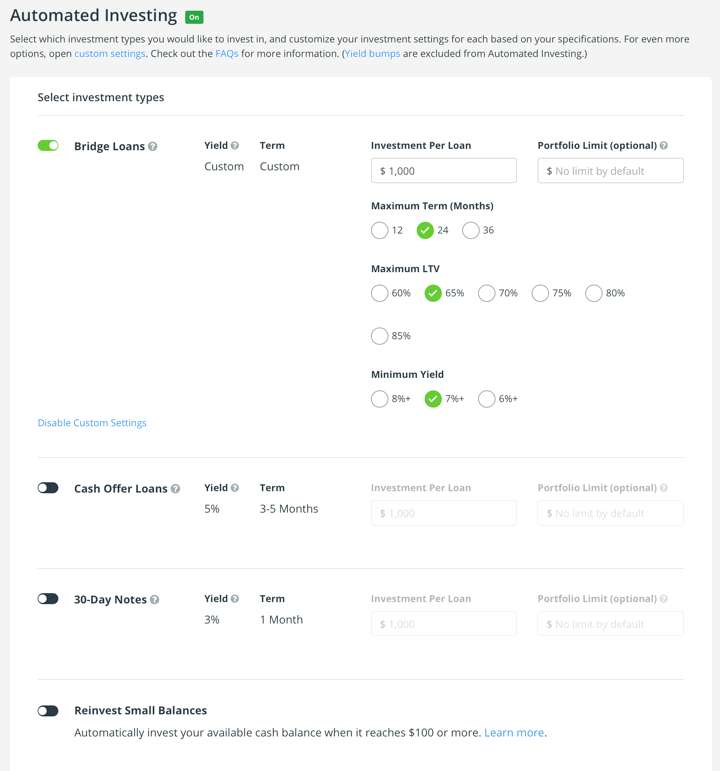
  • Automated investing. The above two characteristics allow PeerStreet to run an automated investment program. You give them say $5,000 and they will invest it automatically amongst five $1,000 loans. You can set certain criteria (LTV ratio, term length, interest rate). When a loan matures, the software can automatically reinvest your available cash. I don’t even have to log in.
  • Consistent underwriting. You should perform your own due diligence in this area, as you can only feel comfortable with automated investing if you think every loan is underwritten fairly. The riskier loans get higher interest rates. The less-risky loans get lower interest rates. The shady borrowers are turned away. I hope they earn their cut by doing this difficult task.
  • Strong venture capital backing. They have a history of increased funding. Series A was $15 million in November 2016. Series B was $30 million in April 2018. Series C was $60 million in October 2019.

Here’s a screenshot of the automated investing customizer tool:

What are PeerStreet drawbacks? A general drawback to real-estate backed loans is that your upside is limited to the full interest being paid back on time, while your downside is much larger if there is a prolonged housing crash. As long as housing prices are flat to strong, everything will probably work out fine because your collateral will cover everything. This is why it is important to have a cushion via the loan-to-value ratio.

In my opinion, one major drawback specific to Peerstreet is lower yields. This is just my limited understanding and I may be wrong, but PeerStreet has a network of lenders bringing in these deals and thus need to be paid some sort of “finders fee”, so the net yield to the investor feels lower than other sites. You could argue that this is also their secret sauce that brings in the high loan volume (and ideally the ability to be more selective), but at some point the rate is too low to justify the risks being taken.

In the current low-interest rate environment, it is also my opinion that too many real estate crowdfunding sites are chasing too few loans, which has been driving down the interest rates offered. I started out being able to find a lot of loans in the 8% to 9% range, but now the more conservative notes are in the 7%-7.5% range. In the current yield environment, my target is an 8% return while also maintaining a loan-to-value ratio of 70% or less.

How does PeerStreet make money? As with other real estate marketplace lenders, they charge a servicing fee. PeerStreet charges between 0.25% and 1%, taken out from the interest payments. This way, PeerStreet only gets paid when you get paid. When you invest, you see the fee and net interest rate that you’ll earn. In exchange, they help source the investments, set up all the required legal structures, service the loans, and coordinate the foreclosure process in case of default. In some cases, the originating lenders retains a partial interest in the loan (“skin in the game”). Here’s a partial screenshot:

peerstreet_fee

What if PeerStreet goes bankrupt? This is the same question posed to LendingClub and Prosper, and their solution is also the same. The loans are held in a bankruptcy-remote entity and will continue to be serviced by a third-party even in a bankruptcy event. From their FAQ:

PeerStreet also holds loans in a bankruptcy-remote entity that is separate from our primary corporate entity. In the event PeerStreet no longer remains in business, a third-party “special member” will step in to manage loan investments and ensure that investors continue to receive interest and principal payments. Additionally, investor funds are held in an Investors Trust Account with City National Bank and FDIC insured up to $250,000.

Tax forms? In previous years, I received both a 1099-INT and a 1099-OID. Basically, both include your gains that will be taxed at ordinary income rates (like bank account interest). Here’s what PeerStreet says:

PeerStreet investors will be issued a consolidated Form 1099 for the income distributed from their investment positions. Investors may receive one or more of the following types of 1099 form:

1099-OID for notes with terms longer than one year (at the time of issue)
1099-INT for notes with terms less than one year (at the time of issue)
1099-MISC for incentives, late fees or other income, if more than $600.

My personal performance. I started with a $10,000 investment in 2016, added another $15,000 in 2017, and added another $10,000 in 2019. Altogether, I also made about $25,000 of withdrawals whenever a loan was paid back and the loan inventory was not attractive. (They pay no interest in idle cash, and I don’t like their short-term options.) Each of my loans was less than 5% of the total portfolio. In order to get first dibs on the good loans, I set up automatic reinvestment when possible.

Here is a screenshot from my account:

As of February 2021, my internal rate of return (IRR) is 6.92% annualized net of all fees and taking into account the periods where my cash was idle. I verified this using my own spreadsheet and it matches the reporting by Peerstreet. Right now, 3 loans are in some phase of the foreclosure process. These loans are all less than 70% LTV, but I don’t know what the final recovery amount will be. In the past, I have had several late loans and all were resolved with no loss of principal (but that is no guarantee of the future). I expect my final IRR to be in the 6% to 7% range.

If you are thinking about this investment, the things I would want you to know are:

  • Real-estate backed loans are highly illiquid and the “maturity date” is just a hopeful number. You can’t just make a few clicks and sell, while the foreclosure process can take years to complete.
  • If you want some degree of reliable cashflow and/or liquidity for your funds, it is important to diversify across multiple, smaller loans.
  • The collateral makes a huge difference. With P2P unsecured loans, being 60 days late usually meant I was going to recover pennies on the dollar. With Peerstreet, I could wait around for an extra year yet still end up with all my principal plus most of the owed interest (if not more due to late charges). I have had many missed maturity dates over the years, but none of my loans have actually resulted in a loss. Usually the borrower realizes that they are better off figuring out how to pay back the loan rather than lose the property. Case Study #1. Case Study #2.
  • My expected net return of 6% to 7% has a good chance to be higher than even many “junk” bonds (and certainly high-grade corporate bonds) in this ultra-low interest rate environment. Being able to earn even 5-6% when corporate bonds are earning only 2-3% is going to attract some attention. Peerstreet is already working on packaging their loans into a fund, which may result in institutional money taking over soon.
  • It shouldn’t be overlooked that my ownership period did not include any prolonged, severe housing price drops.

Case studies. Here are detailed examples from my own investing experience that help illustrate my points:

Other sites that are offering new asset classes are Fundrise (direct ownership of real estate equity), FarmTogether (farmland), Masterworks (art), and Yieldstreet (various). I’ve also invested in LendingClub and Prosper (consumer loans).

Bottom line. PeerStreet offers higher-yield, short-term loans backed by physical real estate. As compared to traditional “hard money lending” on single local properties, Peerstreet allows investors to diversify easily with a $1,000 minimum investment per property, automated reinvestment, and nationwide exposure. In exchange, PeerStreet charges a servicing fee between 0.25% and 1%, taken out of the interest charged to the borrower. The returns you see in the listing are net of their fees. This is a unique asset class and it is important to understand the patience required due to limited liquidity.

If you are interested, you can sign up and browse investments at PeerStreet for free before depositing any funds or making any investments. You must qualify as an accredited investor (either via income or net worth) to invest. If you already invest with them, they now sync with Mint.com.

Tesla S&P 500 Noise vs. Vanguard Total Market Quiet Simplicity

Tesla’s stock value is up a whopping 600% in 2020 alone, with a current market cap of over $550 billion dollars and a P/E ratio of over 1,000. At this moment, it is worth more than Disney, Walmart, or Berkshire Hathaway. Even better, the S&P 500 index managers decided not to allow Tesla in until they were pretty much forced to, as Tesla was now in the top 10 of all US companies. Tesla went up 40% after that announcement because they know that after 12/21 every single S&P 500 index fund and ETF will have to sell a little bit of hundreds of companies and put over 1% of their total assets into Tesla stock (an estimated flurry of $100 billion in mandated trades).

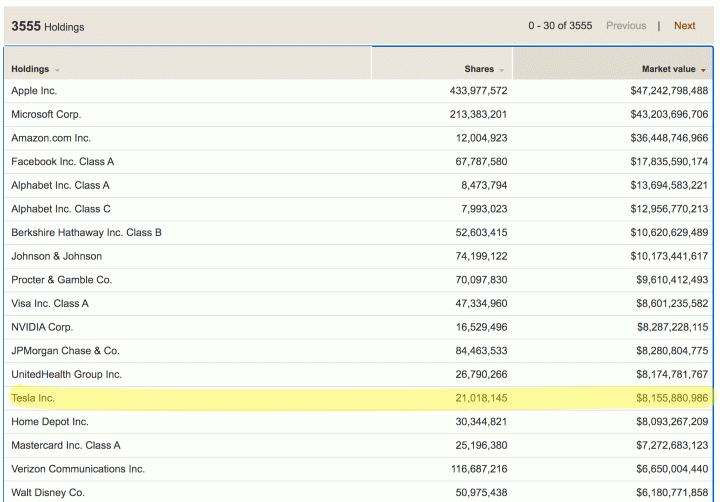
Meanwhile, the Vanguard Total Stock Market fund (VTI) will have to do… nothing. VTI and VTSAX already owned Tesla way back when it closer to $5 a share instead of waiting until it was $600. VTI aims to own the entire US stock market according to market cap. Large-cap, mid-cap, small-cap. Growth and value. Low-vol and high-vol. 3,555 companies, all the way down to Patriot National Bancorp (PNBK) worth only $31 million. Here’s a screenshot of the holdings as of the end of last quarter, October 31st, 2020.

Owning an S&P 500 fund is still a fine idea and this Tesla matter will be noise in the long run, but it is another example of why I prefer the simplicity and quiet elegance of a total market cap fund. You own the entire haystack without lifting a finger, not having to worry about when a company goes from #501 to #490, and vice-versa. The S&P 500 owns most of the haystack, but humans have to vet all the new additions and subtractions (and publicly announce them beforehand).

50 years from now, the haystack will look very different. Here are the top 10 companies as of 2008 (source):

Here are the top 10 companies in the US as of late 2020 (source):

Maybe Tesla will end up justifying their current valuation, or maybe it will be “get crushed like a soufflé under a sledgehammer“. I root for Tesla because I like the advancements in autonomous driving and not having to endure the pain of traffic. (Also, one day I’ll be old and would love full mobility instead of the Handi-Van.) Either way, if you own either the S&P 500 or Total US market fund, you’ll earn the winners. The total market fund will be a little bit quieter, and cost a bit less because you don’t need to pay S&P any licensing fees.

Sometimes I feel like I should write more about stock investing, but I intentionally avoid the short-term noise. I can’t control the outcome, and I can’t predict the outcome, so I detach. This means that I end writing more about my profitable hobbies of earning thousands of dollars in extra income per year by maximizing the interest earn on my bond/cash holdings (same safety, higher return) and credit card rewards. All of this supports my ultimate goal – to get outside and try out this new slackline kit with my daughters that just arrived.